
The Dawn of Consumer Spatial Computing: Snap’s $2,500 Gamble on Standalone AR

The landscape of wearable technology is approaching a definitive crossroads. For years, the industry has chased the "holy grail" of computing: a pair of lightweight, aesthetically acceptable glasses capable of overlaying digital information onto the physical world without the need for a tethered smartphone or a bulky headset. According to recent reports from veteran tech journalist Alex Heath, Snap Inc.—the parent company of Snapchat—is poised to claim the first-mover advantage in this high-stakes race.
This fall, Snap is expected to officially launch its standalone "true" Augmented Reality (AR) glasses, simply branded as "Specs." With a rumored price tag of approximately $2,500 and a limited production run, the device represents a bold pivot for a company once defined by disappearing messages and dog-ear filters. This is no longer a toy for social media enthusiasts; it is a sophisticated piece of spatial hardware designed to challenge the dominance of Apple and Meta.
I. The Core Reveal: Premium Hardware for a Niche Frontier
The upcoming release of Snap’s Specs marks a significant departure from the company’s previous hardware iterations. While the original Spectacles were essentially wearable cameras for recording "Snaps," the new iteration is a fully-fledged spatial computer.
Pricing and Production Strategy
The reported price point of $2,500 places the Specs in a unique market position. It is significantly more expensive than high-end VR headsets like the Meta Quest 3 ($499) but slightly more accessible than the Apple Vision Pro ($3,499). This pricing suggests that Snap is not targeting the mass consumer market—at least not yet. Instead, the company is focusing on "wealthy early adopters," tech enthusiasts, and the professional developer community.
The decision to limit the initial production run to approximately 100,000 units serves two purposes. First, it mitigates financial risk for a company that has historically struggled with hardware inventory (notably the $40 million write-down on the original Spectacles). Second, it creates an aura of exclusivity, allowing Snap to refine its software ecosystem with a dedicated user base before attempting a wider retail push.
Defining "True AR"
In the current market, the term "AR" is often used loosely. Many current "smart glasses" are merely Heads-Up Displays (HUDs) that project a static screen in front of the user’s eye, or "smart frames" that offer audio and camera functions without any visual overlay.

Snap’s Specs are categorized as "true AR." This means the hardware utilizes advanced waveguide optics and spatial sensors to anchor digital objects to the physical environment. In a true AR experience, a virtual character can sit on your actual couch, or a navigation arrow can appear painted onto the real-world street. Crucially, the Specs aim to achieve this without significantly dimming the user’s view of the real world, maintaining the "social transparency" that Snap CEO Evan Spiegel has long championed.
II. A Chronology of Innovation: From Camera Glasses to Specs Inc.
The journey to this fall’s launch has been a decade in the making. To understand the significance of the upcoming Specs, one must look at the iterative path Snap has taken.
- 2016: The Spectacles Debut. Snap rebranded as a "camera company" and released the first Spectacles via bright yellow vending machines. They were stylish but limited to capturing circular video.
- 2018–2019: Refinement and Dual Cameras. Spectacles 2 and 3 improved the form factor and introduced depth sensing, allowing for rudimentary 3D effects in the Snapchat app.
- 2021: The First AR Developer Kit. Snap unveiled its first true AR Spectacles. These were not sold to the public but were distributed to selected creators. They were bulky, had a 30-minute battery life, and suffered from overheating, but they proved the concept of standalone AR.
- Late 2023: The Vision Solidifies. Snap announced it would bring a consumer-ready version of these glasses to market within a few years.
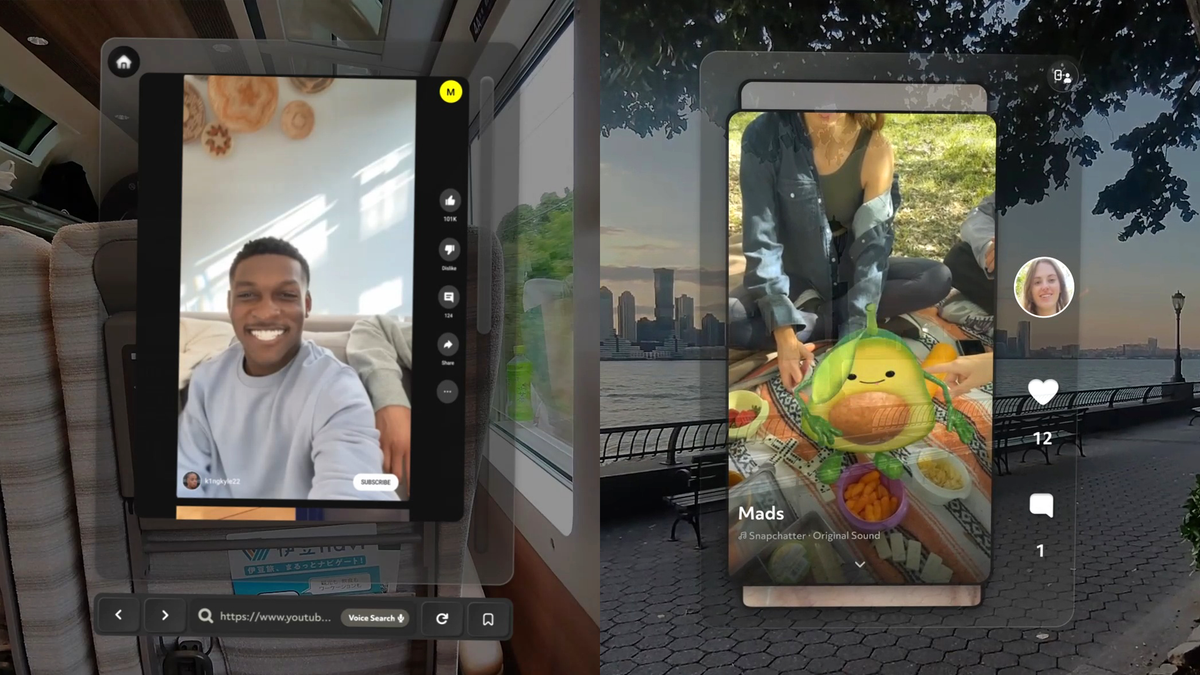
- Late 2024: Snap OS 2.0. The company released a major software overhaul for its developer kits, introducing essential first-party apps like a web browser and gallery, signaling that the platform was maturing beyond simple experimental "Lenses."
- Early 2025: The Birth of Specs Inc. In a strategic structural move, Snap spun its AR hardware division into a dedicated subsidiary named "Specs Inc." This move allowed for more focused R&D and potentially shielded the core social media business from the high costs of hardware development.
III. Technical Architecture: The Power of Snap OS
At the heart of the new Specs is Snap OS, an operating system that represents a fundamental rethink of how users interact with computers. While built on an Android kernel, Snap OS is a "walled garden" by design, optimized specifically for the constraints and opportunities of AR.
The "Lens" Ecosystem
Unlike traditional mobile operating systems, Snap OS does not support standard APK installations. Developers cannot simply port an Android app to the glasses. Instead, they must use Snap’s proprietary Lens Studio software.
This environment uses JavaScript and TypeScript to interact with high-level APIs. While this prevents developers from using low-level native code or third-party engines like Unity, it offers several distinct advantages:
- Interaction Consistency: Because the OS handles core tech like hand-tracking and rendering, every app (or "Lens") feels intuitive and consistent.
- Shared Space: Much like Apple’s visionOS, Snap OS allows for multi-user experiences. Two people wearing Specs can see the same virtual object in the same physical space simultaneously, with almost zero latency.
- Efficiency: By sandboxing Lenses, Snap can maximize the limited battery life and thermal headroom of a glasses-style form factor.
Hardware Evolution
Evan Spiegel has claimed the consumer version of the Specs will be "a much smaller form factor, at a fraction of the weight, with a ton more capability" compared to the 2021 developer units. Achieving this requires a delicate balance of custom silicon, high-brightness micro-LED displays, and advanced heat dissipation—all while keeping the device light enough to wear for extended periods.

IV. Competitive Landscape: Snap vs. The Giants
Snap’s decision to launch this year is a calculated strike against its much larger rivals, Meta and Apple.
- The Meta Comparison: Mark Zuckerberg has frequently teased "Project Orion," Meta’s own true AR glasses. However, reports suggest Meta does not plan to ship a consumer version until late 2027. By launching now, Snap gains a three-year lead in gathering real-world user data and building a developer ecosystem.
- The Apple Comparison: While the Apple Vision Pro is a technical marvel, it remains a "passthrough" headset (using cameras to show the world on an internal screen). True see-through AR glasses from Apple are reportedly not expected until 2028 at the earliest.
- The Chinese Market: While companies like Xreal and Rokid offer AR glasses today, they often rely on a wired connection to a phone or a separate compute "puck." Snap’s Specs are fully standalone, housing the battery, processors, and sensors within the frame itself.
V. Official Vision: The "Crucible Moment" for Evan Spiegel
The leadership at Snap views the Specs not as an accessory, but as the future of the company. In internal communications and public statements, Evan Spiegel has framed this as a "crucible moment."
The formation of Specs Inc. suggests that Snap is preparing for a long-term hardware play. By creating a subsidiary, Snap can potentially seek outside investment specifically for AR hardware, or even prepare for a future where the hardware business eventually eclipses the ad-supported social media app.
While Snap has not officially commented on the $2,500 price leak, the company’s recent focus on "Snap OS 2.0" and the expansion of Lens Studio to include generative AI tools points toward a platform that is ready for more than just developers. The goal is to move the "Snapchat experience" off the phone screen and into the user’s field of vision.
VI. Implications: A Milestone for Consumer AR
The launch of the Snap Specs this fall will likely be remembered as a milestone moment for the industry, regardless of its initial sales figures.
For Developers
The Specs offer a stable, high-performance target for spatial developers. With the Spectacles mobile app serving as a "spectator view," creators can easily demonstrate their AR work to others, solving one of the biggest hurdles in AR marketing: showing people what the wearer is seeing.
For the Industry
If Snap successfully delivers a lightweight, standalone AR device that doesn’t overheat and provides a compelling field of view, it will prove that the technology is ready for the mainstream. It shifts the conversation from "when will AR arrive?" to "what will we do with it?"
For the Consumer
For the average person, the $2,500 price tag remains a barrier. However, the first generation of any transformative technology—from the first Macintosh to the first Tesla—is always expensive. The Specs represent the "Version 1.0" of a future where screens disappear, and our digital and physical lives become indistinguishable.
As the fall release window approaches, all eyes will be on Specs Inc. to see if they can deliver on the promise of true AR. If they succeed, Snap may finally shed its reputation as a social media underdog and emerge as the architect of the next era of personal computing.


Leave a Comment