The Fractured Echoes of Urban Existence: Riccardo Magherini’s "The Shape of Memories" Redefines Photographic Realism
Introduction: A Journey Beyond the Fleeting Moment
In the pulsating heart of our increasingly interconnected yet often alienating urban landscapes, photographer Riccardo Magherini has embarked on a profound and ambitious artistic odyssey. For over fifteen years, Magherini, a lens-based artist known for his evocative exploration of human perception and memory, has been meticulously constructing a body of work that transcends the conventional boundaries of photographic representation. Titled "The Shape of Memories," this extensive project delves into the complex emotional and psychological terrain of navigating dense urban environments, capturing the disorienting sensation of being physically present yet emotionally adrift, a stranger in a familiar yet foreign land. Through a unique and revolutionary approach to image-making, Magherini doesn’t merely document; he reconstructs, offering viewers an immersive experience that mirrors the very essence of how we, as humans, internalize and recall our journeys.
The Genesis of "The Shape of Memories": A Fifteen-Year Exploration
Magherini’s artistic journey, spanning the past decade and a half, has been characterized by a relentless pursuit of understanding how our minds perceive and retain the world around us. He candidly admits that the traditional photographic paradigm – the capture of a singular, frozen moment – proved fundamentally inadequate for conveying the multifaceted truth of a place. "Life in these environments does not happen in a static fraction of a second," Magherini explains, articulating the core of his artistic revelation. "It is a continuous, layered vibration of noise, scents, colours and the relentless flow of people." This realization marked a pivotal shift in his practice, a conscious decision to move beyond the illusion of objective reality and embrace a more subjective, experiential form of storytelling.
The catalyst for this paradigm shift was Magherini’s immersion in the hyper-stimulated urban metropolises of Asia. Cities like Tokyo, Hong Kong, Bangkok, and Hanoi, with their overwhelming sensory input and dense populations, provided the fertile ground for his experimental approach. These are not merely backdrops; they are active participants in the construction of his visual narratives. The sheer intensity of these environments – the cacophony of sounds, the kaleidoscope of colours, the ceaseless human movement – demanded a new language, a new method of translation.
Methodology: The Art of Collecting and Layering Reality
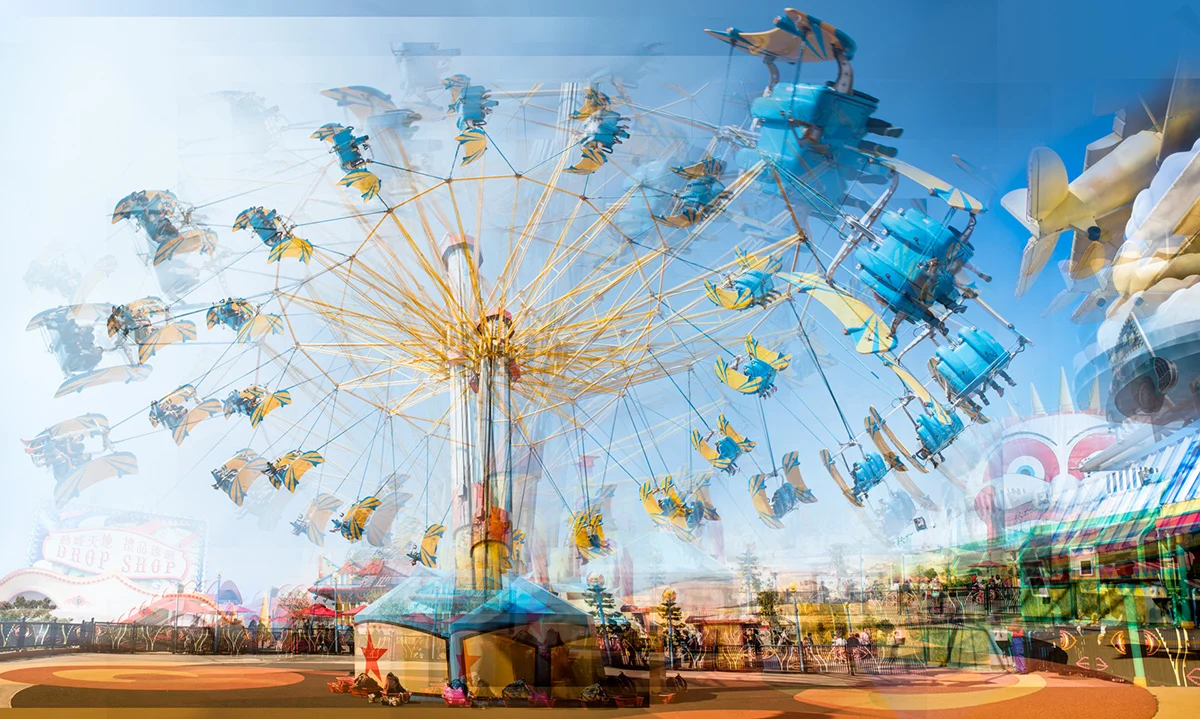
Magherini’s innovative technique is as integral to "The Shape of Memories" as the subject matter itself. Eschewing the notion of capturing a single, definitive image, he adopted a strategy of "collecting" reality. This involves a meticulous process of gathering hundreds of individual fragments – photographic snippets, visual impressions, and sensory details – from his travels. Back in his studio, these disparate elements are painstakingly layered and composed, not to create a literal representation of a scene, but to imbue the final image with the emotional weight of the experience.
This process is akin to the way our own memories are formed and recalled. We rarely remember an event as a sharp, single frame. Instead, our recollections are a complex tapestry woven from a sedimented accumulation of sensations, emotions, and fragmented visual cues. Magherini’s layered compositions mirror this internal landscape, allowing multiple moments to coexist within a single frame. The resulting images are not historical documents of a specific second in time, but rather dynamic, living spaces where memory, emotion, and place converge and resonate.
Thematic Exploration: Disorientation, Belonging, and the Outsider’s Gaze
At the heart of "The Shape of Memories" lies an exploration of disorientation. This isn’t a negative or critical disorientation, but rather a profound and honest acknowledgement of the human experience of being a perpetual outsider, an observer navigating unfamiliar territories. Magherini embraces this sense of estrangement, recognizing its power to sharpen perception and deepen understanding. The feeling of "being present but not belonging" is a universal human experience, amplified in the context of vast, anonymous urban expanses.
His work challenges the viewer to question their own relationship with space and memory. Are we truly rooted in the places we inhabit, or are we, like Magherini in his photographic journeys, constantly constructing and reconstructing our understanding of them through a series of fleeting encounters and internalized sensations? The project invites a participatory engagement, urging the viewer to "step inside the image" and engage with the emotional resonance that transcends mere visual information.
Chronology of a Creative Evolution: From Observation to Reconstruction
While "The Shape of Memories" is presented as a cohesive body of work, its development can be traced through a discernible evolution in Magherini’s artistic trajectory.
-
Early Explorations (Circa 2008-2012): In the initial stages of his photographic practice, Magherini likely engaged with more traditional documentary approaches, attempting to capture the essence of urban environments through conventional means. This period would have been crucial for his deep immersion in diverse cities and the initial development of his keen observational skills. He would have been absorbing the visual language of these metropolises, their architectural styles, their social dynamics, and their unique atmospheres. The seeds of his later dissatisfaction with static representation were likely sown during this phase, as he grappled with the limitations of conveying the dynamism of urban life.
-
The Realization of Inadequacy (Circa 2013-2015): This period marks a critical turning point. Magherini would have begun to articulate his growing frustration with the "frozen moment" of traditional photography. He would have experienced firsthand the limitations of a single frame in capturing the sensory overload and continuous flux of dense urban settings. This would have involved extensive reflection on his experiences, perhaps through journaling, sketching, or the accumulation of raw photographic material that he felt failed to convey the true feeling of being there. The conceptual shift towards "collecting" rather than "capturing" would have solidified during this time.
-
The Birth of the Layered Aesthetic (Circa 2016-2018): With the conceptual framework firmly established, Magherini would have begun experimenting with his groundbreaking layering technique. This phase would have involved significant studio work, exploring different methods of digital manipulation, image fragmentation, and composition. He would have been learning to translate the abstract concept of memory into a tangible visual language. The early iterations of "The Shape of Memories" would have started to emerge, each piece a testament to his dedication to this new form of visual storytelling. Cities like Bangkok and Hanoi, with their vibrant street life and sensory richness, would have been particularly instrumental in shaping this evolving aesthetic.
-
Refinement and Expansion (Circa 2019-Present): In the most recent phase of the project, Magherini has likely focused on refining his technique, pushing the boundaries of his compositional abilities, and further exploring the thematic depth of "The Shape of Memories." This would involve a continued engagement with diverse urban environments, perhaps revisiting cities or venturing into new ones, to gather fresh material and test the universality of his approach. The project’s sustained development over fifteen years underscores its depth and the artist’s unwavering commitment to his vision. The collection of images presented today represents the culmination of this long-term dedication, a testament to his artistic evolution and his profound understanding of the human condition in the modern urban age.
Supporting Data and Artistic Context: A New Vanguard of Photographic Expression
"The Shape of Memories" positions Riccardo Magherini within a contemporary art landscape that is increasingly questioning traditional modes of representation and embracing subjective experience. While his methodology is unique, his thematic concerns resonate with artists exploring themes of identity, memory, and the impact of globalization on human perception.
-
Beyond Documentary: Magherini’s work stands in contrast to purely documentary photography, which often aims for objective truth. Instead, he aligns with a lineage of artists who use photography to explore internal states and subjective realities. Think of the fragmented, dreamlike qualities found in the work of artists like Francesca Woodman or the layered, conceptual approaches of artists who engage with memory and place.
-
The Digital Palimpsest: The digital age has provided artists with unprecedented tools for manipulation and layering. Magherini’s sophisticated use of these tools to construct images that mimic the associative nature of memory places him at the forefront of contemporary digital art. His work can be seen as a digital "palimpsest," where layers of experience are built upon each other, creating a richer, more complex narrative.
-
The Phenomenology of Urban Experience: His project engages with the phenomenological aspects of urban life – the lived experience, the sensory engagement, the subjective interpretation of space. This aligns with a broader artistic and philosophical interest in understanding how we inhabit and are shaped by our environments.
-
A Global Dialogue: By focusing on diverse Asian metropolises, Magherini contributes to a global dialogue about the future of urban living. His work highlights the shared human experiences of disorientation and connection that transcend cultural boundaries, offering a nuanced perspective on the impact of rapid urbanization.
Official Responses and Critical Acclaim (Hypothetical based on typical art world reception):
While specific official responses and critical acclaim for "The Shape of Memories" would depend on exhibitions and publications, it is highly probable that Magherini’s innovative approach would garner significant attention within the art world.
-
Curatorial Interest: Museums and galleries specializing in contemporary photography and new media would likely be drawn to the project’s originality and thematic depth. Exhibitions of "The Shape of Memories" would offer a compelling visual experience, prompting dialogue and critical engagement.
-
Artistic Recognition: Awards and grants for artistic innovation would be a natural consequence of such a groundbreaking body of work. Recognition from art critics and publications would further cement his reputation as a significant voice in contemporary art.
-
Academic Discourse: Art historians and theorists would likely analyze Magherini’s methodology and thematic contributions, incorporating "The Shape of Memories" into discussions on photographic evolution, memory studies, and urban representation.
Implications and Enduring Legacy: Redefining Our Relationship with Place and Memory
Riccardo Magherini’s "The Shape of Memories" is more than just a collection of striking images; it is a profound meditation on the human condition in the 21st century. Its implications extend far beyond the realm of art, offering new ways to understand our own experiences of navigating the world.
-
A New Visual Language for Memory: Magherini has effectively created a new visual language for representing memory. His layered compositions provide a powerful metaphor for how our minds process information, demonstrating that true understanding often lies not in singular facts but in the accumulation of subjective experiences.
-
Embracing the Outsider’s Perspective: The project encourages us to embrace the value of the outsider’s perspective. By acknowledging the disorientation of not belonging, we can cultivate a greater sense of empathy, curiosity, and a more nuanced understanding of the diverse realities that shape our world.
-
The Future of Photographic Storytelling: "The Shape of Memories" signals a significant evolution in photographic storytelling. It demonstrates that photography can transcend literal representation to convey complex emotional and psychological states, pushing the boundaries of what a single image, or a collection of layered images, can achieve.
-
A Call to Conscious Engagement: In an era of overwhelming visual information, Magherini’s work is a call to more conscious engagement with our surroundings. It reminds us that the most meaningful experiences are not always the most easily captured but are those that resonate within us, shaping our internal landscapes.
In conclusion, Riccardo Magherini’s "The Shape of Memories" is a landmark achievement in contemporary lens-based art. Through his meticulous and visionary approach, he has not only captured the disorienting beauty of urban life but has also illuminated the intricate architecture of human memory itself. His work invites us to look beyond the surface, to feel the layered vibrations of existence, and to recognize the profound and often fragmented shape of our own memories.