"The Mandalorian & Grogu" Film: A Critical Examination of Narrative Stumbles and Missed Opportunities
A deep dive into the latest Star Wars cinematic venture reveals a technically proficient but emotionally hollow experience, leaving audiences yearning for genuine stakes and compelling character development.
The highly anticipated "The Mandalorian & Grogu" film has landed in theaters, promising to expand the beloved universe of Din Djarin and Grogu. While visually stunning and boasting the production values audiences expect from a major Star Wars installment, the film has left many critics and fans grappling with a perplexing paradox: how can a movie filled with action be so profoundly boring? This analysis delves into the narrative shortcomings of "The Mandalorian & Grogu," exploring the absence of meaningful stakes, the underdeveloped characters, and the resulting lack of tension that ultimately undermines its potential.
The Core Disconnect: Excitement Without Engagement
The prevailing sentiment surrounding "The Mandalorian & Grogu" is one of disconnect. Despite a barrage of action sequences and familiar characters, the film struggles to forge a genuine emotional connection with its audience. As one observer aptly put it, "It was all just a straight line." This critique points to a fundamental issue: the film, while visually impressive, lacks the narrative arc and emotional weight that define compelling storytelling.
As storytellers ourselves, we are driven to dissect the craft behind the narrative, to understand not just the mechanics of storytelling but also the emotional resonance it achieves. This critical lens, while often a "cursed" aspect of being a storyteller, allows for a deeper appreciation of what works and what doesn’t. In the case of "The Mandalorian & Grogu," this dissection reveals a film that, despite its technical merits, falters in delivering a truly engaging experience.
It is important to preface this analysis by acknowledging the subjective nature of cinematic appreciation. This review is not intended to invalidate the enjoyment of those who found pleasure in the film. As the saying goes, "this shit ain’t math," and personal taste plays a significant role. Furthermore, a personal history with Star Wars, characterized by both affection and complexity, inevitably colors this perspective. However, the aim here is to objectively assess the narrative construction and its impact on the overall viewing experience.
Praiseworthy Elements: Glimmers of Brilliance
Despite the overarching critiques, "The Mandalorian & Grogu" is not without its merits. Several aspects of the film stand out, offering glimpses of the potential that ultimately remained unfulfilled.
A Resonant Soundtrack and Impeccable Visuals
The film’s soundtrack is undeniably a strong suit, with the iconic "Mandalorian" theme continuing to be a standout piece of Star Wars scoring. The sound design immerses the audience in the familiar sonic landscape of the galaxy. Visually, the effects are largely impeccable, with most of the CGI seamlessly integrated into the narrative. However, a notable exception is the rendering of Rotta the Hutt, whose uncanny valley appearance evokes the problematic digital insertions seen in earlier Star Wars installments, creating an unsettling dissonance.
The Enduring Charm of Grogu
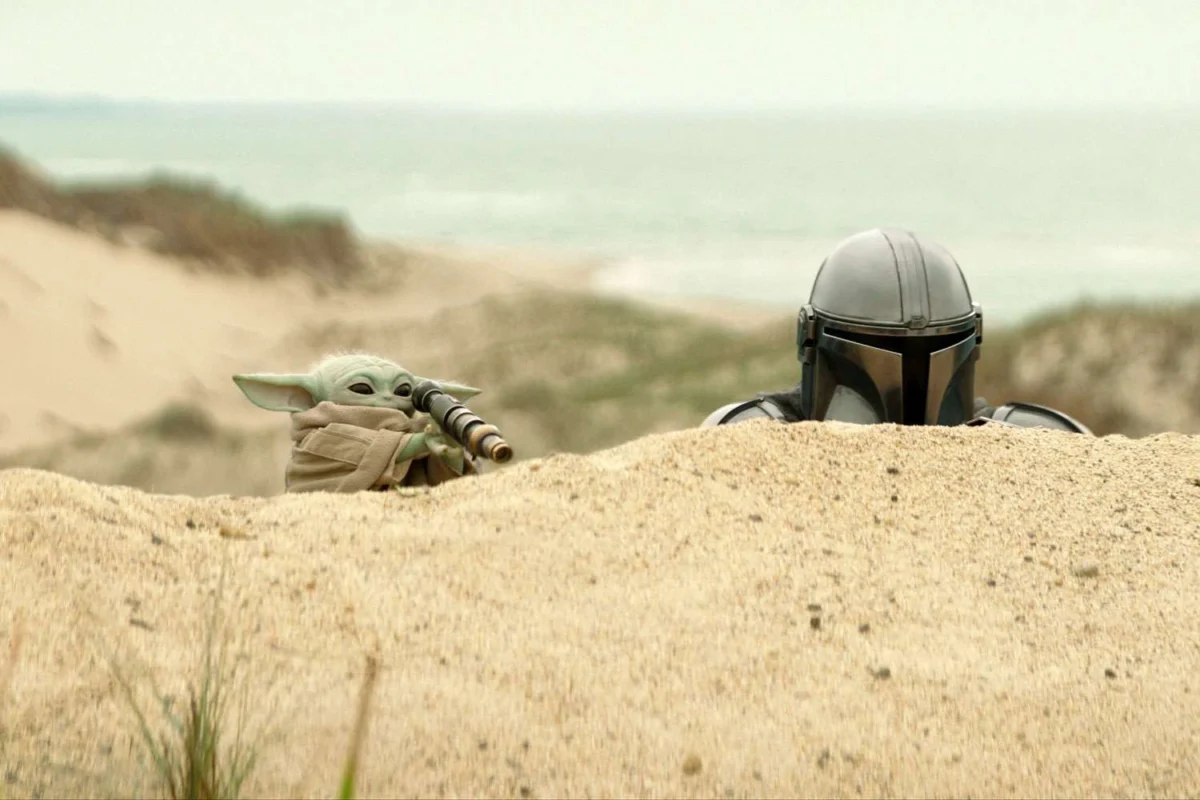
The puppet work for Grogu, affectionately known by many as Baby Yoda, is exceptional and arguably represents the pinnacle of the film’s visual achievements. A particular sequence later in the movie, which heavily features Grogu, proves to be one of the film’s most compelling moments. This highlights a recurring theme: the film is at its strongest when it allows for quieter moments, when characters are given space to breathe and interact organically.
Favreau’s Directorial Acumen
Jon Favreau’s direction, while not prone to flashy theatrics, is consistently solid. He frames shots with a keen eye for composition, creating visually striking sequences that possess a painterly quality. These moments of visual artistry demonstrate a clear understanding of cinematic aesthetics, even if the narrative surrounding them fails to match their impact.
The Narrative Void: A Lack of Stakes and Tension
The most significant critique leveled against "The Mandalorian & Grogu" is its profound lack of stakes and, consequently, tension. The film, despite its near-constant action, feels surprisingly hollow. This hollowness stems from several interconnected factors.
The Problematic Opening: Action Without Consequence
A common piece of advice in action filmmaking is to "start with action." However, as evidenced by classics like "Die Hard" and "John Wick," the most impactful action sequences are often built upon a foundation of character development and established context. These films demonstrate that delaying the onset of high-octane action can, in fact, heighten its impact.
"The Mandalorian & Grogu," however, opts for an immediate plunge into action. While this approach can be effective, as seen in "Star Wars: A New Hope" or "Mad Max: Fury Road," it fails to land here. The opening action sequence, rather than establishing a sense of peril for the protagonists, feels largely consequence-free. Mando and Grogu navigate the conflict with remarkable ease, their actions met with little genuine threat. This establishes a pattern for the rest of the film: a parade of action sequences where our heroes are rarely challenged, rarely injured, and almost never in genuine danger of losing.
The "Straight Line" of Effortless Victory
This lack of jeopardy transforms the film into a "straight line," as described by a young viewer. The narrative unfolds with an almost monotonous predictability, where Mando, often depicted as near-invincible, effortlessly overcomes obstacles. His armor deflects most attacks, he is the superior combatant in nearly every encounter, and when all else fails, Grogu’s nascent Force abilities provide a convenient deus ex machina. This constant stream of consequence-free action, while visually dynamic, lacks the weight and impact of genuine struggle. It’s akin to a "people-mover" rather than a thrilling roller coaster, lacking the crucial ups and downs that define an engaging ride.
The Absence of Meaningful Stakes
At its core, the film suffers from a deficit of stakes. Stakes, defined as what can be won or lost within a narrative, are the bedrock of tension. While the film presents the threat of Imperial remnants, these are often abstract and lack personal resonance. The audience is rarely made to believe that Mando or Grogu are in genuine peril of significant harm or loss. Unlike other action heroes who face devastating consequences in their opening acts, Mando’s early trials are swiftly resolved, offering little in the way of underdog status or vulnerability.
This absence of tangible stakes extends beyond immediate physical danger. The film eschews larger world-building complications, personal struggles, or emotional entanglements. Political maneuvering, a potential avenue for compelling conflict within the New Republic, is treated with a surprising lack of gravity. The alliance with the Hutts, a morally dubious decision, is presented as mere business-as-usual, a missed opportunity to explore the complexities and potential corruption within the nascent government.
Characters as Action Figures, Not Beings
Perhaps the most critical failure of "The Mandalorian & Grogu" lies in its underdeveloped characters. The film presents a cast that feels more like a collection of action figures than fully realized individuals.
The Absence of Personal Arcs
Few characters in the film exhibit the traits of genuine character development. They lack personal problems, internal conflicts, or significant arcs to complete. Mando’s central conflict – taking on a job that goes awry – is presented with little connection to his core identity or personal growth. Grogu, while undeniably adorable, remains largely a plot device, a cute puppet rather than a developing character.
The supporting cast fares no better. Villains are often reduced to one-dimensional "mini-bosses" with forgettable names. Even established characters like Zeb, voiced by the talented Steve Blum, are relegated to mere cameos, present for their visual recognition rather than any substantive contribution to the narrative. Sigourney Weaver’s appearance, while notable, feels more like a contractual obligation than an integral part of the story.
A Narrative Built on Assumptions
The film’s narrative mechanics also suffer from a reliance on audience pre-existing knowledge, particularly from "The Mandalorian" television series. While it assumes viewers are familiar with Mando’s bounty hunter profession and Grogu’s Force abilities, it does little to reintroduce or contextualize these elements for newcomers. This creates a disjointed experience, where crucial information is either implied or entirely absent, further diminishing the potential for character investment.
The plot itself unfolds with a similar lack of depth. Mando undertakes missions to hunt Imperial remnants, but the motivations and true threat posed by these individuals remain vague. Commander Coin, introduced as a potential antagonist, devolves into a "nothingburger," his significance never fully explained. The rescue of a "Buff Young Hutt With A Heart" serves as the film’s central objective, but even this character’s arc is minimal. The journey is a series of escalating challenges that are ultimately resolved with ease, leading to a conclusion where the status quo largely endures.
The Verdict: A Technically Sound but Emotionally Empty Product
In summation, "The Mandalorian & Grogu" presents a film with a multitude of narrative weaknesses:
- Muddy and Insignificant Stakes: The central conflicts lack the weight and consequence necessary to generate genuine concern.
- Action Figures, Not Characters: The cast is largely devoid of personal stakes, arcs, or compelling development.
- Soft, Not Taut Tension: The absence of real peril results in a narrative that feels slack and unengaging.
- A Lack of True Progression: Despite the constant action, the film achieves little in terms of plot resolution or character transformation.
- Missed Opportunities: Crucial plot points and character dynamics are either underdeveloped or glossed over, leaving the audience with more questions than satisfaction.
Comparing it to "Star Wars: The Rise of Skywalker," a film widely considered a critical misstep, "The Mandalorian & Grogu" technically surpasses it. It is a more cohesive and visually polished product. However, "The Rise of Skywalker," despite its flaws, attempted grand gestures and emotional swings. It possessed an ethos, a sense of ambition, even if it ultimately faltered. "The Mandalorian & Grogu," in contrast, feels almost like an exercise in efficient content generation. It strings scenes together without a strong structural foundation, eschewing traditional narrative architecture for a predictable, albeit safe, trajectory. It is unchallenging, predictable, and ultimately, unmemorable.
The common retort to such criticism – "Relax! It’s just supposed to be a fun movie! Turn your brain off! It’s for kids!" – fails to address the fundamental issue. Fun movies can, and often should, be more than just fleeting diversions. The demand to "turn off your brain" suggests a product that actively discourages engagement, a disservice to an audience that, particularly in the case of Star Wars, has a deep emotional investment. Furthermore, while the film may appeal to younger audiences, its reliance on nostalgia and its portrayal of violence are arguably more suited to an adult demographic. The high cost of admission, especially for premium formats like IMAX, further justifies a demand for a more substantial and engaging cinematic experience than a mere "fast food tray of warm content."
The Echo of "Not Interesting"
Ultimately, "The Mandalorian & Grogu" leaves one with the unsettling feeling of a franchise that has lost its way. The sentiment echoes a past conversation about a Star Wars comic pitch: "We can’t really do anything interesting right now." This statement, referring to a universe too bound up in its own lore to allow for genuine impact, seems to perfectly encapsulate the film. It is not interesting. It leaves no lasting impression, no footprint on the universe, and no resonance in the heart. While it will undoubtedly drive merchandise sales, its true value as a piece of storytelling is regrettably minimal.
This critique is offered not as an attack, but as a reflection on the craft of storytelling. For those who enjoyed "The Mandalorian & Grogu," genuine happiness is extended. This analysis is simply an attempt to articulate the narrative shortcomings that prevented a deeper connection. For those interested in exploring the principles of compelling storytelling, including stakes, character, and tension, further investigation into narrative theory, as explored in works like "Damn Fine Story," may prove illuminating. The aim is to foster a deeper appreciation for the art of cinema, and to encourage the creation of stories that not only entertain but also resonate long after the credits roll.