The Pen Strikes Back: A Viral Campaign Reclaims the Power of Analog in the Age of AI
In a digital landscape increasingly saturated with the uncanny efficiency of Artificial Intelligence, a curious counter-movement is emerging. As consumers grow weary of AI-generated content, particularly the often-flawed output of AI-driven design tools, a renewed appreciation for the tangible and the human is taking hold. This sentiment has found a potent champion in the humble pen, a tool long overshadowed by technological advancements, and a recent viral campaign on LinkedIn has ignited a creative resurgence for this analog stalwart.
The story began not with a major marketing department, but with a single LinkedIn user’s speculative advertisement for the iconic Parker Pen Company. This spark of an idea quickly ignited a widespread creative competition, drawing hundreds of submissions and ultimately garnering the attention and support of Parker itself. It’s a refreshing narrative that highlights the enduring power of social media to foster genuine connection and ingenuity, while also offering a compelling case study for how established brands can remain relevant amidst rapid technological shifts.
The Digital Deluge and the Fading Pen
For decades, the ability to "sell me this pen" has been a classic, albeit daunting, interview question for aspiring professionals. It tested an individual’s understanding of product value, persuasive communication, and the ability to connect with a consumer’s needs. However, by the mid-2020s, the very relevance of such a question seemed increasingly archaic. Keyboards and touchscreens had already usurped the pen’s ubiquitous role in daily life for many. The advent of sophisticated AI chatbots, capable of synthesizing, condensing, and rewriting vast amounts of text with astonishing speed, threatened to deliver what many perceived as the final blow to the pen’s significance.
These powerful language models, operating on complex algorithms to generate statistically optimized sequences of tokens that mimic human dialogue, represent a paradigm shift in content creation. For many, the idea of physically writing with a pen might seem like a quaint relic of a bygone era, an inefficient outlier in a world optimized for instant digital gratification. The ease with which AI can churn out prose, code, and even creative concepts has led to a growing concern that human originality and craftsmanship might be devalued, or worse, rendered obsolete.
A Counter-Narrative Takes Flight: The Parker Pen Challenge
Yet, a significant segment of the creative community remains unconvinced of the pen’s obsolescence. They firmly believe that the analog tool possesses an intrinsic value that transcends the capabilities of even the most advanced AI. This conviction recently coalesced into a powerful, and largely organic, viral campaign centered around the Parker Pen Company.
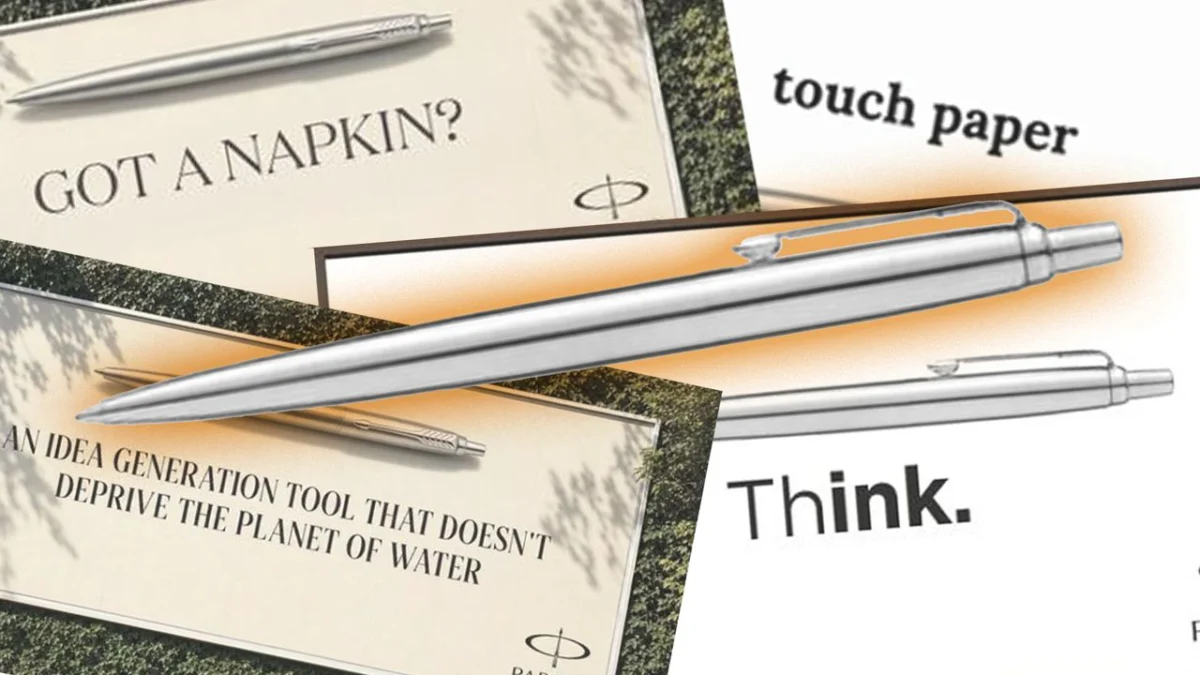
The catalyst was freelance copywriter and creative strategist Kushagra Oberoi. Last week, he shared an "anti-AI campaign ad idea for Parker pens" on LinkedIn. His concept was a striking billboard advertisement featuring a photograph of a classic Parker pen alongside the provocative tagline: "An idea generation tool that doesn’t deprive the planet of water." This simple yet profound message immediately resonated with thousands, garnering a wave of likes and comments.
The post quickly became a springboard for further creative collaboration. Other designers and copywriters began offering their own interpretations and improvements to Oberoi’s initial concept. Recognizing the burgeoning momentum, One Minute Briefs, a popular platform for creative challenges, partnered with Andrew Tindall, Chief Growth Officer at System 1, a marketing effectiveness consultancy. Together, they issued an open call to the creative community: "create billboard-style posters to #SellMeThisPen."
The #SellMeThisPen Phenomenon: Creativity Unleashed
The brief was intentionally simple, aiming to tap into the collective creative energy of designers and marketers. The challenge invited participants to reimagine how a pen could be advertised in today’s digitally-dominated world, with a particular, albeit often implicit, nod to the rise of AI. The ultimate goal was to generate compelling visual and textual concepts that could be tested for their consumer engagement potential.
The response was nothing short of extraordinary. Approximately 350 distinct ideas flooded in, showcasing a remarkable breadth of creative thinking. The Parker Pen Company, through its parent organization Newell Brands, took notice and enthusiastically stepped in to provide prizes for the winning entries. What began as a speculative ad idea had unexpectedly blossomed into a significant, spontaneous, and highly effective organic marketing campaign for the brand.
This phenomenon mirrored earlier instances of brands leveraging public sentiment against AI in their advertising. Polaroid, for example, had previously launched a successful "touch grass" billboard campaign that implicitly critiqued the disembodied nature of AI-generated content. Similarly, the Parker Pen challenge submissions overwhelmingly tapped into the widespread public concerns and a growing distrust surrounding Artificial Intelligence. The humble pen, in these creative visions, was being re-branded not merely as a writing instrument, but as a powerful symbol of authentic human thought, tangible creativity, and mindful expression.
Supporting Data: The Erosion of Trust in AI
The success of the #SellMeThisPen campaign is not merely a matter of creative flair; it is underpinned by significant market research and evolving consumer sentiment. Andrew Tindall highlighted critical findings from a recent study published in the Journal of Marketing Analytics. This research revealed a stark reality for brands utilizing AI: a staggering 8 out of 10 people do not believe brands when they offer explanations for their use of AI.
"The finding is brutal," Tindall stated. "No matter what was claimed, people still assumed the same thing: the company used AI because it helped the company. Not the consumer or society." This sentiment suggests a deep-seated skepticism that AI adoption is driven by genuine consumer benefit or societal progress, but rather by a desire for cost reduction and increased efficiency for the business itself.
This erosion of trust has profound implications for brand communication. When consumers perceive AI as a shortcut for brands, it can breed cynicism and alienate them. In this context, advertising that champions human creativity, craftsmanship, and authenticity – qualities inherently embodied by a pen – holds significant appeal. The Parker Pen challenge, by celebrating these very attributes, inadvertently tapped into a potent vein of consumer disillusionment with the perceived inauthenticity of AI-generated content.
The Winning Concept: A Single Word, a World of Meaning
Amidst the hundreds of submissions, one entry ultimately rose to the top, brilliantly distilling the essence of the campaign into a single, potent word. The winning concept was elegantly simple: Think.
This word operates on multiple levels, embodying the core message with remarkable efficacy. Firstly, it directly refers to the fundamental function of a pen – as a tool that facilitates contemplation, ideation, and the deep processing of thoughts. It evokes the slow, deliberate act of putting pen to paper, a process that often leads to more profound insights than rapid-fire digital generation.
Secondly, and perhaps more pointedly in the context of the anti-AI sentiment, "Think" serves as a direct imperative, a gentle yet firm plea to individuals who might be tempted to outsource their creative thinking to AI. It’s an encouragement to engage in genuine cognitive effort, to ponder, to reflect, and to originate ideas from within, rather than relying on algorithms to simulate them.
The brilliance of this winning concept lies in its subtlety. It doesn’t explicitly denounce AI; rather, it elevates the human capacity for thought and creativity, implicitly positioning the pen as the indispensable instrument for this vital process. It subtly suggests that true thinking is a human endeavor, one that requires engagement, reflection, and the tangible act of creation.
Implications and the Future of Brand Communication
The success of the #SellMeThisPen campaign, and the broader trend it represents, carries significant implications for the future of brand communication, particularly for legacy brands.
The Rise of "Authenticity Marketing": As AI becomes more prevalent, consumers are likely to seek out brands that can demonstrably offer authenticity and human connection. Campaigns that highlight craftsmanship, personal stories, and the tangible aspects of product creation will likely gain traction. The Parker Pen challenge serves as a powerful example of how to tap into this desire by celebrating a timeless tool of human expression.
The "Anti-AI" Stance as a Differentiator: Brands like Polaroid, Cadbury (with its "Make AI Mediocre Again" campaign), and KitKat (encouraging users to be "ruder to AI") have demonstrated that an overt critique of AI can be a viable and effective marketing strategy. For brands that can credibly position themselves as champions of human creativity, this can be a powerful differentiator in a crowded market.
The Renaissance of Analog: The trend of small businesses declaring on platforms like Instagram their intention to use pen and paper instead of AI for communication is indicative of a broader cultural shift. This resurgence of analog tools is not just about nostalgia; it’s about a conscious choice to prioritize intentionality, mindfulness, and a more grounded approach to creation and communication.
The Potential for Official Campaigns: While the #SellMeThisPen challenge was a spontaneous, user-generated phenomenon, it begs the question: Will Parker Pen, or indeed other brands, embrace this sentiment and launch official campaigns that directly leverage the power of the pen in the age of AI? Given the current public mood and the clear resonance of these themes, it seems like a strategically opportune moment for such initiatives. The timing is particularly potent as consumers increasingly question the motivations behind AI adoption by businesses, seeking genuine value and human-centric approaches.
In conclusion, the viral #SellMeThisPen campaign is more than just a clever marketing stunt; it’s a symptom of a larger cultural recalibration. As the world grapples with the implications of advanced AI, there is a palpable yearning for the tangible, the authentic, and the uniquely human. The humble pen, once relegated to the sidelines, has been unexpectedly thrust back into the spotlight, not just as a writing instrument, but as a potent symbol of creativity, contemplation, and the enduring power of the human mind. Whether Parker Pen seizes this opportunity to pen a new chapter in its marketing legacy remains to be seen, but the message from the creative community is clear: the pen, in its elegant simplicity, is indeed mightier than the algorithm.