
The Unfolding Tapestry of Christianity: An Animated Journey Through Two Millennia
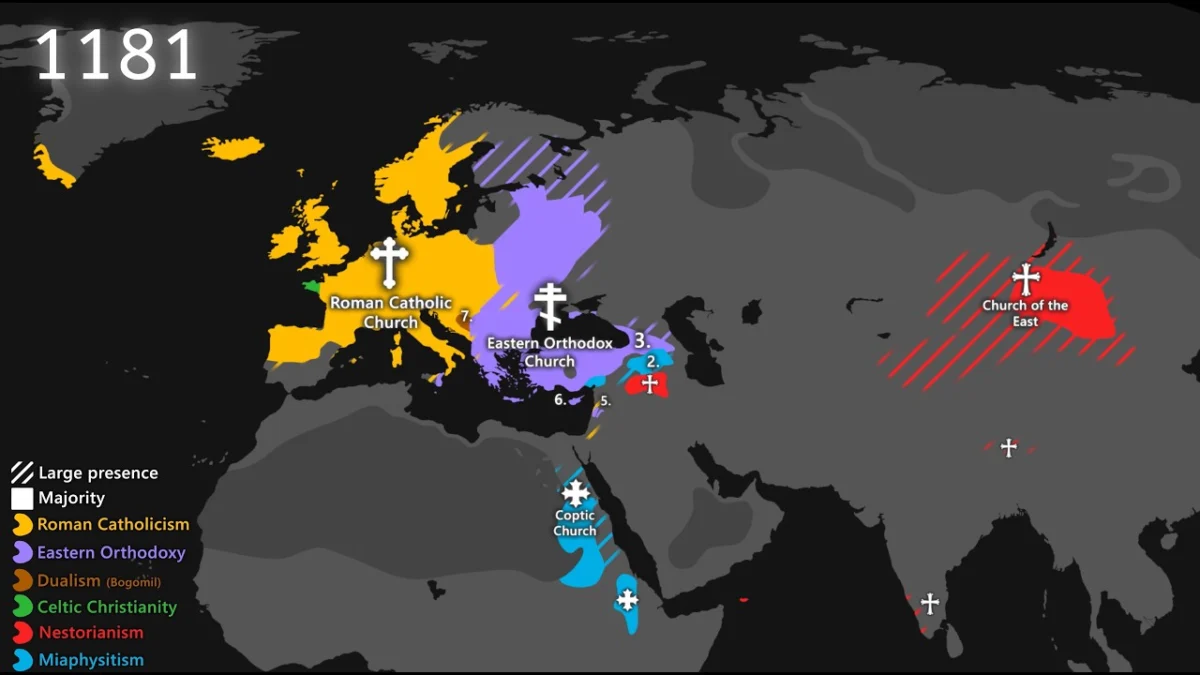
A visually stunning eight-minute video by Ollie Bye charts the remarkable, multifaceted, and enduring global expansion of Christianity, revealing its transformation from a nascent desert faith to a dominant world religion.
May 21, 2026 | By [Your Name/News Outlet Name]
Introduction: Charting the Course of a Global Faith
Christianity, a faith deeply interwoven with the fabric of Western civilization, has embarked on a millennia-long journey that has reshaped continents, cultures, and the very course of human history. While its association with the West, particularly the United States, is often emphasized in modern discourse, the religion’s actual global trajectory is a far more complex and fascinating narrative. An innovative eight-minute animated video by Ollie Bye, titled "The Spread of Christianity: Animated from Antiquity Until Today," offers a compelling visual exploration of this expansive historical phenomenon. This video, available on YouTube, meticulously maps the diffusion of Christianity across the globe, from its humble origins in the Middle East to its pervasive presence in nearly every corner of the Earth today. The animated cartography not only illustrates the sheer geographical reach of the faith but also highlights its remarkable adaptability and the diverse forms it has taken throughout its history.
The Genesis and Early Expansion: From the Levant to the Roman World
The story of Christianity begins not with English hymns, but with the Aramaic spoken in the Levant approximately two millennia ago. As Bye’s animation vividly demonstrates, the initial spread of this new religion was a localized phenomenon, confined to the region where its founder, Jesus of Nazareth, lived and ministered. The early decades and centuries saw Christianity primarily existing as a small, often persecuted, sect within the vast Roman Empire. Its adherents, though few, were characterized by a fervent belief in their message of salvation, resurrection, and a universal spiritual kingdom.
The video’s early segments, which trace this initial diffusion, underscore the profound cultural and political landscape of the time. The Roman Empire, with its extensive network of roads, trade routes, and common languages (primarily Greek and Latin), inadvertently provided the infrastructure for the nascent faith to travel. Missionaries, apostles, and early converts, driven by their conviction, carried the Christian message from Jerusalem to Antioch, Alexandria, Rome, and beyond. This period, often referred to as the "Apostolic Age" and the subsequent centuries of early Christianity, witnessed the formation of distinct Christian communities, the development of core theological doctrines, and the emergence of early church structures.
The animation highlights how Christianity, initially a "desert religion" as described by Bye, began to take root in diverse urban centers and rural areas alike. Its appeal lay in its inclusive message, offering spiritual solace and a sense of community that transcended social strata and ethnic boundaries. This universalistic ethos, a stark contrast to many polytheistic religions of the time, proved to be a powerful catalyst for its growth.
The Constantinian Shift and Imperial Embrace: A New Era of Growth
A pivotal moment in the history of Christianity, and consequently its global spread, arrived with the conversion of Roman Emperor Constantine the Great in the early 4th century CE. The Edict of Milan in 313 CE, which granted religious tolerance throughout the Roman Empire, and Constantine’s subsequent patronage, dramatically altered the landscape for Christians. No longer a persecuted minority, Christianity began to flourish, its influence growing exponentially.
Bye’s animation visually captures this acceleration. As the video progresses, the map begins to fill with the Christian presence, moving beyond the initial pockets of believers. The Roman Empire, once a vessel for its spread, became a powerful engine for its propagation. Imperial support meant the construction of churches, the establishment of ecclesiastical hierarchies, and the increasing integration of Christian leaders into the administrative and social fabric of the empire. This era saw the formalization of Christian doctrine through ecumenical councils, such as the Council of Nicaea in 325 CE, which sought to define core beliefs and address theological disputes. The animation’s inclusion of early variants like Nicene, Celtic, and Chalcedonian Christianity reflects the theological diversifications that emerged during this formative period, even as the faith was consolidating its power.
The spread during this period was not merely a passive diffusion but an active process of evangelization, often intertwined with imperial expansion and cultural assimilation. Christianity began to establish a stronger foothold in Europe, laying the groundwork for its future dominance in the Western world.
The Great Schism and Medieval Missions: Divergence and Expansion
The centuries following the decline of the Western Roman Empire saw Christianity continue its outward march, albeit with regional variations and evolving theological and organizational structures. The Great Schism of 1054 CE, which formally divided Christianity into the Roman Catholic Church in the West and the Eastern Orthodox Church in the East, marked a significant divergence. While the animation might not explicitly detail this schism, its visual representation of expanding Christian influence implicitly acknowledges these distinct branches.
During the medieval period, both Catholic and Orthodox Christianity engaged in significant missionary efforts. Catholic missionaries, often associated with monastic orders, played a crucial role in evangelizing the Germanic tribes, the Slavs, and the Scandinavian peoples. The animation would depict this spread across Northern and Eastern Europe, a region that would later become a stronghold of Christianity.
Simultaneously, Eastern Orthodox Christianity expanded into Eastern Europe, particularly through the efforts of missionaries like Saints Cyril and Methodius, who developed the Glagolitic alphabet to translate religious texts for Slavic populations. This expansion into regions like Bulgaria, Serbia, and Russia further diversified the Christian world. The video’s depiction of various early Christian "variants" implicitly acknowledges the rich tapestry of traditions and practices that developed within these expanding spheres.
The Age of Exploration and Global Christianity: A World Transformed
The period of European exploration and colonization, beginning in the late 15th century, marked a dramatic acceleration and geographical broadening of Christianity’s spread. European powers, driven by economic, political, and religious motivations, carried their faith to the Americas, Africa, Asia, and Oceania. The animation would visually represent this explosive growth, with the map rapidly filling with Christian presence across continents that had previously had little or no exposure to the religion.
This era witnessed the establishment of vast missionary networks, often facilitated by colonial administrations. Figures like St. Francis Xavier in Asia and countless others embarked on arduous journeys to evangelize indigenous populations. However, this expansion was often fraught with complexity, marked by both genuine missionary zeal and the imposition of Christianity alongside colonial rule, leading to the erosion of indigenous cultures and religions.
The Reformation, a seismic event within Western Christianity in the 16th century, also played a role in the subsequent global spread. The emergence of Protestant denominations – Lutheranism, Calvinism, Anglicanism, and later Baptism and Methodism – led to new waves of missionary activity, often in competition with Catholic missions. Bye’s animation, by including a "running legend" of major variants like Anglican, Lutheran, and Baptist, visually captures this diversification and the subsequent global diffusion of these Protestant traditions.
Modern Christianity: Adaptation, Pluralism, and Enduring Influence
The video’s final segments, bringing the animation up to the present day, showcase the extraordinary ubiquity of Christianity. From the bustling metropolises of North America and Europe to the vibrant churches in Africa and Asia, the faith has become a truly global phenomenon. The animation highlights that, with the exception of Antarctica (which surprisingly has eight churches of its own), every continent bears the indelible mark of Christianity.
The text accompanying the video rightly posits that it is perhaps more accurate to speak of the "spread of Christianities" rather than a singular Christianity. The faith’s remarkable adaptability has allowed it to integrate with and influence countless local cultures, resulting in a rich diversity of expressions. As the author notes, Christianity has assimilated qualities from Greco-Roman philosophy, Celtic festivals, and even Korean shamanistic traditions, as evidenced by the author’s observation of church cafes in Seoul. This capacity for syncretism and adaptation has been a key factor in its enduring appeal and its ability to thrive in vastly different socio-cultural contexts.
The animation’s trajectory from a small Middle Eastern sect to a global religion with billions of adherents is a testament to several key factors:
- Non-ethnic Universalism: Christianity’s message is inherently universal, not tied to any particular ethnicity or nationality, making it accessible to all peoples.
- Emotional Resonance: The core narratives of sin, salvation, and rebirth hold profound emotional appeal and offer a framework for understanding the human condition.
- Textual Translation and Missionary Zeal: The dedicated translation of sacred texts and the relentless outward march of missionaries have been crucial in disseminating the faith.
- Versatility in Form: Christianity has demonstrated an incredible capacity to exist and flourish as clandestine underground movements, state religions, and everything in between.
Conclusion: A Continuing Saga
Ollie Bye’s animated map provides a compelling and accessible overview of Christianity’s epic journey. It moves beyond simplistic associations and reveals a dynamic, multifaceted history of adaptation, expansion, and diversification. The visual narrative underscores the profound impact Christianity has had on global history and continues to have on contemporary societies. The enduring presence of Christianity, from its ancient roots to its diverse manifestations today, serves as a powerful reminder of the religion’s remarkable resilience and its profound capacity to connect with humanity across cultures, time, and space. The journey depicted is not merely a historical record but a testament to the ongoing evolution and enduring influence of one of the world’s largest and most diverse faiths.




Leave a Comment