The Crumbling Empire Embodied: A Masterpiece of Book Design in Edward Gibbon’s The Decline and Fall
Introduction: A Testament to Timeless Design
In the annals of book publishing, certain editions transcend mere textual reproduction to become objects of art, encapsulating the very essence of their content within their physical form. Such is the case with the 1946 edition of Edward Gibbon’s monumental work, The Decline and Fall of the Roman Empire, published by The Limited Editions Club (LEC). This particular edition stands as a beacon of exceptional book design, a testament to the vision of its publisher, George Macy, and the artistic prowess of its designer, Clarence P. Hornung. More than just a collection of historically significant essays, this edition transforms the physical act of reading into a visual journey, mirroring the grand narrative of Rome’s descent through a remarkably evocative spine design. This article delves into the creation, impact, and enduring legacy of this seminal work of bibliographic art.
The Genesis of a Publishing Vision: The Limited Editions Club and George Macy
The story of this extraordinary edition is inextricably linked to the visionary George Macy and his brainchild, The Limited Editions Club. Founded in 1929, the LEC was born from a desire to elevate the art of bookmaking. In an era where mass production often prioritized affordability over aesthetic quality, Macy envisioned an imprint dedicated to producing finely illustrated, limited-edition versions of classic literary works. His ambition was not merely to create beautiful books, but to collaborate with the era’s most celebrated artists and designers, imbuing each volume with a unique artistic sensibility.
Macy’s modus operandi was to assemble a roster of creative talent that reads like a who’s who of 20th-century art. He partnered with luminaries such as Henri Matisse and Pablo Picasso, whose illustrations graced the pages of seminal texts. Renowned photographers like Edward Weston also contributed their distinctive visions to LEC publications. These collaborations ensured that each book was not just a vessel for words but a curated artistic experience. The LEC’s commitment extended beyond the inner pages; they often turned their design focus to the entirety of the book, from the endpapers to the binding and, most notably in this instance, the spine.
The publication of Gibbon’s The Decline and Fall of the Roman Empire in 1946 represented a particularly ambitious undertaking for the LEC and Macy himself. This multi-volume historical magnum opus, a cornerstone of historical scholarship, demanded a presentation befitting its monumental scope and intellectual weight. Macy recognized the challenge and opportunity, embarking on what he would later describe as "the most Herculean labor of our career."
A Design That Speaks Volumes: Clarence P. Hornung’s Masterful Spine
The true genius of the 1946 LEC edition of The Decline and Fall lies in its innovative and deeply symbolic spine design, conceived by the accomplished American artist and designer Clarence P. Hornung. Hornung, known for his distinctive style that often blended Art Deco influences with a keen understanding of classical motifs, was tasked with visually representing the vast sweep of Gibbon’s historical analysis. He did not disappoint.
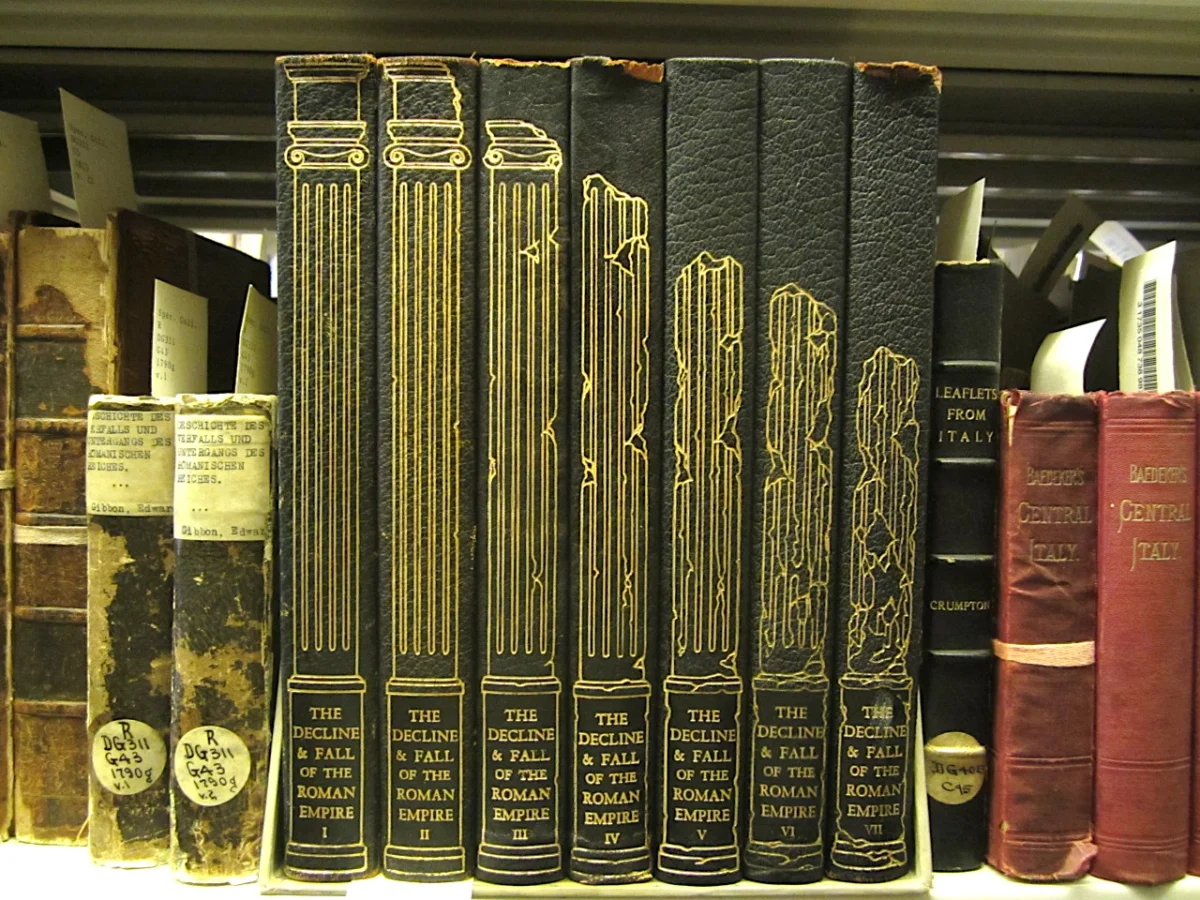
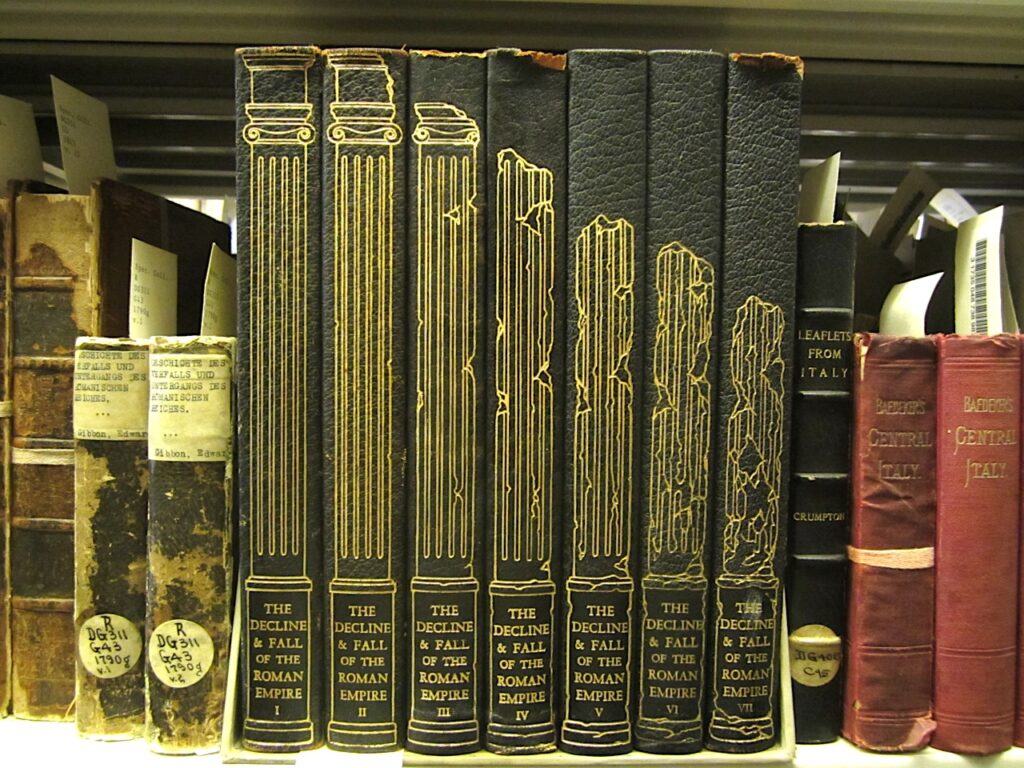
Hornung’s design is a stroke of pure brilliance, ingeniously capturing the very essence of Gibbon’s narrative. The spine features a progressive visual metaphor: Roman pillars that are depicted as gradually crumbling as the reader’s eye moves from Volume 1 to Volume 7. This seemingly simple yet profoundly effective motif serves as a powerful visual analogue to the historical trajectory described by Gibbon. Each volume, as it represents a later stage in the empire’s history, displays its architectural elements in a state of greater decay. The robust, unblemished pillars of the early volumes give way to fractured columns, toppled capitals, and the encroaching dust of ages in the later volumes.
This is not a mere decorative element; it is a narrative device embedded within the physical object. The spine becomes a silent storyteller, a visual timeline of imperial erosion. As one handles the set, the gradual disintegration of the pillars serves as a constant, subtle reminder of the themes Gibbon explores: the internal decay, the external pressures, and the inevitable forces that led to the fragmentation and eventual collapse of one of history’s most enduring empires. The choice of pillars, iconic symbols of Roman strength and architectural achievement, makes their decay all the more poignant and impactful.
The meticulous execution of this design further enhances its power. Hornung’s rendering of the pillars is detailed and evocative, conveying a sense of both grandeur and vulnerability. The gradual progression of decay is carefully calibrated, ensuring that the visual narrative unfolds seamlessly across the seven volumes. This is a design that rewards close observation and contemplation, inviting the reader to engage with the book not just intellectually but aesthetically.
The Artistic and Intellectual Synthesis: Piranesi’s Enduring Influence
Beyond Hornung’s groundbreaking spine design, the 1946 LEC edition further enriched its presentation by incorporating illustrations by the celebrated 18th-century Italian printmaker, Giovanni Battista Piranesi. Piranesi, renowned for his dramatic and often haunting etchings of Roman ruins, provided a visual complement that resonated deeply with Gibbon’s subject matter.
Piranesi’s works, particularly his series Vedute di Roma (Views of Rome) and Le antichità romane (Roman Antiquities), are characterized by their monumental scale, dramatic chiaroscuro, and a profound sense of antiquity. His depictions of crumbling structures, overgrown arches, and vast, echoing spaces perfectly captured the romantic and melancholic grandeur of Rome in ruins. These etchings served not only as illustrations but as visual meditations on the passage of time and the ephemeral nature of even the most powerful civilizations.
The inclusion of Piranesi’s prints in the LEC edition was a masterstroke of curatorial vision. They provided a visual context that was both historically resonant and artistically compelling. For readers of Gibbon, Piranesi’s art offered a tangible, visual manifestation of the world Gibbon described. The stark beauty of his ruins, often imbued with a sense of awe and desolation, mirrored the complex emotions evoked by Gibbon’s detailed account of the empire’s protracted demise. The juxtaposition of Gibbon’s rigorous historical analysis with Piranesi’s evocative artistic interpretations created a multi-layered reading experience, where text and image worked in concert to deepen the reader’s understanding and appreciation of the subject.
The Herculean Labor: A Legacy of Excellence
George Macy’s characterization of the LEC edition of The Decline and Fall as "the most Herculean labor of our career" speaks volumes about the dedication, effort, and meticulous attention to detail that went into its creation. Producing a seven-volume set of this magnitude, each volume a work of art in its own right, was an undertaking of immense proportions.
The LEC’s commitment to quality was evident in every aspect of production. From the selection of the finest paper and inks to the precision of the typesetting and the craftsmanship of the bindings, no detail was overlooked. The collaboration between Hornung and Piranesi, along with the editorial team responsible for the textual accuracy and scholarly apparatus, represented a confluence of expertise aimed at producing a definitive edition.
The success of this edition cemented The Limited Editions Club’s reputation as a purveyor of exceptional books. It demonstrated that the pursuit of aesthetic excellence and the preservation of literary heritage could go hand in hand. The edition not only served to disseminate Gibbon’s seminal work to a wider, appreciative audience but also elevated the very concept of book collecting, showcasing how a book could be both a repository of knowledge and a treasured work of art.
The legacy of this 1946 edition extends beyond its immediate impact. It continues to be studied and admired by bibliophiles, design historians, and scholars of Gibbon’s work. It serves as a benchmark for what can be achieved when artistic vision, scholarly rigor, and dedication to craftsmanship converge. The design, in particular, remains a powerful example of how visual elements can profoundly enhance and interpret the written word, creating a holistic and unforgettable reading experience.
Enduring Significance and Availability
The 1946 edition of Edward Gibbon’s The Decline and Fall of the Roman Empire by The Limited Editions Club stands as a remarkable achievement in the history of book design. Clarence P. Hornung’s ingenious spine, depicting the progressive decay of Roman pillars, offers a profound visual metaphor for the empire’s decline. Coupled with the evocative etchings of Giovanni Battista Piranesi, this edition transforms the historical narrative into a multi-sensory experience.
For those interested in exploring this masterpiece further, additional information can be found through various resources. An earlier version of this article, providing a historical context, was originally published in June 2015. Further details on this specific 1946 edition are available at https://georgemacyimagery.wordpress.com/2014/12/17/heritage-press-the-decline-and-fall-of-the-roman-empire-by-edward-gibbon-1946/. For collectors with the means, copies of this exceptional edition may be available for purchase through select antiquarian booksellers or online marketplaces, though its rarity and historical significance often command a considerable price.
The enduring appeal of this edition lies in its ability to transcend the typical boundaries of book production. It is a testament to the power of design to illuminate text, to evoke emotion, and to create an object of lasting beauty and intellectual engagement. The crumbling pillars on its spine continue to stand as a silent, eloquent monument to the rise and fall of empires, and to the enduring art of bookmaking.
Supporting Data and Context:
- Publication Date: 1946
- Publisher: The Limited Editions Club (LEC)
- Author: Edward Gibbon
- Designer: Clarence P. Hornung
- Illustrator (Prints): Giovanni Battista Piranesi
- Number of Volumes: 7
- Key Design Element: Progressive crumbling of Roman pillars on the spine, visually representing the decline of the empire.
- George Macy’s Description: "the most Herculean labor of our career."
Related Content:
The exploration of visually rich and historically significant books often sparks interest in related fields. For those fascinated by the intersection of literature, history, and design, further avenues of exploration include:
- Vintage Book Covers: Examining the evolution of book cover design across different eras and genres can reveal fascinating trends and artistic influences. Resources such as "55 Covers of Vintage Philosophy, Psychology & Science Books Come to Life in a Short Animation" and "157 Animated Minimalist Mid-Century Book Covers" offer glimpses into this visual history.
- The History of Rome: For a deeper dive into the subject matter of Gibbon’s masterpiece, exploring historical accounts and analyses of Rome’s origins and development, such as "How Rome Began: The History As Told by Ancient Historians," provides valuable context.
Conclusion: A Masterpiece of Material Culture
The 1946 edition of Edward Gibbon’s The Decline and Fall of the Roman Empire by The Limited Editions Club is more than just a beautifully produced book; it is a profound work of material culture. It stands as a powerful testament to the vision of George Macy, the artistic genius of Clarence P. Hornung, and the enduring power of Giovanni Battista Piranesi’s imagery. Through its innovative design, this edition not only presents a seminal historical work but also embodies its narrative, offering a tangible and unforgettable encounter with the grandeur and eventual dissolution of an empire. It serves as an enduring reminder that the art of bookmaking, when executed with passion and skill, can elevate literature to new heights of aesthetic and intellectual appreciation.