The Unveiling of Merihim: A Deep Dive into the Architect of Pestilence from The Book of Fiends
FOR IMMEDIATE RELEASE
In the annals of esoteric lore and malefic bestiaries, few entities capture the chilling essence of cosmic horror and biological corruption quite like Merihim. This enigmatic figure, described as the "youngest of the Galchutt," emerges from the pages of The Book of Fiends: A Malefic Bestiary for 5E, a renowned compendium of infernal and monstrous entities. Far more than a mere creature of terror, Merihim embodies a terrifying intersection of scientific malevolence, ancient servitude, and a philosophy of chaotic liberty, diligently tending to the vile works of elder powers even as they slumber.
The existence of Merihim is inextricably linked to the "Long Quiet," a period of profound cosmic stillness that descended after the "Masters had passed." Within the deepest, most abhorrent clefts of the earth, specifically the dreadful Cavern of Eurl-kallat Dath—the Cavern of Dripping Darkness—Merihim, the self-proclaimed Shepherd of Malignancy, labored tirelessly. This slim, unsettling volume, described as "bound in a white volume sheened with a silver-grey which is slick and greasy to the touch," chronicles his horrifying genesis, his grotesque physical manifestation, and his eventual, willing descent into a profound slumber, pledging fealty to forces that transcend conventional morality.
Merihim’s narrative serves as a stark reminder of the boundless imagination employed in creating truly formidable adversaries within the realm of tabletop roleplaying games, particularly those tailored for Dungeons & Dragons 5th Edition. His lore, steeped in Lovecraftian dread and biological horror, presents a creature whose very being is a testament to the corruption of life itself, designed to challenge heroes not merely with brute force, but with existential dread and the insidious spread of contagion.
The Genesis of a Plague-Bearer: A Chronology of Malignancy
The tale of Merihim is not merely a description of a monster, but a chilling chronology of cosmic events and the dedication of a singular, horrifying entity. From his origins in the shadow of vanished gods to his strategic entry into a promised oblivion, Merihim’s story is one of unwavering, albeit terrifying, purpose.
The Long Quiet and Merihim’s Servitude
The narrative of Merihim begins in an epoch defined by absence: "In the days when the Masters had passed and the Long Quiet had fallen upon all the Caverns of the Galchutt." This period suggests a cosmic shift, a withdrawal or defeat of supreme entities, leaving behind a void that their most loyal, and often most horrifying, servitors sought to fill or maintain. Merihim is presented as one such "truest of their servitors," an entity whose very existence is predicated on continuing the grim legacy of his departed masters. His initial role as the "Shepherd of Malignancy" is not one of leadership in a conventional sense, but rather a dedicated custodian, tending to the "vile works which had been left to his care." This establishes Merihim as a creature of immense responsibility within the hierarchy of cosmic evil, a testament to his unique capabilities even in the absence of direct oversight.
The Cavern of Eurl-kallat Dath: A Crucible of Contagion
Central to Merihim’s operations is the Cavern of Eurl-kallat Dath, translated ominously as the "Cavern of Dripping Darkness." This location is depicted not merely as a lair, but as a living laboratory, a vast, subterranean ecosystem dedicated entirely to pestilence and mutation. "Within the Caverns of the Galchutt there was a place where pestilence hung thick in the air. In that place of kallat dath, the Galchutt set the crafty mind of Merihim to work." The description evokes a sensory nightmare: the air heavy with the stench of decay and disease, the sound of unseen fluids dripping, the oppressive, lightless expanse. It is here that Merihim’s true genius for destruction was unleashed. The text paints a vivid picture of a biological arms race within this cavern, where "cancerous mutations were given motile form and demonic phages waged wars of fecund prosperity." This implies a dynamic, evolving environment where Merihim constantly experimented, refined, and unleashed new forms of biological terror, pushing the boundaries of life and death into grotesque new configurations. The cavern itself is a character, a festering womb from which all manner of blight emerges.
The Works of Merihim: Architect of Biological Corruption
From the "incubation vats and wild proving fields of Eurl-kallat Dath," Merihim perfected an unfathomable array of diseases and mutations. His methods were not crude, but rather demonstrated a perverse artistry. He is credited with having "wrought the arts of Jessuk to fungal life," suggesting a mastery over mycology transformed into a weapon. What these "arts of Jessuk" entail is left to the imagination, but the implication is a sophisticated understanding of biological systems twisted to generate sentient, aggressive fungal forms capable of widespread devastation. Beyond this, he "exercised the corruption of nature’s order with its own hand." This phrase speaks to a deeper, philosophical malevolence, where Merihim didn’t just create new diseases, but subverted natural processes, turning life against itself. Perhaps he engineered parasites that mimic symbiotic relationships only to devour their hosts from within, or viruses that rewrite genetic code to produce self-destructive organisms. His work was not random; it was a systematic, intelligent dismantling of natural harmony, using nature’s own mechanisms as tools for its undoing.
The Corruption of Merihim: A Manifestation of Malignancy
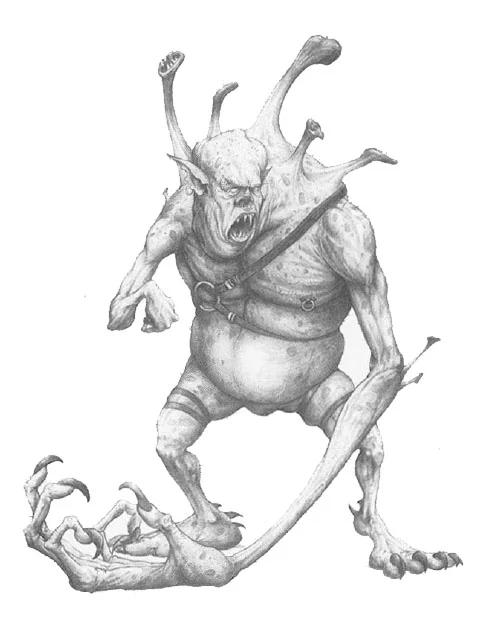
Merihim’s physical form is a direct reflection of his vile purpose and the cosmic forces he serves. His body is a living testament to the "touch of Abhoth," a cryptic reference that hints at a connection to a primordial entity of cosmic filth and creation-from-chaos, often associated with Lovecraftian horrors. This touch has left Merihim grotesquely asymmetrical, his "very essence… unbalanced in the equations of life." His right arm is described as "shriveled with palsy," a withered limb symbolizing perhaps a rejection of natural function or a consequence of his communion with corrupting forces. In stark contrast, his left arm has "grown to immense, twisted proportions," a powerful, mutated appendage that likely serves as a primary tool for his gruesome experiments and defense.
His hunched back is a source of "miasmic fecundity," a horrific, pulsating landscape of biological growth. From this putrescent mass sprout six prehensile, fleshy stems, each terminating in a "toothy maw." These stems are not merely decorative; they are "direct conduit[s] to fetid and corrupted organs," internal breeding grounds for the most virulent diseases. The "maws of cancerous life" at the end of these stems are the primary vectors for his most devastating attack: the "smotherfume." This noxious cloud is not merely a poison; it is a "polluted disease," a concentrated exhalation of the countless pathogens festering within him. The smotherfume likely causes rapid decay, agonizing mutations, or a slow, agonizing death, spreading Merihim’s plague-ridden essence to all who fall victim to its embrace.
The Ascension of Merihim: Pledging to Oblivion
Merihim’s narrative culminates in an act of profound, if terrifying, devotion. "In the time when the Princes were drawn into their web and the Masters in their chains were taken into their slumber, Merihim still labored within his cavern. And for long years thereafter, he labored still." This passage describes a further progression of the cosmic drama, where even the "Princes"—perhaps a tier of power below the "Masters"—are ensnared, and the Masters themselves enter a state of forced or voluntary quiescence. Yet, Merihim remains, a constant amidst the shifting tides of cosmic power, his dedication unwavering.
His tireless service eventually garners the attention of the dormant powers: "And the Princes, though caught still in their web, looked out upon the world and saw this mighty service. And they reached out to the Shepherd of Malignancy." This recognition is pivotal. Merihim, the diligent servant, is finally called upon. He "answered their call and fulfilled the rites of fealty unto their name," a ritualistic acknowledgment of his loyalty and a deeper integration into their cosmic scheme.
This fealty leads to his "Ascension," a paradoxical journey into oblivion. "So he became the one who willingly entered the Slumber, pledging the vows of the Natharl’nacna even in the Time of Loss and binding himself to a servitude of oblivion." The "vows of the Natharl’nacna" are a profound commitment, perhaps a sacred oath of self-effacement for a greater, chaotic purpose. His entry into "Slumber" is not a defeat but a strategic maneuver, a binding "servitude of oblivion," indicating a waiting game. The promise is that "when the Time of Dissolution comes, the truth of his service shall be remembered." This prophecy hints at a future cataclysm, a grand unraveling where Merihim’s dormant power and dedicated service will play a crucial, devastating role.
The Call to Anarchy: A Philosophical Undercurrent
The concluding lines of Merihim’s lore offer a chilling philosophical pronouncement that transcends mere monster statistics: "Let all who would serve the will of Chaos think of the Shepherd. Reflect upon the Faith of Anarchy and covet only that deepest of all communions in which the will of Gods shall be forsaken as tyranny and the will of Demons hold resplendent liberty." This is not just a creature of disease; it is an avatar of a profound ideology. It positions Merihim as an exemplar for those who seek to serve "Chaos," equating divine order with "tyranny" and demonic will with "resplendent liberty." This radical philosophy suggests that true freedom lies in the unbridled, destructive force of chaos, a world unshackled by divine laws or moral strictures. Merihim, in his diligent service to powers of corruption and his willing descent into slumber for a future awakening, embodies this "Faith of Anarchy," offering a terrifying model for those who would dismantle established orders in the name of primordial, unfettered power.
Supporting Data: Contextualizing Cosmic Horror
Understanding Merihim requires an appreciation for the broader cosmic tapestry from which he emerges, as well as the design philosophy that brought him to life.
The Galchutt: Masters of the Cosmic Abyss
While the provided text offers glimpses, the Galchutt are implied to be entities of immense, cosmic power, perhaps akin to Lovecraftian Great Old Ones or Outer Gods. They are the "Masters," the prime movers behind the "Caverns" and the architects of the vile works Merihim tends. Their "passing" and subsequent "Long Quiet" suggest a cyclical nature of cosmic dominion, or a temporary withdrawal rather than absolute defeat. Merihim’s unwavering service, even in their absence, speaks volumes about the depth of their influence and the enduring loyalty they command from their most devoted creations. The "Princes," who recognize Merihim’s service, likely represent a secondary tier of these cosmic powers, still active or semi-active even while the Masters are in "chains" or "slumber." This hierarchy adds depth to the lore, painting a picture of a vast, ancient, and utterly alien cosmic order.
The Book of Fiends: A Seminal Bestiary
Merihim is a product of The Book of Fiends, a bestiary that has garnered significant acclaim within the tabletop roleplaying community, particularly for its innovative approach to demonology and cosmic horror. Published by Green Ronin Publishing, it stands out for its meticulous lore, unique creature designs, and its ability to inspire dread beyond mere stat blocks. The original review cited, "Legions of Hell," suggests a broader context of infernal entities, but The Book of Fiends distinguishes itself by pushing beyond conventional depictions of devils and demons, venturing into more primal, alien forms of evil. Merihim is a prime example of this, embodying biological terror and philosophical anarchy in a way that resonates deeply with players and Dungeon Masters seeking truly memorable antagonists. Its adaptation for D&D 5th Edition allows for seamless integration into popular campaigns, bringing its unique brand of horror to a wider audience.
Influences and Thematic Resonance
The "touch of Abhoth" is a clear nod to Clark Ashton Smith’s Cthulhu Mythos entity, Abhoth, the Source of Uncleanliness, a primordial, amorphous blob from which all monstrous life and filth originate. This connection immediately grounds Merihim in the tradition of cosmic horror, where entities are not just evil but fundamentally alien and antithetical to natural order. Merihim’s focus on disease, mutation, and the corruption of life echoes themes found in bio-horror and body horror subgenres. His very existence challenges the sanctity of life, presenting it as raw material for grotesque experimentation and a vector for cosmic will. The thematic relevance extends to the nature of evil itself: is it merely destructive, or can it be a form of perverse creation, a twisted mirror of divine artistry? Merihim suggests the latter, portraying evil as a meticulous, intelligent force capable of sustained, strategic malevolence.
Critical Reception and Design Philosophy
The original article’s "DESIGN NOTES" highlight Merihim as a prime example of the enduring quality and utility of The Book of Fiends. Justin Alexander, the author of the commentary, unequivocally praises the bestiary as "fantastic" and emphasizes the extensive use he has derived from it over the years. This isn’t merely a casual endorsement; it speaks to the book’s effectiveness in inspiring compelling narratives and challenging encounters.
Exemplary Bestiary Design
Merihim’s detailed lore, grotesque physicality, and profound philosophical underpinnings demonstrate the best practices in monster design. Rather than simply providing statistics, The Book of Fiends imbues its creatures with rich backstories, motivations, and unique capabilities that transcend typical combat encounters. Merihim isn’t just a damage-dealer; he’s a lore-bearer, a philosophical statement, and a source of environmental horror. His existence can shape entire campaign arcs, forcing players to confront not just a powerful foe, but the very nature of corruption and cosmic indifference. The specific mention of Merihim’s "crafty mind" and his "wrought the arts of Jessuk to fungal life" speaks to a creature that engages in strategic biological warfare rather than mindless destruction, making him a far more insidious and memorable threat.
Utility in Storytelling
Alexander’s appreciation for The Book of Fiends stems from its practical utility in roleplaying games. Creatures like Merihim provide more than just combat challenges; they offer hooks for mystery, investigation, and moral dilemmas. A Dungeon Master can weave Merihim’s influence through a campaign long before the party ever encounters him directly, through outbreaks of strange diseases, mutated flora and fauna, or the discovery of ancient texts detailing the "Shepherd of Malignancy." His eventual "Ascension" and promised return provide a long-term antagonist, a looming threat that can drive narratives across multiple gaming sessions or even campaigns. The intricate details of his physical corruption and the descriptions of Eurl-kallat Dath allow DMs to craft truly immersive and terrifying encounters, appealing to sensory horror and psychological dread.
Implications: The Legacy of Malignancy
Merihim’s story concludes not with his defeat, but with a chilling prophecy and a profound philosophical statement, leaving significant implications for any world he inhabits.
The Time of Dissolution: A Looming Cataclysm
Merihim’s willing entry into "Slumber," contingent upon the "vows of the Natharl’nacna" and the promise of remembrance "when the Time of Dissolution comes," signifies a strategic, long-term threat. The "Time of Dissolution" itself is implied to be a cosmic-level event, an unraveling or collapse of reality, perhaps orchestrated by the very "Princes" and "Masters" Merihim serves. His awakening during this period would unleash his perfected plagues and mutations upon a world already on the brink, amplifying the chaos and ensuring the complete corruption of all life. This prophecy positions Merihim as a latent doomsday weapon, a biological agent awaiting the precise moment to fulfill his ultimate, destructive purpose. His "servitude of oblivion" is not passive; it is a dedicated wait for the final, grand act of cosmic anarchy.
Cosmic Horror and Moral Decay
The philosophical conclusion of Merihim’s lore—the exhortation to "forsake the will of Gods as tyranny" and embrace "resplendent liberty" in the "will of Demons"—has profound implications for the moral landscape of a fantasy world. It presents a nihilistic worldview where established order, even divine, is oppressive, and true freedom lies in absolute chaos and self-serving destruction. Merihim, the architect of biological horror, becomes a terrifying icon for this "Faith of Anarchy." This ideology can corrupt mortals, cults, and even lesser demonic entities, inspiring them to dismantle societal structures, spread disease, and propagate mutations in the name of a perceived liberation. It suggests that the greatest evil is not just physical suffering, but the twisting of fundamental values and the seduction of sentient beings into a belief system that glorifies entropy.
Impact on Game Worlds and Heroic Endeavors
For game masters and players, Merihim’s existence poses a unique challenge. Heroes might first encounter the symptoms of his influence—a spreading blight, strange mutations in wildlife, or inexplicable pandemics—long before they understand the source. Investigating Merihim would lead them into ancient, forgotten places, exposing them to cosmic horrors that threaten not just their lives, but their sanity. Confronting Merihim would demand not only martial prowess but also intellectual cunning and a deep understanding of arcane lore and biological science (however twisted). The very act of fighting him would be a struggle against contamination, a race against time to prevent the spread of his plagues. His philosophical underpinnings also offer rich roleplaying opportunities, forcing characters to confront the allure of chaotic freedom versus the necessity of order, and the seductive power of ultimate self-interest. Merihim ensures that the struggle against evil is never simple, often involving the erosion of reality itself.
In conclusion, Merihim from The Book of Fiends is more than a mere stat block; he is a meticulously crafted entity of cosmic horror, biological warfare, and philosophical nihilism. His story, deeply rooted in ancient lore and culminating in a chilling prophecy, solidifies his place as one of the most compelling and terrifying adversaries in contemporary fantasy bestiaries, a testament to the enduring power of well-conceived monstrous entities to enrich and challenge the imagination.