The Visual Philosophy of Christian Quintin: Bridging the Psyche and the Natural World
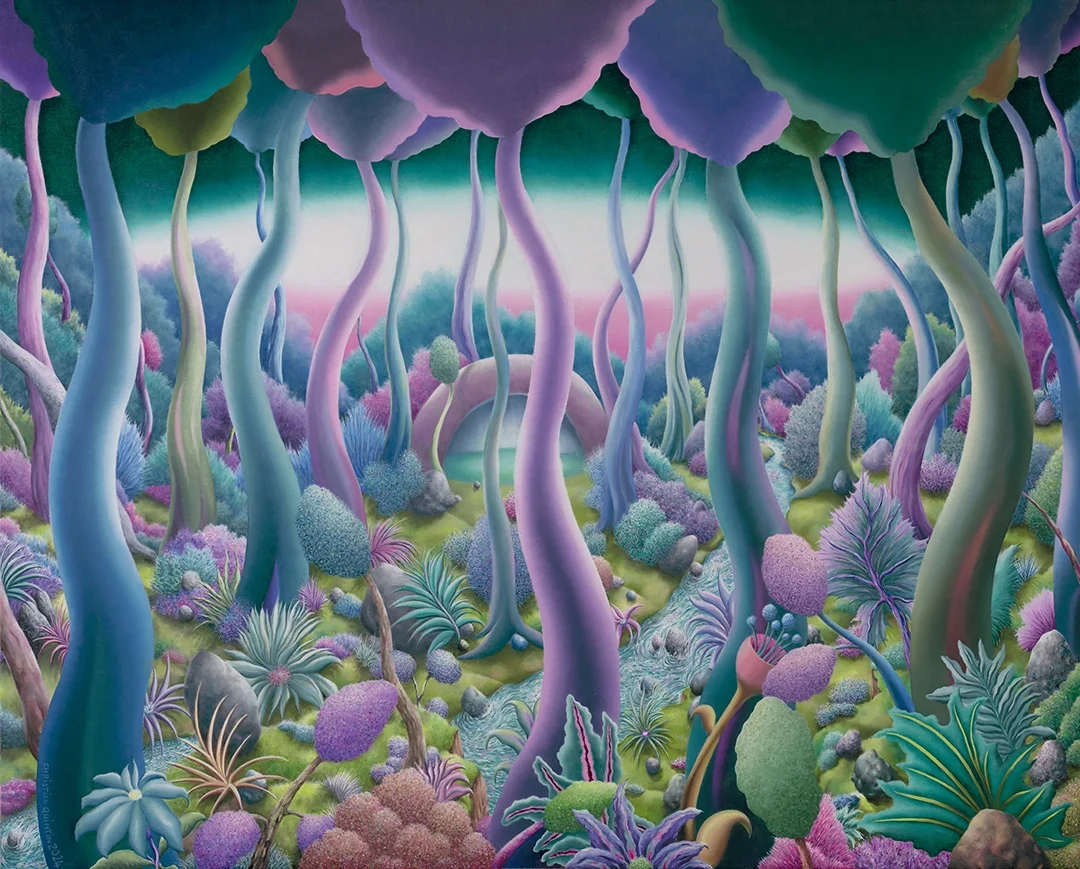
For over four decades, Christian Quintin has occupied a singular space in the contemporary art world—a space where the precision of classical French draftsmanship meets the expansive, mystical light of Northern California. Quintin does not merely paint landscapes or portraits; he constructs "emotional terrains" and "interior constellations." His work arrives with the weight of déjà vu, presenting images that feel like memories of feelings experienced before words were available to describe them.
Born in the rugged coastal region of Brittany and refined in the prestigious ateliers of Paris, Quintin’s career has evolved into a unified vision that defies easy classification. It is at once Romantic, Surrealist, and deeply philosophical. In an era often dominated by irony, cynicism, and rapid-fire digital consumption, Quintin’s meticulous, slow-burning practice offers a radical alternative: beauty as a form of sanctuary and resistance.
Main Facts: A Unified Vision of Two Worlds
Christian Quintin’s body of work is characterized by a "kaleidoscopic consciousness," a term he uses to describe the blurring of boundaries between the self and the environment. His practice is divided—though he would argue unified—between two primary modes: intricate, symbolic surrealism and luminous, emotive landscapes.

The Surrealist Language
Quintin’s surrealism is not "Freudian" in the traditional sense; it does not seek to shock or uncover hidden traumas. Instead, it serves as a map of the psyche. In these works, often rendered in pen and ink or oil, human faces emerge from crystals, necks transform into tree trunks, and hair unfurls into leafy canopies. These are not accidents of "automatism" but are built with extreme intent, often taking six to seven months of daily labor to complete.
The Emotional Landscape
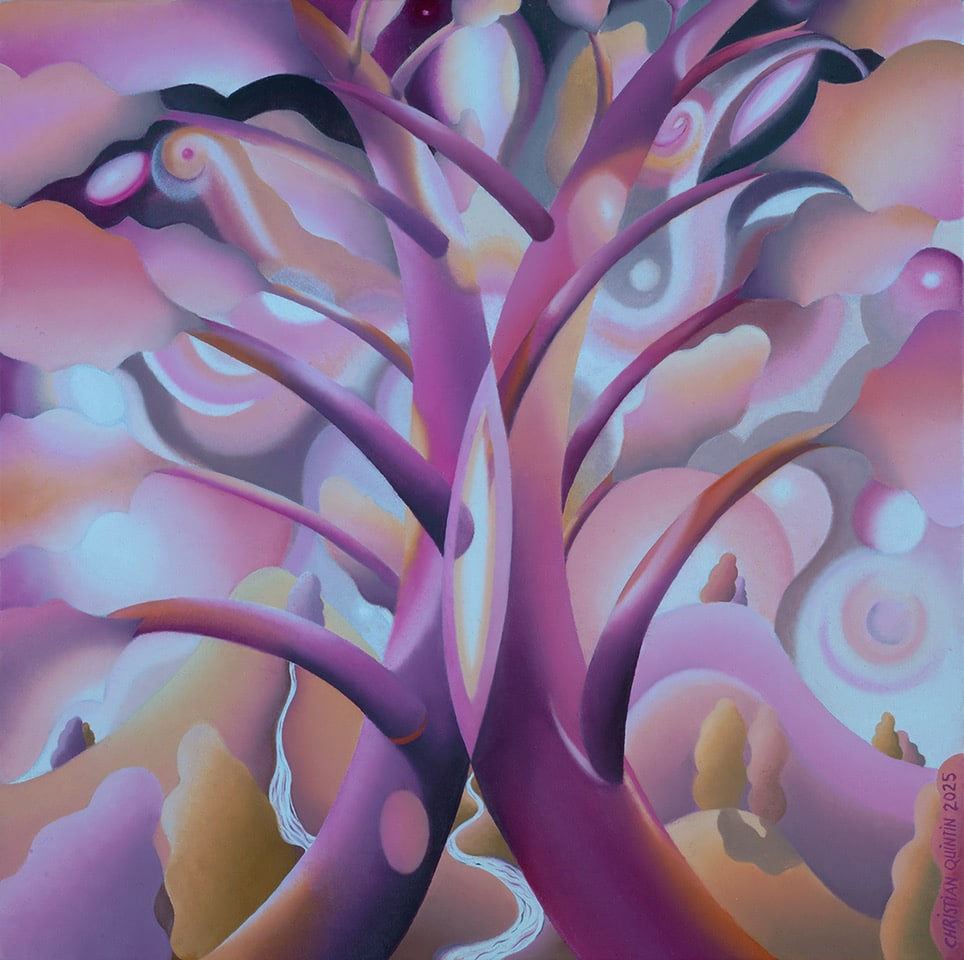
Parallel to his surrealist works are his landscapes. These are not mere documentations of place but are "breathing" sceneries. Whether depicting the vineyards of Sonoma County or the storm-lashed cliffs of Brittany, Quintin uses color—bright emeralds, violet skies, and olive seas—to convey mood rather than literal reality. In his world, trees sway like dancers and rivers carry the weight of memory.
Technical Mastery
A hallmark of Quintin’s work is his rejection of shortcuts. He utilizes a diverse range of mediums—including graphite, pastel, oil, and crosshatched ink—choosing the material that best suits the "soul" of the specific piece. His technical discipline, forged at the Beaux Arts Academy, allows him to render the impossible with a clarity that makes it feel inevitable.

Chronology: From the Coast of Brittany to the Valleys of California
To understand Quintin’s art is to understand the geography of his life. His work is a continuous dialogue between his European roots and his American home.
1957–1974: The Formative Coastline
Quintin was born in 1957 in Saint Brieuc, a port town in Brittany, France. His childhood was set against a backdrop of ruined castles, moody northern light, and the Atlantic’s relentless tides. The L’Île de la Comtesse, a small island near his birthplace, became a mythic anchor for his imagination. The solitude and storybook aura of this coastline instilled in him a lifelong sensitivity to nature’s grandeur and melancholy.
1975–1980: The Parisian Discipline
At age 18, Quintin moved to Paris to study at the prestigious Beaux Arts Academy. It was here that his romantic instincts were tempered by classical rigor. He mastered the traditional techniques of the old masters, developing the precise draftsmanship that remains the backbone of his work today. During this period, he absorbed the influences of the French Symbolists and the Surrealists, learning to use art not just as a mirror to the world, but as a window into the mind.

1981–1998: The California Resonance
The most significant turning point in Quintin’s life occurred in 1981 when he relocated to Northern California. Settling in the vineyards of Sonoma County, he found a landscape that resonated with his internal world. The sacred ecology of the American West—its redwoods, rolling hills, and golden light—offered a new vocabulary. He began to see the "spirit in the tree," merging the myths of his childhood with the vitality of his new environment.
1999–Present: International Recognition
In 1999, Quintin’s career reached a new plateau when he began exhibiting at the Vorpal Gallery, the institution famous for introducing M.C. Escher to the American public. This association solidified his place among artists who blend technical perfection with mind-bending concepts. In the 2020s, under the representation of Lorin Gallery, his work transitioned to the global stage, appearing at major international fairs such as KIAF in Seoul and Art Central in Hong Kong.
Supporting Data: The Anatomy of a Masterpiece
Quintin’s work is defined by its duration and depth. He famously works with a "slow art" philosophy that stands in stark contrast to the contemporary art market’s demand for high-volume output.

The Time of Creation
Two of Quintin’s most celebrated works, The Aviary and La Porte Ouverte, serve as benchmarks for his process:
- The Aviary: A complex self-portrait where the artist’s face emerges from a crystal structure, integrated into an ecosystem of birds and foliage. This piece took six months of meticulous work to achieve its layered transparency.
- La Porte Ouverte: Inspired by a poem by the Sufi mystic Rumi ("Why stay in prison when the door is wide open?"), this work required seven months of intricate crosshatching. The result is a visual meditation on freedom and consciousness that defies logical boundaries.
The Medium as Message
Quintin does not stick to a single "signature" medium. Instead, he approaches each piece like a musician selecting an instrument:
- Ink and Graphite: Used for his most detailed surrealist explorations, where line and shadow create a sense of architectural permanence.
- Pastel and Oil: Reserved for his landscapes and "emotional terrains," where the blending of light and color can mimic the fluidity of human feeling.
Official Responses: Critical Reception and the Return to Beauty
Critically, Quintin has been praised for filling a specific void in the modern art landscape. While much of contemporary art focuses on social critique or conceptual abstraction, Quintin has remained steadfast in his pursuit of the aesthetic and the intuitive.

Critical Acclaim
Critics have consistently noted the "meditative" quality of his work. Suzanne Munich, in a review titled Mental Landscapes, highlighted his ability to map the internal world. Dan Taylor of the Press Democrat described his work as an "emerging beauty," while Alhia Warren characterized his portfolio as a "beautiful intimate mystery."
The "Diagnosis" of Beauty
A 2022 review from the Calabi Gallery offered perhaps the most poignant assessment of Quintin’s relevance: "In an era largely devoid of it, his work is beautiful. We could all use more beauty in our lives." This sentiment suggests that Quintin’s work is not merely decorative, but serves as a necessary "diagnosis" for a society suffering from aesthetic and spiritual exhaustion.
Institutional Recognition
His technical mastery has earned him numerous accolades, including the Grumbacher Award (1987) and the Award of Excellence from the California State Fair (1990). His transition to the international gallery circuit in Paris, Los Angeles, and Seoul confirms that his "regional" inspirations have a universal resonance.
Implications: Art as a Sanctuary for the Soul
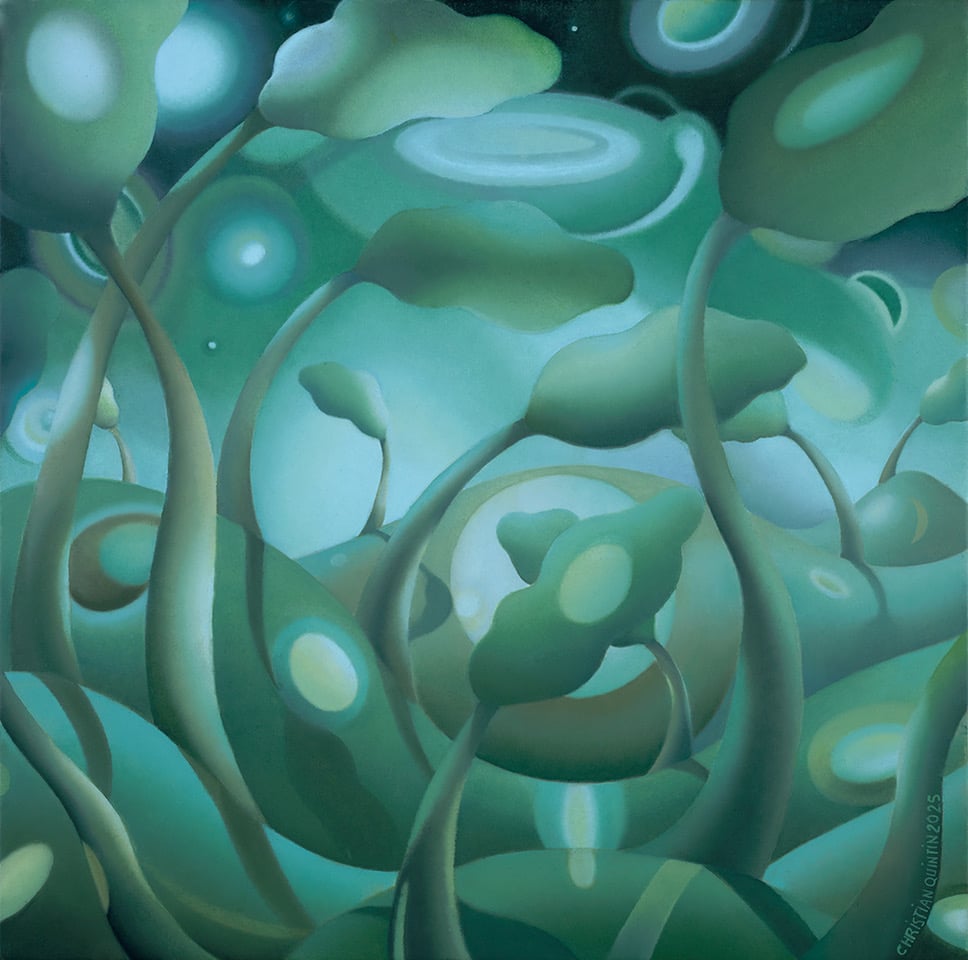
The legacy of Christian Quintin lies in his role as a bridge between disparate worlds. He connects the European tradition of the Symbolists with the American "Visionary Art" movement—the lineage of psychedelic spiritualists and nature-worshippers of the West Coast. However, Quintin brings a classical restraint to this visionary tradition, creating a "sacred geometry" of thought.
Beauty as Resistance
In Quintin’s philosophy, creating something beautiful is a radical act. By rejecting the trend toward the ugly, the ironic, or the ephemeral, he asserts that art should provide a "wondrous sanctuary for the soul." His work implies that the natural world and the human psyche are not separate entities, but are part of a single, breathing fabric.
The Invitation to Slow Down
Quintin’s career serves as a testament to the power of patience. His refusal to simplify his imagery or speed up his process invites the viewer to adopt a similar stance. To look at a Quintin painting is to be asked to "read it like poetry," to wander into the imagery, and to find one’s own meaning in the metaphors buried in the bark of a tree or the lines of a face.
Conclusion
As Christian Quintin continues to exhibit his work from Paris to Seoul, his message remains remarkably consistent: art should be intuitive, emotional, and profoundly beautiful. He remains a visual philosopher of the highest order, reminding us that even in a digital age, the most profound landscapes are the ones we carry within ourselves. His work is not a detour from reality, but a reentry into its most essential, hidden dimensions.