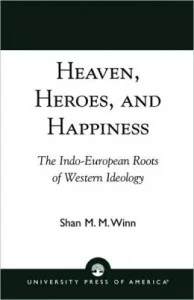
Tracing the Threads of Time: Shan Winn’s "Heaven, Heroes, and Happiness" Unearths Indo-European Roots of Western Thought
FOR IMMEDIATE RELEASE
London, UK – [Current Date] – A compelling new work, "Heaven, Heroes, and Happiness: The Indo-European Roots of Western Ideology" by Shan Winn, offers a profound exploration into the deep historical currents that have shaped Western civilization. The book, currently garnering attention in academic and historical circles, posits that much of our modern worldview, often perceived as distinctly contemporary, is in fact intricately interwoven with the belief systems and societal structures of the Proto-Indo-Europeans – a fascinating and influential people group from the Bronze Age.
While contemporary discourse frequently emphasizes the divergence between modern and ancient perspectives, Winn’s research, reviewed recently by a leading voice in Norse mythology scholarship, meticulously highlights a remarkable degree of continuity. This continuity, rather than being a mere historical footnote, is presented as a fundamental bedrock upon which Western thought and societal organization are built, challenging readers to re-evaluate the origins of their own ideological landscape. The book serves as a vital resource for anyone seeking to understand the enduring legacy of a civilization that, though ancient, remains profoundly relevant.
Main Facts: Unearthing Ancient Foundations
Shan Winn’s "Heaven, Heroes, and Happiness" delves into the often-overlooked yet pervasive influence of the Proto-Indo-Europeans (PIE) on the development of Western thought and societal norms. The central thesis of the book is that the ideological frameworks, social hierarchies, and even mythological narratives of these ancient peoples, who flourished during the Bronze Age, continue to resonate deeply within modern Western societies. This is a bold claim in an era that often prides itself on its perceived departure from historical precedent, yet Winn presents a meticulously researched argument supported by a wealth of linguistic, archaeological, and cultural data.
The Proto-Indo-Europeans are identified as a people or conglomerate of peoples believed to have originated in the vast Pontic-Caspian steppe, a region spanning parts of modern-day Ukraine, Russia, and Kazakhstan. Far from being an obscure footnote in human history, their impact was monumental. They were characterized by a nomadic or semi-nomadic pastoralist lifestyle, marked by innovative technologies such as the early domestication of horses and the pioneering use of wheeled carts. These advancements facilitated their remarkable expansion and cultural diffusion across Eurasia, profoundly shaping the societies they encountered and eventually settled within.
Indeed, the reach of the Proto-Indo-Europeans was so extensive that virtually the entirety of Europe, alongside significant portions of Asia, bears their indelible mark. Major historical groups such as the Celts, Slavs, Greeks, Romans, and Germanic peoples are all recognized as Indo-European societies, their cultures and languages largely derived from the foundational Bronze Age Proto-Indo-European model. The most evident testament to this legacy lies in the Indo-European language family itself, which encompasses almost all modern European languages – with a few notable exceptions like Basque and Finnish – all descended from the original Proto-Indo-European tongue.
However, Winn’s book argues compellingly that the Indo-Europeans bequeathed to us far more than just the linguistic tools we use to communicate. Their contributions extend to the very architecture of our social structures, the underlying cosmology of our belief systems, and even the narrative templates for our myths and philosophies. By meticulously connecting these ancient threads to contemporary patterns, "Heaven, Heroes, and Happiness" offers a fresh perspective on the deep historical roots of what we consider distinctly "Western." It invites readers to trace the ideological lineage from the steppes of Eurasia to the complexities of the 21st century, revealing a fascinating and enduring cultural inheritance.
Chronology: From Steppe Nomads to European Dominance
The narrative of Proto-Indo-European influence unfolds across millennia, beginning with their genesis and culminating in their widespread impact across Eurasia. Understanding this chronology is crucial to grasping the depth and breadth of their legacy as presented in Winn’s work.
The Proto-Indo-European Genesis
The story of the Proto-Indo-Europeans typically begins in the Bronze Age, roughly between 4500 and 2500 BCE, on the Pontic-Caspian steppe. This vast grassland, stretching from the Black Sea to the Caspian Sea, provided an ideal environment for their pastoralist lifestyle. As nomadic or semi-nomadic peoples, their lives revolved around the herding of livestock, particularly cattle and sheep, which necessitated movement across wide territories in search of fresh pastures. This lifestyle inherently fostered adaptability, resourcefulness, and a strong sense of community within their kin groups.
Crucially, the Proto-Indo-Europeans were pioneers of technological innovation that would forever alter human history. They are credited as one of the first peoples to domesticate horses for riding and traction, an advancement that revolutionized transportation, warfare, and communication. Simultaneously, they developed and utilized wheeled carts, significantly enhancing their ability to transport goods, move their settlements, and facilitate their extensive migrations. These innovations were not merely practical; they fundamentally shaped their worldview, fostering a dynamic, expansive culture distinct from the more settled agricultural communities they would later encounter. Their deep connection to horses, in particular, often found expression in their mythology, where divine horses and chariots played significant roles, symbolizing speed, power, and celestial travel.
The Great Migrations and Dispersal
Equipped with superior mobility and, arguably, military advantages derived from their horse culture, the Proto-Indo-Europeans embarked on a series of migrations during the Bronze Age that would reshape the demographic and cultural landscape of Eurasia. These movements, often referred to as "expansions" or "dispersals," were not necessarily large-scale invasions in every instance but rather a complex process involving waves of migration, cultural assimilation, and often, the imposition of their language and social structures onto existing populations.
From their steppe homeland, various groups fanned out in different directions. Some moved westward into Europe, giving rise to the ancestors of the Celts, Germanic peoples, Slavs, Balts, and Italic tribes (who would found Rome). Others migrated southward into Anatolia (Hittites), eastward into Central Asia, and eventually into the Indian subcontinent (Indo-Aryans) and Iran (Iranians, including the ancestors of Zoroastrians). In each region, they profoundly shaped the local societies, often establishing new elites and influencing indigenous cultures. The common linguistic thread connecting these disparate groups, the Indo-European language family, is a powerful testament to their shared origin and the effectiveness of their cultural transmission. This linguistic unity, despite later diversification, hints at an underlying cultural and ideological coherence that Winn seeks to illuminate.
Evolution of Ideology
As the Proto-Indo-Europeans settled into diverse geographical and ecological niches, their initial nomadic culture necessarily evolved. They transitioned from purely pastoralist societies to more settled agricultural communities, often integrating with the pre-existing populations of "Old Europe" or other regions. This process of cultural syncretism led to variations and adaptations of their core ideological tenets. However, as Winn meticulously illustrates, certain fundamental structures and worldviews proved remarkably resilient, enduring across vast distances and through significant historical transformations.
For instance, while the specific manifestations of their social hierarchy or their pantheon of gods might differ between, say, ancient India and early medieval Scandinavia, the underlying tripartite framework and certain mythological archetypes persisted. This evolution demonstrates not a dilution of their original influence, but rather a robust adaptability that allowed their core ideas to permeate and structure new civilizations. The book argues that these inherited frameworks, refined and reinterpreted over millennia, laid the groundwork for many of the enduring institutions, ethical systems, and philosophical inquiries that define Western civilization today, bridging the gap between ancient steppe traditions and the complexities of modern nation-states.
Supporting Data: Pillars of Indo-European Influence
Winn’s central argument is buttressed by a wealth of "supporting data" that draws from various academic disciplines, illuminating specific aspects of Indo-European culture that have left an indelible mark on Western thought. These include the remarkably consistent tripartite social structure, the linguistic evidence that connects disparate cultures, and the profound religious and mythological continuities.
The Enduring Tripartite Structure
One of the most compelling pieces of evidence presented by Winn, building extensively on the foundational work of Georges Dumézil, is the pervasive tripartite hierarchical structure found across virtually all Indo-European societies. This structure divides society into three distinct, yet interdependent, functions or classes:
- Sovereignty and Religion: Comprising rulers, priests, and legal figures, responsible for divine favor, justice, and the overall order of the cosmos and society.
- Warfare: Consisting of warriors and the military class, charged with protection, expansion, and the maintenance of martial prowess.
- Fertility and Production: Encompassing farmers, herders, artisans, and merchants, responsible for sustaining the community through labor and generating wealth.
This specific organizational principle, which may appear almost intuitively "natural" to those raised in Western societies, is, as Winn argues, almost uniquely Indo-European in its consistent and explicit manifestation. Dumézil famously demonstrated how this tripartition was not merely a sociological phenomenon but also a fundamental principle underpinning Indo-European cosmology. Divine realms mirrored this structure, with gods and goddesses often categorized and interacting according to their assigned function. For example, in Norse mythology, figures like Óðinn (sovereignty, magic) and Týr (justice, law) represent the first function, Þórr (warfare, protection) the second, and Freyr and Freyja (fertility, prosperity) the third. Similar patterns can be observed in Roman (Jupiter, Mars, Quirinus) and Indian (Brahmin, Kshatriya, Vaishya) pantheons and social classes.
While modern Western societies have, of course, evolved beyond rigid caste systems, Winn asserts that this tripartite division remains a "primary reference point" around which our societies are implicitly ordered. We can still discern echoes in the division of governmental powers (legislative, executive, judicial), the distinct roles of religious/intellectual elites, the military, and the vast economic sectors. The sheer consistency and widespread nature of this tripartite ideology, both in social organization and divine representation, across such a vast array of historically and geographically separated Indo-European cultures, constitutes a powerful testament to a shared ancestral worldview.
Linguistic Evidence and Cognates
Beyond social structures, the Indo-European language family itself offers a treasure trove of "supporting data." Linguistic reconstruction, a meticulous process of comparing related languages to deduce features of their common ancestor, the Proto-Indo-European language, reveals striking insights into their culture. Shared vocabulary, known as cognates, for specific concepts provides direct evidence of their societal norms, religious beliefs, and daily lives.
For instance, the reconstruction of terms for kinship ("ph₂tḗr" for father, "méh₂tēr" for mother), specific deities (a sky-father god like "Dyēus Ph₂tḗr"), social roles, and even agricultural practices ("yugóm" for yoke, "*h₂erh₃-" for to plow) paints a vivid picture of a cohesive, albeit internally diverse, culture. The very existence of a reconstructed Proto-Indo-European lexicon allows scholars to infer not just individual words but entire conceptual frameworks and cultural values shared across the vast Indo-European diaspora. This linguistic bedrock underscores the deep historical connections that Winn explores.
Religious and Mythological Continuities
Winn further illustrates Indo-European influence through enduring religious and mythological themes. One significant example is the figure of Zarathustra, the Iranian prophet of the second millennium BCE. As a priest within an Indo-European society, Zarathustra’s teachings, which would later profoundly influence monotheistic religions, particularly Christianity, were not created in a vacuum. While his philosophy represented radical departures from ancestral traditions—introducing a stark ethical dualism and a more abstract concept of divinity—he nevertheless drew heavily upon existing Indo-European mythical themes and cosmological elements as his raw materials. Concepts such as cosmic order (Asha in Zoroastrianism, corresponding to Rta in Vedic traditions), the struggle between truth and falsehood, and the ultimate triumph of good, all resonate with broader Indo-European moral frameworks.
Beyond Zarathustra, a host of other shared mythological motifs permeate Indo-European traditions. These include the archetype of a sky god (e.g., Zeus, Jupiter, Dyaus Pitar, Týr), a powerful thunder god (e.g., Thor, Indra, Perun), divine twins (e.g., the Ashvins, Castor and Pollux), the concept of a sacred tree or cosmic axis connecting different realms, and a veneration for horses. The recurrence of these narrative elements and divine figures across diverse cultures—from the Vedas of India to the sagas of Iceland—strongly suggests a common mythological inheritance. Winn’s work highlights how these continuities are not merely coincidental but reflect a shared "deep structure" of thought and belief, demonstrating how the ancient Indo-Europeans shaped the very stories and spiritual frameworks through which their descendants made sense of the world.
Archaeological and Genetic Insights
While Winn’s book primarily focuses on cultural and ideological continuities, the last few decades have seen significant advancements in archaeology and genetics that increasingly corroborate and refine theories about Proto-Indo-European origins and migrations. Ancient DNA analysis, in particular, has provided compelling evidence for the movement of peoples from the Pontic-Caspian steppe into Europe and Asia, often matching the linguistic and cultural spread predicted by earlier scholarly models. Archaeological findings of specific burial practices (like kurgan mounds), distinctive pottery, and the widespread use of certain tools or technologies across proposed Indo-European expansion routes further lend material weight to the cultural diffusion theories that underpin Winn’s arguments. These interdisciplinary connections strengthen the overall understanding of the Proto-Indo-Europeans not just as a linguistic construct, but as a historically verifiable and culturally impactful force.
Official Responses and Scholarly Debates: Navigating Complexities
Winn’s work, like any significant contribution to Indo-European studies, engages with and builds upon a rich tradition of scholarship, inevitably navigating areas of consensus and ongoing debate. The book prominently features the influence of two titans in the field: Georges Dumézil and Marija Gimbutas, whose distinct approaches represent different facets of the complex academic landscape.
The Legacy of Georges Dumézil
Georges Dumézil (1898-1986) remains one of the most respected and influential scholars in Indo-European studies, particularly renowned for his groundbreaking work on the tripartite ideology. Winn’s reliance on Dumézil’s theories is well-placed, as his contributions are widely accepted for their analytical rigor and explanatory power. Dumézil was the first to systematically identify and analyze the remarkable centrality of tripartism in Indo-European social structures, mythologies, and even divine pantheons. His comparative approach, examining evidence from ancient India, Iran, Rome, and the Germanic world, revealed a consistent pattern of three functional divisions: sovereignty (religious and juridical), force (military), and prosperity (fertility and production).
Dumézil’s genius lay in demonstrating that this was not merely an arbitrary classification but a fundamental ideological framework that structured these societies at every level, from their social classes to the attributes of their gods. His work provided a powerful tool for understanding the underlying coherence of diverse Indo-European cultures, offering insights into their shared worldview. The reviewer’s ready acceptance of the "soundness of Dumézil’s ideas" reflects the broad academic consensus regarding his methodological innovation and the compelling evidence he marshaled. His theories continue to be a cornerstone for interpreting Indo-European social and religious systems, forming a robust foundation for Winn’s arguments about continuity.
Critiquing Marija Gimbutas and "Old Europe"
In contrast to the widespread acceptance of Dumézil’s work, Marija Gimbutas (1921-1994), another hugely influential figure, presents a more contentious legacy. Winn draws heavily on Gimbutas, but the reviewer expresses significant reservations regarding her interpretations, echoing a broader scholarly debate. Gimbutas is celebrated for her pioneering archaeological work in Eastern Europe, unearthing vast amounts of data about pre-Indo-European cultures. However, her interpretations, particularly her "Old Europe" hypothesis, have been the subject of intense scrutiny and criticism.
Gimbutas posited that the peoples of pre-Indo-European Europe (roughly 7000-3000 BCE) lived in uniformly peaceful, egalitarian, and harmonious societies. According to her, these cultures were primarily agrarian, highly valued art, and were characterized by the worship of a Great Goddess, suggesting a matriarchal or matrifocal social organization. This vision of "Old Europe" painted a utopian picture, often contrasted sharply with the subsequent arrival of the Indo-Europeans.
Gimbutas, through her "Kurgan hypothesis" (a term she coined to describe the archaeological culture associated with the Proto-Indo-Europeans), depicted the Indo-Europeans as "big, bad" patriarchal invaders. In her narrative, these steppe warriors mercilessly conquered and subjugated the peaceful peoples of Old Europe, erasing their way of life, introducing hierarchy, warfare, and a male-dominated pantheon. This created a stark, almost Manichaean dichotomy: a golden age of peaceful matriarchy destroyed by violent patriarchy.
The reviewer critically observes that while there might be some truth to the idea that pre-Indo-European societies were closer to a less hierarchical existence than the Indo-Europeans, Gimbutas "greatly overstates her case." The criticism highlights that her stark dichotomy and idealized portrayal of "Old Europe" played directly into the "unrealized hopes and dreams of mid-to-late-twentieth-century liberalism/progressivism." This suggests that Gimbutas’s work, perhaps inadvertently, became a vehicle for contemporary ideological aspirations, offering a supposedly historical utopian model for progressive thought. The academic community largely acknowledges Gimbutas’s immense contribution in bringing attention to these pre-Indo-European cultures, but her specific interpretations, particularly the extent of matriarchy, peacefulness, and the sweeping generalizations about cultural destruction, are widely debated and often challenged for lacking sufficient empirical support or for being overly romanticized.
The reviewer further notes that Winn "mostly accepts Gimbutas’s work uncritically." This uncritical acceptance leads to a specific criticism: Winn’s "annoying habit of assuming that Indo-European goddesses could only be holdovers from Gimbutas’s Old Europe." This implies a perceived intellectual blind spot, as if the Proto-Indo-Europeans were so "completely, cartoonishly patriarchal" that they were incapable of developing original goddesses within their own cultural framework. This point challenges the notion that all female deities in Indo-European pantheons must necessarily be remnants of a pre-existing matriarchal system, overlooking the complex and often powerful roles of goddesses within Indo-European mythology itself (e.g., goddesses of sovereignty, war, wisdom, and fertility, like Athena, Juno, Saraswati, and the Vanir goddesses). While Winn does make a passing reference to the "obvious, almost Zoroastrian dualism inherent in Gimbutas’s vision," this brief acknowledgment, in the reviewer’s estimation, does not sufficiently address the broader issues with Gimbutas’s highly polarized framework.
This section underscores the importance of critical engagement with even foundational scholarship and highlights the ongoing, dynamic nature of Indo-European studies, where new evidence and interpretative frameworks constantly refine our understanding of these ancient peoples.
Implications: Bridging Past and Present
Shan Winn’s "Heaven, Heroes, and Happiness" offers far more than a historical recount; it provides crucial implications for understanding modern Western identity, the value of interdisciplinary research, and the future directions of Indo-European studies. The book ultimately serves as a powerful reminder that our present is inextricably linked to a deep and complex past.
Relevance to Modern Western Identity
The most significant implication of Winn’s work lies in its ability to illuminate the profound historical layers underpinning modern Western identity. By meticulously tracing the Indo-European roots of our social structures, cosmological beliefs, and even our linguistic patterns, the book challenges the often-held notion that Western societies are solely products of recent enlightenment or post-industrial developments. Instead, it reveals a remarkable degree of cultural continuity, suggesting that many of our fundamental assumptions about hierarchy, law, spiritual order, and the very concept of heroism are ancient inheritances.
Understanding these deep historical threads allows for a more nuanced appreciation of how Western thought has evolved. It explains why certain societal archetypes resonate so deeply, why specific narrative structures feel inherently "right," and why certain values persist despite radical shifts in technology and governance. For instance, the implicit respect for a hierarchical order, even in democratic societies, or the enduring appeal of the warrior-hero archetype, can be better understood through the lens of Indo-European tripartism and mythology. This historical consciousness encourages us to examine the unspoken assumptions that guide our institutions and cultural narratives, fostering a more informed dialogue about tradition, progress, and the ongoing construction of identity in a globalized world. It suggests that while we may embrace modernity, the echoes of the Bronze Age continue to shape our collective psyche.
The Value of Interdisciplinary Study
Winn’s research, by its very nature, exemplifies the immense value of interdisciplinary study. The book synthesizes insights from linguistics (tracing language families), archaeology (interpreting material culture and migration patterns), comparative mythology (identifying shared narratives and divine figures), sociology (analyzing social structures), and religious studies (exploring belief systems). This integrated approach is essential for reconstructing ancient cultures like the Proto-Indo-Europeans, who left no direct written records. No single discipline could fully capture the complexity of their influence; it is through the careful triangulation of evidence from multiple fields that a comprehensive picture emerges.
"Heaven, Heroes, and Happiness" thus stands as a testament to how cross-disciplinary collaboration can unlock profound insights into human history. It showcases the power of weaving together disparate threads of evidence to create a rich tapestry of understanding, demonstrating how linguistic cognates can illuminate social practices, and how archaeological finds can corroborate mythological narratives. This interdisciplinary methodology not only enriches the historical narrative but also provides a model for future research into complex historical phenomena.
Challenges and Future Directions in Indo-European Studies
Finally, Winn’s book, by engaging with established scholars like Dumézil and Gimbutas, implicitly points to the ongoing dynamism and inherent challenges within Indo-European studies. It is a field constantly evolving, with new archaeological discoveries, advancements in ancient DNA analysis, and reinterpretations of linguistic data continually refining our understanding. The debates surrounding Gimbutas’s work, for instance, highlight the critical importance of scholarly rigor and the careful distinction between empirical evidence and interpretative frameworks, especially when dealing with emotionally charged topics like ancient gender roles or societal structures.
Future directions in Indo-European studies will undoubtedly continue to leverage cutting-edge technologies, such as advanced genetic sequencing and computational linguistics, to further unravel the mysteries of these ancient peoples. These tools promise to provide even more granular detail about migration routes, population admixture, and the precise timing of cultural diffusions. However, as Winn’s work demonstrates, the humanistic interpretation of these data remains paramount. The challenge lies in integrating scientific findings with a nuanced understanding of cultural, ideological, and mythological continuities.
Ultimately, "Heaven, Heroes, and Happiness" is lauded as an excellent introduction to the multifaceted world of Indo-European society and mythology. It is a fascinating study that successfully bridges the vast expanse of time, revealing the enduring ways in which aspects of their worldviews and ways of life have persisted into the present day. For students, scholars, and general readers alike, it offers a compelling entry point into a field that continues to reshape our understanding of where we come from and who we are. The book is highly recommended for anyone seeking to uncover the ancient roots that still nourish the tree of Western ideology.