"Treasury of Folklore" Compendium Unveiled: A Monumental Journey into Humanity’s Shared Imagination
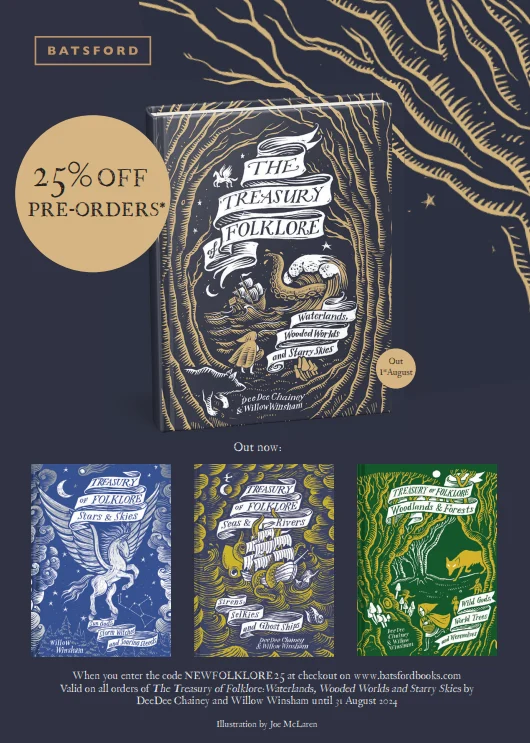
LONDON, UK – [Date of publication, e.g., July 25, 2024] – A decade-long exploration into the universal tapestry of human storytelling culminates this August with the release of The Treasury of Folklore: Waterlands, Wooded Worlds and Starry Skies. This eagerly anticipated compendium, published by Batsford Books, brings together the most captivating tales and beliefs from the acclaimed Treasury of Folklore series into a single, beautifully bound volume, fulfilling the authors’ original vision for a comprehensive global anthology.
Slated for release on August 1st, 2024, and now available for pre-order, this "hefty tome" promises to be a definitive collection for both seasoned folklore enthusiasts and new readers. While containing no new material, it meticulously curates favourite passages and original illustrations by Joe McLaren from the three bestselling predecessors: Seas and Rivers, Trees and Woodlands, and Stars and Skies. The compilation offers a profound journey through the diverse landscapes that have shaped human imagination, revealing the enduring commonalities in our deepest fears, dreams, and aspirations.
A Vision Realized: From Fragmented Journeys to a Unified Narrative
The genesis of The Treasury of Folklore series began nearly a decade ago, sparked by the vibrant, global exchange of stories fostered by the #FolkloreThursday hashtag. Authors Dee Dee Chainey and Willow Winsham embarked on a mission not just to document folklore, but to understand its underlying human truths. Their initial ambition was grand: a single, all-encompassing volume that would traverse every physical landscape inhabited by humans across the world.
However, the sheer volume and richness of the material they uncovered quickly surpassed the confines of a single book. This wealth of narrative led to the creation of three distinct, yet interconnected, volumes. Seas and Rivers plunged into the watery depths, Trees and Woodlands explored the mysteries of sylvan realms, and Stars and Skies looked heavenward, each book celebrating the unique folklore born from specific environments. The popularity of these individual titles, the authors confess, has been both "surprising and heartwarming," a testament to the enduring human appetite for stories that reflect our collective spirit.
The recent suggestion to produce a compendium presented an invaluable opportunity to finally realize that initial, ambitious vision. "We immediately knew that we had to take this opportunity to bring the folklore together as originally envisaged: in one volume," the authors stated. This process involved a meticulous re-reading and curation of their existing work, approaching familiar texts with fresh eyes to select the most impactful and representative narratives. The goal was to seamlessly weave together the diverse threads of global folklore into a cohesive narrative that would span "shared landscapes across time and place." The result, they affirm, has "blown us away," describing themselves as "utterly thrilled" to share this exquisite collection with the world.
A Compendium of Shared Humanity: Content and Craftsmanship
The Treasury of Folklore: Waterlands, Wooded Worlds and Starry Skies is more than just a collection of tales; it is an exploration of the universal human condition. The authors’ overarching discovery, woven throughout the series and now solidified in this compendium, is that despite geographical and cultural variations, "we are all inherently the same." We share primal fears of the unknown, gaze with awe at the vastness of time and space, and long for the wonders the world has to offer. The monsters we name and the heroes we celebrate may differ, but the underlying psychological and emotional landscapes are remarkably consistent.
The compendium is thoughtfully structured into three core sections, mirroring the original books. Each section is enhanced by the distinctive and evocative original illustrations of Joe McLaren, whose artwork has become synonymous with the series. The physical presentation of the book itself is a point of pride for the authors, who praise its "size and the cover combining everything and the beautiful cream paper," describing it as a "hefty tome indeed." It is designed not merely as a book to be read, but as an object to be cherished – a beautiful addition to any bookshelf or coffee table, intended to spark conversation and connection.

While it is crucial to note that the compendium does not introduce new stories or research, its value lies in its comprehensive, curated format. It offers a convenient and aesthetically pleasing way to access the series’ most beloved content, making it an ideal gift or a foundational text for anyone seeking to understand the enduring power of folklore.
Journeys into Myth: Glimpses from the Compendium
To celebrate the forthcoming release, the authors have provided tantalizing extracts that showcase the breadth and depth of the compendium’s content. These glimpses transport readers from perilous waterways to mystical forests and up to the silent moon, illustrating the rich tapestry of human belief.
Water Horses: Majestic and Malevolent Creatures from the Depths
Our journey begins with the chilling allure of water horses – beings of immense power that embody humanity’s primal fear and respect for untamed waters. These creatures, whether real or cautionary tales, serve as potent symbols of nature’s deceptive beauty and inherent danger.
Among the most famous is the Scottish Kelpie, a formidable water horse frequently confused with the each-uisge. While both are malevolent, the kelpie typically haunts rivers, dragging unwary riders to a watery grave. Its legend is so deeply ingrained in Scottish culture that monumental 30-meter sculptures, visible from the M9 motorway near Falkirk, have stood since 2013, a modern testament to its enduring hold on the national imagination. The kelpie’s presence in contemporary literature, from Lari Don to J.K. Rowling’s Fantastic Beasts and Where to Find Them, further cements its iconic status. Yet, curiously, this specific variant of water horse is largely absent from English folklore, suggesting a unique regional development of the myth.
Across the border, Welsh folklore presents the Ceffyl Dwr, a shapeshifting spirit of the waters that persisted in belief well into the 19th century. In the north, it adopted various forms, often violent, while in the south, it consistently appeared as an enchanting, albeit treacherous, small horse. Tales emphasize its incredible speed, covering vast distances before vanishing, leaving its hapless rider to drown. An intriguing exception to its cruelty was its treatment of clergymen of any creed, who were said to be able to ride it safely to their destinations, while their companions were often less fortunate. This detail hints at the interplay of ancient beliefs with evolving religious contexts.
Scandinavian mythology introduces the Bäckahäst, or "brook horse," a luminous and majestic creature often sighted in the fog. Like its Celtic counterparts, it beguiles riders, particularly children – perhaps to heighten the sense of peril – before plunging back into the water, trapping its victims. A popular tale recounts a group of boys saved from the Bäckahäst when the last child, in awe, mispronounces a colloquial phrase that accidentally invokes the name of Christ, a name the creature despises. Despite their fearsome reputations, many tales of the Bäckahäst, like those of the kelpie, conclude with the riders surviving, often by tricking the horse or invoking specific protective measures. These narratives collectively speak to humanity’s ongoing struggle to navigate and survive the powerful, often inscrutable, forces of nature.
Lords of the Wild: Sylvan Sovereigns and Guardians of the Green
Leaving the treacherous waters, the compendium ventures into the "verdant greenery of the forest," the domain of the Lords of the Wild. These powerful spirits and creatures, found in woodlands and jungles worldwide, embody humanity’s complex relationship with the natural world – a mix of reverence, fear, and a desire for protection or appeasement.

In Finnish mythology, Tapio, also known as Metsähine or Hiisi, reigns as the king of the forest realm. Depicted as tall and thin, with a coat of ermine fur or moss and a hat, he shares visual characteristics with Europe’s Green Man figures, peering out from mossy eyebrows and often sporting a great beard. His back, like that of Scandinavian hulder, is said to resemble a gnarled tree, symbolizing his intrinsic connection to the forest. Tapio is both the personification and protector of the woods, holding sway over all its creatures. Traditionally, hunters sought his blessing for a successful hunt, vowing to respect the land and its inhabitants. His family – benevolent wife Mielikki (or malevolent Kuurikki), son Nyrikki (who guides hunters), and daughter Tulikki (who directs prey) – further illustrates the intricate cosmology of Finnish nature worship. The Estonian equivalent, notably, possesses only one eye, drawing parallels to the Norse god Odin.
The Slavic Leshy (or Leshii, Lyeshy) stands as a formidable tutelary spirit, a protector of trees and animals, particularly wolves or bears depending on the region. Known by many names, all linking him to the forest, the Leshy hibernates in winter, much like the bears he often serves. Descriptions vary widely, likening him to Greek satyrs with horns, claws, and a bushy beard, sometimes forest green or entirely moss-covered. A master shapeshifter, he can alter his size from a blade of grass to a towering tree, and mimic any forest creature, human, or plant. In human form, he can be identified by a lack of eyelashes or brows, shoes worn on the wrong feet, or clothing wrapped opposite to local fashion. Some have only one eye, but all share wild hair and cloven feet, linking them to fauns or even the Devil.
The Leshy’s presence is announced by bellowing winds, scattering all creatures in terror. Those who trespass in his domain without invitation risk being confused, lured from paths, and lost forever. A notorious trickster, the Leshy mimics voices, entices victims, and can, reputedly, tickle them to death. He inflicts illness, abducts women and children, and can curse entire farms, leading to annual sacrifices of cows in regions like Olonetsky District, Russia, to appease him. Yet, safety from the Leshy can be found through prayers, offerings of bread or tobacco, or by employing specific counter-magical practices like turning clothes inside out and shoes on the wrong feet – actions said to provoke laughter from the spirit, thereby returning the lost to their rightful path. The Leshy is also depicted as a social creature, living with his wife (the lesovikha) and children, capable of battling his own kind with clubs fashioned from trees, and even frequenting taverns to gamble with squirrels. These complex portrayals reveal a deep-seated human understanding of the forest as both a nurturing haven and a perilous, sentient entity demanding respect.
The Hare on the Moon: Celestial Enigmas and Earthly Fates
Finally, the compendium invites readers to gaze skyward, exploring the enduring motif of the Hare on the Moon. This widespread belief, found across numerous cultures, imbues the lunar surface with a recognizable form, often seeing the Sea of Tranquillity as the rabbit’s head and other seas as its ears.
In the Buddhist Sasa-Jātaka, the hare, alongside his friends the otter, jackal, and monkey, champions the virtue of giving alms. To test their generosity, the deity Sakka descends to Earth disguised as an old man. While his companions offer readily available food, the hare, having only grass, nobly offers himself as sustenance by leaping into a fire. For this ultimate act of faithfulness, Sakka rescues the hare and places him upon the moon for all eternity, sometimes even drawing his image there with essence from a squeezed mountain. This tale underscores themes of self-sacrifice, compassion, and divine reward, resonating across similar narratives in other cultures.
A Sri Lankan tale echoes this theme, with a lost Buddha encountering a hungry and poor hare. The hare immediately offers himself for food, throwing himself onto a fire created by Buddha. Recognizing the selfless act, Buddha uses his powers to save the creature and send him to the moon. Similarly, in Japan, the Tsuki no Usagi (Moon Rabbit) appears when the Man in the Moon, disguised as a beggar, tests animals for food. The rabbit, with only grass, sacrifices itself on a fire, prompting the beggar to reveal his true form and take the selfless rabbit to live with him on the moon. This poignant story is a beloved part of Japanese tradition, often shared with children during the Harvest Moon and Mid-Autumn Festival, teaching valuable lessons about generosity and selflessness.
However, not all lunar hare tales are benevolent. A South African narrative presents a darker twist, attributing human mortality to the hare. The Moon tasks the Hare with delivering a message to humanity: that just as she "dies" and returns each month, so too would humans. But the flighty Hare misdelivers the message, telling people they would simply die, without the promise of return. Enraged by this catastrophic error, the Moon attacks the Hare with a hatchet, only succeeding in splitting his lip. In retaliation, the Hare lashes out, scarring the Moon’s face – markings that, according to the tale, are still visible as the dark shapes on the moon today. This stark contrast highlights the diverse ways different cultures grapple with fundamental questions of life, death, and the very nature of existence through their celestial narratives.

Implications and a Lasting Legacy
The release of The Treasury of Folklore: Waterlands, Wooded Worlds and Starry Skies is more than just a publishing event; it is a significant cultural contribution. By unifying these diverse tales, the compendium reinforces the profound truth that, beneath the veneer of cultural differences, humanity shares a fundamental imaginative landscape. It provides an invaluable resource for understanding how our ancestors processed their environments, celebrated their heroes, and grappled with their fears, offering insights that remain remarkably relevant today.
This meticulously crafted volume serves as a powerful reminder of folklore’s role in preserving intangible heritage, connecting us to the ancient wisdom and collective consciousness of humankind. It encourages readers to look beyond the surface of a story and delve into the shared human experiences it represents, fostering empathy and cross-cultural understanding. As a "conversation starter," it invites dialogue, reflection, and a renewed appreciation for the enduring power of narrative in shaping our world.
Pre-Order Now and Discover the Universal Thread
The Treasury of Folklore: Waterlands, Wooded Worlds and Starry Skies is now available for pre-order from major retailers and will be officially released on August 1st, 2024. For those wishing to secure their copy directly, Batsford Books is offering a 25% discount when ordering from their website (www.batsfordbooks.com/book/the-treasury-of-folklore/) using the code NEWFOLKLORE25.
Embark on this extraordinary journey through the collective human imagination and discover the threads that bind us all, across waterlands, wooded worlds, and starry skies.