Unearthing Frontiers: A Journey into Classic Science Fiction Adaptations
In a compelling bi-weekly series for Reactor Magazine, Alan Brown delves into the "front lines and frontiers" of science fiction and fantasy, meticulously reviewing classic books that define the genre. His focus is on narratives brimming with "alarums and excursions"—tales of soldiers and spacers, scientists and engineers, explorers and adventurers, all infused with the excitement of battles, chases, and clashes. This insightful column offers readers a fresh perspective on foundational works, often drawing comparisons between their original literary forms and subsequent cinematic adaptations.
Brown’s latest exploration stems from a personal rediscovery. Having recently enjoyed Michael Crichton’s Jurassic Park in print, long after experiencing Steven Spielberg’s iconic film, he embarked on a quest through a local used bookstore’s trove of movie tie-in novels. This endeavor was driven by a common curiosity among science fiction enthusiasts: to revisit or, in many cases, discover for the first time, the original literary sources behind beloved big-screen spectacles. It’s a phenomenon where many are intimately familiar with the stories of H.G. Wells or Jules Verne through film and television, yet remain largely unacquainted with the novels that first brought these imaginative worlds to life. For Brown, the inaugural selection for this literary-cinematic comparative journey was a cornerstone of dystopian science fiction: Pierre Boulle’s Planet of the Apes.
Pierre Boulle: Architect of Dystopian Visions
Before delving into the narrative intricacies of Planet of the Apes, it is crucial to appreciate the genius of its creator, Pierre Boulle. Born in 1912, this French author (who passed away in 1994) carved out a distinguished literary career spanning decades, producing over twenty novels and numerous short story collections. Boulle’s life experiences significantly informed his writing, particularly his service as a secret agent for the Free French in Indochina during World War II, which culminated in his capture and imprisonment.
These harrowing wartime experiences provided the bedrock for his first major international success, The Bridge Over the River Kwai, published in 1952. The novel, a powerful exploration of human nature, duty, and the absurdities of war, captivated audiences worldwide. Its 1957 film adaptation, directed by David Lean and starring Alec Guinness, became a cinematic landmark, sweeping seven Academy Awards, including Best Picture and Best Actor for Guinness. This early triumph established Boulle as a writer capable of crafting narratives with profound psychological depth and universal appeal.
Following The Bridge Over the River Kwai, Boulle turned his attention to science fiction, a genre that allowed him to project his keen observations of human society onto speculative canvases. His 1963 novel, Planet of the Apes (originally titled La Planète des Singes), solidified his reputation further. This audacious work transports its protagonists to a world inverted, where intellectually dominant apes rule over primitive, mute humans. The novel was immediately lauded for its biting social satire, drawing comparisons to classic allegories like Jonathan Swift’s Gulliver’s Travels for its trenchant critique of civilization, intelligence, and the precariousness of human dominance. Boulle’s ability to infuse speculative fiction with such profound philosophical and sociological commentary cemented his status as a master storyteller.
The Cinematic Revelation: Planet of the Apes (1968)
For many, the 1968 film adaptation of Planet of the Apes is not merely a movie; it is a cultural touchstone, a transformative experience that defines an era of science fiction cinema. Alan Brown vividly recalls his first viewing as a thirteen-year-old in the grandeur of Rockville, Connecticut’s largest theater – a stately old brick edifice adorned with velvet-cushioned seats, brass rails, a sweeping balcony, and opulent gilt ornamentation. The dramatic maroon curtain, parting to reveal the screen, was an overture to the immersive spectacle that awaited. Sitting close, in the fourth or fifth row to the left, Brown felt enveloped by the action, the colossal screen looming above, making every moment intensely real. This was 1968, a year Brown describes as the "golden age of science fiction," where every narrative felt fresh, groundbreaking, and profoundly impactful.
The film’s opening sequence remains a masterclass in tension and economical storytelling. Brown remembers the visceral intensity as the Icarus spaceship careened out of control, heading for a crash landing on an unknown world. The astronauts, struggling to awaken from cryogenic hibernation, their faces etched with danger and confusion, hastily inflated a raft and grabbed emergency packs. The grim discovery of a deceased crew member underscored the perilous isolation of their journey. The design of their futuristic yet believable spaceship, inspired by NASA’s real-world endeavors in the race to the moon, lent an air of authenticity to the fantastical premise.
Even at a young age, Brown exhibited the critical eye common among science fiction aficionados, engaging in good-natured "nit-picking." He pondered the crew’s composition – three men and one woman – questioning its efficacy for species perpetuation. As a former Boy Scout, he found the astronauts’ hard-shell backpacks impractical, poorly laid out, and seemingly lacking essential contents. These minor observations, however, did little to diminish the overall impact. Charlton Heston’s portrayal of Taylor, a cynical and "nihilistic" astronaut, immediately commanded attention, overshadowing his less developed crewmates, Landon and Dodge. The initial bleak, desolate landscape made the discovery of lush greenery and a tranquil pond a moment of exhilarating relief, their eagerness to plunge into the water utterly believable. The sudden loss of their clothes and gear, followed by the terrifying attack of the gorilla troops, was as stunning and disorienting for the audience as it was for the protagonists.
A significant factor in the film’s lasting success was the utterly convincing depiction of the ape society. The revolutionary makeup and prosthetics, combined with meticulously crafted costumes, weapons, and the architectural design of their village, brought the intelligent simians to life with unprecedented realism. Brown recalls Taylor’s perilous existence as a laboratory animal, his burgeoning affection for Nova, and the charming, intellectual performances of Kim Hunter as the chimpanzee scientist Zira, and Roddy McDowall as her fiancé, Cornelius. The script, co-written by Rod Serling and Michael Wilson, was praised for its sharp dialogue and a masterful blend of jeopardy, horror, humor, and pointed social satire. This satire resonated deeply with the societal upheavals and anxieties of the 1960s, making the film feel acutely relevant. Brown attests that his attention never wavered throughout the film, culminating in the archaeological expedition that unraveled the planet’s true, horrifying history and delivered one of cinema’s most memorable and impactful twist endings. It is no surprise that the movie achieved such immense success, securing its place as one of Brown’s all-time favorite films and a timeless classic.
The Literary Foundation: Pierre Boulle’s Planet of the Apes (1963)
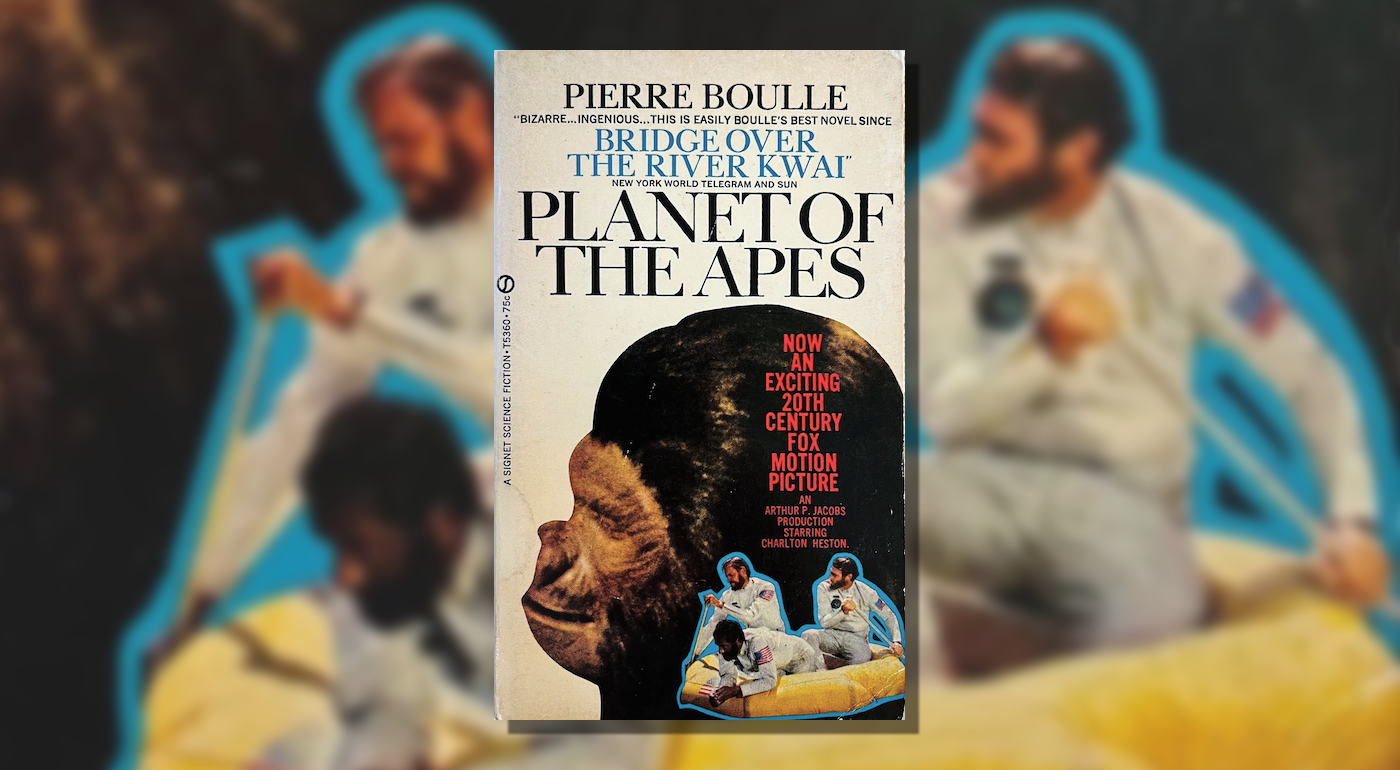
While the 1968 film etched itself into the collective consciousness, its narrative foundation lies in Pierre Boulle’s 1963 novel, La Planète des Singes. Brown’s copy, a Signet paperback, likely a later printing given its use of film photos on the cover, stemmed from the original 1963 Vanguard Press hardcover. The novel immediately distinguishes itself with an "old-fashioned" framing story: a sophisticated, married couple aboard a private space yacht discovers a message in a bottle, which contains the main narrative. This narrative, a first-person account penned by a journalist named Ulysse Mérou, details an extraordinary interstellar voyage.
Mérou embarks on this journey with the brilliant inventor Professor Antelle, his assistant Arthur Levain, and a pet chimpanzee named Hector. Their destination is the distant star Betelgeuse, a crucial divergence from the film, which cleverly obscures the possibility of the planet being Earth until the final reveal. The expedition, funded by unspecified means, proceeds in a spaceship of Professor Antelle’s own design. A key scientific element, time dilation, means that while the crew experiences only two years of travel, many centuries will have elapsed on Earth, a consequence they seem surprisingly unconcerned about.
Upon arrival, they discover Soror, a habitable planet orbiting Betelgeuse. Boulle, for the sake of his narrative, imbues Soror with an almost improbable resemblance to Earth – a similar atmosphere, geology, flora, and fauna. The crew, opting for a shuttlecraft landing rather than the film’s dramatic crash, establishes a foothold. Professor Antelle, a quintessential "all-purpose genius" common in early science fiction, not only designed their vessel but also possesses an uncanny ability to evaluate the new environment. After their arduous journey, the men find a beautiful swimming hole and, unable to resist, dive in. It is here they first encounter Nova, a stunning young woman. Their initial attempts at communication are shattered when Nova, in a chilling display of primitive instinct, immediately attacks and murders Hector, their pet chimpanzee. Soon after, her tribe arrives, destroying the men’s clothing and their landing craft, signaling their complete vulnerability.
At this juncture, Alan Brown notes that the film’s plot, remarkably, adheres "pretty faithfully for the most part" to Boulle’s novel. Levain is killed, while Mérou, Professor Antelle, and Nova are captured. They are caged and subjected to experimental study by Doctor Zira, a chimpanzee scientist. Boulle’s ape society, however, is far more sophisticated than the film’s depiction, which was constrained by 1960s special effects budgets. In the book, the apes are as technologically advanced as present-day humans on Earth. Their society is clearly stratified into three distinct races: the powerful Gorillas, who serve as leaders and hunters; the bureaucratic and priestly Orangutans; and the intellectual Chimpanzees, who are the scientists and thinkers.
Mérou’s journey through captivity is fraught with moral dilemmas. He harbors misgivings about mating with the unintelligent Nova but eventually submits to the apes’ directive to perpetuate the human species. Through sheer determination, he gradually learns the ape language, a process that takes considerable time. He eventually convinces the apes of his intelligence, earning his freedom to live within their society. During this period, he discovers Professor Antelle, who, under the profound stress of his experiences, has regressed to a pre-verbal state, contentedly mated with another captive human.
Mérou’s intellectual awakening brings him into closer contact with Cornelius, Zira’s fiancé and a fellow scientist. Cornelius is fascinated by Mérou’s intelligence and takes him to an archaeological dig, a scene faithfully recreated in the movie, where they unearth a talking human doll. This startling discovery hints at a preceding age of human dominance, a concept deeply unsettling to the ape scholars. Further complicating matters, Nova becomes pregnant, sparking even greater consternation among the apes, who fear the re-emergence of intelligent humans.
Boulle dedicates a "horrific chapter" to Mérou’s visit with a chimpanzee scientist conducting brain surgery experiments on captive humans. This ape details how removing different parts of the human brain affects their cognitive functions, and how electrical stimulation has coerced some into mimicking speech, though without true intelligent thought. One subject, however, demonstrates an implausible (by modern scientific standards, yet a recurring trope in science fiction) ability to tap into "racial memories." From these memories, Mérou learns the devastating history: humans gradually ceded more responsibilities to domesticated apes, growing increasingly complacent, unambitious, and disengaged. This decline ultimately culminated in a violent ape revolt, driving humans from their cities and homes.
Nova and Mérou’s baby is born, displaying remarkable intelligence, confirming the apes’ fears. Concerned for their child’s safety, Zira and Cornelius devise a daring plan: they replace human test subjects on an experimental space flight with Mérou, Nova, and their infant. Mérou, having presumably learned to pilot during his initial voyage, successfully navigates this vessel to Professor Antelle’s orbiting ship, allowing them to escape back to Earth. The novel delivers a potent twist ending upon their return, only for the framing story to re-emerge, providing a second, equally shocking twist that underscores the cyclical nature of Boulle’s profound moral tale.
In summary, Boulle’s novel stands as a "clever morality tale," masterfully employing a speculative premise to compel readers to re-evaluate their own society, intelligence, and perceived superiority. While the film remained largely faithful to the story’s core and themes, it naturally amplified the "action and conflict," a hallmark of Hollywood adaptations. Both versions, however, offer distinct yet equally powerful narratives.
A Legacy Forged: The Planet of the Apes Franchise
The unprecedented success of the 1968 Planet of the Apes film transcended its science fiction roots, exploding into a pervasive and enduring media franchise that has captivated audiences for over half a century. The original movie spawned four direct sequels, each building upon the grim future established in the first: Beneath the Planet of the Apes (1970), Escape from the Planet of the Apes (1971), Conquest of the Planet of the Apes (1972), and Battle for the Planet of the Apes (1973). While these films expanded the mythology, their quality, as is often the case with rapid-fire sequels, demonstrably declined towards the end of the series.
The 1970s saw the franchise further proliferate with live-action and animated television series, introducing the ape-dominated world to a new generation of viewers. Comic books also became a significant medium for extending the narrative and exploring new facets of the ape civilization.
In 2001, director Tim Burton attempted a reboot of the film series, but despite a star-studded cast and impressive visuals, it struggled to capture the critical and commercial success or the cultural resonance of the original.
However, the 21st century witnessed a triumphant resurgence for the franchise with a critically acclaimed and commercially successful new series of films. Beginning with Rise of the Planet of the Apes in 2011, this reboot cleverly reimagined the origin story, setting it in the near future and focusing on the genetic engineering that inadvertently leads to the rise of intelligent apes and the decline of humanity. This compelling narrative continued with Dawn of the Planet of the Apes (2014), War for the Planet of the Apes (2017), and the recently released Kingdom of the Planet of the Apes (2024), each film deepening the complex struggle for dominance between humans and apes. This modern saga has been praised for its sophisticated storytelling, advanced motion-capture technology, and profound emotional depth.
Beyond the silver screen, the Planet of the Apes universe has continued to expand through a myriad of additional comic books, tie-in novels, immersive video games, and a vast array of toys and collectibles. The sheer breadth and longevity of the Planet of the Apes narrative have firmly embedded it within popular culture, making it exceedingly difficult today to find individuals unfamiliar with its core premise in one of its many iterations. It stands as a testament to the power of Boulle’s original concept and its remarkable adaptability across various storytelling mediums.
Enduring Resonance and Final Reflections
Alan Brown’s journey into the literary origins of Planet of the Apes reaffirms the enduring power of both the novel and its iconic film adaptation. The 1968 movie, as he passionately asserts, remains one of his all-time favorites and has deservedly achieved classic status, transcending the confines of science fiction fandom to become a permanent fixture in mainstream popular culture. Its groundbreaking special effects, compelling performances, and unforgettable ending continue to resonate with new generations.
The novel by Pierre Boulle, though possessing a more introspective and philosophical tenor than its cinematic counterpart, proved to be an equally enjoyable and profoundly satisfying experience. Its "clever morality tale" encourages deep reflection on societal structures, the nature of intelligence, and the perils of human hubris. The comparison of these two distinct forms of media—the thoughtful literary exploration and the action-packed cinematic spectacle—offers invaluable insights into the art of adaptation and the unique strengths each medium brings to a shared narrative. In this particular instance, both the book and the movie excel in their respective tellings, each providing a rich, immersive experience that is unequivocally worth seeking out.
The enduring legacy of Planet of the Apes is a testament to the timeless questions it poses about evolution, civilization, and our place in the natural order. It challenges us to look beyond the surface, to question authority, and to consider the profound implications of our actions. Its continued relevance across decades and through multiple reboots underscores its status as a cornerstone of speculative fiction.
Now, the floor is turned over to you, the readers. What are your thoughts on the seminal 1968 film Planet of the Apes, or the insightful novel that preceded it? How do you view the vast and varied media franchise in all its different forms? Which versions and extensions of this captivating story hold a special place as your personal favorites, and why?