
Unearthing the Enduring Roots: Shan Winn’s "Heaven, Heroes, and Happiness" Reveals Proto-Indo-European Legacies in Western Thought
FOR IMMEDIATE RELEASE
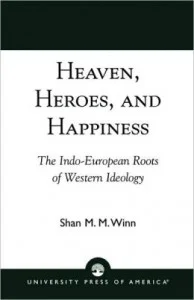
LONDON, UK – [Date of publication] – In an era often characterized by a relentless focus on modernity and divergence, a compelling new work by Shan Winn, Heaven, Heroes, and Happiness: The Indo-European Roots of Western Ideology, offers a profound counter-narrative. The book, lauded as an excellent introduction to Indo-European society and mythology, argues that despite the vast temporal and cultural chasm separating us from our pre-Christian European ancestors, a significant and often overlooked continuity underpins the very fabric of Western thought and societal structures. This ambitious exploration delves into the deep historical currents that connect the nomadic pastoralists of the Bronze Age Pontic-Caspian steppe to the complex societies of today, revealing an enduring ideological heritage that continues to shape our perceptions of the world.
The Invisible Threads: Main Facts of an Enduring Legacy
Shan Winn’s Heaven, Heroes, and Happiness challenges readers to reconsider the origins of many fundamental aspects of Western civilization. Far from being a mere academic exercise, the book asserts that core ideological frameworks, societal structures, and even mythic themes prevalent in contemporary Western societies are direct descendants of the Proto-Indo-Europeans. The author emphasizes that while modern scholarship frequently highlights the stark differences between ancient and contemporary worldviews, an equally compelling case can be made for profound, often subconscious, continuities.
The central thesis of Winn’s work revolves around the idea that the Proto-Indo-Europeans, a people or group of peoples originating in what is now parts of Ukraine, Russia, and Kazakhstan, did not merely spread their languages across Eurasia. More significantly, they disseminated a distinct ideological model that permeated the cultures they encountered and subsequently shaped. This model, characterized by specific social hierarchies and cosmic understandings, formed the bedrock upon which diverse Indo-European societies—from the Celts and Slavs to the Greeks, Romans, and Germanics—were built. The book serves as a critical reminder that understanding these ancient foundations is essential for a complete grasp of Western identity.
A Journey Through Time: Chronology of Indo-European Influence
The Dawn of a Civilization: Origins on the Pontic-Caspian Steppe
The narrative begins with the Proto-Indo-Europeans themselves, tracing their probable origins to the vast, windswept Pontic-Caspian steppe during the Bronze Age. These were not sedentary agriculturalists but nomadic or semi-nomadic pastoralists, whose very way of life fostered a particular set of values and social organization. Their innovations were transformative: they were among the first peoples to master the domestication of horses and to utilize wheeled carts, technologies that would revolutionize warfare, transportation, and migration across vast distances. This mobility was key to their eventual widespread influence.
Archaeological evidence, linguistic reconstruction, and genetic studies paint a picture of a dynamic people whose cultural package included not just technological advancements but also a distinct social organization and religious worldview. Their proto-language, reconstructed by linguists through comparative methods, serves as the ancestral tongue for nearly all modern European languages, with notable exceptions like Basque and Finnish. This linguistic commonality is often the most readily recognized legacy, yet Winn’s work underscores that it was merely one facet of a much broader cultural diffusion.
The Great Expansion: Shaping Continents and Cultures
During the Bronze Age, the Proto-Indo-Europeans embarked on a series of migrations and cultural diffusions that profoundly reshaped the ethnographic and ideological landscape of Eurasia. Their expansion was not necessarily a monolithic invasion but a complex process involving various waves of migration, assimilation, and cultural exchange. As they settled in new territories, their distinct cultural traits intertwined with existing local traditions, creating the diverse tapestry of Indo-European societies we recognize today.
From the British Isles to the Indian subcontinent, their influence became undeniable. The Celtic tribes of Western Europe, the Germanic peoples of Northern Europe, the Latin speakers who founded Rome, the Hellenic city-states of Greece, and the Slavic groups of Eastern Europe all share this common ancestral thread. In the East, the Indo-Iranians carried these traditions into Persia and India, giving rise to powerful civilizations and complex religious systems. This vast geographic spread and the enduring nature of their cultural imprint underscore the potency of the Proto-Indo-European model, setting the stage for the ideological continuities that Winn meticulously explores.
Unpacking the Foundations: Supporting Data of Western Ideology
The Tripartite Social and Cosmic Order: A Unique Blueprint
One of the most compelling pieces of evidence for Indo-European continuity, and a cornerstone of Winn’s argument, is the pervasive tripartite hierarchical structure found across virtually all Indo-European societies. This structure, extensively analyzed by the influential French scholar Georges Dumézil, divides society into three distinct functions:
- Sovereignty and Priesthood: The highest tier, responsible for spiritual guidance, justice, and overall governance. This function is often associated with divine authority and wisdom.
- Warriors: The second tier, dedicated to defense, conquest, and the maintenance of order through force. Their role is to protect the community and expand its influence.
- Commoners: The broadest tier, encompassing farmers, merchants, craftspeople, and laborers, responsible for sustenance and material prosperity.
What makes this tripartite division so significant is not just its existence, but its near-universal application across disparate Indo-European cultures, from ancient India (the caste system with Brahmins, Kshatriyas, Vaishyas) to Roman society (Flamines, Equites, Quirites) and Norse mythology (Odin/Tyr, Thor, Freyr/Njord). This specific organization, though it may seem intuitively logical to those raised in Western cultures, is far from a universal human societal model. Many other cultures developed entirely different frameworks.
Crucially, this tripartite structure was not merely a societal arrangement; it was deeply embedded in their cosmology. The divine realm mirrored the human one, with gods and goddesses often categorized and interacting according to these three functions. The frequent recurrence of the number three in Indo-European mythologies, rituals, and artistic expressions—a phenomenon as distinctive as the number seven in the ancient Middle East or four in many Native American traditions—further underscores the profound ideological grounding of this tripartite worldview. While modern Western societies have evolved beyond a strict adherence to these divisions, Winn argues that this ancient framework still serves as a "primary reference point" around which our social and political structures are, perhaps unconsciously, ordered. Concepts like the separation of powers (executive, legislative, judicial) or the historical distinction between clergy, nobility, and commoners, arguably echo these ancient patterns.
Linguistic Roots and Shared Concepts
Beyond social structure, the Indo-European language family itself provides a rich vein of supporting data. Comparative linguistics allows scholars to reconstruct Proto-Indo-European vocabulary and concepts, revealing shared ideas about kinship, religion, law, and the natural world. Words for "king," "god," "horse," "wheel," and even specific religious rituals can be traced back to this common ancestor, indicating a shared conceptual universe that traveled with the language. The very structure of these languages, with their inflections and grammatical categories, often reflects underlying cognitive patterns that contribute to a distinct way of perceiving and articulating reality.
Religious and Philosophical Lineages: The Case of Zarathustra
Another compelling example of ideological continuity highlighted in Winn’s book is the figure of Zarathustra, the Iranian prophet of the second millennium BCE. His teachings formed the basis of Zoroastrianism, a religion that would profoundly influence later monotheistic traditions, notably Judaism, Christianity, and Islam. Zarathustra, though a radical reformer who introduced a strong dualistic cosmology and an emphasis on ethical choice, was himself a priest within an Indo-European society.
Winn demonstrates that while Zarathustra’s philosophy marked a significant departure from the polytheistic practices of his ancestors, he nevertheless utilized existing Indo-European mythical themes and concepts as "raw materials." The battle between cosmic forces of good and evil, the idea of a final judgment, and the importance of truth (Asha) versus falsehood (Druj) can be seen as innovative reinterpretations of older Indo-European dualisms and moral frameworks. This illustrates how even revolutionary ideological shifts often build upon, rather than entirely discard, the deep-seated conceptual structures inherited from earlier traditions. It highlights the remarkable resilience and adaptability of these foundational ideas.
Scholarly Context and Debate: Engaging with Influential Minds
Winn’s work stands on the shoulders of giants in Indo-European studies, most notably Georges Dumézil and Marija Gimbutas. Her synthesis of their respective contributions forms a crucial part of the book’s analytical framework, yet it also opens avenues for scholarly discussion and critical evaluation.
Georges Dumézil’s Enduring Legacy
Georges Dumézil (1898-1986) is widely regarded as one of the most brilliant and influential scholars of comparative mythology and Indo-European studies. His theory of the "three functions" (tripartition) in Indo-European societies and mythologies, as discussed earlier, was groundbreaking. Dumézil meticulously demonstrated how this ideological structure permeated diverse cultures, from ancient India to Rome and the Germanic peoples, providing a powerful lens through which to understand their social organization, pantheons, and epic narratives. The soundness and empirical breadth of Dumézil’s work are largely accepted within the academic community, making his contributions a robust foundation for Winn’s exploration of continuity. His methodology, which involved rigorous comparative analysis of textual and mythological sources, has ensured the lasting relevance of his insights.
Marija Gimbutas and the "Old Europe" Hypothesis: A Point of Contention
In contrast to Dumézil’s generally accepted framework, the work of Marija Gimbutas (1921-1994) presents a more complex and often controversial aspect of Indo-European studies. Gimbutas, an archaeologist, developed the "Old Europe" hypothesis, which posited that pre-Indo-European Europe was characterized by uniformly peaceful, egalitarian, matriarchal agrarian societies that worshipped a Great Goddess. She argued these cultures were highly developed, valuing art and harmony, until the arrival of the "big, bad Indo-Europeans" who, she claimed, mercilessly conquered, subjugated, and eradicated this idyllic way of life.
While Gimbutas’s work has been influential, particularly in feminist archaeology and certain spiritual movements, it has also faced significant criticism from mainstream academia. Critics argue that her interpretation of archaeological evidence is often selective, her conclusions tend to overstate the uniformity and peacefulness of pre-Indo-European societies, and her stark dichotomy between "Old Europe" and the "patriarchal invaders" is overly simplistic. The original reviewer of Winn’s book specifically notes that Gimbutas "greatly overstates her case, creating a stark dichotomy and casting the peoples of ‘Old Europe’ in a light that played directly into the unrealized hopes and dreams of mid-to-late-twentieth-century liberalism/progressivism, giving people of such a persuasion a supposedly historical utopian model to look back (and therefore, of course, forward) to." This suggests that Gimbutas’s interpretations, while providing a counter-narrative to traditional patriarchal histories, might have been influenced by contemporary ideological currents rather than being purely data-driven.
Winn’s Engagement: A Critical Appraisal
Winn’s reliance on Gimbutas, particularly her "uncritical" acceptance, is highlighted as a potential weakness by the original reviewer. The critique points out an "annoying habit of assuming that Indo-European goddesses could only be holdovers from Gimbutas’s Old Europe, as if the Indo-Europeans were so completely, cartoonishly patriarchal that they couldn’t have had any original goddesses of their own." This observation suggests a potential blind spot in Winn’s analysis, where the influence of Gimbutas’s model might lead to an underestimation of the Indo-Europeans’ own complex and internally developed spiritual traditions, including their female deities. While the Indo-Europeans certainly introduced significant social changes, including potentially more hierarchical and patriarchal structures in certain contexts, to deny them the capacity for creating their own goddesses is to oversimplify a nuanced cultural evolution.
Nevertheless, the reviewer acknowledges Winn’s passing reference to the "obvious, almost Zoroastrian dualism inherent in Gimbutas’s vision." This is a significant point, as it implicitly recognizes the black-and-white portrayal in Gimbutas’s work, mirroring the distinct opposition of good and evil, light and dark, found in Zoroastrian thought. This observation, though brief, demonstrates an awareness within Winn’s own text of the strong, almost mythic, narrative structure underpinning Gimbutas’s hypothesis.
The Enduring Echoes: Implications for Modern Understanding
The Invisible Threads of Western Thought
The implications of Winn’s meticulous study extend far beyond the realm of academic history. By illuminating the deep roots of Western ideology, Heaven, Heroes, and Happiness offers a powerful lens through which to understand our present. The concept of the tripartite structure, for instance, even in its attenuated modern forms, can be seen to subtly influence our institutional design, our professional classifications, and even our subconscious expectations about societal roles. From the historical estates of the realm to the modern divisions of labor and power, the echoes of this ancient framework persist, often unnoticed.
This realization challenges the notion of Western thought as a purely linear progression, instead revealing it as a complex tapestry woven from ancient threads. It suggests that many of our deeply held assumptions about justice, heroism, governance, and even happiness might carry the imprint of these distant ancestors. Understanding this continuity can provide a richer, more nuanced perspective on the historical development of Western civilization, moving beyond simplistic narratives of progress or rupture.
Beyond the Surface: Understanding Contemporary Ideologies
In a world grappling with complex social and political dynamics, Winn’s work encourages a deeper introspection into the origins of our collective consciousness. Why do certain narratives of heroism resonate so powerfully? Why do we often default to specific hierarchical understandings? The answers, Winn suggests, are not solely products of recent history but are deeply embedded in an ideological bedrock laid down millennia ago.
By revealing these enduring patterns, the book offers insights into the persistence of certain cultural tropes, the resonance of specific mythological archetypes, and the underlying conceptual frameworks that continue to shape political discourse and social values. It allows us to recognize that while surface manifestations change, some fundamental structures of thought and valuation possess remarkable longevity.
The Enduring Value of Indo-European Studies
Ultimately, Heaven, Heroes, and Happiness reaffirms the profound importance of Indo-European studies. It is not merely an academic niche but a vital field that uncovers the foundational layers of a vast segment of human history and culture. Such interdisciplinary research, combining linguistics, archaeology, mythology, and social history, provides an indispensable framework for understanding the profound interconnectedness of ancient and modern worlds.
Shan Winn’s work is a valuable contribution, offering both an accessible introduction for newcomers and stimulating insights for those already familiar with the field. Despite some points of critical debate regarding its engagement with specific scholars, the book successfully demonstrates the fascinating ways in which aspects of ancient Indo-European worldviews and ways of life have survived and continue to resonate in the present day. It is a highly recommended read for anyone seeking to understand the deep, often hidden, continuities that bind our contemporary world to its ancient past.
Click here to view or buy Heaven, Heroes, and Happiness at Amazon.com.

Leave a Comment