Unifying Humanity Through Myth: A Grand Compendium of Global Folklore Unveiled
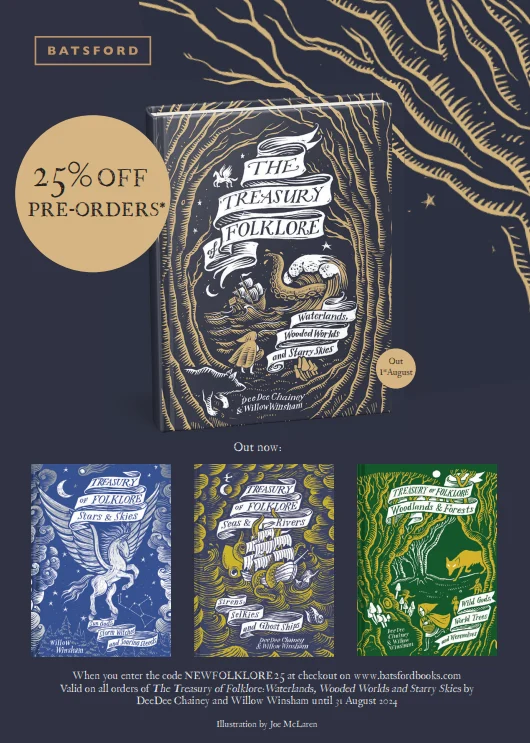
LONDON, UK – July 23, 2024 – Nearly a decade after embarking on a journey to chronicle the world’s diverse myths and legends, authors Dee Dee Chainey and Willow Winsham are set to release a landmark compendium, "The Treasury of Folklore: Waterlands, Wooded Worlds and Starry Skies." This eagerly anticipated volume, available for pre-order now and launching on August 1st, 2024, consolidates the most beloved tales from their acclaimed three-book series, presenting a unified vision of humanity’s shared fears, dreams, and customs across landscapes and cultures.
The new compilation, published by Batsford Books, revisits the original ambition of the authors: to encapsulate the vast tapestry of global folklore within a single, substantial tome. It promises to be a "hefty tome" of beautifully bound cream paper, featuring the distinctive original illustrations of Joe McLaren, making it an exquisite addition to any collection. While containing no new material, it meticulously curates and presents the rich narratives previously explored in "Seas and Rivers," "Trees and Woodlands," and "Stars and Skies," inviting readers to rediscover the profound connections that bind human experience through myth.
The Genesis of a Grand Vision: From Single Volume to Celebrated Series
The journey of "The Treasury of Folklore" began with an ambitious, singular concept: to create one comprehensive book exploring how humans across the globe interact with, interpret, and mythologize the physical landscapes they inhabit. However, the sheer volume and richness of the material uncovered by Chainey and Winsham quickly demonstrated that such an endeavor could not be confined to a single publication. This expansive discovery led to the development of the acclaimed three-book series, each volume dedicated to a distinct natural realm.
The authors’ initial inspiration, nearly a decade ago, was significantly bolstered by the vibrant, global community fostered through the #FolkloreThursday hashtag. This online phenomenon showcased an overwhelming outpouring of shared narratives, igniting a desire to create something "meaningful, lasting, that reflected the unifying universality of folklore across the globe." The subsequent popularity of the individual volumes – Seas and Rivers, Trees and Woodlands, and Stars and Skies – underscored the widespread resonance of their work, garnering both surprise and profound gratitude from the creators.
A Decade’s Journey: From Concept to Compendium
The initial vision for a singular, all-encompassing volume of folklore, conceived almost ten years ago, laid the foundational stone for what would become a celebrated literary series. The extensive research and rich material soon necessitated a division into three distinct yet interconnected books: "Seas and Rivers," exploring the myths of aquatic realms; "Trees and Woodlands," delving into the enigmatic tales of forests; and "Stars and Skies," gazing upwards at celestial folklore. Each book, a testament to humanity’s intricate relationship with its environment, found its own dedicated audience, solidifying the series’ reputation.
The enduring success and heartwarming reception of these individual titles prompted a new opportunity. The suggestion to create a compendium reignited the authors’ original desire to unite this vast body of work. This decision was not taken lightly; it involved a rigorous behind-the-scenes process. Chainey and Winsham meticulously re-read their own words, approaching the familiar narratives with "fresh eyes." The challenge lay in carefully curating what to include and what to judiciously omit, ensuring that the new single volume would seamlessly integrate the diverse landscapes and timeless stories, spanning "shared landscapes across time and place."
The meticulous editorial effort culminated in a product that has "blown away" the authors themselves. Their excitement is palpable regarding the physical attributes of the forthcoming compendium: its substantial size, the evocative cover art that masterfully combines elements from the original three books, and the tactile pleasure of the "beautiful cream paper." This "hefty tome" represents not just a compilation, but a return to the original, grand design, embodying a decade of dedicated research and a deep appreciation for the universal threads of human storytelling.
Unearthing Universal Truths: Supporting Data from the Treasury
The core philosophy driving "The Treasury of Folklore" series, and now its magnificent compendium, is the belief in the fundamental sameness of humanity. Despite varying geographies, customs, and names for mythical entities, Chainey and Winsham discovered that humans across the globe share "primal fears and dreams." This universal resonance is beautifully illustrated through the diverse tales collected, demonstrating how collective imagination grapples with the unknown, reveres natural power, and longs for connection. The extracts below offer a glimpse into these shared narratives, acting as poignant supporting data for the authors’ overarching thesis.

Water Horses: Majestic and Malevolent Creatures from the Depths
From the mist-shrouded lochs of Scotland to the foggy rivers of Scandinavia, the figure of the water horse stands as a potent symbol of nature’s deceptive beauty and inherent danger. These mythical steeds, though varying in specific characteristics, universally embody the primal human fear of the unknown depths and the unpredictable power of water.
The Scottish kelpie, often conflated with the broader term "water horse," is a particularly prominent figure. While the each-uisge (water horse) typically haunts lakes and lochs, the kelpie is found in rivers. Both lure unwary travelers, particularly men, onto their backs before dragging them to a watery demise. The tales often present cunning methods to "tame" a kelpie, such as using a bridle marked with a cross, but this control is invariably "illusory and fleeting," highlighting the untamable nature of the wild. The chilling narrative of dispatching a kelpie with "red-hot iron" underscores the raw, elemental struggle between man and myth. The enduring power of the kelpie is visually manifest in the colossal 30-meter sculptures near Falkirk, a modern testament to its hold on the Scottish imagination, further cemented by its appearance in contemporary literature like J.K. Rowling’s Fantastic Beasts and Where to Find Them. Interestingly, English folklore, despite its rich tapestry, conspicuously lacks a similar water horse tradition, suggesting distinct regional mythological developments.
Across the border in Wales, the Ceffyl Dwr filled this folkloric void, remaining a staple belief well into the 19th century. Its form and intent varied regionally; in the north, it was a shapeshifting, violent spirit, while in the south, it consistently appeared as an enchanting, small horse. Its remarkable speed allowed it to traverse "huge distances in an impossibly short space of time" before vanishing, leaving its hapless rider to drown. A curious exception, however, was granted to clergymen of "any creed," who could ride the Ceffyl Dwr unscathed, a rare example of a supernatural entity showing denominational impartiality.
The bäckahäst, or "brook horse," of Scandinavia shares many commonalities with its Celtic cousins. Often sighted in foggy conditions, it is described as a "majestic and luminous being" that beguiles riders before plunging them into the water. A recurring motif in bäckahäst tales involves children as victims, perhaps to heighten the sense of vulnerability and impending tragedy. One popular story recounts a group of boys on a frozen river, saved only when the last child, in awe, mispronounces a rhyming phrase to sound like "Jesus Christ," causing the bäckahäst, which despises the sacred name, to disappear. These tales, despite their ominous warnings, often conclude with the riders surviving, implying a chance for cunning or divine intervention. Like the kelpie, the bäckahäst could also be put to work, often through trickery, further illustrating the complex, sometimes exploitable, relationship between humans and these powerful water spirits.
Lords of the Wild: Guardians of Nature’s Heart
Venturing into the "verdant greenery of the forest," we encounter the powerful "Lords of the Wild"—spirits and creatures that embody the untamed essence of woodlands and jungles worldwide. These figures range from malevolent forces of destruction to protective guardians, reflecting humanity’s dual perception of nature as both a bountiful provider and a perilous domain.
In Finnish mythology, Tapio, also known as Metsähine or Hiisi, reigns as the king of the forest realm. He is depicted as a tall, thin figure, clad in ermine fur or moss, with a moss- and lichen-covered beard and bushy eyebrows, often likened to the European Green Man. His back is said to resemble a gnarled tree, highlighting his profound connection to the forest itself. Tapio is both the personification and protector of the woods, holding sway over all its creatures. Historically, hunters would seek his blessing before a chase, pledging respect for the wilderness, believing he could ensure a plentiful haul or condemn them to an empty-handed return. Tapio’s family—his benevolent wife Mielikki (or Kuurikki when displeased), and his children Nyrikki (who guides hunters) and Tulikki (who directs prey)—further illustrate the intricate pantheon associated with the forest’s life cycle.
The Leshy (or leshii, lyeshy) of Slavic folklore is another formidable tutelary spirit, a protector of trees and animals, particularly wolves or bears in different traditions. Known by numerous names, all pointing to their dominion over the forest, leshies are often likened to Greek satyrs, sporting horns, claws, and a beard that can be forest green or moss-covered. These shapeshifting entities can alter their size and form at will, appearing as tall as a tree or as small as a blade of grass, or even mimicking familiar humans, animals, or plants. When in human guise, they possess distinguishing features: lack of eyelashes or brows, shoes worn on the wrong feet, or clothing wrapped unconventionally. Some are depicted with a single eye, cloven feet, wings, or tails, emphasizing their liminal, otherworldly nature.
Leshies are trickster figures, capable of mimicking voices, shrieking laughter, clapping, or howling to warn intruders. Those who ignore these warnings risk being "lost to the wilds by morning," confused and disoriented by the leshy’s manipulation of their surroundings. Their playful malevolence extends to tickling victims to death, inflicting illness, and abducting women and children. Farmers, particularly in the Olonetsky District of Russia, even sacrificed cows annually to appease them and protect their herds. However, safety from a leshy’s wrath could be found through prayer or offerings of bread and tobacco. Leshies live alone or with their wives (lesovikha) and children, sometimes in forest huts. They are not above internal conflict, waging war with clubs made from ripped-up trees, and are notorious gamblers, often using squirrels as currency or playing cards (excluding clubs, due to their resemblance to the Christian cross). Strategies to evade leshies often involve counter-intuitive actions, such as turning clothes inside out or swearing at them, which is said to provoke laughter and a return to the right path, highlighting the often absurd logic of folkloric protection.

The Enduring Myth of the Moon Hare
Gazing skyward, humanity has long projected its narratives onto the celestial canvas, none more enduring than the motif of a rabbit or hare residing on the moon. This widespread belief, found in diverse cultures across the globe, offers a powerful testament to the shared human capacity for symbolic interpretation and self-sacrifice. The Sea of Tranquillity is often seen as the rabbit’s head, with the seas of Fertility and Nectar forming its ears, illustrating how cultural narratives shape our perception of natural phenomena.
In the Buddhist Sasa-jātaka, the hare, alongside his friends (an otter, jackal, and monkey), pledges to give alms on a fast day. When the deity Sakka, disguised as an old beggar, tests their generosity, the hare, having only grass, offers his own body as sustenance by throwing himself into a fire. Sakka, moved by this ultimate act of faithfulness, saves the hare and enshrines his image upon the moon for all eternity, sometimes by extracting the essence of a mountain to draw the image. This narrative of selfless sacrifice is echoed in a similar tale from Sri Lanka, where the hare offers himself to a lost and hungry Buddha, who, in turn, places him on the moon. Japan’s Tsuki no Usagi (Moon Rabbit) shares a nearly identical story: a rabbit sacrifices itself on a fire for a disguised beggar (the Man in the Moon), who then elevates the selfless creature to live with him. This popular Japanese tale is traditionally shared with children during the Harvest Moon and Mid-Autumn Festival, reinforcing themes of altruism and cosmic reward.
In a starkly contrasting vein, a tale from South Africa attributes a more tragic role to the hare. Here, the flighty creature is responsible for humanity’s mortality. Sent by the Moon to deliver a message that humans, like the moon, would "die" (fade) only to return, the hare instead incorrectly conveys that humans would simply die. Enraged by this catastrophic error, the Moon attacks the hare with a hatchet, only managing to split its lip. In retaliation, the hare lashes out, scarring the Moon’s face – markings that, according to the legend, are still visible as the dark shapes on the moon today. This narrative, while unique in its negative portrayal, still highlights the hare’s significant, albeit mischievous, role in shaping human destiny and cosmology.
These diverse tales, whether warning of danger, celebrating natural power, or explaining cosmic phenomena, collectively underscore the authors’ assertion: that despite superficial differences, humanity’s deepest fears, aspirations, and moral lessons find universal expression in the timeless language of folklore.
Official Responses: Authors’ Reflections on a Decade of Storytelling
Dee Dee Chainey and Willow Winsham, the creative minds behind "The Treasury of Folklore," express profound satisfaction and a touch of awe at the culmination of their decade-long project. Reflecting on the journey, they state, "When we began writing together nearly a decade ago, we could never have dreamed where it would take us." The initial inspiration drawn from the "overwhelming outpouring of folklore through the #FolkloreThursday hashtag" solidified their resolve to "create something meaningful, lasting, that reflected the unifying universality of folklore across the globe."
The popularity of the original three books has been a source of immense encouragement. "The popularity of the three books in the Treasury of Folklore series… has been both surprising and heartwarming," they share, extending heartfelt thanks to "each and every person who has bought and read these books."
The decision to create the compendium marked a significant moment, allowing them to finally realize their initial vision of a single, encompassing volume. The collaborative process of re-evaluating their existing work for the compendium was a challenging yet rewarding one. "Much work went on behind the scenes, reading through the words we already knew so well, with fresh eyes, as we worked out what to include and what to leave out, in the best way to bring it all together in one volume that spans our shared landscapes across time and place," the authors explain. The final product has exceeded their expectations. "To say we have been blown away by the end result is an understatement, and we are utterly thrilled to be able to share this beautifully bound volume with you." They particularly praise the aesthetic and tactile qualities of the book: "We love the size and the cover combining everything and the beautiful cream paper: it is a ‘hefty tome’ indeed."
The authors also wish to manage expectations regarding the content, clarifying, "We must stress the fact that you will not find new material within this book, containing as it does text taken directly from the existing three books of the series." However, they emphasize its value as a curated collection, believing it "will however, make a beautiful addition to any book case or coffee table, a conversation starter, a way to connect." Their "official response" is one of pride, gratitude, and a renewed conviction in the power of folklore to unite and enlighten.

Implications: Connecting Humanity Through Timeless Tales
The release of "The Treasury of Folklore: Waterlands, Wooded Worlds and Starry Skies" carries significant implications for both enthusiasts of myth and the broader cultural landscape. In an increasingly fragmented world, this compendium serves as a powerful reminder of our shared humanity, demonstrating how "in so many ways, we are all inherently the same." The collection underscores that "we, as humans, all share primal fears and dreams, no matter where we live, how we dress, or what we choose to name the monsters of our myths and legends." This message of unity, embedded in the very fabric of storytelling, fosters empathy and cross-cultural understanding.
Beyond its academic and cultural value, the book is designed to be a tangible point of connection. As the authors suggest, it is envisioned as a "conversation starter," an object to be shared and discussed, bridging gaps between generations and cultures. By presenting these tales in a single, accessible volume, it encourages a deeper appreciation for the enduring power of narrative to explain the inexplicable, to navigate moral complexities, and to inspire wonder. From the dread of the unknown around a campfire to the awe inspired by "the eternity of time under the glimmer of ancient stars," these stories articulate universal human experiences.
The book’s structure, divided into three sections mirroring the original volumes and enhanced by Joe McLaren’s "wonderful original illustrations," offers both a familiar journey for existing fans and an immersive introduction for new readers. Its very existence, born from an initial vision that was too grand for a single book, now fulfills that vision, offering a holistic perspective on humanity’s mythological heritage.
"The Treasury of Folklore: Waterlands, Wooded Worlds and Starry Skies" is now available for pre-order, with a release date of August 1st, 2024. Readers are encouraged to secure their copy to embark on this profound exploration of our collective imagination.
To pre-order your copy and delve into the rich tapestry of global folklore, visit:
Amazon.co.uk Link
For a special 25% discount, order directly from Batsford Books using the code NEWFOLKLORE25:
Batsford Books Link