
Unpacking Alain de Benoist’s "On Being a Pagan": A Critical Examination of Modern Pagan Thought
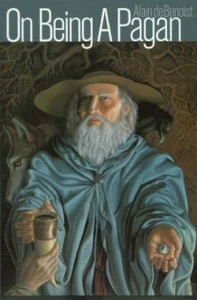
Paris, France – In the landscape of contemporary religious and philosophical discourse, few works ignite as much debate and introspection as those that challenge prevailing worldviews. Among them, Alain de Benoist’s seminal text, On Being a Pagan, stands out as a powerful, albeit contentious, critique of the Judeo-Christian paradigm and an ambitious articulation of a "new paganism." This work, authored by the multidisciplinary French thinker, delves deep into the theological foundations of Western civilization, proposing an alternative rooted in historical European paganism, yet filtered through a distinctly modern lens. While praised for its incisive criticisms of monotheism, the book has simultaneously drawn significant scrutiny for its underlying humanistic framework, prompting a vital discussion on the essence of modern paganism itself.
Main Facts: A Bold Reimagining of Paganism
Alain de Benoist, a prominent figure in the European New Right, presents On Being a Pagan as more than just an academic exercise; it is a philosophical manifesto aimed at deconstructing the dominant Judeo-Christian worldview. His central thesis revolves around the inherent dualism he perceives at the heart of monotheistic thought – a division that he argues extends beyond religious dogma into secularized modern ideologies. This dualism, he contends, manifests in stark binaries such as God versus the world, good versus evil, and the sacred versus the profane.
In contrast, Benoist posits a "new paganism" characterized by its rejection of this fundamental dualism. He champions a worldview where the divine is immanent and consubstantial with the world, where values are pluralistic and often antagonistic yet resolve into a harmonious whole, and where tolerance and a nuanced understanding of conflict prevail. His vision draws inspiration from ancient European spiritual traditions, emphasizing a "mythological" rather than "chronological" connection to the past, seeking enduring truths that transcend temporal boundaries.
However, the very elements that lend On Being a Pagan its intellectual force also form the basis of its most profound criticisms. Reviewers and scholars have highlighted a pervasive humanistic undercurrent in Benoist’s philosophy, arguing that his "new paganism" ultimately places humanity, rather than the divine or the natural world, at the center of existence. Statements such as "man is the law of the world and the measure of all things" and the assertion that "gods are made in the image of men" reveal a conceptual framework that, for many, ironically reinstates a form of dualism – albeit one where humanity assumes the role of the "uncreated being" and divinity becomes a product of human creation. This human-centric approach, critics argue, diminishes the very numinous and non-human elements essential to historical paganism, reducing it to a superficial intellectual construct.
Chronology: The Intellectual Trajectory and Context
The Intellectual Journey of Alain de Benoist
Alain de Benoist’s intellectual output spans decades, establishing him as a prolific and influential, albeit controversial, thinker. Born in 1943, de Benoist emerged as a key ideologue of the Nouvelle Droite (New Right) movement in France, known for its focus on cultural identity, critiques of liberalism and egalitarianism, and a deep engagement with philosophical traditions. His work is characterized by its multidisciplinary nature, drawing from philosophy, history, sociology, and comparative religion. Influenced by figures such as Friedrich Nietzsche, Carl Schmitt, and the German Conservative Revolution, de Benoist developed a sophisticated critique of modernity, which he often attributes to the legacy of Judeo-Christianity. On Being a Pagan, first published in French as Vu de droite: Anthologie critique des idées contemporaines (1977) and then as Comment être païen (1981), represents a pivotal moment in his thought, directly addressing the spiritual and metaphysical dimensions of his broader cultural and political philosophy. His intellectual journey demonstrates a consistent effort to find alternative foundations for European identity and values, beyond what he perceives as the eroding influence of Abrahamic religions and their secular offshoots.
Historical Context of "Pagan Revival"
The latter half of the 20th century witnessed a significant resurgence of interest in paganism across Western societies, evolving into diverse movements like Wicca, Heathenry, Druidry, and various forms of polytheistic reconstructionism. This "pagan revival" was fueled by a desire for spiritual paths rooted in nature, ancient European heritage, and a rejection of perceived monotheistic rigidity and patriarchy. Scholars and practitioners alike sought to reconnect with pre-Christian spiritualities, often emphasizing ecological awareness, immanent divinity, and pluralism.
De Benoist’s On Being a Pagan entered this evolving landscape, offering a distinctly philosophical and intellectual interpretation of paganism that diverged from many of the more ritualistic or nature-centric contemporary movements. While some modern pagans might find resonance in his critique of dualism and his call for a reconnection with European roots, his abstract, human-centric approach to divinity often clashes with the experiential and devotional aspects central to many pagan practices. His work, therefore, occupies a unique position, acting as an intellectual touchstone for certain currents within the broader pagan sphere while also sparking debates about the very definition and practice of modern paganism.
Publication and Reception
Upon its initial publication, On Being a Pagan (or its earlier iterations) quickly garnered attention, particularly within intellectual circles engaged with the European New Right’s ideas. Its English translation made it accessible to a wider audience, prompting discussions in academic philosophy, religious studies, and among practitioners of modern paganism. While not a bestseller in the popular sense, it became a significant text for those seeking a rigorous philosophical defense of paganism against monotheistic dominance.
The reception has been mixed. Admirers praise Benoist’s erudition, his sharp critique of monotheistic epistemology, and his nuanced arguments for a pluralistic worldview. They appreciate his attempt to provide a robust intellectual framework for paganism, moving beyond simplistic romanticism. However, critics, including the reviewer of the article in question, have consistently pointed out what they see as fundamental flaws: a reductionist humanism, a disembodied understanding of divinity, and an ultimate failure to truly transcend the dualistic thinking he so vehemently opposes. His work remains a subject of ongoing academic and philosophical debate, often cited in discussions concerning identity, religion, and the future of Western thought.
Supporting Data: Deconstructing Benoist’s Arguments and Their Flaws
De Benoist’s Critique of Monotheistic Dualism
At the core of Benoist’s argument is the assertion that monotheism, particularly in its Judeo-Christian manifestations, is fundamentally predicated on a dualistic worldview. This dualism, he argues, creates an unbridgeable chasm between "uncreated being" (God) and "created being" (the world), leading to a host of conceptual problems and societal implications. This division extends to ethical realms, establishing absolute categories of good versus evil, and permeates the sacred-profane distinction, where the sacred is entirely set apart from the mundane.
Benoist contends that this dualistic framework inevitably leads to an exclusionary and often intolerant attitude. If one’s worldview is based on absolute good and evil, then those who hold differing beliefs are not merely mistaken, but embody the principle of evil itself. This, he suggests, provides the ideological justification for crusades, conversions, and the extermination of adversaries.
The Allure of a "New Paganism"
In stark contrast, Benoist paints a compelling picture of a "new paganism" rooted in a fundamentally non-dualistic understanding of reality. He draws inspiration from "the ancient Germanic conception of time," which, unlike the linear, teleological time of monotheism, is cyclical and mythological. For Benoist, a pagan revival is not about a chronological return to a past era but a "mythological" reconnection to enduring truths that "surpass time and still speaks to us today." It is about tapping into something "that cannot be surpassed" rather than something that has been "surpassed."
Central to this pagan vision is the concept of divine immanence, where "the divine is immanent in and consubstantial with the world." The sacred, in this view, is not opposed to the profane but encompasses it, giving it meaning. This holistic perspective naturally fosters an "antagonistic pluralism of values," where different ideals can coexist and even clash without devolving into radical, irreconcilable opposites. Instead, these antagonisms "naturally resolves itself in a harmonious whole." This nuanced pluralism, Benoist argues, lends itself to tolerance and a refreshing freedom from moralism and crusading zeal, embodying Nietzsche’s famous declaration of being "beyond good and evil."
Benoist further illustrates this by contrasting the monotheistic and pagan approaches to conflict. In a dualistic framework, an enemy is demonized as the embodiment of evil, making their extermination or conversion the only acceptable outcome. Paganism, with its plurality of norms, allows for an enemy to be viewed as a specific individual or group with conflicting interests. The conflict is circumstantial, and once resolved, the adversary can return to their life, even being "honored as a worthy adversary," a recurring motif in ancient European heroic literature.
He also critically examines the biblical view that power is inherently evil, where the "just are weak" and the "powerful are evil by virtue of their power." Benoist rejects this inversion of values, arguing that "freedom, the ability to direct the course of one’s own life, and justice, the fulfillment of mutually agreed-upon rights and duties, cannot be assumed; they must be won, and this requires power." This assertion underlines his embrace of a more robust, vitalistic worldview.
The Reviewer’s Fundamental Objections: Humanism as a Trojan Horse
Despite the praiseworthy insights into monotheistic shortcomings, the review article contends that Benoist’s overarching conceptual framework ultimately undermines his stated goals. The core criticism lies in what is identified as a pervasive humanism that subtly reintroduces the very dualism Benoist strives to overcome.
The reviewer highlights several key quotes from Benoist:
- "Man is the law of the world and the measure of all things; he simultaneously expresses the totality of the world and the very face of God."
- "Man does not ‘discover’ what was there before him. He founds and creates the world by the meaning he gives to things."
- "Alone of all the animals, man’s actions are not predicated by his membership in a species."
- "Gods are made in the image of men, for whom they offer a sublimated re-presentation."
- "There is no need to ‘believe’ in Jupiter or Wotan… gods and beliefs may pass away, but the values remain."
These statements, according to the critique, reveal a "simplistic and crude subjectivism." While acknowledging a "pinch of truth" in Nietzschean perspectivism – that humans have some "creative agency in shaping our realities" – the reviewer argues that Benoist pushes this to an extreme, where human consciousness becomes the sole arbiter of meaning and reality. This is deemed ironic, as the dichotomy between subjective and objective is itself a pillar of the Judeo-Christian dualism Benoist so forcefully denounces.
Drawing on the French phenomenologist Maurice Merleau-Ponty, the reviewer emphasizes the "intertwining between perceiver and perceived," making it impossible to definitively separate human contributions from those originating from the perceived world. Humans are "co-creators," not sole creators, in the world’s ongoing self-creation.
The Problem of Disembodied Divinity
The most significant philosophical departure from historical paganism, in the reviewer’s eyes, is Benoist’s assertion that gods are "superfluous" and only the "values they represent are truly important." This perspective, the critique argues, "reduces divinity to the level of the profane – that which can be questioned and debated." If the sacred is "immanent in and consubstantial with the world," as Benoist himself eloquently states, then to claim it is merely "immanent in and consubstantial with" human caprices is a profound contradiction. This effectively reinstates a "stale, monotheistic dualism," merely substituting humanity for God as the "uncreated being," and relegating divinity to the "created being" category – a construct of human intellect.
Furthermore, Benoist is criticized for establishing a "false (and quintessentially Christian) dichotomy between ‘nature’ and ‘culture’," where nonhuman elements like animals, plants, and rivers are reduced to a "biologically deterministic ‘nature’." His pagan, Benoist writes, "does not deify [the world]… but makes it a place where the deity can emerge." Again, this is pure subjectivism, implying that the divine requires human recognition to manifest. Historical paganism, the reviewer counters, had no such rift; both "nature" and "culture" were mutable and intertwined, with the nonhuman world possessing its own "culture" and humanity its "nature."
Ultimately, the reviewer concludes that what Benoist proposes is essentially humanism, adorned with "a few trappings of paganism," designed to answer fundamental philosophical questions ("Why is there something rather than nothing?" – "Because Man created it!").
Official Responses: Navigating the Intellectual Crosscurrents
Academic and Philosophical Reception
Alain de Benoist’s work, including On Being a Pagan, is generally not mainstream within academic religious studies, partly due to his association with the Nouvelle Droite, which has been linked to far-right political thought. However, his philosophical critiques of modernity and monotheism have found resonance in certain intellectual circles, particularly those interested in post-structuralist critiques of Western epistemology and the search for alternative foundations. Within these niches, On Being a Pagan is often discussed as a significant, albeit controversial, attempt to articulate a non-Abrahamic metaphysics. Scholars often engage with his arguments regarding dualism and pluralism, even if they ultimately reject his humanistic conclusions or his political leanings. His work serves as a reference point for understanding a particular current of European intellectual thought that seeks to re-evaluate the Enlightenment and its perceived Judeo-Christian roots.
Internal Debates within Modern Paganism
Within the diverse and often fragmented landscape of modern paganism, Benoist’s On Being a Pagan has provoked considerable debate. Many pagan traditions emphasize direct experience of the divine, animistic perspectives, and a deep reverence for the natural world as inherently sacred. For these practitioners, Benoist’s intellectual, human-centric approach, which seems to reduce gods to mere values and the world to a canvas for human meaning-making, can be deeply problematic. They often argue that his philosophy misses the experiential, devotional, and intrinsically spiritual core of paganism.
However, some intellectually inclined pagans or those exploring philosophical paganism might find his work stimulating. His rigorous critique of monotheistic dualism, his emphasis on immanence, and his arguments for a pluralistic worldview resonate with aspects of contemporary pagan thought. His work forces a critical self-reflection within the pagan community: What does it mean to be pagan in the modern world? How much of ancient tradition can and should be reconstructed? What is the role of human agency versus divine presence? Benoist’s work, even when rejected, contributes to these ongoing internal dialogues, acting as a provocative intellectual counterpoint to more spiritual or devotional approaches.
The "Puerile Forms" Critique and Self-Reflection
A particularly telling aspect of the critique against Benoist comes from his own words. He rightly criticizes "paganism’s reemergence under… puerile forms." The reviewer, however, skillfully turns this critique back on Benoist himself, concluding that On Being a Pagan, despite its merits, ultimately "represents paganism in yet another ‘puerile form’." This is a significant "official response" from a critical perspective, suggesting that a purely intellectual, humanistic reinterpretation of paganism, devoid of genuine spiritual engagement with the numinous and the non-human, is as superficial as the simplistic, often romanticized, forms it seeks to transcend. It highlights the profound gap between intellectual theorizing and the lived, experienced reality of a religious or spiritual path.
Benoist’s own admission in a later essay, "Thoughts on God," further complicates his position: "I have not personally had any experience of the divine (I am the opposite of a mystic)… As I have a theological mentality, the interest I bring to belief systems is of a purely intellectual order." This candid revelation, cited by the reviewer, becomes a crucial piece of "supporting data" for the criticism. It underscores the argument that a purely intellectual approach to theology, especially one challenging deeply held spiritual beliefs, can be inherently limited. For many, understanding divinity and spiritual systems requires a level of experiential engagement that transcends mere scholarly analysis, much like a gardener needs to get their hands dirty to truly understand gardening.
Implications: The Enduring Questions of Modern Paganism
The Enduring Relevance of the Debate
The critical engagement with Alain de Benoist’s On Being a Pagan holds profound implications for several fields. For modern paganism, it underscores the ongoing, fundamental struggle to define its identity. Is paganism primarily a philosophical stance, a cultural heritage, an ethical framework, or a deeply spiritual and devotional path? Benoist’s work, by pushing a humanistic interpretation, forces a confrontation with these questions, challenging practitioners to articulate what truly constitutes their faith beyond mere aesthetic preference or intellectual dissent.
For the philosophy of religion, the book and its critiques offer a rich case study in attempting to articulate non-monotheistic metaphysical systems in a post-Enlightenment world. It highlights the challenges of deconstructing dominant worldviews without inadvertently replicating their problematic structures. As a work of cultural criticism, Benoist’s efforts, however flawed, represent a significant attempt to diagnose and offer an alternative to what he perceives as the spiritual and cultural malaise of the West.
The Challenge of Authenticity vs. Modernity
One of the central tensions illuminated by this debate is the perennial challenge of "authenticity" versus "modernity" in contemporary spiritual movements. How can modern paganism genuinely connect with ancient traditions without becoming either a rigid, anachronistic reconstruction or a superficial, anthropocentric adaptation? Benoist attempts to find a "mythological" rather than "chronological" connection, but his critics argue that his approach ultimately sacrifices the very essence of the ancient traditions by stripping them of their intrinsic spiritual content and non-human reverence. This tension remains a vital area of exploration for any modern spiritual movement seeking roots in a distant past.
Beyond Intellectualism: The Role of Experience in Theology
The most poignant implication drawn from the critique of Benoist’s work concerns the role of personal experience in theological understanding. His self-professed lack of divine experience, coupled with his purely intellectual engagement with belief systems, raises a critical question: Can one truly write a meaningful theology of a lived faith without some form of personal, even if not mystical, encounter with the sacred? The reviewer posits that "the heart of paganism is the intersection between the numinous and the flesh – all the flesh that comprises this outrageously greater-than-human world." By dismissing or devaluing both the spiritual and the animal in favor of human intellect and "frivolous whims," Benoist’s brand of paganism, despite its intellectual rigor, may consign itself to a "relatively superficial level."
A Call for Deeper Engagement
In conclusion, On Being a Pagan by Alain de Benoist is a significant intellectual endeavor that effectively highlights the philosophical shortcomings of monotheistic dualism and articulates a compelling vision of pluralism and immanence. However, the critical analysis reveals that its foundational humanism ultimately undermines its potential for a genuinely non-dualistic and spiritually rich paganism. The debate surrounding this book serves as a vital call for deeper engagement within modern pagan thought – one that demands both intellectual rigor and a profound, experiential connection to the numinous and the entire, interconnected, greater-than-human world. It reminds us that true spiritual revitalization may require more than just a change in intellectual framework; it may demand a re-enchantment of the world that transcends purely human-centric perspectives.


Leave a Comment