Unveiling the Writhing One: New Lore Sheds Light on Ptolus’s Most Enigmatic Galchutt
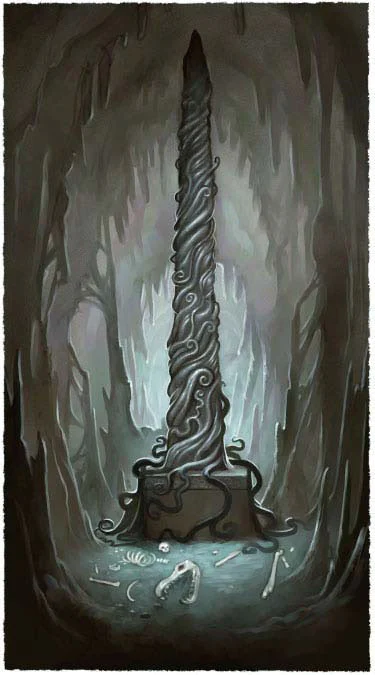
Ptolus, The City by the Spire – A recently compiled lorebook, now circulating among select arcane circles and scholarly institutions within Ptolus, has cast an unsettling light on one of the city’s most elusive and terrifying cosmic entities: Kihomenethoth, known chillingly as "The Writhing One." A member of the dreaded Galchutt, ancient beings of profound chaos and cosmic malevolence, Kihomenethoth distinguishes itself through a unique, insidious method of influence, eschewing direct confrontation for a pervasive, mind-altering "Touch" that binds victims into a collective extension of its inscrutable will. The document, purportedly derived from fragmented ancient texts and modern investigative findings, paints a chilling portrait of a dormant yet omnipresent threat, poised to unleash a cataclysmic "Summons of the Dissolution."
Main Facts: The Silent Horror Unveiled
Kihomenethoth, a name that evokes dread among those few aware of the Galchutt, is described not as a rampaging destroyer but as a profound, insidious intelligence. The core revelation of the new lorebook is its nature as the "One Who Sleeps Apart." Unlike its kin, often associated with overt acts of destruction or direct manipulation, Kihomenethoth is said to have consciously chosen separation from the "Throne of Shadow," its traditional domain. Instead, it slumbers deep within the cosmic fabric, specifically "beneath the ancient Crypt of All Crypts," a location shrouded in mystery but hinted to be a nexus of forgotten sorrow and existential chill, where it is "succored by the souls of winter." This enigmatic state has also earned it the moniker "Lost and Living Idol," a paradox that underscores its peculiar existence.
The central mechanism of Kihomenethoth’s influence is its "Touch." The lorebook explicitly states, "He goes not forth to work his feats, but lets his Chosen come to him, so that they might be blessed with his Touch." This blessing is anything but benevolent. Individuals who encounter and are subjected to the "tendrils of its thought" undergo a profound transformation. Described as the "black oil of his thought" passing from one mind to the next, this mental contagion results in a complete subsumption of the individual’s consciousness. The affected, thenceforth known as "the Touched," become "as one with the great god," effectively transforming into "extensions of his will left to writhe through the world."
Through these thralls, Kihomenethoth achieves a distributed consciousness and sensory perception. The lorebook chillingly asserts that through the Touched, "he can see with many eyes and hear with many ears," and further, "shall breathe the air they shall breathe and walk where they walk." This implies a pervasive, shared experience, stripping the Touched of their individuality and turning them into mere conduits for the Galchutt’s observation and subtle manipulation. The ultimate objective, as detailed in the newly surfaced texts, is the "Summons of the Dissolution." This prophesied event describes a future moment when, "on the night when the bonds of all bonds are broken, they shall hear the call of their Master and their footsteps shall guide them to the Path of Chaos." This ominous declaration suggests a coordinated, apocalyptic convergence of the Touched, ushering in an era of profound cosmic disorder dictated by Kihomenethoth’s unfathomable purpose.
Chronology: Whispers from Deep Time
The historical trajectory of Kihomenethoth’s influence, as pieced together by scholars, stretches back into the primordial mists preceding recorded history. The Galchutt, as a collective, are believed to predate the current cosmological order, emerging from the raw chaos of creation. Kihomenethoth’s unique path, however, diverged early. Ancient prophecies and fragmented runic tablets, often unearthed in forgotten crypts beneath the Spire, hint at a period of immense cosmic strife when Kihomenethoth made the deliberate choice to "Sleep Apart." This decision, speculated to have occurred millennia ago, perhaps during an epochal conflict among the Galchutt or a strategic withdrawal from direct cosmological engagement, established its passive, subterranean existence within the "Crypt of All Crypts." Early civilizations, long vanished, left behind cryptic warnings of the "Lost and Living Idol," often depicted in abstract, writhing forms, suggesting a latent awareness of its presence and the subtle dread it inspired. These early cults, though small and quickly suppressed, were the first to experience the "Touch," their brief, terrifying existences recorded only in the most obscure and censored histories.
During the Age of Silence, a dark period in Ptolus’s past marked by pervasive ignorance and the suppression of magical knowledge, Kihomenethoth’s influence remained largely unchecked, though unseen. Its thralls likely operated in the shadows, their actions attributed to madness, demonic possession, or unknown pestilence. The true nature of their affliction was obscured by a lack of understanding regarding the Galchutt. The rise of arcane scholarship and organized magical societies, particularly in the centuries leading up to the modern era, saw sporadic instances of research into cosmic horrors. Ancient texts and artifacts, some bearing the distinct psychic residue of the "black oil of his thought," began to surface, prompting wary scholars to catalogue these strange occurrences. However, the sheer passivity of Kihomenethoth meant it was often overlooked in favor of more overtly destructive Galchutt.
More recently, specific incidents within Ptolus have brought Kihomenethoth’s insidious presence into sharper focus. The lorebook’s "design notes" explicitly link its original compilation to investigations surrounding "The Laboratory of the Beast" and later, "The Vladaam Affair." While the specifics of these incidents remain classified by relevant authorities, it is understood that they involved unsettling manifestations of psychic contagion, widespread behavioral anomalies, and the discovery of individuals acting with a disturbing, unified purpose that defied conventional explanations. These events, occurring within the last few decades, served as a catalyst for deeper investigation into the Galchutt’s more subtle forms of influence. The combined findings from these disparate cases, along with the rediscovery and translation of previously unreadable ancient texts, culminated in the recent compilation of this lorebook, marking a significant, albeit terrifying, advancement in understanding the elusive "Writhing One." This new compilation is not merely an academic exercise; it represents a critical step in acknowledging and potentially countering a threat that has historically operated beneath the threshold of direct perception.
Supporting Data: Deconstructing the Writhing One
The Galchutt, as a classification, refers to a category of pre-cosmic entities, often described as alien intelligences from beyond the known universe, embodying pure chaos and entropy. They are not gods in the traditional sense, but forces of nature, albeit sentient and malicious, whose very existence warps reality. Kihomenethoth’s designation as "the most passive of the Galchutt" is a crucial distinction, setting it apart from its more overtly destructive brethren. This passivity is not weakness but a strategic choice, allowing it to exert influence without expending cosmic energy on direct intervention, a long-game strategy that is perhaps more terrifying in its patience.
The "Crypt of All Crypts," where Kihomenethoth is said to "sleep apart," is not understood as a literal burial site but rather a metaphysical nexus. Scholars speculate it might be a dimension adjacent to Ptolus, a psychic anchor point beneath the very foundations of reality, or even a symbolic representation of a deep, forgotten layer of existence. The phrase "succored by the souls of winter" is interpreted in various ways. Some arcane linguists believe "souls of winter" refers to the collective despair, apathy, and forgotten memories of countless sentient beings across epochs – a pervasive cosmic melancholy that serves as a psychic nutrient for the dormant entity. Others suggest it refers to the cold, entropic forces that underpin the universe, feeding Kihomenethoth’s chaotic nature. This dormancy allows it to accumulate vast, subtle power, patiently awaiting its opportune moment.
The moniker "Lost and Living Idol" further elucidates its unique status. Kihomenethoth is "lost" because its true physical form, if it ever had one comprehensible to mortals, is either absent, shattered, or exists in a dimension inaccessible to conventional means. Yet, it is "living" in the most terrifying sense, its consciousness actively perceiving and influencing through its proxies. It is an "idol" not in the sense of being worshipped by choice, but as a focal point for the Touched, a terrifyingly real presence that compels their devotion and servitude.
The "Touch" itself is a profound form of psychic assimilation. Unlike conventional mind control, which typically overrides an individual’s will, Kihomenethoth’s Touch seems to dissolve the very concept of individual identity. The "black oil of his thought" is often described metaphorically as a corrosive psychic energy that seeps into the mind, blurring the lines between self and entity. The Touched do not merely obey; they become an intrinsic part of Kihomenethoth’s distributed consciousness. They retain their physical forms and often their basic skills, but their motivations, perceptions, and ultimately their very being are subsumed. This allows Kihomenethoth to gather intelligence, subtly manipulate events, and prepare for the "Summons of the Dissolution" without ever revealing a physical form. The horror lies in the existential annihilation of the individual, replaced by a collective, writhing extension of an alien will. The phrase "he can see with many eyes and hear with many ears" is not hyperbole; it describes a network of perception that grants the Galchutt unparalleled awareness across vast distances and through countless individual experiences, all filtered through its own alien consciousness.
The "Summons of the Dissolution" is the ultimate, catastrophic endgame. "The night when the bonds of all bonds are broken" is speculated to be an astrological alignment of immense cosmic significance, a weakening of the very fabric of reality, or a moment of widespread societal and spiritual collapse. During this time, the Touched, scattered across Ptolus and potentially beyond, will be compelled by an irresistible psychic call to converge on the "Path of Chaos." This path is not necessarily a physical road but a metaphysical trajectory towards a singular purpose: to bring about a state of absolute, unmitigated chaos, presumably for Kihomenethoth to finally manifest, or perhaps, to integrate itself fully into the collapsing reality, thereby achieving a terrifying apotheosis. The lorebook implies that the destruction wrought by Kihomenethoth would not be of cities or lives, but of coherence, order, and the very concept of individual existence.
The compilation of this lorebook is itself a testament to the persistent threat. While the original "design notes" suggest it was hastily assembled in dire circumstances, likely by a scholar or group facing imminent danger during the events of "The Laboratory of the Beast" or "The Vladaam Affair," its emergence now signifies a critical threshold. It suggests that Kihomenethoth’s subtle machinations have reached a point where they can no longer be ignored, compelling even the most secretive researchers to share their findings, however incomplete. This act of documentation, though potentially incomplete, represents a desperate effort to understand and potentially combat a force that thrives on obscurity and the erosion of individual will.
Official Responses: Denial, Disbelief, and Desperate Measures
The official response to the existence and nature of Kihomenethoth is, predictably, fragmented and often contradictory, reflecting the difficulty in comprehending such an elusive threat. The most prominent religious institutions within Ptolus, particularly the Church of the Celestial Paladins and the Temple of the Unified Pantheon, largely dismiss the more arcane details of Galchutt lore as heretical speculation or exaggerated myth. Publicly, they preach against demonic influence and general evil, but rarely acknowledge specific entities like Kihomenethoth, fearing widespread panic or a crisis of faith. Privately, however, specialized inquisitorial branches within these faiths maintain extensive records on cosmic threats, including the Galchutt, and are known to dispatch clandestine agents to investigate unusual psychic phenomena or cult activity that aligns with the descriptions of the Touched. Their strategies often involve immediate extermination of any confirmed Touched individuals and the complete obliteration of associated artifacts or locations, prioritizing containment over understanding.
The numerous arcane societies and mages’ guilds, such as the Inverted Tower and the Guild of Arcane Lore, approach Kihomenethoth with a mixture of academic fascination and profound dread. While some radical mages might seek to study or even harness the "tendrils of thought" – a dangerous and often fatal endeavor – the vast majority of senior archmages advocate for extreme caution. The dangers of psychic contagion and the dissolution of individual identity are well-understood horrors within their ranks. Debates rage among scholars regarding the true nature of the "Crypt of All Crypts" and the implications of the "Summons of the Dissolution," with some advocating for proactive magical wards and preventative rituals, while others argue for strict non-interference, believing any direct engagement could hasten the prophesied cataclysm. Official guidelines from the Archmage’s Council typically warn against unauthorized research into Galchutt lore and mandate reporting any suspected instances of the "Touch."
The city government of Ptolus, particularly its intelligence branches like the Watchful Order and the Codekeepers, generally operates under a policy of public denial regarding cosmic horrors. They attribute unexplained phenomena to mundane causes, criminal activity, or localized magical incidents, fearing that widespread knowledge of Galchuth threats would destabilize the populace. However, deep within their clandestine operations, special task forces are known to monitor and investigate patterns of strange behavior, unusual cult gatherings, and disappearances that align with the lore of Kihomenethoth. These groups often work in concert with the more pragmatic elements of religious and arcane organizations, forming an uneasy alliance against threats they cannot publicly acknowledge. Their focus is primarily on preventing large-scale manifestations and maintaining public order, often at the cost of fully understanding the underlying cosmic danger. The general populace of Ptolus remains largely unaware of Kihomenethoth, seeing it as nothing more than a whispered ghost story or a lunatic’s delusion, ensuring the "Writhing One" continues to operate in the shadows, its influence growing subtly, almost imperceptibly, within the bustling city.
Implications: The Looming Shadow Over Ptolus
The emergence of this detailed lorebook on Kihomenethoth, the Writhing One, carries profound implications for the inhabitants and defenders of Ptolus. Firstly, it fundamentally shifts the understanding of cosmic threats. While other Galchutt might manifest as direct physical dangers, Kihomenethoth represents a more insidious, existential horror. Its modus operandi—the silent subsumption of individuality—means that its agents could be anyone, anywhere. This creates an environment of pervasive paranoia, eroding trust and making it incredibly difficult to identify and combat the threat. The enemy is not an external force to be fought with steel and spell, but a creeping internal corruption that dissolves the very essence of self.
For adventurers and heroes operating within Ptolus, the challenge presented by Kihomenethoth is uniquely daunting. Traditional methods of combat are largely ineffective against a foe that lacks a physical form and whose "presence" is distributed across countless unwitting thralls. Detection becomes paramount, but distinguishing between genuinely touched individuals and those merely suffering from madness or other influences is a perilous task. The very act of investigating Kihomenethoth risks exposure to the "black oil of his thought," making every inquiry a potential journey into self-annihilation. The lorebook effectively transforms Ptolus into a potential psychic battleground, where the most dangerous conflicts are fought not with swords, but within the minds of its citizens.
Furthermore, the detailed exposition of the "Summons of the Dissolution" elevates Kihomenethoth from a localized terror to a world-ending threat. The prophecy of "the night when the bonds of all bonds are broken" suggests a cosmic event, not merely a regional catastrophe. This places the ultimate stakes far beyond the city limits, implying that Kihomenethoth’s influence, though currently centered on Ptolus, is a harbinger of a wider, universal chaos. The goal is not conquest but a fundamental reshaping of reality, a dissolution into pure, writhing disorder, guided by the collective consciousness of the Touched.
The meta-context provided by the original "design notes" – that the lorebook was "hastily compiled… just a few minutes before the start of a session" and linked to specific incidents like "The Laboratory of the Beast" and "The Vladaam Affair" – suggests an urgent, almost desperate effort to document a rapidly escalating threat. In a journalistic context, this indicates that the information was likely extracted under duress or discovered amidst unfolding crises, underscoring the immediate relevance and danger posed by Kihomenethoth. This is not merely an academic treatise but a field report from the front lines of an unseen war, a warning compiled by someone who understood the imminent danger of the "Writhing One" and sought to arm others with knowledge before it was too late.
The implications for long-term survival in Ptolus are grim. If Kihomenethoth cannot be directly confronted, and its influence is primarily through subtle mental assimilation, then the city faces a slow, inexorable erosion of its collective will and identity. The true horror is not violent destruction, but the quiet disappearance of self, the transformation of a vibrant metropolis into a distributed network of consciousness for an alien entity. The lorebook serves as a stark warning, a call to vigilance against a foe that operates not in the darkness, but within the very minds of the unsuspecting, patiently awaiting the "Summons of the Dissolution" to usher in an age of ultimate chaos.