Vincent Endwell’s "Olyoke": A Deep Dive into Appalachian Cosmic Dread
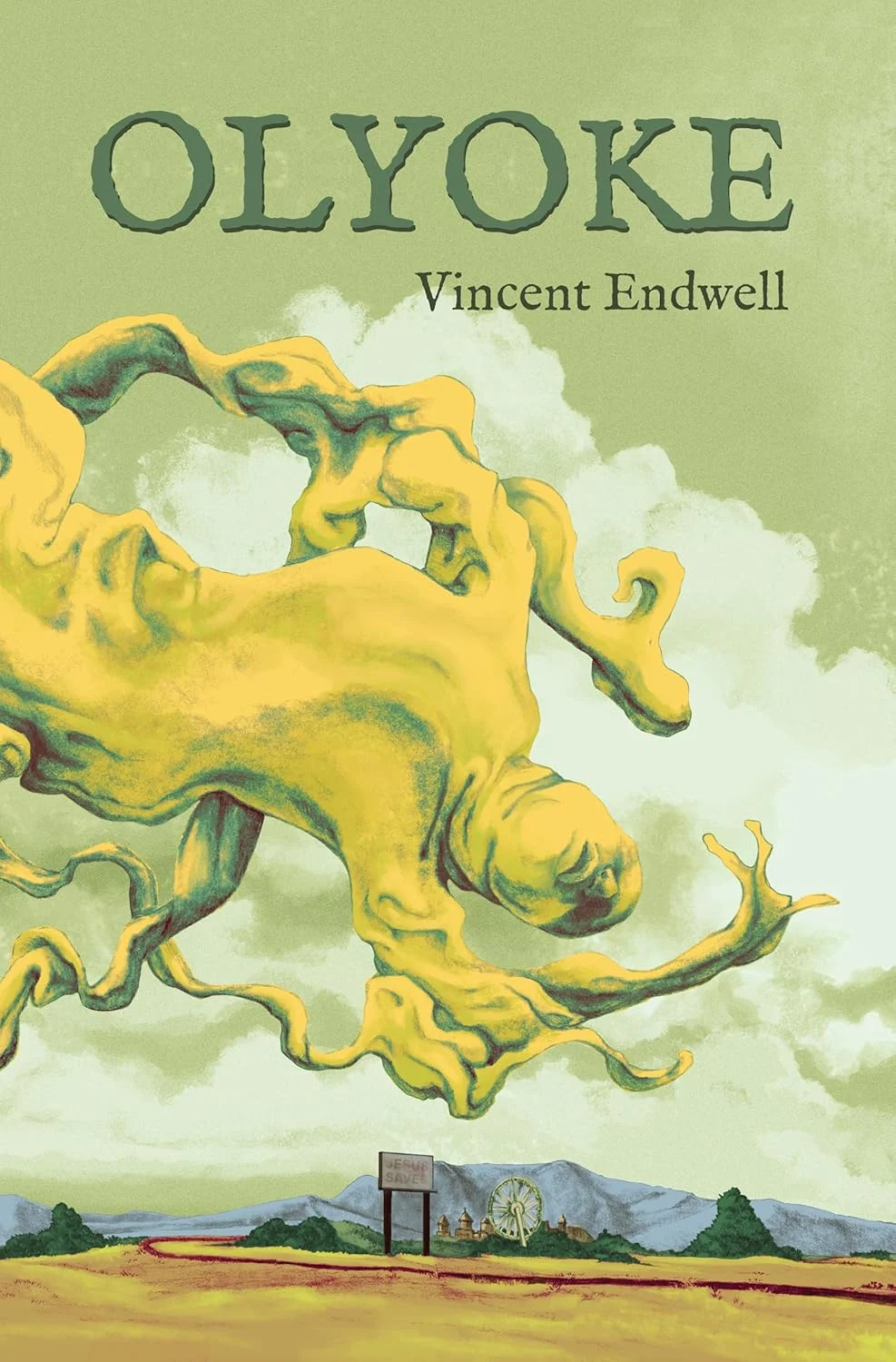
A new collection of linked stories, Olyoke by Vincent Endwell, carves out a disturbing niche in contemporary weird fiction, weaving a tapestry of existential dread steeped in Appalachian folklore and Lovecraftian tradition. Presented as a series of parables from the scriptures of a shadowy mountain cult, the book masterfully explores complex themes of identity, perception, language, bodily transformation, and the relentless erosion of free will. While its narrative structure and stylistic choices may challenge some readers, the collection ultimately delivers a profoundly unsettling experience that resonates with the anxieties of our modern era.
Endwell’s Olyoke defies easy categorization, acting less as a conventional short story collection and more as a fragmented scripture for an imagined cult nestled deep within the Smokey Mountains. Its pages are drenched in an atmosphere of creeping dread, a slow-burn descent into the uncanny that promises no neat resolutions. Instead, readers are invited into a meticulously constructed world where every seemingly disparate event or character serves to deepen an overarching mystery, culminating in a pervasive sense of existential unease that lingers long after the final page is turned. The work firmly plants itself in the lineage of weird fiction, drawing heavily from the cosmic horror of H.P. Lovecraft and the atmospheric, reality-bending narratives of Robert Chambers’ seminal The King in Yellow (1895). This literary heritage is not merely referenced but reinterpreted through a distinctly Appalachian lens, offering a fresh perspective on ancient, unknowable forces.
The Unfolding Chronicle of Olyoke: A Descent into the Uncanny
The journey into Olyoke begins not with a clear narrative, but with an unsettling fragment, a stylistic choice that immediately signals the collection’s unconventional nature and its commitment to unsettling its audience.
The Genesis of Dread: Hieronymus Johnson’s Fragments
The opening piece introduces itself as a partially salvaged fragment from the writings of a self-proclaimed prophet, Hieronymus Johnson. Rescued from a fire that claimed its author, this incomplete text immediately acquires a "supernatural glow of importance," presenting itself as a "Holy Writ for a Smokey Mountain cult." The decision to start with such an ambiguous, ancient-feeling document is a powerful statement, setting a tone of archaic mystery and foreboding.
The excerpt provided offers a glimpse into this unique linguistic landscape:
"It was the advent of First Winter when the raven-thinkers arrived unto the ville and commenced their proclamation. See, this was in the days of Karnivale and Oats, in Celsior, when the sea was still filthy red with the blood of languids and the law of the Potentate was exercised through the land, and so the raven-thinkers then were nothing more than nuisance and vermin […] There they sat, querulous, croaking their news to all the villeagers [sic]. The Pestulance was coming, and it was coming swift as Eurus from the East." (pp. 6-7)
This dense, almost impenetrable prose is a deliberate stylistic choice. While it might not offer immediate clarity to a first-time reader, its primary function is to establish a mood – one that hovers between the King James Bible and ancient epic poems. Endwell aims to evoke the feeling of reading a "Book of the Blue Ridge Apocalypse," creating a unique voice imbued with invented archaisms. This ambition, while largely successful in inspiring "a sense of awe and dread," occasionally falters, with some of the invented archaicisms verging on feeling like misspellings or misused words, potentially overstepping the delicate balance required for such a distinctive linguistic register. Nevertheless, its impact is undeniable, firmly planting the reader in a world both familiar and terrifyingly alien.
Unveiling Olyoke’s Mysteries: Early Explorations
Following this cryptic introduction, the collection delves into a series of stories that begin to flesh out the strange town of Olyoke and its peculiar inhabitants. These narratives showcase characters grappling with, or often succumbing to, the "weird, semi-divine forces" that permeate their reality.
In "The Modeling Resin," social worker Beth-Anne is drawn back to a decrepit bar-boarding house from her childhood. Her visit to check on an elderly recluse inadvertently resurrects buried memories, forcing her to confront the mysterious death of her sister and its chilling potential connection to the very apartment she now inhabits. This story introduces the idea that the past is not merely prologue but an active, malignant force shaping the present.
"The Strange Case of the Collapsible Man" injects a dose of surrealism, following a specialized estate company tasked with emptying a house filled with Egyptian artifacts. Their challenge is the home’s guardian: a wooden man whose appendages can extend or collapse infinitely, a grotesque sentinel embodying the collection’s theme of bodies in unsettling transformation.
"Pyramid" takes a more metaphysical turn. After his grandfather’s death, Frank and his partner Damion inherit a clock that serves as a portal to a mystical desert, allowing them to traverse time itself. These initial stories, while diverse in their immediate plots, are subtly linked, laying down the first threads of Olyoke’s intricate web of mysteries.
The Spreading Contagion: Interconnected Horrors
As the collection progresses, the seemingly isolated incidents begin to coalesce, revealing a deeply interconnected and increasingly horrifying reality. Endwell masterfully employs recurring motifs and subtle clues that reward the attentive "reader-detective." What initially appear as minor ailments or environmental curiosities—such as "sore, red eyes" or the presence of "red frogs"—evolve into deeply disturbing manifestations of a pervasive, insidious force.
"Itch" exemplifies this escalating dread. Its protagonist, consumed by a terror of contagion, finds herself in an uncontrollable cycle of scratching and peeling dead skin from her eyelids until they bleed. This visceral portrayal of self-mutilation, driven by an unseen, internal command, highlights the theme of agency loss.
In "Love in The Reem," Christine and Dylan embark on a date amidst a burgeoning plague, one that demands behavioral adjustments far beyond typical social distancing. As their evening unfolds, they progressively disregard hygiene and health recommendations, seemingly compelled by an unseen influence, even as they observe an increasing number of red frogs dying around them. These stories brilliantly illustrate how the individual, often unknowingly, succumbs to the "inexorable forces" at play in Olyoke, with their personal transformations mirroring the environmental decay.
Innovative Narratives: Dialogue as Revelation
A particular strength of Endwell’s writing lies in his command of dialogue, which shines brightly in the collection’s non-traditional narrative frameworks. These experimental pieces not only provide fresh perspectives but also deepen the mystery of Olyoke in compelling ways.
"The Wandering Daughter" unfolds entirely through discussions on a social media forum reminiscent of Reddit. The primary commentator, a former employee of "Hailey Land" (a thinly veiled Dollywood-like amusement park), recounts her time at the park’s eerie wax museum before its destruction by fire. The forum discussions are peppered with asides linking the theme park to the occult bedrock of Olyoke, with employees speculating, "Hailey Land is a (bad) pun on Holy Land […] The original owner was also a revival preacher, so there’s definitely something weird going on there" (p. 30). The core narrative revolves around a mysterious woman who repeatedly appears at the wax museum, desperately searching for her missing daughter among the static sculptures. Like many stories in Olyoke, this piece concludes without a definitive resolution, leaving questions unanswered. This open-endedness, however, feels natural within the dialogue-driven format, mirroring the often-abrupt conclusions of real-world internet investigations.
Further showcasing this strength is "Wine and Crime Club – Episode 121: A Cursed Play and Quality Rosé," presented as a podcast transcript. Here, the hosts casually discuss the enigma surrounding a play titled "A Pyramid Fit for a King"—a subtle nod to the earlier "Pyramid" story, rewarding the attentive reader. This all-dialogue piece masterfully juggles two intertwined narratives: the podcasters’ heedless exploration of a theater potentially serving as a nexus for dangerous supernatural forces, and the story of the cursed play itself. The play, once rehearsed, began to consume its director and cast. The director became trapped within the theater, asking the crew, "Oh, do the doors exist for you?" (p. 75). On opening night, the performance took a terrifying turn:
"The final lines were said, but the actors never bowed. They just started again with the first scene. They performed for over 14 hours before people finally pulled them off the stage. And when asked why they had done so, the actors all expressed that they believed something to be watching the performance, and ‘If we don’t stop, it won’t come.’" (p. 78)
The chilling ambiguity of "What wouldn’t come?" creates an escalating sense of anxiety, suggesting that the podcasters, too, might face a similar fate once their recording stops. This story is replete with hints and subtle foreshadowing regarding the themes and outcomes of subsequent narratives, yet these revelations are so seamlessly woven into the uncanny atmosphere that they never feel like conventional spoilers, instead enriching the pervasive sense of dread.
Supporting Data: Literary Lineage and Stylistic Dissections
Endwell’s Olyoke is not merely a collection of tales but a carefully constructed homage and evolution within the weird fiction genre, though not without its stylistic eccentricities.
Literary Lineage: Lovecraft, Chambers, and Appalachian Roots
The overt references to Lovecraftian tradition and Robert Chambers’ The King in Yellow are central to understanding Olyoke‘s literary DNA. Lovecraft’s cosmic horror—the terror of the incomprehensible, the insignificance of humanity in the face of ancient, alien entities—is a clear influence on Endwell’s "inexorable forces." Similarly, Chambers’ The King in Yellow, with its cursed play that drives readers to madness and unveils a malign, alternate reality, provides a direct blueprint for the collection’s exploration of destabilized reality and the insidious power of art. Endwell successfully transplants these classic tropes into the rugged, isolated landscape of Appalachia. This regional anchoring imbues the cosmic horror with a distinct flavor of local folklore, turning the Smokey Mountains into a crucible for both ancient, ineffable evils and deeply rooted, cult-like superstitions. The "Holy Writ" of Hieronymus Johnson serves as a perfect example of this fusion, presenting a localized, distorted gospel that reflects a uniquely American brand of cosmic dread.
Thematic Deep Dive: Identity, Transformation, and Agency
At its core, Olyoke is a profound meditation on the erosion of the self. The themes of "bodies in transformation" manifest grotesquely, from the collapsible man to characters physically changing under unseen influences. These transformations are not merely physical; they are outward signs of a deeper, internal dissolution of "identity." Characters’ perceptions are constantly warped, making it increasingly difficult for them to distinguish reality from delusion, sanity from madness. The collection repeatedly illustrates how "inexorable forces" patiently and gradually strip away human "agency and free will," leaving individuals as puppets to a larger, malevolent design. This gradual loss of control is particularly chilling, reflecting a fear that resonates deeply in an age marked by overwhelming global events and complex societal pressures. "Language and meaning" also play a crucial role, with the archaic prose of Johnson’s fragments and the recursive dialogues of the podcast story suggesting that understanding itself is a fragile, mutable construct.
Stylistic Nuances and Challenges
While Endwell demonstrates significant talent, the collection also exhibits certain stylistic tendencies that, at times, detract from its overall impact.
The Double-Edged Sword of Archaism: The invented archaic language, particularly in the opening piece, is a bold artistic choice. When successful, it conjures an atmosphere of ancient dread and prophetic utterance, effectively establishing the "Book of the Blue Ridge Apocalypse" vibe. However, as the reviewer notes, there are moments where Endwell "oversteps the limits," and these unique linguistic constructions can feel less like deliberate archaisms and more like misspellings or awkward phrasing, momentarily pulling the reader out of the immersive experience.
The Pitfalls of Prose: Over-Description and Simile Saturation: In some of the more traditionally structured short stories, a tendency towards "over-description" is evident. This can sometimes bog down the narrative, shifting the focus from character experience to excessive world-building. This particular critique is often leveled at Lovecraftian fiction, where the emphasis on conveying incomprehensible cosmic vastness can lead to dense, purple prose. For readers seeking a more streamlined narrative, this can be a hurdle.
Furthermore, an "overuse of similes" occasionally mars the prose, particularly noticeable in "Pyramid." While a well-crafted simile can enhance understanding, Endwell sometimes employs them too frequently or with insufficient precision, leading to "clunky lines" that distract rather than illuminate. Examples such as "Wrapping your mind around it was like trying to get too little paper around too large a box" (p. 134) or the puzzling "Damion sat back, green leaves hanging like a limpid from his chopsticks" (p. 134) highlight this issue. The latter, featuring a grammatical misuse of "limpid," forces the reader to pause and verify, disrupting the narrative flow. The reviewer concedes that Endwell is capable of "deliciously weird and insightful prose," making these stylistic missteps all the more frustrating when they overshadow genuine talent, as seen in these paragraphs:
"The log farmhouse was swaddled in yarn-dark leaves like an old man draped in a shawl, a wrinkled bark face peering out. Red-frogs peeped like a phone left off the line. Latex powder and the soapy smell of liquid sterilizer somehow still surrounded Damion like a shroud, as it always seemed to for hours after a shift, just one of those things you learn to live with.
The headlights petered out like a wish you give up." (p. 127)
While the farmhouse simile is effective, the subsequent examples demonstrate a tendency to pile on comparisons where less would be more, occasionally diluting the impact of otherwise strong atmospheric writing.
Official Responses: Authorial Intent and Anticipated Resonance
While Olyoke is a work of fiction and thus lacks "official responses" in the conventional sense, the reviewer’s analysis strongly suggests Endwell’s clear authorial intent and anticipates a specific reader engagement.
Authorial Intent and Reader Engagement
Endwell’s construction of Olyoke points to a deliberate strategy to create an immersive, puzzle-box experience. The interconnectedness of the stories, the "references and clues to Olyoke’s mysteries peppered throughout the book," and the persistent "unanswered questions" are designed to engage "reader-detectives." The open endings and the way "foreshadowing discretely blends into the eerie atmosphere" encourage readers to actively participate in deciphering the overarching narrative, to cross-reference details, and to construct their own interpretations of Olyoke’s dark heart. This approach transforms reading from a passive activity into an active investigation, fostering a deeper connection with the material.
Cult Following in the Making
The reviewer confidently asserts that Olyoke is "a book that’s begging to have a cult following, and it may get one." This prediction is well-founded. The unique blend of Appalachian setting with classic weird fiction tropes, the intricate web of interconnected mysteries, the unsettling atmosphere, and the contemporary relevance of its themes—particularly the slow, insidious loss of agency—are all ingredients for a work that resonates deeply with a dedicated readership. Works that defy easy categorization and invite intellectual engagement often find their most fervent admirers among cult followings, who appreciate the depth and unconventional nature of such narratives.
Implications: Contemporary Relevance and Legacy
Olyoke concludes on a powerful, unsettling note, cementing its place as a significant voice in contemporary horror.
The Climax of Control: "The Celebration"
The final story, "The Celebration," brings many of the collection’s themes to a terrifying head. It follows Maggie Warner, a workaholic playwright staging her production, The Winsome Daughter. Echoing the cursed play in The King in Yellow, this theatrical endeavor begins to unravel the very fabric of Maggie’s reality. Driven by vivid dreams in which she inhabits the body of "The Whistler"—a cheerful, fat man in a green twill suit planning a sinister ritual to coincide with her play—Maggie increasingly struggles to distinguish between her waking life and these oppressive dreams. As The Whistler’s influence strengthens, pushing her towards dangerous acts, he begins to exert control not just over Maggie, but over the people around her, culminating in a chilling depiction of complete identity dissolution and the triumph of an external will. This ending is a masterclass in slow-burn horror, leaving the reader with a profound sense of unease and the unsettling realization that free will might be an illusion.
A Contemporary Horror Echo
The thematic core of Olyoke—the portrayals of bodies in transformation, human nature courting oblivion, and the arrogance of prophecy leading to the patient and gradual erosion of agency—resonates powerfully with the anxieties of our present age. In a world grappling with information overload, existential threats, and the perceived loss of individual control in the face of vast, complex systems, Endwell’s exploration of "how harmful outside forces can patiently and gradually take away our agency and free will" feels acutely relevant. The "fear that feels very much of our times" is meticulously crafted and amplified throughout the collection, transforming the fantastical horrors of Olyoke into potent metaphors for contemporary societal and psychological unease.
Legacy in Appalachian Weird Fiction
Despite the occasional "craft slip-ups," which the reviewer suggests are "in most cases, a part of its charm," Olyoke stands as a "morbidly playful addition to Appalachian horror." Its rawness and unconventional structure contribute to its unique appeal, offering a fresh, yet deeply rooted, perspective on regional horror. By infusing the rich, often melancholic landscape of Appalachia with the cosmic dread of weird fiction, Vincent Endwell has crafted a collection that is both deeply unsettling and intellectually stimulating. Olyoke is poised to leave a lasting impression, not only within its niche but as a compelling exploration of humanity’s precarious hold on reality and selfhood in the face of the truly inexplicable.