
"The Treasury of Folklore" Unveils Definitive Compendium: A Global Journey into Shared Human Stories
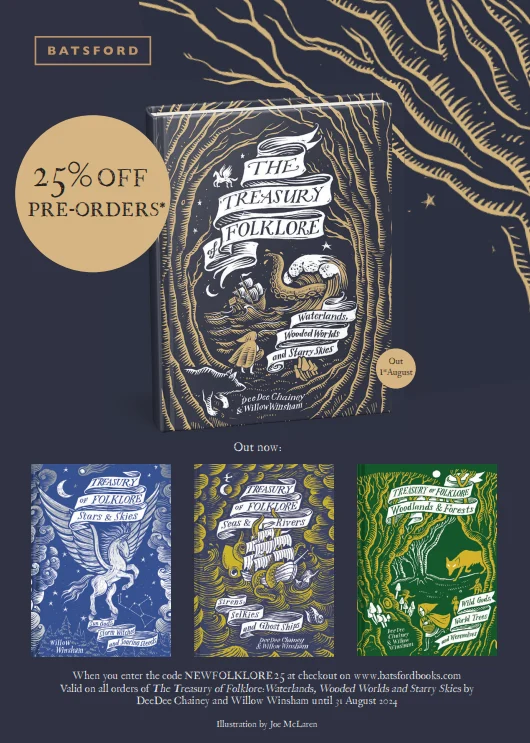
London, UK – July 22, 2024 – Nearly a decade after its inception, the critically acclaimed Treasury of Folklore series by Dee Dee Chainey and Willow Winsham is set to culminate in a magnificent single-volume compendium. Titled The Treasury of Folklore: Waterlands, Wooded Worlds and Starry Skies, this ambitious new release compiles the most cherished tales and insights from the original three best-selling books, offering readers a unified exploration of humanity’s universal fears, dreams, and beliefs woven into the fabric of our landscapes.
Originally conceived as a solitary tome encompassing folklore from every physical landscape, the sheer volume of material unearthed by Chainey and Winsham quickly necessitated an expansion into a trilogy: Seas and Rivers, Trees and Woodlands, and Stars and Skies. Now, the authors’ initial vision is realized in a beautifully bound "hefty tome" that promises to be both a definitive reference and a treasured object for enthusiasts of myth, legend, and human culture. Available for pre-order now, the compendium is slated for release on August 1, 2024.
The Genesis of a Folkloric Journey
The Treasury of Folklore series began its life almost ten years ago, fueled by a profound desire to understand the intricate relationship between humans and the natural world through the lens of traditional storytelling. Inspired by the vibrant and overwhelming outpouring of global folklore shared via the #FolkloreThursday hashtag, authors Dee Dee Chainey and Willow Winsham embarked on a mission to create something meaningful and lasting – a work that would reflect the unifying universality of folklore across the globe.
Their initial ambition was grand: a single book that would traverse all types of physical landscapes inhabited by humans, from the deepest oceans to the highest peaks. However, as they delved deeper into their research, the wealth of material proved far too extensive for a lone volume. This delightful problem led to the creation of three distinct, yet interconnected, books, each focusing on a specific realm: the aquatic wonders of Seas and Rivers, the mysterious depths of Trees and Woodlands, and the cosmic expanse of Stars and Skies.
The unexpected popularity and heartwarming reception of the original trilogy underscored the enduring human fascination with these ancient narratives. "The popularity of the three books… has been both surprising and heartwarming," the authors shared, expressing their gratitude to "each and every person who has bought and read these books." This enthusiastic reception laid the groundwork for the next logical step.
Fulfilling the Original Vision: A Compendium Emerges
The suggestion to create a compendium of the Treasury of Folklore books was met with immediate enthusiasm by the authors. It presented a unique opportunity to return to their original concept, consolidating the rich tapestry of folklore into a single, comprehensive volume. This transition, while seemingly straightforward, involved a meticulous process of curation and reflection.
"Much work went on behind the scenes, reading through the words we already knew so well, with fresh eyes," the authors recounted. The task involved carefully selecting and harmonizing content from the existing books, ensuring that the new volume flowed cohesively and captured the essence of their journey. The goal was to create a unified narrative that spanned shared landscapes across time and place, celebrating the threads that connect human experience globally.

The result, by the authors’ own admission, has exceeded expectations. "To say we have been blown away by the end result is an understatement, and we are utterly thrilled to be able to share this beautifully bound volume with you," they stated. They particularly praised the physical attributes of the new book: "We love the size and the cover combining everything and the beautiful cream paper: it is a ‘hefty tome’ indeed."
It is important to note that The Treasury of Folklore: Waterlands, Wooded Worlds and Starry Skies does not contain new material. Instead, it offers a carefully curated selection of text taken directly from the existing three books, presented in a refreshed and unified format. This makes it an ideal addition to any bookshelf or coffee table, serving not just as a source of knowledge but as a catalyst for conversation and connection. The compendium is thoughtfully structured into three distinct sections, each corresponding to the original books, and features the wonderful original illustrations of Joe McLaren, whose evocative artwork has become synonymous with the series.
Supporting Data: Unearthing Universal Truths through Diverse Lore
The core revelation of the Treasury of Folklore series, and now its compendium, is the profound universality of human experience reflected in our myths. "We discovered that we, as humans, all share primal fears and dreams, no matter where we live, how we dress, or what we choose to name the monsters of our myths and legends," the authors explain. Whether gazing at the ocean, fearing the dark forest, or pondering the cosmos, humans across cultures grapple with similar existential questions and desires.
To illustrate this, the book delves into diverse folkloric examples, offering a glimpse into the rich tapestry of beliefs that connect us.
Water Horses: Majestic and Malevolent Creatures from the Depths
One compelling example of shared human anxieties surrounding the unknown is found in the widespread tales of water horses. These creatures, often depicted as both beautiful and treacherous, embody the perils lurking beneath the surface of rivers, lakes, and lochs. They serve as powerful cautionary tales, warning against recklessness and the deceptive allure of wild nature.
The most renowned of these is the Scottish kelpie, though its aquatic cousin, the each-uisge, which favors lakes and lochs, is equally formidable. While often used interchangeably, the distinction is vital to Scottish folklore. The kelpie, with its irresistible equine form, lures unsuspecting travelers onto its back, only to drag them to a watery demise. Yet, stories also hint at methods of temporary taming, often involving a cross-marked bridle, though such control is fleeting and ultimately illusory. The ancient fear of the kelpie is so ingrained in the Scottish imagination that it inspired monumental 30-meter (98ft) sculptures near Falkirk in 2013, visible from the M9 motorway, and continues to appear in modern literature, from Lari Don to J.K. Rowling’s Fantastic Beasts and Where to Find Them. Intriguingly, such water horses are conspicuously absent from English folklore, highlighting regional variations within seemingly similar cultural landscapes.
Across the border in Wales, the Ceffyl Dwr fills this folkloric niche. A staple of Welsh belief well into the 19th century, this water horse exhibits regional differences in appearance and intent. In North Wales, it is a shapeshifting spirit, prone to violence. In the south, it consistently appears as an enchanting, small horse, luring riders to their doom with impossible speed. A notable exception, demonstrating "denominational equality," is that clergymen of any creed were said to be immune to its malevolent tricks, arriving at their destinations unscathed while their companions were cast aside.

Scandinavian folklore offers the bäckahäst or "brook horse," often seen in foggy conditions. Described as majestic and luminous, it similarly entices riders, particularly children, before plunging into the water, trapping its victims. Tales often end with the riders surviving, sometimes by invoking the name of Christ, which the bäckahäst is said to despise. Like the kelpie, the bäckahäst could also be tricked into labor, reflecting humanity’s perpetual desire to exert control over wild, powerful forces. These diverse tales underscore a universal human fascination with and apprehension of the mysterious depths of water, personified through these magnificent, yet deadly, steeds.
Lords of the Wild: Shapeshifting Gods and Guardians of the Forest
Moving from the perilous waters to the verdant depths of the forest, the compendium explores the "Lords of the Wild"—lordly spirits and creatures that embody humanity’s complex relationship with untamed nature. These figures range from benevolent protectors to malevolent tricksters, reflecting both the awe and the fear inspired by the sylvan realm.
In Finnish mythology, Tapio (also known as Metsähine or Hiisi) reigns as the king of the forest. Tall and thin, with a coat of ermine or moss, and a head crowned with a hat, he embodies the forest itself. His face, often described as peering from bushy eyebrows of moss and lichen, and his back resembling a gnarled tree, links him directly to the landscape. Tapio is both the personification and protector of the forest, holding sway over all its creatures. Historically, hunters would seek his blessing, pledging respect for the woods and its inhabitants, in exchange for a plentiful hunt. His family, including his benevolent wife Mielikki (or stern Kuurikki), and children Nyrikki (who guides hunters) and Tulikki (who directs prey), further illustrate a sophisticated animistic worldview where every aspect of nature has a guiding spirit.
Slavic folklore introduces the leshy (also leshii or lyeshy), a tutelary spirit of the woods, protector of trees and animals, particularly wolves or bears. A shapeshifter of immense power, the leshy can alter its size from a blade of grass to a towering tree. When appearing in human form, tell-tale signs betray its true nature: absence of eyelashes or brows, shoes worn on the wrong feet, or clothing wrapped in an inverted manner. Some portray him with cloven feet, a wild beard, and even wings and a tail, linking him to older, more chthonic deities or even the Devil.
The leshy is a formidable trickster. Its bellowing can whip up winds, and its shrieking laughter, clapping, or howling warns intruders. Those who ignore these warnings are often led astray, confused, and lost to the wilds, never to be seen again. They can mimic voices, tickle victims to death, and cause illness. They are known for abducting women and children, and even cursing entire farms. To appease these powerful spirits, villagers historically offered bread, tobacco, or even sacrificed a cow. Protection against a leshy often involves turning clothes inside out or shoes on the wrong feet, or even swearing at them, which is said to make them laugh and return you to the right path. These intricate beliefs highlight the profound respect, fear, and practical strategies ancient cultures developed to navigate and survive within dense, wild forests.
The Hare: Celestial Messenger and Arbiter of Fate
Finally, the compendium lifts our gaze skyward to the moon, a celestial body that has served as a universal canvas for human imagination. Across diverse cultures, the moon’s surface patterns have inspired myriad tales, with a common motif being the image of a rabbit or hare. The Sea of Tranquillity, for instance, is often seen as the hare’s head, with other lunar seas forming its ears.
One of the most widespread narratives is that of the self-sacrificing hare. In the Buddhist Sasa-jātaka, the hare, a paragon of almsgiving, offers himself as food to the deity Sakka, disguised as a beggar, when he has nothing else to offer. For this ultimate act of faithfulness, Sakka immortalizes the hare by placing his image on the moon for all eternity. Similar tales resonate across Asia: in Sri Lanka, Buddha saves a self-sacrificing hare and sends him to the moon. In Japan, the "Tsuki no Usagi" (Moon Rabbit) offers himself to a beggar (the Man in the Moon in disguise), leading to his celestial ascent. These tales, often told to children during the Harvest Moon and Mid-Autumn Festival, emphasize compassion, selflessness, and the rewards of virtuous action, reflecting shared moral values across distinct cultural landscapes.

In stark contrast, a tale from South Africa attributes a far more somber role to the hare. Here, the flighty creature is responsible for humanity’s mortality. Sent by the Moon to deliver a message of cyclical death and rebirth (like the moon’s phases), the hare instead inaccurately conveys only that humans will die permanently. Enraged, the Moon attacks the hare, splitting its lip, while the hare, in retaliation, scars the Moon’s face – explaining the dark shapes visible on the lunar surface. This narrative offers a dramatically different perspective on the hare’s lunar connection, providing a mythological explanation for the irreversibility of human death and the physical features of the moon itself. These varied stories underscore how different cultures interpret the same celestial phenomena, weaving narratives that reflect their unique understandings of life, death, morality, and the cosmos.
Official Responses and Implications: A Bridge Across Cultures
The authors’ journey with The Treasury of Folklore has been a testament to the enduring power of storytelling and its ability to connect humanity across geographical and temporal divides. Their work demonstrates that beneath the surface differences of custom and belief, lies a profound shared human experience. "Gazing across the ocean into the vast horizon, we all long for the treasures and pleasures that the wide world around us can offer. We all dread the unknown as we gather around our campfires in the darkness of the nighttime forest. We all stand in awe of the eternity of time under the glimmer of ancient stars, wondering about the unwritten future of our own short lives," the authors eloquently observe.
This new compendium, meticulously crafted and visually enriched by Joe McLaren’s original illustrations, serves as more than just a collection of tales. It is a carefully curated anthology designed to spark curiosity, foster understanding, and remind us of our collective heritage. By presenting these diverse stories in a single volume, Chainey and Winsham offer a powerful tool for cultural appreciation and a celebration of the universal human spirit.
As a "beautiful addition to any book case or coffee table," the compendium is poised to become a "conversation starter, a way to connect" – fulfilling the authors’ aspiration for creating something meaningful and lasting. It reinforces the idea that folklore is not merely archaic superstition, but a living, breathing testament to our shared primal fears, dreams, and aspirations, articulated through the unique lenses of countless cultures.
The Treasury of Folklore: Waterlands, Wooded Worlds and Starry Skies is now available for pre-order and will be officially released on August 1, 2024. Readers can secure a 25% discount when ordering directly from Batsford Books using the code NEWFOLKLORE25. This definitive volume invites readers on an unparalleled journey, bridging ancient traditions with contemporary understanding, and affirming the profound unity that lies at the heart of human storytelling.
Pre-order Information:
- Amazon UK: The Treasury of Folklore: Waterlands, Wooded Worlds and Starry Skies
- Batsford Books: Order with code NEWFOLKLORE25 for 25% off.




Leave a Comment