The Architecture of Stillness: House House and the Radical Quiet of ‘Big Walk’
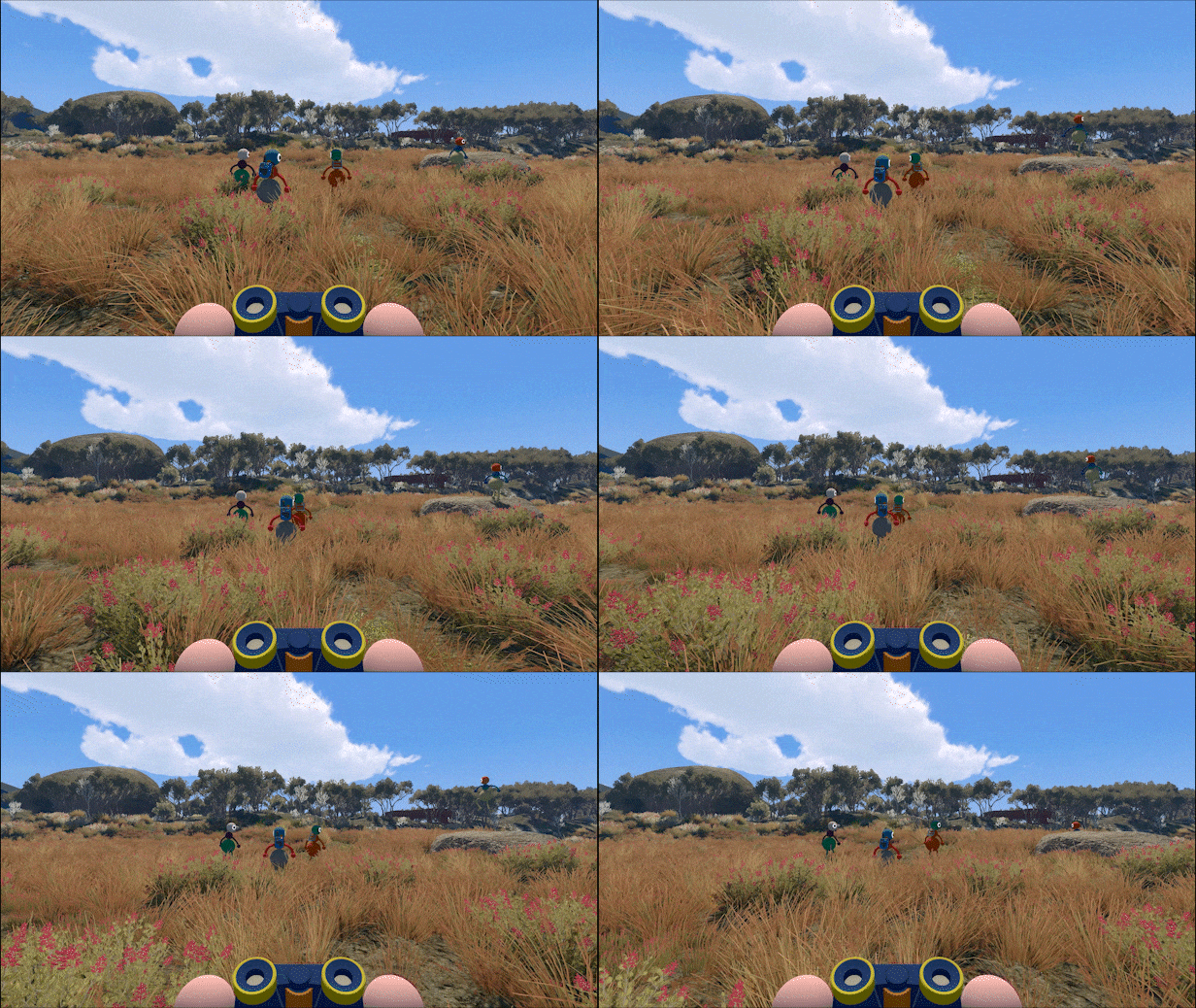
In an era of interactive entertainment defined by high-octane battle royales, hyper-violent urban simulations, and the relentless pursuit of digital dominance, a small studio from Melbourne is proposing a radical alternative: a walk in the park.
House House, the developer that achieved global phenomenon status with the mischievous Untitled Goose Game, has officially unveiled its next ambitious project, Big Walk. Billed as a "cooperative online walker-talker," the game represents a sharp departure from the dopamine-driven loops of modern gaming. Instead of asking players to conquer a world, Big Walk invites them to simply inhabit one, placing communication, navigation, and the shared experience of getting lost at the center of its design.
Scheduled for release on August 4, the game is poised to be a landmark title for Steam, PlayStation 5, and notably, the "Switch 2"—marking one of the first explicit software confirmations for Nintendo’s highly anticipated next-generation hardware.
Main Facts: A New Genre of Connection
At its core, Big Walk is an open-world multiplayer game, but it eschews the traditional markers of the genre. There are no experience points to grind, no enemies to defeat, and no loot to hoard. The primary "mechanics" of the game are walking and talking.
Set within a sprawling, ethereal landscape of dreamy vistas, checkered interiors, and rocky coastal ledges, players must work together to navigate a world that is as beautiful as it is confusing. The developer describes the experience as a "collaborative game where puzzles and the lengths required to solve them take center stage."

The game’s most striking feature is its approach to communication. While many modern games use voice chat as a utility for tactical coordination, Big Walk treats it as a core gameplay element. Players use proximity-based voice chat to stay in touch, but the world itself occasionally interferes. Certain areas of the map are designed to render players "speechless," stripping away their ability to talk and forcing them to devise innovative, non-verbal ways to signal intent and solve challenges.
Key details of the launch include:
- Developer: House House (Melbourne, Australia)
- Release Date: August 4
- Platforms: Steam (PC), PlayStation 5, and Nintendo Switch 2.
- Core Gameplay: Group navigation, spatial puzzle solving, and social interaction.
- Visual Style: Stylized, low-poly aesthetics with a focus on natural light and surreal architecture.
Chronology: From Mischievous Geese to Mindful Hikers
The journey toward Big Walk began with House House’s emergence as a powerhouse of independent game design. The studio first gained attention with Push Me Pull You, a surreal local-multiplayer sports game that emphasized physical comedy and awkward cooperation. However, it was 2019’s Untitled Goose Game that catapulted the four-person team into the cultural zeitgeist.
Untitled Goose Game was a masterclass in "low-stakes" play. By casting the player as a "horrible goose" tasked with ruining a quiet English village’s afternoon, House House proved that there was a massive, untapped market for games that prioritized humor and charm over violence.
Following the massive success of the "Goose," the industry watched closely to see what the studio would do next. While many expected a direct sequel, House House chose to pivot. Development on Big Walk has been a multi-year process focused on refining the "social feel" of the game.

The announcement of Big Walk late last year signaled a shift in the studio’s philosophy. Where the goose game was about isolation and disruption, Big Walk is about community and cohesion. The timeline of the game’s reveal has been carefully managed to highlight its status as a "slow" experience, culminating in the recent release date announcement and the confirmation of its arrival on next-generation platforms.
Supporting Data: The Mechanics of the "Walker-Talker"
To understand why Big Walk is generating such significant industry interest, one must look at the specific mechanics that differentiate it from other walking simulators.
1. The Physics of Communication
In Big Walk, sound is spatial. If a friend wanders over a hill, their voice fades. if they fall into a ravine, their cries for help will echo from below. This creates a tangible sense of presence that is often missing from digital social spaces. The game includes various tools—such as binoculars, maps, and compasses—that must be shared and discussed to find the way forward.
2. The Logic of "Nothingness"
The game’s trailer explicitly states that the experience is about "sometimes, not really doing anything at all." This is supported by data from the "cozy gaming" sector, which has seen a 20% year-over-year growth in player engagement. Games like A Short Hike and Sky: Children of the Light have proven that players value "dead time" in games—moments of reflection that allow for genuine conversation between friends.
3. Collaborative Puzzle Design
The puzzles in Big Walk are not traditional "lock and key" obstacles. Instead, they are environmental challenges that require a group to be in multiple places at once or to communicate complex visual information. One revealed segment shows players navigating a massive checkered floor room, using their collective perspective to identify patterns that are invisible to a single observer.

Official Responses: The Philosophy of House House
The developers at House House have been vocal about their desire to create a game that feels like a "hangout space." In official promotional materials, the team emphasizes that the challenge isn’t the terrain, but the maintenance of the group.
“As much as Big Walk is a game about walking and talking, it’s also about exploring, and getting lost, and doing challenges,” a representative for House House shared during the latest trailer reveal. “We wanted to capture that specific feeling of being on a long walk with friends—where the conversation drifts, the path is uncertain, and the goal is less important than the company.”
Industry analysts have noted that House House is leaning into "friction" as a design tool. By making it easy to get lost and difficult to stay together, the game forces players to actually care about one another. This is a direct rebuttal to the "quality of life" trends in gaming that automate navigation and communication, often stripping away the social necessity of the experience.
Furthermore, the mention of the "Switch 2" has sent ripples through the tech community. While Nintendo has yet to officially unveil the technical specifications of its next console, House House’s commitment to the platform suggests that Big Walk may utilize new hardware features—perhaps related to haptic feedback or enhanced social networking capabilities—that align with the game’s tactile, communal nature.
Implications: The Rise of the Anti-Action Movement
The emergence of Big Walk is more than just a new product launch; it is a symptom of a larger shift in the digital landscape. As the "attention economy" becomes increasingly aggressive, players are seeking out "digital sanctuaries."

The Social Antidote
For many, the post-pandemic world has left a lingering desire for low-pressure social interaction. Big Walk functions as a digital surrogate for the physical world’s simplest pleasure: a stroll. In a market saturated by Grand Theft Auto’s cynicism and Fortnite’s frantic energy, Big Walk offers a rare commodity: sincerity.
A New Benchmark for Indie Influence
House House’s ability to dictate terms—releasing a game about "nothing" on the world’s most powerful consoles—demonstrates the growing power of indie studios. They are no longer just filling gaps between AAA releases; they are defining the cultural conversation. If Big Walk succeeds, it could pave the way for a new sub-genre of "ambient multiplayer" games.
Technical Evolution
The focus on "walking" requires a high degree of environmental fidelity. For Big Walk to succeed, the world must be worth looking at. The screenshots and GIFs released thus far show a sophisticated use of color and scale, suggesting that House House is pushing its artistic boundaries. The rocky ledges, elevated pathways, and surreal round buildings suggest a world that is part botanical garden, part M.C. Escher painting.
Conclusion
Big Walk is a gamble on the idea that players are tired of being heroes, survivors, or legends. It bets that, given the choice, many would rather just be a friend. By stripping away the traditional scaffolds of video game "fun"—combat, competition, and constant progression—House House is attempting to uncover a deeper form of engagement.
When the game launches on August 4, it will provide a litmus test for the industry. Can a game about walking and talking hold the attention of a generation raised on instant gratification? If the success of Untitled Goose Game is any indication, the world may be more than ready to slow down, take a breath, and go for a very long walk.