The Architect of Perception: David Hockney’s Legacy of Technological Vision
The passing of David Hockney marks the end of an era, not merely for the world of fine art, but for the broader intersection of human creativity and technological evolution. Hockney was more than a painter of vibrant Yorkshire landscapes and sun-drenched Californian pools; he was a perceptual engineer who spent over six decades arguing that "looking" is an active, rigorous skill rather than a passive biological function.
As the global creative community reflects on his life, Valentina Culatti, Global Senior Director of Creative Strategy and Production at Snap Inc., suggests that Hockney’s true masterpiece was his approach to the tools of the future. In an age dominated by the rapid ascent of Artificial Intelligence and digital saturation, Hockney’s philosophy offers a vital roadmap for how humanity might navigate the next frontier of visual culture.
Main Facts: A Life Defined by the "Active Eye"
David Hockney’s career was a continuous rebellion against the "single lens." He famously critiqued the standard camera for its inability to capture the way humans actually experience space. To Hockney, a photograph was a frozen moment seen through a "pinhole," whereas human vision is a composite of memory, movement, and selective focus.
His recent exhibitions, most notably at the Serpentine in London and the immersive Bigger & Closer show at Lightroom, serve as the final testament to this vision. These shows frame Hockney not as a traditionalist clinging to the brush, but as a visionary who embraced the iPad, the fax machine, the Polaroid, and multi-camera cinematography to expand the boundaries of what can be seen.
The core of his contribution lies in the distinction between the tool and the vision. Whether he was using an 18th-century camera lucida or a 21st-century tablet, his objective remained unchanged: to challenge the audience to step inside the work and become an "implicated participant" rather than a detached consumer.
Chronology: The Technological Evolution of a Visionary
Hockney’s relationship with technology was never about novelty; it was about utility. His timeline reveals a man constantly searching for tools that could keep pace with the speed of human thought and the shifting nature of light.
The 1960s–1970s: Breaking the Frame
While Hockney gained fame for his acrylic paintings of Los Angeles, he was already experimenting with the limitations of the frame. By the late 1970s, he began creating "joiners"—composite photographs made of dozens of Polaroids or 35mm prints. By layering different perspectives of the same scene, he mimicked the way the human eye scans an environment, effectively "de-flattening" the photographic medium.
The 1980s–1990s: The Fax and the Photocopy
In the late 1980s, Hockney began using fax machines to transmit "home-made prints" to friends and galleries. This was a radical democratization of art, bypassing traditional shipping and logistics to share work instantaneously. He later moved into color photocopying, treating the machine as a printing press to create complex, layered compositions.
The 2010s: The iPad Revolution
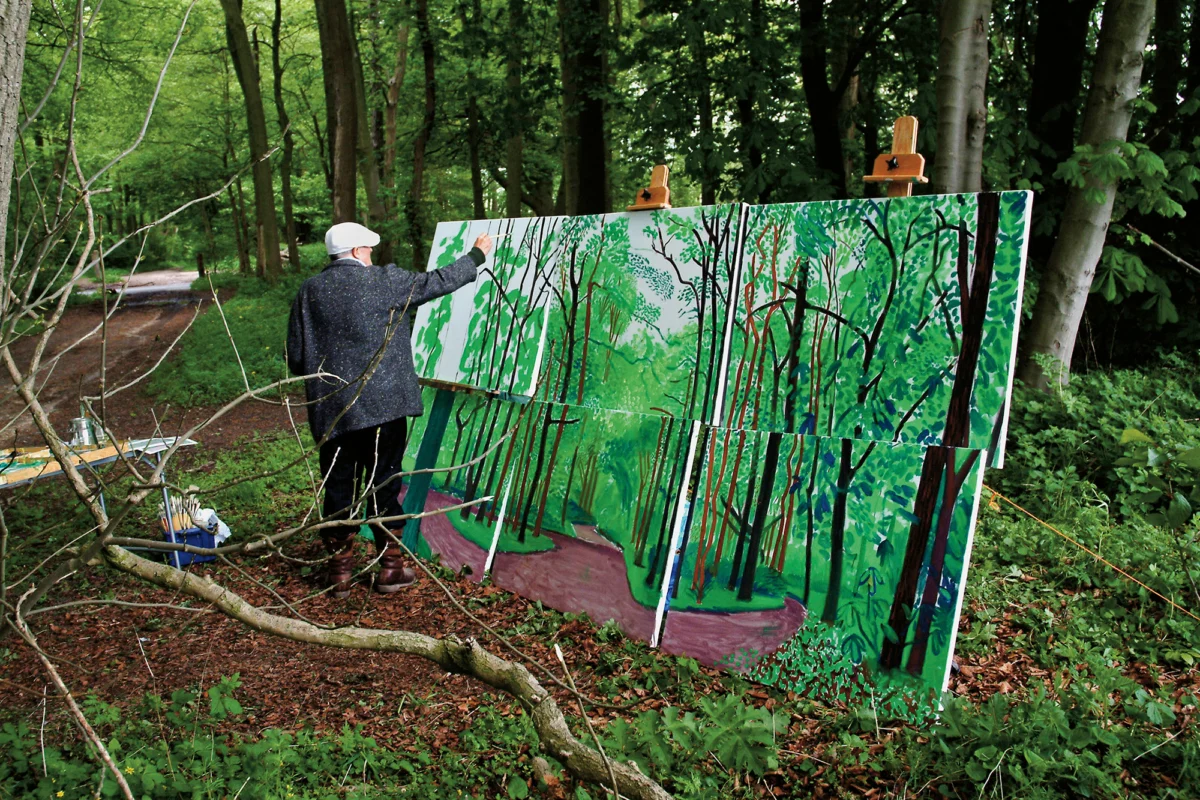
The introduction of the iPad in 2010 marked a significant turning point. Hockney famously kept a device by his bed, allowing him to paint the dawn over the Woldgate Woods in East Yorkshire before breakfast. For Hockney, the iPad wasn’t a replacement for oil; it was a medium of light. The "speed" of the digital brush allowed him to capture the fleeting transitions of the morning sun that traditional pigments, which require drying time, simply could not match.
The 2020s: Immersive Realities
In his final years, Hockney moved into large-scale immersive environments. His Bigger & Closer (not smaller & further away) exhibition utilized high-resolution projection mapping and surround sound to place the viewer inside his canvases. This was the culmination of his 60-year quest to make the audience feel "inside" the art.
Supporting Data: The Mechanics of Hockney’s Methodology
Hockney’s move into digital and multi-screen filmmaking was backed by a rigorous understanding of optics. His nine-camera films, which are central to his current Serpentine exhibition, provide empirical evidence of his theories on perception.
By mounting nine cameras on a rig and driving through a forest, Hockney captured nine slightly different perspectives simultaneously. When displayed on nine screens, the viewer is forced to choose where to look. Data from audience engagement at these exhibitions shows a marked difference compared to traditional galleries: visitors spend significantly longer in front of these multi-screen works because the brain is forced to "stitch" the reality together, mimicking the cognitive load of actual physical presence.
Furthermore, Hockney’s iPad paintings were not just static images. They were recorded as "replays," allowing viewers to see every stroke in the order it was made. This transparency of process transformed the artwork from a finished product into a performative event, bridging the gap between the artist’s hand and the viewer’s eye.
Official Responses and Institutional Legacy
The art world’s response to Hockney’s technological embrace has evolved from skepticism to reverence. In the early 2010s, critics often dismissed his iPad works as "sketches" or "gimmicks." However, the overwhelming public success of his immersive shows has forced a re-evaluation.
Valentina Culatti of Snap Inc. highlights that Hockney’s work is a "masterclass" in audience evolution. "He understood, intuitively, that the future of art lay in participation," Culatti notes. She argues that Hockney’s ability to engage "digitally-native teens" alongside "long-established fans" is a feat few contemporary artists have managed.
Institutional support remains robust. The Tate Modern has officially announced plans to continue Hockney’s immersive legacy. In 2026, to mark what would have been his 90th birthday, the gallery’s iconic Turbine Hall will host a major installation. This project is expected to utilize cutting-edge digital technology to honor his lifelong provocation: that we must never stop finding new ways to see the world.
The Serpentine Galleries, currently hosting A Year in Normandie, have emphasized that Hockney’s work is more relevant than ever. Their curators argue that in a world of "algorithmic curation," Hockney’s insistence on the "human eye’s choice" is a necessary counter-narrative.
Implications: The Hockney Lesson for the AI Era
The most urgent implication of Hockney’s legacy concerns the current global debate over Artificial Intelligence. As industries scramble to understand what generative AI means for creativity, Hockney’s approach offers a profound distinction between "automated taste" and "expanded perception."
The Tool vs. The Author
Hockney never allowed the tool to dictate the vision. When using an iPad, he didn’t use filters or automated effects; he used the stylus to mimic the manual labor of a brush. Culatti suggests that the modern creative industry is asking the wrong question: "What can the technology do?" Hockney’s question was always: "What kind of seeing does it make possible?"
The implication for AI is clear: the technology should serve as a "research assistant" or a "mirror," surfacing patterns and pressure-testing assumptions, but the final "authorial gaze" must remain human. Hockney’s work proves that creativity does not live in the software; it lives in the human decision of where to look and what to notice.
The Democratization of the Gallery
Hockney’s success with immersive exhibitions suggests a shift in how art will be consumed in the future. By moving away from "white-walled galleries" that many find alienating, Hockney opened the door for a more inclusive form of cultural participation. This "participatory turn" is likely to influence how museums and brands interact with audiences, moving toward experiences that are "playful enough for children" yet "revelatory for experts."
The Skill of Looking
Perhaps the most lasting implication of Hockney’s life is the reminder that looking is a moral and intellectual effort. In an era of "doom-scrolling" and passive consumption, Hockney’s insistence that "joy is serious work" serves as a call to action. He demonstrated that technology, when used correctly, doesn’t have to alienate us from nature; it can bring us closer to it.
David Hockney taught us that vision is not a gift we are born with, but a craft we must hone. Whether through a 17th-century lens or a 21st-century screen, the goal remains the same: to truly see the light on the trees, the ripple in the pool, and the world in all its complex, multi-layered glory. As he famously proved, that is a task that begins every morning, before breakfast.