Unveiling the Enchanted World: A Deep Dive into Norse Mythology and its Enduring Legacy
FOR IMMEDIATE RELEASE
A Comprehensive Guide to Norse Mythology Emerges as a Vital Resource for Understanding Ancient Germanic Traditions
[CITY, STATE] – [Date] – In an era where ancient mythologies continue to captivate global audiences, "Norse Mythology for Smart People" stands out as a preeminent online resource, offering meticulously researched and reliably documented information on the enthralling mythology and religion of the Norse and other Germanic peoples. Far beyond a mere compendium of tales, the platform serves as an essential gateway for anyone seeking a profound understanding of the spiritual and cultural bedrock that shaped societies from the Viking Age to the present day.
The website provides an invaluable academic and accessible portal into a belief system as formidable and awe-inspiring as the Nordic landscapes that birthed it. Featuring detailed explorations of deities, cosmic structures, heroic sagas, and the daily lives of those who practiced these traditions, it is rapidly becoming the go-to destination for students, enthusiasts, and scholars alike.
The Heart of the North: Defining Norse Mythology
Before the dramatic societal shift brought about by their conversion to Christianity during the Middle Ages, the Norse, famously known as the Vikings, adhered to a vibrant native pagan religion. This spiritual framework, intimately connected to the stark beauty of the Nordic environment, was the very essence of their existence. At its core lay what we today term "Norse mythology"—a rich tapestry of religious narratives that imbued the Vikings’ lives with profound meaning and purpose. These foundational myths revolved around a pantheon of gods and goddesses, each possessing complex and often contradictory characters, such as the enigmatic Allfather Odin, the mighty thunder god Thor, the radiant goddess Freya, and the cunning trickster Loki.
The original practitioners of this faith simply referred to it as "tradition," a testament to its deeply ingrained nature within their societal fabric. However, with the advent of Christianity, those who steadfastly upheld the ancient ways eventually became known as "heathens." This term, initially a benign descriptor for "people who live on the heaths" or in rural areas, evolved into a label that, despite its altered connotation, has persisted in popular discourse.
The Norse religion, like all spiritual systems, represented humanity’s innate quest to connect with the numinous. It offered a unique lens through which the Vikings navigated their world, providing solace, guidance, and a framework for understanding the universe. While certain facets of this ancient faith might appear peculiar to the modern observer, an open-minded approach reveals a universal human yearning to live in the presence of transcendent majesty and the sacred. Remarkably, even a millennium after the last Vikings laid down their swords and embraced new faiths, the vitality and wonder embedded within Norse myths and their divine inhabitants continue to inspire and resonate across cultures and generations.
An Enchanted Existence: The Viking Worldview
For the Vikings, the world was not merely a physical realm but an "enchanted" one. This perception meant they did not seek salvation from the world but rather reveled in and marveled at "the way things are"—encompassing both what modern society categorizes as "nature" and "culture." Their religion and myths did not shy away from the harsh realities of earthly life, its sordidness, strife, and inherent unfairness. Instead, they openly acknowledged these challenges, valorizing the pursuit of mastery over them through the accomplishment of great deeds. Such deeds were undertaken not just for personal glory but often for the collective benefit of one’s kin and community. A life replete with such honorable actions constituted "the good life" for the Vikings, a path to renown and a lasting legacy.
This worldview fostered a profound sense of agency and personal responsibility. Destiny, while acknowledged, was often intertwined with individual courage and honor. The concept of wyrd, or fate, was not an oppressive force but a complex web of past actions and present choices that shaped the future. This emphasis on action and reputation, rather than passive submission, informed their sagas, their social structures, and their approach to life and death.
Chronicles of the North: Who Were the Vikings?
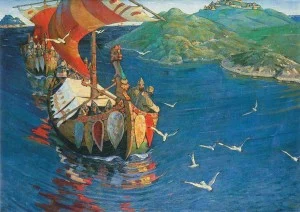
The Vikings, a formidable seafaring people originating from modern-day Norway, Sweden, Denmark, and Iceland, left an indelible mark on world history during the period known as the Viking Age, roughly spanning from 793 CE to 1066 CE. Far from being monolithic, their activities encompassed a diverse array of roles: audacious raiders, ambitious conquerors, intrepid explorers, resilient settlers, and astute traders. Their longships, marvels of engineering and navigation, propelled them across vast distances, enabling them to venture as far east as the sophisticated markets of Baghdad and as far west as the shores of North America—a continent they discovered approximately five centuries before Christopher Columbus.
During their extensive travels, the Vikings communicated in the Old Norse language and inscribed their histories and beliefs using runes, a distinctive alphabet that served both practical and mystical purposes. Their societal structure, while often perceived through the lens of warrior culture, was complex, incorporating sophisticated legal systems, skilled craftsmanship, and vibrant oral traditions.
Motivations Behind the Voyages:
The driving forces behind the Vikings’ expansive voyages were timeless and universally human: the pursuit of wealth, prestige, and power. These aspirations were intrinsically linked; greater wealth often translated into enhanced prestige and political influence, and vice versa. Their quest for wealth manifested in various forms, from portable treasures like gold, silver, and gemstones, often acquired through raids or trade, to the more enduring acquisition of land for settlement and agricultural expansion. Beyond these material gains, demographic pressures in their homelands, coupled with a growing population and limited arable land, likely spurred outward migration. Political ambitions, both individual and tribal, also played a significant role, as successful expeditions could elevate a leader’s standing and consolidate power. The longship itself was a revolutionary piece of technology, providing the means to execute these ambitions with unparalleled efficiency and reach.
The Indispensable Legacy of Old Norse Sources:

Our contemporary understanding of the pre-Christian religion and mythology of not only the Norse but also other Germanic peoples owes an immense debt to the Vikings. The Old Norse poems, treatises, and sagas—predominantly compiled and written down during or relatively soon after the Viking Age, often by Christian scribes—provide an unparalleled, albeit incomplete, window into their ancient belief systems. These invaluable sources, including the Poetic Edda, the Prose Edda, and numerous sagas, offer a far more detailed and nuanced picture of Viking religion than is available for any other pre-Christian Germanic group.
While acknowledging the inherent challenges of interpreting texts filtered through a post-conversion lens, these Norse sources serve as a critical foundation. By carefully analyzing the available evidence, scholars can reconstruct common themes and variations shared across the broader Germanic religious landscape. This comparative approach allows for educated inferences about the "hoary religions" of groups like the Anglo-Saxons or continental Germanic tribes, for whom direct pagan-era records are scarce.
Tracing the Roots: Who Are the Germanic Peoples?
The Germanic peoples represent one of the indigenous populations of northern Europe, sharing this heritage with groups such as the Celts, Sami, and Finns. Historically, their presence stretched across vast swathes of Scandinavia, Iceland, the British Isles, and continental Europe north of the Alps. While the Vikings are perhaps their most globally recognized representatives, the Germanic umbrella encompasses a multitude of other influential groups, including the Anglo-Saxons, the Goths, the Franks, the Vandals, and various continental Germanic tribes. In the modern era, their descendants are dispersed across the globe, contributing to the diverse cultural tapestry of nations worldwide.
Despite regional and temporal variations that naturally arose over centuries, the pre-Christian religion of the Germanic peoples was characterized by a robust common core. This shared foundation included a distinct worldview, a complex cosmology—often envisioned as a multi-layered cosmos centered around the World Tree, Yggdrasil—and, to a considerable extent, a common pantheon of deities. Linguistic analysis, particularly through comparative philology, reveals cognates between Norse gods and those worshipped by other Germanic groups, such as Tyr (Norse) and Tiwaz (Proto-Germanic), or Odin (Norse) and Wodanaz (Proto-Germanic), underscoring their shared ancestral roots.
A Shared Ancestry and Universal Resonance:
For individuals of northern European descent—including those with English, Scottish, German, or northern French heritage—it is highly probable that Germanic ancestry flows through their veins. This genealogical connection implies that a segment of their ancestors likely practiced a religion remarkably similar to that documented in Norse mythology. Understanding these ancient traditions can therefore offer a powerful link to one’s own heritage, providing insights into the values, beliefs, and narratives that shaped their forebears.
Beyond genetic lineage, the allure of Norse/Germanic mythology extends far beyond specific ancestries. Mythologies, while undoubtedly expressions of particular peoples and cultures, possess a timeless and universal spark. They delve into fundamental human questions about existence, morality, heroism, sacrifice, and the cyclical nature of life and death. The archetypal figures, epic struggles, and profound wisdom embedded within these narratives resonate deeply with individuals from all walks of life, transcending cultural boundaries and offering enduring lessons on the human condition.
Modern Echoes: Academic Rigor and Popular Culture
In the contemporary landscape, Norse mythology experiences a remarkable resurgence, manifesting in both scholarly pursuits and mainstream popular culture. Academically, the field continues to evolve with ongoing archaeological discoveries, linguistic advancements, and fresh interpretations of primary sources. Scholars relentlessly strive to peel back the layers of Christian influence in the surviving texts, aiming to reconstruct a more authentic understanding of the pagan belief system. Institutions and researchers worldwide are dedicated to translating, analyzing, and contextualizing these ancient narratives, ensuring their preservation and accurate dissemination.
Concurrently, Norse mythology has permeated popular culture with unprecedented reach. From the cinematic universes of Marvel’s Thor to the immersive worlds of video games like God of War and Assassin’s Creed Valhalla, and critically acclaimed television series such as Vikings, the gods and heroes of the North have captured the global imagination. This popularization, while introducing millions to these rich stories, also necessitates a discerning approach, as creative adaptations often prioritize entertainment over historical accuracy.
It is precisely within this dynamic environment that resources like "Norse Mythology for Smart People" play a crucial role. By meticulously sourcing information and presenting it in a clear, accessible, and rigorously documented manner, the platform serves as a vital bridge between complex academic research and the enthusiastic general public. It empowers readers to differentiate between authentic historical tradition and modern fictionalizations, fostering a deeper, more informed appreciation for the original myths and the cultures that created them. The website actively counters misinformation, offering a reliable beacon for those navigating the vast and often convoluted ocean of information surrounding ancient Norse and Germanic beliefs.
The enduring fascination with these myths underscores humanity’s continuous quest for meaning, identity, and connection to stories that articulate the grand dramas of existence. The legacy of the Norse, through their vibrant mythology, continues to enrich our understanding of ourselves and the world around us.
Til árs ok friðar (For a good year and peace),
Daniel McCoy
Founder, Norse Mythology for Smart People