Poul Anderson: A Grandmaster’s Enduring Legacy in Science Fiction and Fantasy
Poul Anderson (1926-2001) stands as one of the most revered and prolific authors in the annals of speculative fiction, a true Grand Master whose vast bibliography spans the breadth of science fiction and fantasy. From intricate space operas exploring the decline of galactic empires to grim, mythic fantasies steeped in Norse lore, Anderson’s work consistently showcased a profound understanding of history, human nature, and the cosmos. This article delves into a selection of his pivotal works, examining their thematic depth, narrative power, and lasting influence on the genres.
A Grandmaster’s Prolific Pen: Main Facts and Career Overview
Born in Bristol, Pennsylvania, and raised in Denmark before returning to the United States, Poul Anderson’s diverse background undoubtedly contributed to the rich tapestry of his storytelling. His career, launched in the late 1940s, blossomed through the Golden Age of science fiction and beyond, earning him numerous accolades including multiple Hugo Awards, three Nebula Awards, the Gandalf Grand Master Award for fantasy, and the Science Fiction and Fantasy Writers of America (SFWA) Grand Master Award.
Anderson was a master of versatility, equally adept at crafting hard science fiction narratives grounded in scientific principles, sweeping space operas, compelling alternate histories, and deep, often melancholic, epic fantasies. His works are frequently characterized by meticulous world-building, complex moral dilemmas, and a literary prose style that elevated the genre. For many, an early encounter with Anderson’s writing proved formative, revealing the profound intellectual and emotional potential of speculative fiction. His early short story collection, 7 Conquests (1969), with its evocative cover art by Emanuel Schongut, served as an accessible entry point for countless readers, offering diverse tales that showcased his imaginative scope and linguistic artistry.
The Flandry Saga: Imperial Twilight in the Terran Empire
Among Anderson’s most celebrated creations is the Dominic Flandry series, a cornerstone of classic space opera that presents a fascinating blend of intergalactic espionage and imperial decline. Centered on Dominic Flandry, an intelligence officer for a vast, yet slowly decaying, Terran Empire, these tales are often categorized as "James Bond in space," a comparison that captures Flandry’s dashing demeanor and talent for navigating perilous situations. However, Anderson imbues Flandry with a far deeper complexity, presenting him as an anti-hero burdened by cynicism and a keen awareness of his civilization’s inevitable decline.
Chronology and Thematic Evolution
The Flandry saga unfolds across a series of novels and short story collections, charting Flandry’s career from his early days as a promising young ensign to a seasoned, weary veteran.
-
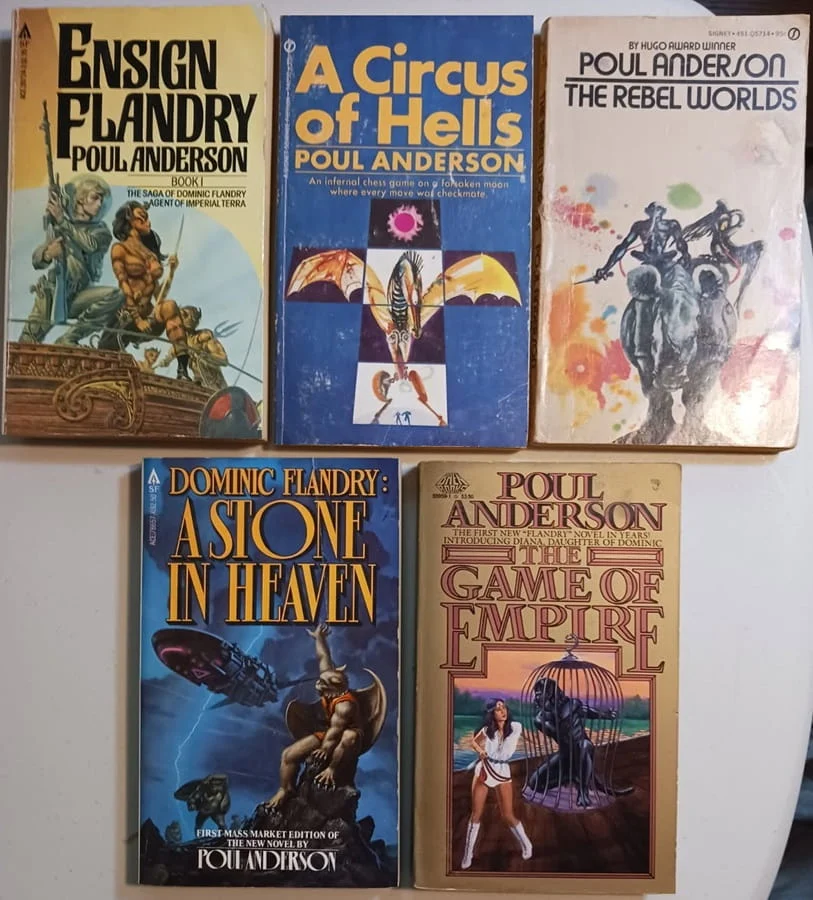
Early Adventures and Character Introduction: Ensign Flandry (1966) introduces readers to a younger, somewhat less jaded Flandry, establishing the intricate political landscape of the Terran Empire and its primary adversaries, the Merseian Empire. This novel, along with the short story collections Agent of the Terran Empire (1965) and Flandry of Terra (1965), often featuring the iconic cover art by Michael Whelan for their Ace editions (1979-1980), laid the groundwork for the character’s unique blend of bravado and melancholy. These stories showcase Flandry’s sharp intellect, his skills in combat and diplomacy, and his often-unconventional methods for protecting an empire he knows is doomed.
-
Escalating Conflicts and Moral Ambiguity: Novels like A Circus of Hells (1970) and The Rebel Worlds (1969) delve deeper into the Terran Empire’s struggles, portraying Flandry engaging in intricate intelligence operations against various alien threats and internal rebellions. Here, Anderson masterfully explores themes of moral compromise, the lesser of two evils, and the heavy personal cost of fighting a protracted, unwinnable war. Flandry is often forced into morally gray areas, making choices that save countless lives but leave indelible marks on his soul.
-
Deepening Despair and Philosophical Inquiry: As the series progresses, the tone often darkens. A Knight of Ghosts and Shadows (1974) is particularly notable for its philosophical depth, exploring Flandry’s existential angst and his reflections on the nature of civilization, heroism, and the cosmos. The narrative frequently juxtaposes moments of thrilling action with profound introspection, a hallmark of Anderson’s mature writing.
-
The Empire’s Final Stages: Later works such as A Stone in Heaven (1979), with its captivating Whelan cover and illustrations by Esteban Maroto, and The Game of Empire (1985), featuring Victoria Poyser’s artwork, bring Flandry closer to the twilight of his career and the Terran Empire’s ultimate fate. These novels emphasize the cyclical nature of power and the inevitability of change, even on a galactic scale. Flandry, by this point, is a figure of tragic heroism, understanding that his efforts merely delay the inevitable, yet continuing to fight out of a profound sense of duty and a love for the fading embers of human civilization.
Supporting Data and Significance
The Flandry series is more than just thrilling adventure; it’s a sophisticated meditation on decline, an exploration of how a vast, powerful civilization grapples with its own mortality. Anderson’s intricate galactic politics, his believable alien races (like the enigmatic Merseians and the honor-bound Ythrians), and his detailed technological concepts elevate the series beyond simple space opera. The enduring appeal of the Flandry books lies in their blend of swashbuckling action, political intrigue, and a deeply human, if flawed, protagonist who embodies the melancholy beauty of a dying age.
Otherworldly Visions: Swordsmen in the Sky and "Swordsman of Lost Terra"
Anderson’s expansive imagination wasn’t confined to the far reaches of space. He also ventured into the realm of what might be termed "Sword & Planet" fantasy, albeit with his unique twist. For many readers, an early exposure to this facet of his talent came through anthologies such as Swordsmen in the Sky (1964), an iconic collection graced by a dynamic cover from Frank Frazetta. This anthology featured Anderson’s "Swordsman of Lost Terra" (1951), a story that, despite its setting on a far-distant future Earth after a cataclysm, profoundly captured the spirit of heroic fantasy.
Genre Blending and Narrative Drive
"Swordsman of Lost Terra" is a prime example of Anderson’s ability to blur genre lines. While technically set in a science fiction future, the story’s emphasis on heroic combat, exotic characters, and fantastic settings gives it a distinct fantasy feel. It evokes the grand tradition of Edgar Rice Burroughs’ Barsoom novels, with their headlong action and vibrant, imaginative worlds. Anderson’s narrative drive in this tale is relentless, propelling the reader through a world transformed by millennia, where remnants of advanced technology mingle with primitive societies and ancient mysteries.
The story’s allure lies in its unabashed embrace of adventure. Readers are transported to a landscape where ancient ruins hint at forgotten glories, and every corner holds the promise of danger and discovery. This blend of post-apocalyptic science fiction with sword-wielding heroics demonstrated Anderson’s versatility and his deep appreciation for the foundational tropes of pulp adventure, filtering them through his sophisticated narrative lens.
The Northern Gloom: The Broken Sword
Perhaps Anderson’s most enduring and critically acclaimed fantasy work is The Broken Sword (1954, revised 1971), a novel frequently cited as a masterpiece of dark fantasy. The Del Rey edition from 1981, adorned with Boris Vallejo’s iconic cover art, introduced the tale to a new generation of readers, cementing its status as a genre classic.
Plot, Themes, and Norse Influences
The Broken Sword is a grim and powerful saga deeply rooted in Norse mythology and folklore. It tells the story of Skafloc, a human child stolen by elves as an infant and replaced with a changeling. Raised among the magical, often cruel, denizens of the otherworldly realms, Skafloc is ultimately caught in a cosmic conflict between the forces of the Light Elves and the Trolls, aided by various other mythical beings, including dwarves, giants, and even the Norse gods themselves.
The novel is characterized by its stark, uncompromising vision of a world steeped in fate and ancient animosities. Unlike the clear-cut morality often found in other epic fantasies of the era, The Broken Sword revels in shades of gray. Its characters, both human and mythical, are driven by passions, flaws, and destinies that are often tragic. At its heart, despite the pervasive gloom and violence, lies a beautiful yet doomed love story, adding a poignant layer to the epic struggle.
Supporting Data and Literary Significance
Anderson’s prose in The Broken Sword is exquisite, echoing the cadence and power of the Old Norse Eddas and sagas. His language is rich, evocative, and perfectly suited to the mythic scope of the narrative. The novel explores profound themes: the burden of identity, the clash between different worlds and moral codes, the inexorable grip of fate, and the raw, often brutal, nature of existence in a world where gods and monsters walk among mortals.
The novel’s influence on the fantasy genre is undeniable. While often not mentioned in the same breath as Tolkien’s The Lord of the Rings or Howard’s Conan tales in popular discourse, The Broken Sword holds a significant place among discerning readers and critics. It predates many elements of what would later be termed "grimdark" fantasy, presenting a world where heroism is often tragic, victories are costly, and darkness is never fully vanquished. Its unflinching portrayal of violence, its complex characters, and its atmospheric, mythic prose make it a unique and powerful contribution to the genre. Its place as a foundational text for darker, more morally ambiguous fantasy is well-deserved.
Poul Anderson’s Enduring Legacy: Implications and Official Responses
Poul Anderson’s contribution to speculative fiction cannot be overstated. His extensive bibliography, spanning dozens of novels and hundreds of short stories, showcases a remarkable intellectual curiosity and a mastery of narrative craft.
Official Recognition and Critical Acclaim
His numerous awards, including multiple Hugo and Nebula Awards, are official testaments to his standing among his peers and readers. The Gandalf Grand Master Award for fantasy and the SFWA Grand Master Award for science fiction specifically acknowledge his monumental impact across both genres. Critics consistently lauded his ability to blend scientific rigor with imaginative storytelling, his richly drawn characters, and his sophisticated thematic explorations. He was a writer who could entertain while simultaneously prompting deep thought about history, philosophy, and the human condition.
Broad Influence and Timeless Appeal
Anderson’s versatility allowed him to influence a wide array of authors. His Flandry series laid groundwork for future space operas that explored imperial decline and espionage, inspiring writers to imbue their galactic empires with historical and philosophical depth. The Broken Sword, with its grim tone and deep mythological roots, influenced subsequent generations of fantasy writers to explore darker, more complex narratives beyond the clear-cut heroics of traditional fantasy.
The implications of Anderson’s work are far-reaching. He demonstrated that speculative fiction could be both intellectually stimulating and viscerally exciting, that it could explore complex moral landscapes without sacrificing adventure. His stories resonate today because they grapple with timeless questions: the rise and fall of civilizations, the nature of heroism, the burden of knowledge, and the enduring human struggle against overwhelming odds.
Conclusion
Poul Anderson remains a towering figure in speculative fiction, a writer whose work continues to captivate and challenge readers decades after its initial publication. From the cynical yet honorable Dominic Flandry battling for a dying empire to the tragic hero Skafloc caught in a mythic struggle of fate, Anderson’s characters and worlds are etched into the collective consciousness of the genre. His ability to craft compelling narratives across such a diverse spectrum of themes and styles ensures that his legacy as a Grand Master will endure, inviting new generations to discover the profound richness of his imaginative universe. For anyone seeking to delve into the very foundations of modern science fiction and fantasy, Poul Anderson’s bibliography offers an essential and deeply rewarding journey.