Unearthing the Roots of Conflict: The Anglo-Boer Wars and the Forging of South Africa
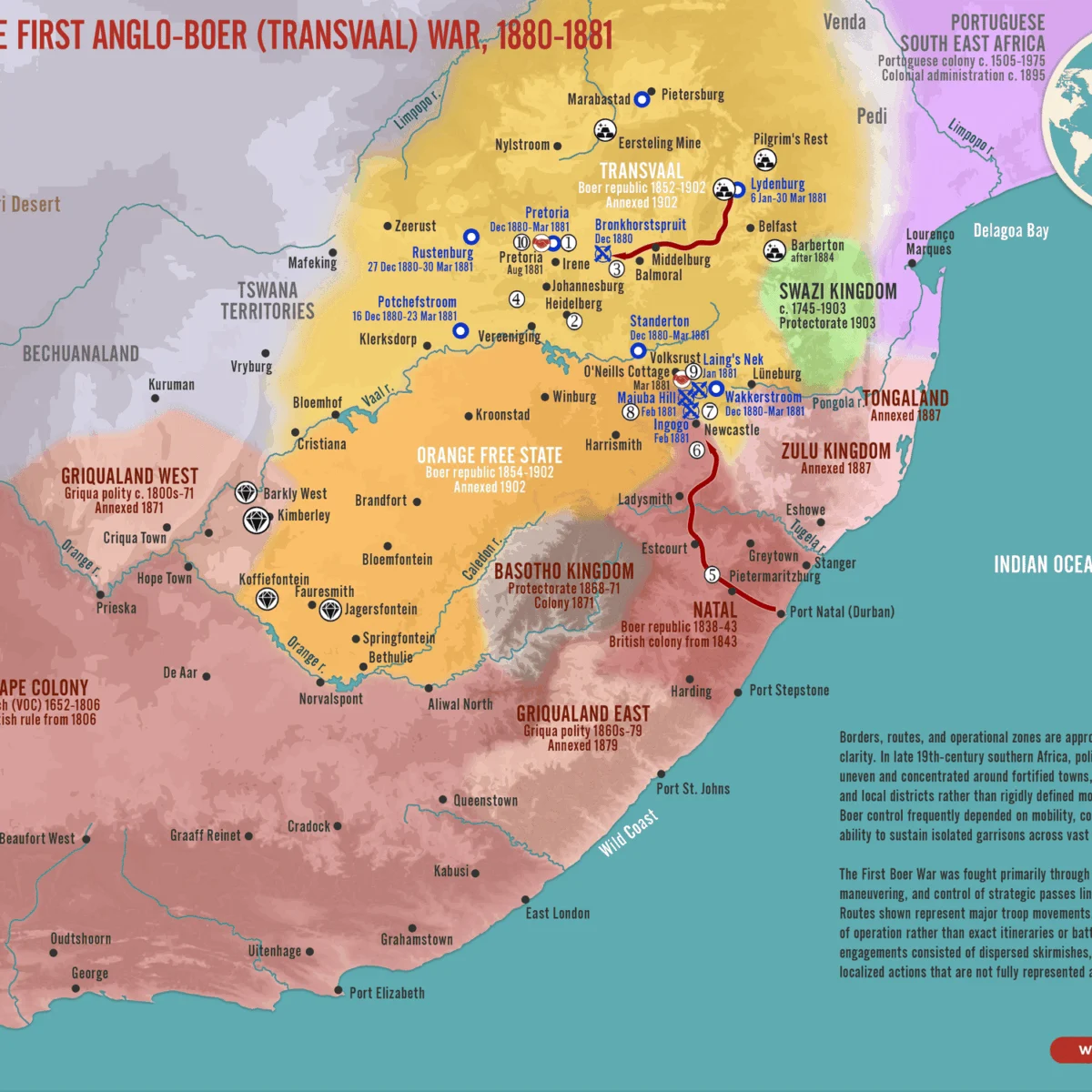
PRETORIA, SOUTH AFRICA – [Current Date, e.g., June 8, 2026] – The 19th century in Southern Africa was a crucible of imperial ambition, settler expansion, and indigenous displacement, culminating in two brutal conflicts that profoundly shaped the region’s future: the Anglo-Boer Wars. These wars, fought between British imperial forces and Dutch-descended Boer settlers, laid the foundations for the modern state of South Africa, leaving an indelible legacy of nationalism, racial division, and economic transformation.
This extensive gallery of images and accompanying historical analysis, curated by Mark Cartwright, delves into the intricate story of this rivalry, exploring the motivations, battles, and long-term consequences that continue to resonate today. The conflicts, particularly the Second Anglo-Boer War, proved to be immensely costly, both in terms of human lives and financial resources, sparking widespread debate within Britain itself regarding the moral and economic viability of imperialist foreign policy.
The Genesis of Rivalry: Settlers, Land, and Gold
The seeds of conflict were sown throughout the 19th century as British and Boer settlers, primarily of Dutch, French Huguenot, and German ancestry, frequently found themselves at odds. Both groups were engaged in a relentless push to establish new settlements and secure resources across Southern Africa, often at the direct expense of the region’s diverse African peoples.
The British, having seized the Cape Colony from the Dutch in 1806, steadily expanded their influence, establishing Natal as a colony in 1843. Their imperial objectives were multifaceted: securing vital sea routes to India and the East, exploiting natural resources, and asserting global dominance.
Meanwhile, the Boers, or Afrikaners as they would later be known, harboured a deep-seated desire for independence from British rule, fueled by cultural differences, disputes over slavery, and land ownership. This yearning for self-determination led to a pivotal migration known as the Great Trek.
Chronology of Conflict and Consolidation
The path to war was long and complex, marked by waves of migration, territorial disputes, and the dramatic discovery of immense mineral wealth.
The Great Trek: A Quest for Independence (1830s)
A defining moment in Boer history was the Great Trek of the 1830s. Driven by a desire to escape British administrative control, particularly the abolition of slavery and perceived interference in their way of life, thousands of Boers packed their ox-wagons and migrated northwards and eastwards from the Cape Colony. This arduous journey led to the establishment of new independent republics in the interior.
The Voortrekker Monument in Pretoria, South Africa, stands as a powerful symbol of this migration. A detail of a relief sculpture by Peter Kirchhoff, captured in an image by Anagoria and published on June 5, 2026, vividly depicts the Great Trek, illustrating the determination of the Boers to forge their own destiny away from British authority. These migrations ultimately led to the creation of the Transvaal (formally recognized in 1852) and the Orange Free State (1854), two sovereign Boer republics.
The Discovery of Wealth: Diamonds and Gold (1867-1886)
For decades, the British and Boer entities coexisted, albeit uneasily. However, the discovery of vast mineral riches irrevocably altered the geopolitical landscape. In 1867, diamonds were found near Kimberley, igniting a diamond rush that brought immense wealth and a new wave of European immigrants to the region. Even more significant was the discovery of the world’s largest goldfields on the Witwatersrand in the Transvaal in 1886.
These discoveries transformed the relatively agrarian Boer republics into crucial economic hubs, attracting a flood of "Uitlanders" (foreigners), predominantly British, seeking fortune. This demographic shift and the immense strategic value of the goldfields intensified British imperial interest and generated considerable friction with the fiercely independent Boers. The Boers, led by figures like Paul Kruger, president of the Transvaal, viewed the Uitlanders with suspicion, fearing they would eventually outnumber and politically overpower the original Boer inhabitants, thus undermining their hard-won independence.
The First Anglo-Boer War (1880-1881)
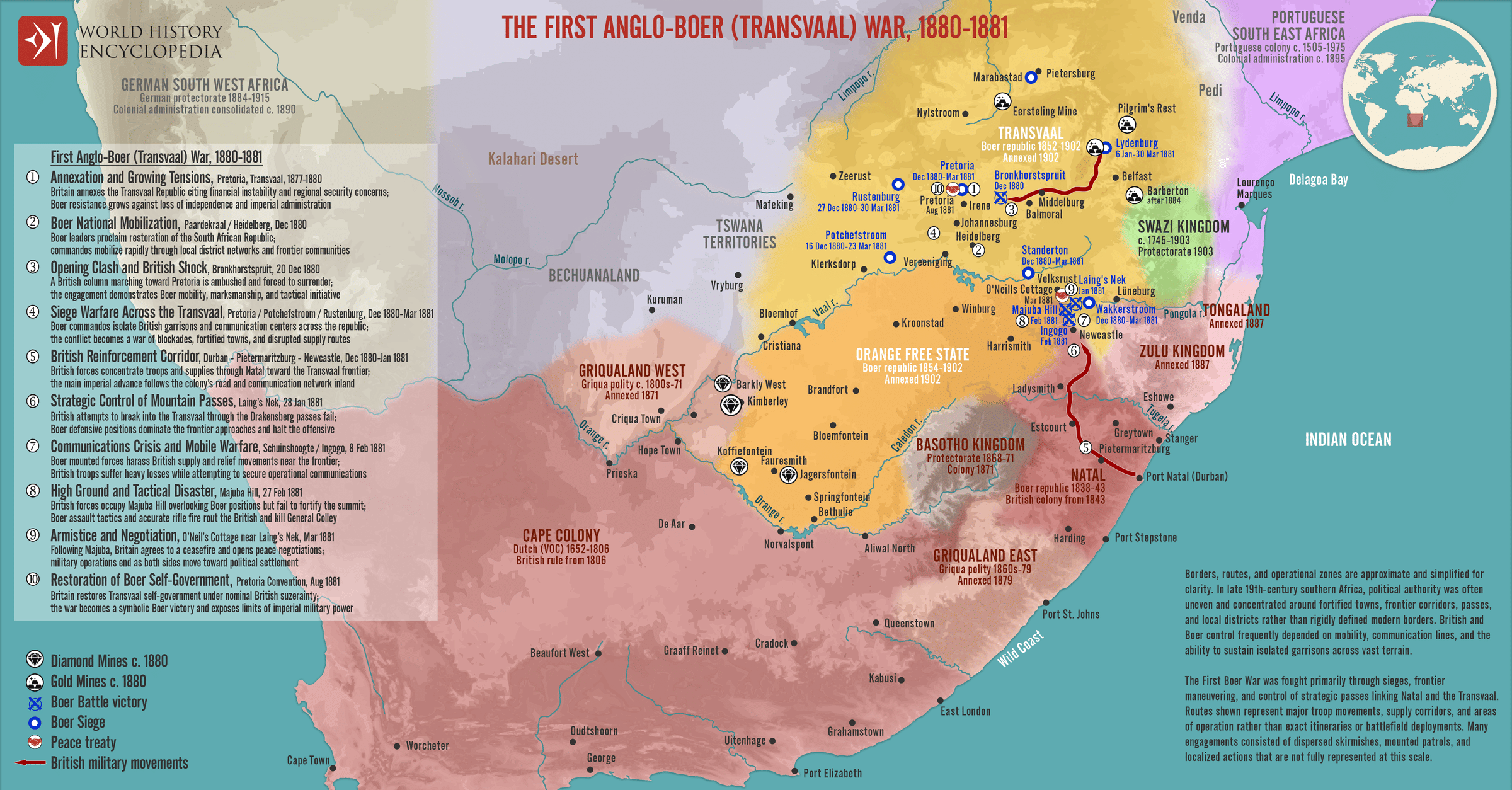
The simmering tensions erupted into open warfare in the First Anglo-Boer War, often referred to as the Transvaal War. The immediate catalyst was the British annexation of the Transvaal in 1877, a move intended to stabilize the region and facilitate a confederation of Southern African states under British control. The Boers, however, resisted this annexation, viewing it as a direct assault on their sovereignty.
The conflict was relatively short and marked by several decisive Boer victories. Utilising their intimate knowledge of the terrain and superior marksmanship, Boer commandos, often mounted and highly mobile, proved effective against the more conventionally organised British forces. The Battle of Majuba Hill in February 1881 was a humiliating defeat for the British, leading to a peace settlement. The British, under Prime Minister William Gladstone, recognized the Transvaal’s self-governance under British suzerainty, a compromise that granted the Boers significant autonomy but did not fully satisfy their aspirations for complete independence. This war served as a crucial learning experience for the British military, highlighting the need for tactical adaptation in colonial warfare.
The Second Anglo-Boer War (1899-1902)
Despite the First War’s outcome, the underlying issues remained unresolved. The vast wealth of the Witwatersrand goldfields continued to fuel British imperial ambitions, spearheaded by influential figures like Cecil Rhodes, who envisioned a continuous British dominion from ‘Cape to Cairo’. The grievances of the Uitlanders in the Transvaal, denied voting rights and subject to Boer laws, provided a convenient pretext for British intervention. Lord Alfred Milner, the British High Commissioner for Southern Africa, actively pursued a confrontational policy, believing that only a decisive show of force would secure British paramountcy.
The Second Anglo-Boer War, also known simply as the Boer War, was a far larger, more protracted, and infinitely more brutal conflict. It unfolded in three distinct phases:
-
Conventional Warfare (October 1899 – January 1900): Initially, the Boers launched pre-emptive strikes into British territory, laying siege to key towns such as Ladysmith, Mafeking, and Kimberley. The British, underestimating the Boers’ military capabilities, suffered a series of early defeats during "Black Week" in December 1899. However, massive reinforcements from across the British Empire, led by commanders like Lord Roberts and Lord Kitchener, eventually broke the sieges and drove the Boers back. By June 1900, the British had captured the capitals of both Boer republics, Pretoria and Bloemfontein, and declared the war over.
-
Guerrilla Warfare (March 1900 – May 1902): The declaration of victory proved premature. The Boers, under new leadership including Louis Botha and Jan Smuts, abandoned conventional tactics and launched a highly effective guerrilla campaign. Their small, mobile commando units harassed British supply lines, ambushed patrols, and attacked isolated garrisons, proving incredibly difficult to pin down.
-
British Counter-Insurgency and Scorched Earth (1900-1902): In response to the tenacious Boer resistance, the British adopted increasingly harsh counter-insurgency tactics. Lord Kitchener implemented a "scorched earth" policy, systematically destroying Boer farms, crops, and livestock to deny resources and support to the commandos. To prevent Boer civilians from aiding the guerrillas, and to manage the vast numbers of displaced persons, the British established a network of concentration camps. Conditions in these camps were appalling, leading to the deaths of tens of thousands of Boer women and children, primarily from disease and malnutrition. An estimated 26,000 Boer civilians, overwhelmingly women and children, and at least 20,000 black Africans confined in separate, often worse, camps perished.
Supporting Data: The Staggering Costs of Empire
The Second Boer War, in particular, exacted an enormous toll on all involved parties.
Economic Costs: The conflict placed a massive financial burden on the British Empire. As noted by the original article, the Second Boer War alone cost Britain an astronomical £200 million. To put this into perspective, this sum is equivalent to approximately £21 billion (or over $26 billion USD) in today’s money, a testament to the sheer scale of the military effort and logistical challenges. This expenditure significantly impacted the British treasury and led to increased taxation. The Boer republics, for their part, were left devastated, with their infrastructure ruined and economies shattered.
Human Costs: The human toll was equally, if not more, devastating:

- British Forces: Approximately 22,000 British and imperial soldiers died, with the vast majority succumbing to disease (typhoid, dysentery) rather than combat wounds.
- Boer Forces: Around 6,000 Boer combatants were killed in action.
- Boer Civilians: The 26,000 deaths in concentration camps represent a tragic loss, primarily women and children, a significant proportion of the Boer population.
- African Civilians: The often-overlooked tragedy of the war was the impact on African populations. Tens of thousands of Africans were caught between the warring factions, serving as labourers, scouts, and combatants for both sides. At least 20,000, and potentially many more, died in separate concentration camps or from the widespread disruption and famine caused by the conflict. Their suffering largely went unrecorded and unrecognized for decades.
Military Innovations: The war saw the widespread use of modern weaponry, including smokeless powder rifles and machine guns, which contributed to high casualty rates in conventional engagements. It also highlighted the effectiveness of guerrilla tactics against a numerically superior, but less agile, conventional army. The British learned hard lessons in logistics, intelligence gathering, and adapting to unconventional warfare, which would influence their military doctrine for years to come.
Official Responses and International Scrutiny
The conduct and outcomes of the Anglo-Boer Wars, especially the second conflict, generated significant "official responses" and public debate both domestically and internationally.
British Government: Initially, the British government, under Primelanders like Lord Salisbury and later Arthur Balfour, maintained a firm stance on imperial expansion and the necessity of securing British interests in Southern Africa. However, the unexpected tenacity of the Boers, the high financial and human costs, and the revelations about the concentration camps led to increasing public and political disquiet. While the war ultimately solidified British control, the moral price was high. The Treaty of Vereeniging, signed in May 1902, brought an end to the war. It stipulated that the Boer republics would surrender their independence and become British colonies, but it also included generous terms for their rehabilitation, including financial aid for reconstruction and the promise of self-government in due course. Crucially, the issue of voting rights for black Africans was left to be decided by the future self-governing colonies, a decision with profound long-term implications.
Boer Leadership: Figures like Paul Kruger and the subsequent commando leaders such as Louis Botha and Jan Smuts demonstrated unwavering resolve in their fight for independence. Their initial strategy was to leverage their knowledge of the land and their highly motivated, citizen-soldier forces. Even after the formal defeat, their continued guerrilla resistance forced the British to negotiate rather than impose an unconditional surrender. The Boer leaders, despite losing their independence, managed to secure significant concessions that preserved their cultural identity and laid the groundwork for their political resurgence in a unified South Africa.
International Reaction: The Second Anglo-Boer War was widely reported across the globe and generated considerable international sympathy for the Boers. Many European nations, particularly Germany, France, and the Netherlands, condemned British actions, viewing them as an example of aggressive imperialism. Public opinion in these countries often sided with the smaller, independent Boer republics against the might of the British Empire. This international criticism, though it did not directly alter the war’s outcome, contributed to a sense of isolation for Britain and fueled anti-imperialist sentiment worldwide.
Implications: A Legacy of Union and Division
The Anglo-Boer Wars had far-reaching implications, shaping not only the political landscape of Southern Africa but also influencing broader imperial policies and anti-colonial thought.
The Union of South Africa (1910)
The most immediate and significant political outcome was the formation of the Union of South Africa in 1910. This act unified the former British colonies of the Cape and Natal with the former Boer republics of the Transvaal and the Orange Free State into a single, self-governing dominion within the British Empire. This union was, in many ways, a compromise between former adversaries, largely driven by a shared desire among white settlers to consolidate power and manage the vast African majority.
While the union brought political stability for the white population, it simultaneously entrenched racial segregation. The provisions of the Treaty of Vereeniging, which deferred the question of African voting rights, were carried into the Union’s constitution. This effectively disenfranchised the black African majority and laid the institutional groundwork for the discriminatory policies that would later evolve into apartheid. The political power dynamic shifted, with former Boer generals like Louis Botha and Jan Smuts becoming the first Prime Ministers, integrating Afrikaner interests into the new state.
Impact on the British Empire
For the British Empire, the Anglo-Boer Wars were a sobering experience. The immense financial cost and the military struggles exposed vulnerabilities within the imperial system. The protracted nature of the conflict and the moral outrage generated by the concentration camps led to a significant questioning of imperialist foreign policy at home.
The economist and social scientist J.A. Hobson (1858-1940) was a prominent voice among those who began to critique imperialism, both from an economic and moral perspective. His influential work, Imperialism: A Study (1902), argued that imperialism was driven by the economic interests of a wealthy elite rather than the welfare of the nation, and that it diverted resources from domestic social reform. The Boer War thus became a catalyst for anti-imperialist movements and debates within Britain, influencing a generation of thinkers and politicians. The war also spurred military reforms within the British army, leading to improvements in training, logistics, and intelligence gathering.

The Rise of Afrikaner Nationalism
For the Boers, the wars, particularly the Second, served to forge a powerful and enduring sense of Afrikaner nationalism. The shared trauma of war, the scorched-earth policy, and the concentration camps became central to their collective memory and identity. This nationalism would play a dominant role in South African politics for decades, leading to the rise of the National Party and the implementation of apartheid in 1948. The Voortrekker Monument, commemorating the Great Trek, later became a powerful symbol of this burgeoning Afrikaner identity and heritage.
Legacy and Modern South Africa
The Anglo-Boer Wars left a complex and often painful legacy. They are remembered for their brutality, the suffering of all populations involved, and their role in establishing a deeply unequal society in South Africa. While the Union of South Africa represented a victory for British imperial ambition in consolidating control, it was a victory that came at a profound human cost and laid the groundwork for a century of racial oppression.
Modern South Africa continues to grapple with the historical reverberations of these conflicts. Efforts are ongoing to acknowledge the suffering of all victims, including the often-forgotten African populations, and to promote reconciliation in a nation still striving to overcome its divided past. The images and narratives from this period serve as a stark reminder of the complexities of colonialism, the devastating consequences of war, and the enduring quest for self-determination and justice.
About the Publisher & Fundraiser
World History Encyclopedia is a non-profit organization dedicated to publishing free, carefully researched, and reviewed history content for a global audience. Our mission is to make reliable historical information accessible to everyone.
To continue providing this invaluable resource, we rely on the support of our readers. It costs approximately $20,000 a year to run our servers and maintain our extensive online library. We are currently in the midst of our Server Costs Fundraiser 2026, and we need your help to reach our goal.
With just 10 days left in the current phase of our fundraiser, we have raised $10,582 towards our $20,000 target. Every contribution, no matter how small, makes a significant difference in ensuring that history remains free and accessible.
If you appreciate the content and resources provided by World History Encyclopedia, please consider donating at www.worldhistory.org/donate/.
To remove promotional messages from printouts and enjoy an ad-free experience, you can also become a supporting member at www.worldhistory.org/membership/.
Thank you for supporting our vital work!