The Alchemy of Dreams: Leonora Carrington’s Mythical Menagerie Manifests in New York
The boundaries between the subconscious and the physical world have rarely been as porous as they were in the mind of Leonora Carrington. A titan of Surrealism who spent much of her life evading the labels of the art establishment, Carrington’s legacy is currently undergoing a massive global reappraisal. At the center of this revival is Shape of Dreams, a landmark exhibition at New York’s L’SPACE Gallery that invites viewers to witness the moment the artist’s painted phantoms stepped off the canvas and into the three-dimensional realm.
Through a collection of large-scale lost-wax bronze sculptures and intricate gold-plated jewelry, the exhibition provides a rare look at the final chapter of a career that spanned nearly a century and multiple continents. It is a testament to an artist who refused to be "sallied by social convention," transforming personal trauma and ancient folklore into a visual language that remains as hauntingly relevant today as it was during the height of the Surrealist movement.
I. Main Facts: From the Pictorial Plane to the Bronze Cast
The Shape of Dreams exhibition, running through late July at L’SPACE Gallery in New York City, marks a significant moment for collectors and scholars alike. While Leonora Carrington (1917–2011) is primarily celebrated for her tempera and oil paintings—intricate, crowded scenes reminiscent of Hieronymus Bosch but infused with Celtic and Mesoamerican mysticism—her sculptural work represents a profound evolution of her artistic "voice."

The Sculptural Transition
The exhibition focuses on Carrington’s late-period exploration of form. The majority of the bronze works on display were cast toward the end of her life, with a select few produced posthumously under the guidance of her estate. These works utilize the ancient "lost-wax" (cire perdue) casting process, a method that allows for extreme detail and texture, capturing the organic, almost tactile nature of her dream-beings.
Key Highlights of the Exhibition
- Large-Scale Bronzes: The gallery features monumental works such as Gato de la Noche (2010) and La Madre de los Lobos (2008). These figures, often standing several feet tall, occupy the room with a totemic, priestess-like presence.
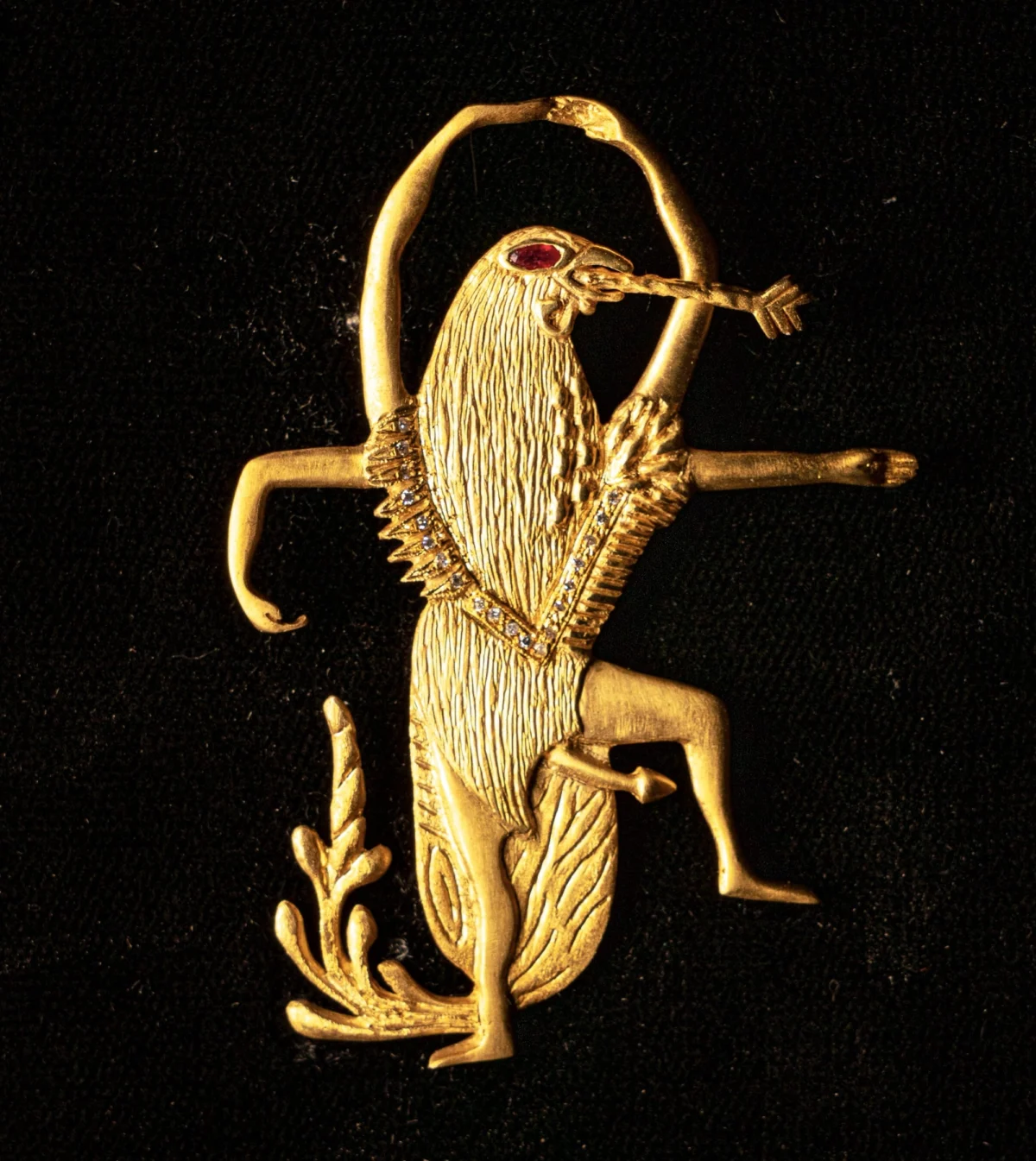
- Wearable Art: In addition to the sculptures, the exhibition showcases Carrington’s venture into jewelry. Pieces like Bailarin, crafted from 24k gold-plate on sterling silver and accented with gemstones, demonstrate her ability to scale her cosmic vision down to the intimate size of a talisman.
- Thematic Consistency: The figures in Shape of Dreams are not new inventions; they are the literal manifestation of the characters that populated her paintings for decades. Cloaked figures, hybrid animal-humans, and masked entities form a silent "procession" through the gallery space.
II. Chronology: The Making of a Rebel Icon
To understand the bronzes in New York, one must understand the tumultuous century that forged the artist. Leonora Carrington’s life was a series of escapes—from the constraints of the British upper class, from the horrors of war, and from the psychiatric institutions that sought to "tame" her imagination.
1917–1935: The Rebellious Debutante
Born into a wealthy textile family in Lancashire, England, Carrington was raised in a world of privilege that she found stifling. Her father, a self-made industrialist, envisioned a life of domesticity and high society for her. However, Leonora was fueled by the Celtic folk tales shared by her Irish mother and grandmother. Her childhood was marked by a series of expulsions from convent schools. Her "antics" became legendary: she practiced writing backward (a Leonardo da Vinci-esque habit) and claimed to be attempting levitation. Despite her father’s insistence that she be presented at the court of King George V as a debutante, Leonora’s gaze was fixed on the avant-garde.

1936–1940: The Surrealist Awakening
The turning point came in 1936 when Carrington attended the International Surrealist Exhibition in London. There, she encountered the work of Max Ernst, a German Surrealist who would become her lover and mentor. She fled to France with Ernst, settling in Saint-Martin-d’Ardèche. During this period, she was integrated into the inner circle of Surrealism, interacting with figures like André Breton, Salvador Dalí, Joan Miró, and Pablo Picasso. While the male Surrealists often viewed women as "femme-enfants" (child-muses), Carrington rejected the role, famously stating, "I didn’t have time to be anyone’s muse… I was too busy rebelling against my family and learning to be an artist."
1940–1942: War, Trauma, and Flight
The onset of World War II shattered her idyllic life in France. After Ernst was arrested by the Gestapo as an "enemy alien," Carrington suffered a psychological breakdown. She fled to Spain, where she was forcibly committed to a psychiatric institution in Santander. The treatments she endured there were harrowing, involving powerful drugs and physical restraint. She eventually escaped her handlers in Lisbon and sought asylum in the Mexican Embassy, marrying the diplomat Renato Leduc to secure her passage to the Americas.
1943–2011: The Mexican Exile and Artistic Maturity
Mexico became Carrington’s true home. There, she found a culture that embraced the supernatural as a part of daily life. Alongside fellow expatriate artist Remedios Varo and photographer Kati Horna, she formed a "three witches" circle of artistic and occult exploration. Over the next six decades, she refined her style, incorporating Mayan mythology and the flora and fauna of Mexico into her work. Her transition into bronze sculpture in her later years allowed her to give her internal mythology a physical, permanent weight.

III. Supporting Data: The Symbology of the Sculptures
The works in Shape of Dreams are dense with symbolic data that bridges the gap between different cultures and psychological states.
The Hybrid and the Mask
A recurring element in the L’SPACE exhibition is the use of masks, as seen in the work Looking In (2010). In Carrington’s world, the mask is not a tool for hiding but a vehicle for transformation. Her "human-animal hybrids," such as Catwoman (2011), reflect her belief in the fluidity of identity. These are not merely decorative figures; they represent the "nagual"—the Mesoamerican belief that a human can transform into an animal counterpart.
Technical Specifications and Provenance
- Gato de la Noche (2010): A lost-wax bronze casting that exemplifies her use of elongated limbs and draped, architectural clothing.
- The Inventor of Atole (2011): This piece (51 x 23 x 31.5 inches) references atole, a traditional Mexican corn-based drink. By titling a surrealist sculpture after a common staple of Mexican life, Carrington grounds her high-fantasy concepts in the reality of her adopted homeland.
- La Madre de los Lobos (2008): A phantasmic figure with oversized hands and a horned headdress, this sculpture serves as a prime example of the "priestess" archetype that Carrington revisited throughout her life.
The "Lost-Wax" Significance
The choice of the lost-wax method for these late works is significant. Because the mold is destroyed during the process, each casting remains a labor-intensive labor of love. This permanence contrasts with the themes of "transience and uncertainty" that the gallery notes were central to her work following her psychiatric internment.

IV. Official Responses: The Gallery and the Critical Lens
The reception of Shape of Dreams has been overwhelmingly positive, with critics noting the "processional" quality of the installation.
L’SPACE Gallery Statement:
The gallery’s curatorial team emphasizes that this exhibition was born of a specific curiosity: "There are exhibitions that begin with scholarship, and there are exhibitions that begin with intuition. Shape of Dreams began with a simple but persistent question: what happens when the fantastical beings that inhabit Leonora Carrington’s paintings step out of the canvas and into our world?"
The gallery further describes the experience as an encounter with a "magical world" where "priestesses, hybrid animals, and dream-beings have entered the gallery space."

The Critical Context:
Art historians have pointed out that Carrington’s late-life turn to sculpture was a way of reclaiming her narrative. By making her dreams three-dimensional and heavy, she ensured they could no longer be dismissed as "feminine whimsy" or mere "illustrations." The sculptures demand physical space and respect, standing as silent guardians of her psychological history.
V. Implications: The Carrington Renaissance
The Shape of Dreams exhibition does not exist in a vacuum. It is part of a broader "Carrington Renaissance" that has swept the international art world over the last three years.
The Global Context
In 2022, the Venice Biennale titled its central exhibition The Milk of Dreams, named after a book of Carrington’s short stories. This catapulted her back into the global spotlight, cementing her status not just as a "female Surrealist," but as a foundational figure of 20th-century art. Simultaneously, the Musée du Luxembourg in Paris is hosting Leonora Carrington: Portrait of a Singular Artist (through July 19), and a major biopic titled Leonora in the Morning Light is currently in development.

The Legacy of the Exile
The implications of Carrington’s work are particularly resonant in the modern era. Her themes of exile, the fluidity of gender and species, and the navigation of mental health crises speak directly to contemporary social concerns. She proved that the "surreal" was not just an art movement but a survival strategy.
As Shape of Dreams concludes its run in New York, it leaves behind a clear message: Leonora Carrington’s world was never meant to be confined to a flat surface. By bringing these figures into our three-dimensional space, the exhibition honors an artist who spent her entire life trying to levitate, writing the secrets of the universe backward, and reminding us that the most profound truths are often found in the shape of our dreams.