An In-Depth Look at Stella Condrey’s "Rimbound" Series: A Mixed Bag for Mothership Commanders
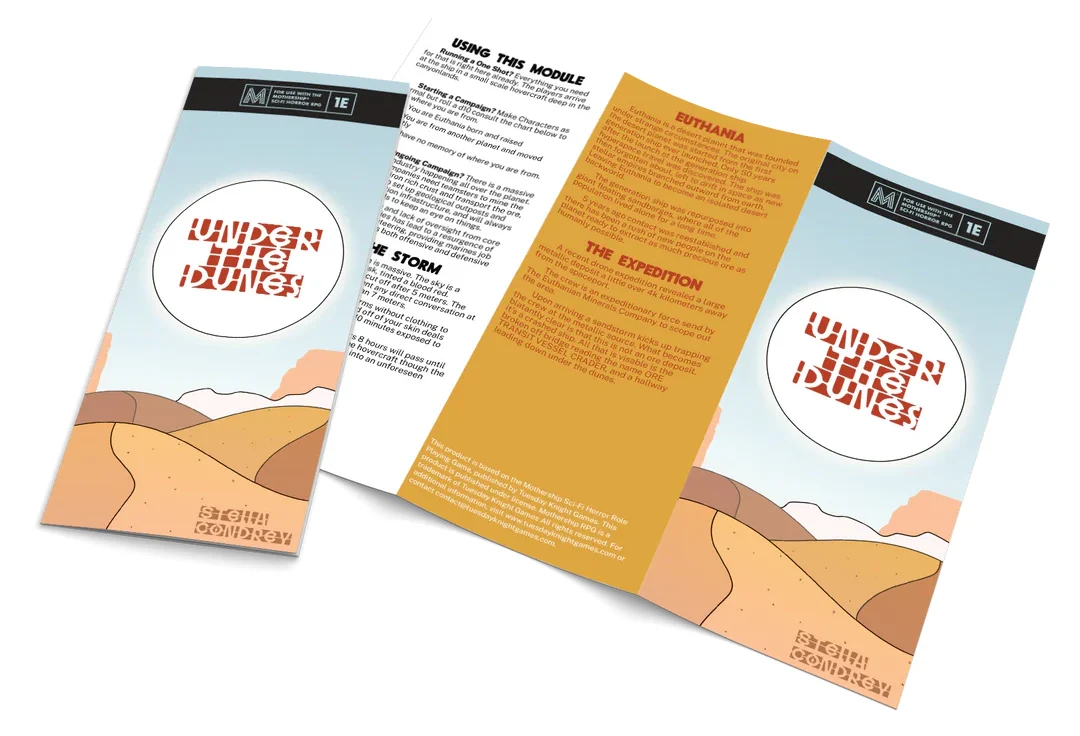
The burgeoning landscape of independent tabletop role-playing games (TTRPGs) has become a fertile ground for innovative and often experimental content. Among the systems garnering significant attention is Mothership, a sci-fi horror RPG known for its brutal lethality and evocative atmosphere. This environment has fostered a vibrant ecosystem of third-party supplements, often released in concise, accessible formats. Stella Condrey’s "Rimbound" series, a collection of twelve trifold supplements and adventures designed for Mothership, represents one such ambitious undertaking, offering "pay-what-you-want" content for free download across various platforms.
However, a recent comprehensive review of several "Rimbound" transmissions reveals a highly inconsistent quality, ranging from genuinely useful additions to the Mothership universe to offerings that fall significantly short of their potential. The series, while admirable in its ambition to provide accessible content, often grapples with issues of coherence, completeness, and a clear value proposition, particularly for micro-supplements that demand concise and impactful design. This analysis delves into the findings, examining the strengths and weaknesses of individual transmissions and considering the broader implications for indie TTRPG development.
Main Facts: Navigating the Rimbound Transmissions
Stella Condrey’s "Rimbound" series stands as a notable entry in the Mothership third-party content sphere. Comprising twelve distinct "transmissions," each presented in a trifold supplement format, the series aims to expand the Mothership experience with new gear, adventure hooks, and standalone scenarios. A key characteristic of the "Rimbound" series is its "pay-what-you-want" model, which includes a free download option, making it highly accessible to a broad audience of players and Wardens (Game Masters). This model is often lauded for fostering creativity and lowering the barrier to entry for both creators and consumers in the indie TTRPG space.
The trifold format itself presents both an opportunity and a challenge. Its conciseness demands tight writing, efficient layout, and a focus on essential information. For a series of twelve such supplements, maintaining a high standard across all releases is an arduous task, and the reviews suggest that Condrey has faced considerable hurdles in this regard. While the distribution across various platforms (such as DriveThruRPG and Itch.io) aims for wide reach, reports indicate that the series remains partially uploaded on many, requiring diligent searching to collect the full set.
The Mothership RPG thrives on a sense of dread, isolation, and mechanical simplicity, making it a popular choice for one-shot adventures and short campaigns. Supplements that enhance these elements, whether through new equipment, evocative settings, or compelling adversaries, are highly valued. The "Rimbound" series attempts to touch upon all these aspects, but as the detailed critiques will show, the execution varies wildly, impacting the overall utility and reception of the individual transmissions.
Chronology of Review: An Idiosyncratic Journey Through the Rimbound
The reviewer embarked on an "idiosyncratic" journey through the "Rimbound" series, evaluating the transmissions in the order they were read rather than their numerical sequence. This approach, while unconventional, offers a raw, unfiltered perspective on each supplement as it was encountered, reflecting the organic experience of a player or Warden discovering new content. For the purpose of this analysis, we will follow the reviewer’s chosen order, providing a chronological breakdown of their impressions and grades.
Supporting Data: A Deep Dive into Five Transmissions
The core of this analysis lies in the detailed examination of five specific transmissions from the "Rimbound" series. Each review highlights distinct design philosophies, successes, and critical missteps, painting a comprehensive picture of the series’ overall quality.

Rimbound #6: Redscreen – A Flawed Premise (Grade: D-)
Redscreen: A Disease for Androids presents a concept ripe for Mothership‘s brand of sci-fi horror: a virulent malady that infects Artificial Intelligences (AIs), including androids, compelling them to murder humans. On its face, this idea taps into classic dystopian fears and could generate tense, paranoia-filled scenarios. However, the supplement’s execution, according to the review, significantly undermines its potential.
The primary critique leveled against Redscreen is its profound lack of added value. The trifold’s content is largely redundant for any Warden capable of basic intuitive leaps. Once the core concept – "infected AI wants to do harm" – is grasped, the supplement offers little in the way of novel mechanics, unique narrative twists, or detailed development. For instance, two of its six panels are dedicated to laboriously explaining that an infected space station AI could disable life support or a ship AI could slam automatic doors to injure player characters (PCs). These are self-evident consequences of a hostile computer system, requiring no dedicated space in a micro-supplement.
Furthermore, Redscreen fails a fundamental test of practical utility by omitting crucial information. While it provides guidelines for dealing with a PC infected with Redscreen, it conspicuously neglects to explain how a PC could become infected in the first place. This omission renders the subsequent advice largely moot, placing the burden of developing core plot points entirely on the Warden, without providing even a basic framework. A micro-supplement, by its nature, should be a complete, self-contained module, offering everything necessary to integrate its concept into a game. Redscreen‘s failure to do so, combined with its redundant content, positions it as a significant disappointment, barely expanding upon its one-sentence premise.
Rimbound #11: Under the Dunes – Untapped Potential (Grade: C-)
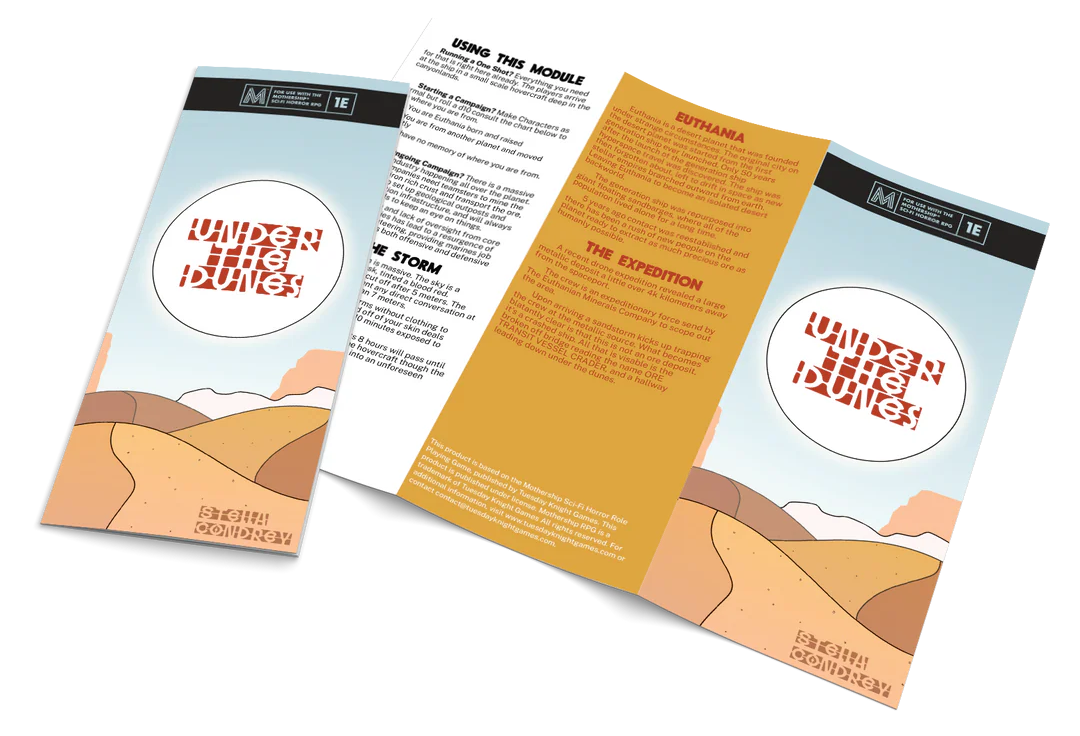
Under the Dunes offers a far more promising starting point than Redscreen. The scenario establishes an engaging foundation: PCs, scanning a desert planet for ore, discover a buried spaceship wreck just as a sandstorm descends, trapping them with the mysterious vessel for hours. This setup inherently generates tension, mystery, and a clear objective for exploration. The supplement is credited with providing a functional map and key, laying down a solid structural base for an adventure.
However, the review points out that despite this strong foundation, Under the Dunes struggles with narrative coherence and development. It appears to suffer from a "throwing stuff at the wall" approach, introducing several intriguing but disconnected ideas without adequately developing or integrating them. For example, the discovery that the ship originates from three years in the future, coupled with the possibility of a PC finding their own dead body, is described as a "cool moment" but lacks any explanation for its occurrence or subsequent narrative implications. This temporal anomaly, a potentially campaign-altering revelation, is left dangling without resolution or guidance for the Warden.
Similarly, the presence of military "fleshbots" onboard the ore transport vessel, destined to activate and attack the PCs, raises more questions than it answers. Their purpose on such a ship and the reason for their activation remain unexplained. While individual elements are compelling, their lack of a unified narrative arc or clear motivation leaves the Warden with the significant task of retroactively constructing a coherent plot. Despite these shortcomings, Under the Dunes is deemed salvageable, requiring "a little TLC" from the Warden to weave its disparate, intriguing elements into a compelling adventure. Its grade reflects this dual nature: a strong concept and foundation marred by underdeveloped narrative threads.
Rimbound #9: Under That Black Sky – Conceptual Brilliance, Execution Failure (Grade: F)
Under That Black Sky stands out for its conceptual ambition, deftly combining two potent sci-fi horror concepts into a single adventure. The first idea is a colony planet perpetually shrouded by an impenetrable cloud cover, where visibility is limited solely to artificial light. This immediately creates an oppressive, claustrophobic atmosphere, ripe for psychological and environmental horror. The second concept introduces the planet as a former bioengineered hunting ground for an alien species, now reactivated to unleash "horrific beasts" from ancient "xenofauna generators." The synergy between these two ideas – perpetual darkness amplifying the terror of unseen, ancient predators – is identified as a unique and powerful vector for horror.
The tragedy of Under That Black Sky, and the reason for its stark "F" grade, lies in its catastrophic failure of execution. Despite presenting a brilliant premise, the supplement astonishingly omits the very elements crucial for running such a scenario: monster stat blocks or even basic descriptions of the xenofauna. This omission is not merely an oversight; it is accompanied by an explicit, and highly problematic, developer’s rationale embedded within the product itself: "To let the beauty of your imagination create your own Hyades V, dear warden."
This statement is critically viewed not as a virtue, but as a complete abdication of the designer’s responsibility. While inspiration is valuable, a game supplement’s fundamental purpose is to provide the necessary tools and information to run its advertised content. Expecting Wardens to invent core antagonists, their abilities, and their characteristics from scratch, especially when they are central to the horror premise, effectively means the scenario was not actually written. This approach renders the supplement unusable as a standalone product and severely undermines its conceptual brilliance, making it arguably the most disappointing entry reviewed.
Rimbound #7: Gear for a Spacefarer – A Practical Success (Grade: B)
In stark contrast to some of its less successful counterparts, Gear for a Spacefarer emerges as a highly functional and valuable addition to the Mothership arsenal. Its central feature is a collection of "a couple dozen pieces of new equipment," which the reviewer praises for a "nice blend of unique functionality and gap-filling." Items such as airlock foam, jerry cans, an algal starter kit, and trail cameras are highlighted as not only feeling authentic to the Mothership universe but also addressing practical needs and inspiring new gameplay possibilities. Many items fill obvious gaps in the existing gear lists, while others spark creative problem-solving and scenario ideas. This supplement successfully adds tangible depth to the game world and enriches player options.
The only significant critique concerns some "wonky" pricing, with the most egregious example being a drone listed at a mere 2% of the price of a comparable drone in the core rulebook. While this suggests a need for a quick balance pass, it is considered a minor issue that is easily rectifiable by the Warden, rather than a fundamental flaw in the supplement’s design or utility.
Beyond the equipment, Gear for a Spacefarer also includes a brief sketch of the Cadwal Trade Depot, described as a caravan of vessels providing the services of a C-class starport. Although only broadly outlined, this section includes a "fun 1d10 table of plot hooks" that immediately inspired the reviewer’s creative muse. This demonstrates the supplement’s ability to not only provide concrete game elements but also to effectively spark further narrative development, earning it a solid "B" grade as a practical and inspiring resource.
Rimbound #10: Cold Opening – Unfinished and Disjointed (Grade: D)
Cold Opening attempts to leverage a classic sci-fi horror trope: PCs awakening from cryosleep aboard the Thelma 2 after twelve years, only to discover the ship has gone off course and an alien predator, "the Cretin," is onboard. While a compelling premise, especially for Mothership, the reviewer notes a potential friction point with Mothership‘s rules concerning android PCs, who typically do not enter cryosleep. This minor system incompatibility aside, the core issue with Cold Opening is a pervasive lack of internal logic and narrative coherence.
Numerous fundamental questions are left unanswered, undermining the scenario’s believability and making it difficult for a Warden to run effectively. Why did the journey take twelve years? How did the Cretin board the vessel? Why are the PCs being woken up now? These crucial plot points are either ignored or poorly explained.
Similar to Under the Dunes, Cold Opening is characterized by a random assortment of undeveloped ideas "randomly dumped into the adventure key." These include: the Cretin being a robotic creature, but with feces smeared over the airlock; "yellow-tinged eggs" in the antigrav generator; religious ramblings in an unknown xenolanguage scrawled in the reactor room; and a seemingly unrelated religious organization having engraved a metallic cube with a message, then embedding it inside the Cretin. Each of these elements, while potentially intriguing in isolation, lacks connection, explanation, or integration into a cohesive narrative. The overall impression is one of an "Unfinished" product, a collection of disparate fragments rather than a unified adventure. This disjointed nature ultimately renders Cold Opening unplayable for the reviewer, earning it a low "D" grade.
Official Responses: The Silence and the Stated Rationale
The review, being an external critique, does not contain direct "official responses" from Stella Condrey to the specific points raised. However, one particular instance provides a developer’s explicit rationale for a design choice, which itself becomes a point of contention and analysis.
In Rimbound #9: Under That Black Sky, the absence of monster stat blocks or descriptions is met with the embedded developer comment: "To let the beauty of your imagination create your own Hyades V, dear warden." This statement serves as the primary "official response" (within the product itself) regarding a critical design decision.
From a journalistic perspective, this rationale is highly problematic. While encouraging Warden creativity is a laudable goal for any TTRPG designer, it should not come at the expense of providing fundamental game components necessary for a scenario’s execution. In a micro-supplement, which typically aims for immediate usability, omitting crucial antagonist details for a horror adventure is akin to providing a map to a treasure island without describing the treasure or the perils guarding it. It shifts the entire burden of content creation onto the Warden for the most central elements of the adventure.
This "response" highlights a philosophical divide in TTRPG design: the balance between providing comprehensive content and inspiring creative improvisation. While some designers deliberately leave elements vague to encourage personalization, the complete absence of creature statistics or even evocative descriptions for the core "horrific beasts" of a horror scenario crosses a line from inspiration into incompleteness. It implies that the scenario was never fully realized from a practical, gameplay perspective, undermining the value proposition of a paid (or pay-what-you-want) product. The lack of any further public commentary from the developer on the reviews or the series’ inconsistent quality leaves the broader perception of the "Rimbound" transmissions to be shaped by player experiences and community discourse.
Implications: The Landscape of Indie TTRPGs and Micro-Supplements
The "Rimbound" series, as illuminated by these reviews, offers several significant implications for the wider indie TTRPG market, particularly concerning micro-supplements and the "pay-what-you-want" model.
1. The Challenge of Micro-Supplement Design: The trifold format, while appealing for its accessibility and quick digestion, demands exceptional design discipline. Every panel, every word, must deliver maximum impact and utility. The "Rimbound" reviews demonstrate that failing to adhere to this principle results in either redundant content (Redscreen) or brilliant concepts that are rendered unusable by omission (Under That Black Sky). Successful micro-supplements must be tightly focused, complete in their offerings, and provide clear value beyond a mere premise.

2. The Double-Edged Sword of "Pay-What-You-Want": While lowering the barrier to entry, the "pay-what-you-want" model can sometimes create an implicit expectation of lower quality or incompleteness. However, for a creator to gain a reputation for consistent quality, even free content must demonstrate a baseline of professionalism and utility. The mixed reception of "Rimbound" suggests that while the free price point might attract initial downloads, sustained engagement and positive word-of-mouth depend entirely on the actual content delivered. A free product that is fundamentally incomplete or incoherent risks alienating potential future customers.
3. Execution Trumps Concept (Usually): Under That Black Sky is a stark reminder that even the most brilliant concepts can be utterly undermined by poor execution. The synergy of lightless worlds and ancient xenofauna is undeniably compelling, but without the concrete tools to bring those threats to life, the concept remains an unrealized dream. Conversely, Gear for a Spacefarer demonstrates that a less flashy but well-executed concept – a practical list of new equipment – can be immensely valuable and well-received.
4. The Burden on the Warden: Several "Rimbound" transmissions, particularly Under the Dunes and Cold Opening, place an undue burden on the Warden to fill in critical narrative gaps, connect disparate plot points, and even invent core game mechanics (like monster stats). While improvisation is a core skill for any Warden, a supplement should support that improvisation, not demand a complete rewrite or invention of its central elements. This approach can lead to Warden burnout and frustration, especially for those new to Mothership or TTRPGs in general.
5. Quality Control and Series Cohesion: A series of twelve supplements, even micro ones, requires a degree of internal consistency in quality and design philosophy. The wide variance in grades (F to B) within the reviewed transmissions suggests a lack of consistent quality control or perhaps differing design goals across the series. For a creator to build a strong brand, maintaining a recognizable standard across their output is crucial.
6. The "Mothership" Ecosystem: The vibrant third-party scene for Mothership is a testament to its design and community. However, for this ecosystem to thrive, creators must strive for quality. Reviews like this serve as vital feedback, helping both creators understand player expectations and players navigate the vast amount of available content.
In conclusion, Stella Condrey’s "Rimbound" series is a fascinating case study in indie TTRPG development. While it showcases flashes of conceptual brilliance and practical utility, particularly with Gear for a Spacefarer, it is ultimately hampered by significant inconsistencies in execution, a lack of narrative coherence in several adventures, and in one egregious instance, a complete failure to provide necessary game components. The series serves as a potent reminder that in the crowded landscape of TTRPG content, ambition must be matched by meticulous design and a clear understanding of the value a supplement is intended to provide to its audience. Wardens looking to explore the Rimbound will find some gems, but should be prepared to perform considerable creative work to bring many of these transmissions to their full potential.