Uncanny Magazine Unveils Highly Anticipated Issue 71: A July/August Extravaganza of Speculative Fiction
FOR IMMEDIATE RELEASE
[City, State] – July 2, 2026 – Uncanny Magazine, the acclaimed recipient of multiple Hugo, Locus, and World Fantasy Awards, is set to release its 71st issue on July 7, 2026. This forthcoming issue promises an unparalleled collection of speculative fiction, poetry, essays, and interviews, further cementing the magazine’s reputation as a vanguard of the genre. Readers can anticipate a rich tapestry of narratives and insightful commentary, delivered through a multi-stage release designed to maximize accessibility and engagement.
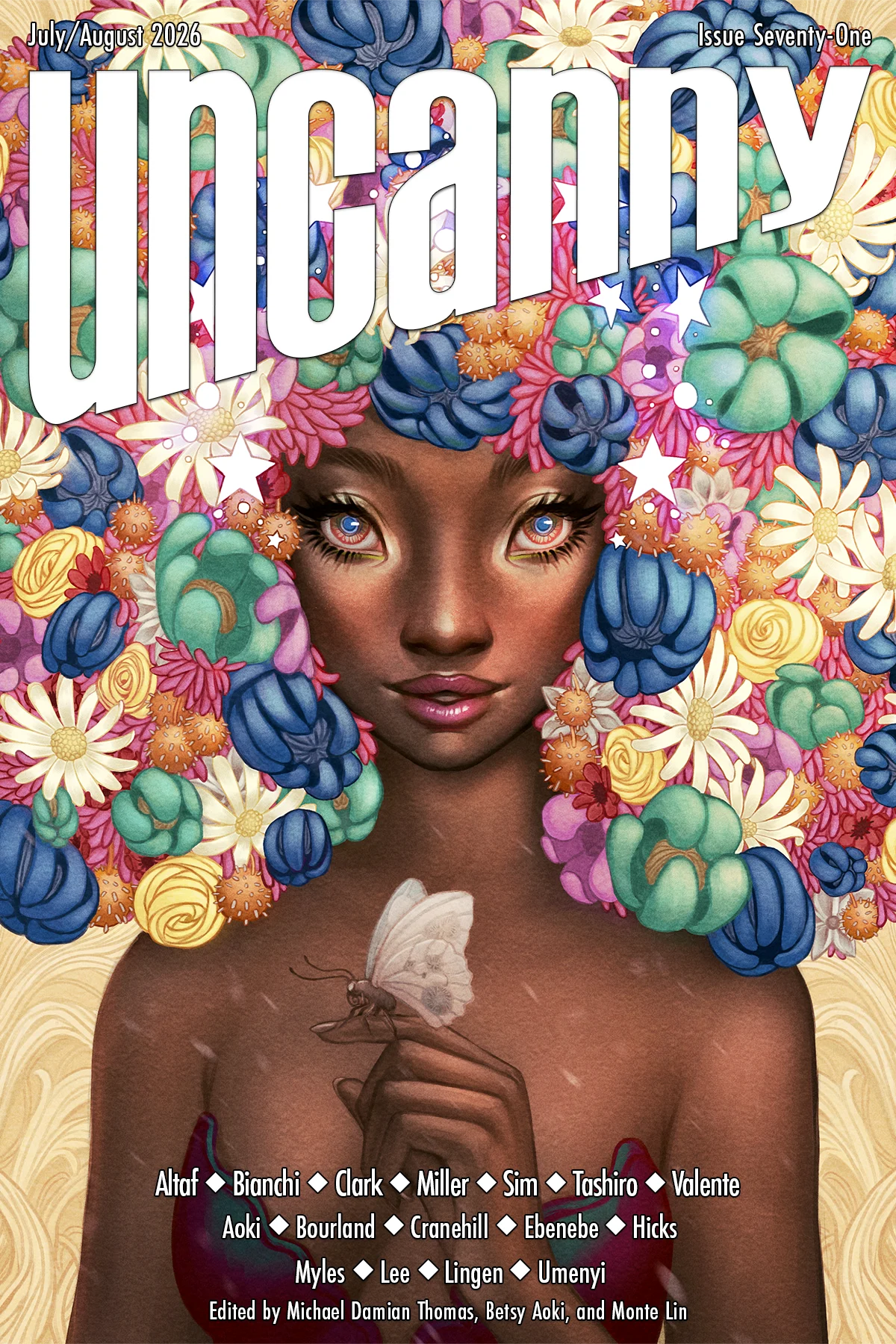
Issue 71, covering July/August 2026, features a stunning cover art piece titled "Flower Crown" by the immensely talented Ejiwa "Edge" Ebenebe, immediately setting a tone of vibrant imagination and profound beauty. The complete content will be available in eBook format on the primary release date, July 7th, while free online content will be strategically staggered, with the first half appearing on July 7th and the remainder on August 4th. This bifurcated approach ensures both immediate gratification for subscribers and broad accessibility for the wider speculative fiction community.
The magazine’s consistent dedication to showcasing diverse voices and groundbreaking stories has earned it a revered position within the literary world. With a lineup that includes both established titans and emerging talents, Issue 71 is poised to be another landmark publication, offering readers a deep dive into the extraordinary and the thought-provoking.
Main Facts: A Beacon of Award-Winning Speculative Fiction
Uncanny Magazine stands as a titan in the speculative fiction landscape, a status meticulously built through consistent quality and an unwavering commitment to innovative storytelling. Its impressive collection of Hugo, Locus, and World Fantasy Awards is not merely a testament to critical acclaim but a reflection of its profound impact on readers and writers alike. These accolades underscore the magazine’s role in defining the contemporary genre, consistently pushing boundaries and challenging conventional narratives.
The core facts surrounding the release of Issue 71 paint a clear picture of its significance:
- Publication: Uncanny Magazine, Issue 71 (July/August 2026).
- Primary Release Date: July 7, 2026.
- Second Online Release Date: August 4, 2026.
- Awards: The magazine is a multi-award winner, including the prestigious Hugo, Locus, and World Fantasy Awards. This pedigree assures readers of the high caliber of content within its pages.
- Cover Art: "Flower Crown" by Ejiwa "Edge" Ebenebe. The cover, a visually striking and evocative piece, depicts a Black woman with large, honey-gold eyes and blue pupils, her hair a riotous explosion of red, pink, dark blue, green, and yellow flowers and orange thistles. A delicate white butterfly or moth rests on her finger, held gently to her chest, while she wears a shoulder-less bodice of dark crimson and deep green. This imagery immediately signals the magazine’s commitment to artistic excellence and diverse representation.
- Content Availability: The full issue will be available immediately in eBook format for subscribers on July 7th. Free online content will be released in two phases: half on July 7th and the remaining half on August 4th.
- Subscription & Support: eBook subscriptions are readily available via Weightless Books, providing a convenient way for readers to access each new issue upon release. Additionally, Uncanny Magazine actively seeks community support through its Patreon campaign, a vital mechanism for sustaining independent publishing and fostering the arts.
This blend of critical recognition, artistic vision, and a clear content strategy positions Issue 71 as a must-read for enthusiasts of speculative fiction and a cornerstone publication for the summer of 2026.
Chronology of Content Release: A Phased Journey into the Uncanny
The release strategy for Uncanny Magazine Issue 71 is meticulously designed to cater to different reader preferences while fostering sustained engagement throughout July and August. This dual-phase approach is a hallmark of many independent digital publications, balancing the need for immediate access with the desire to make content widely available.
Phase 1: July 7, 2026 – The Grand Unveiling
On the inaugural release date, readers will gain immediate and comprehensive access to the entire issue through the eBook version. This offers the ultimate convenience for subscribers who prefer to consume the full breadth of content in one sitting, whether on an e-reader, tablet, or computer. The eBook format ensures a cohesive reading experience, allowing for seamless transitions between stories, essays, and poems.
Concurrently, the first half of the issue’s content will be made available for free online. This initial wave is strategically chosen to provide a compelling taste of the issue’s depth and breadth, enticing new readers and satisfying the immediate curiosity of long-time followers. This first batch includes:
- Fiction: "Leavetaking" by Tia Tashiro, "Learning the Loom" by P. Djèlí Clark, and "This Is Just Another Carnaval Love Story" by Jana Bianchi. These stories promise to immerse readers in diverse worlds and narratives.
- Reprint: "White Lines on a Green Field" by Catherynne M. Valente, offering a chance to revisit or discover a celebrated work by a master of the craft.
- Essays: "The Strange Worlds Among Us—of Turing, Trans People, and the Road to Laniakea" by Ryka Aoki and "Doctor Who in an Exciting Adventure with AI Slop 1969 AD" by Lizbeth Myles. These pieces delve into contemporary issues through speculative lenses.
- Poetry: "Instructions for Becoming Fire" by Chisomaga Umenyi and "Six Views of a Speedster" by Gwendolyn Hicks, offering lyrical explorations of complex themes.
- Interview: Caroline M. Yoachim’s interview with P. Djèlí Clark, providing valuable insights into the acclaimed author’s creative process and inspirations.
- Podcast Episode 71A: This audio offering will feature Michael Damian Thomas’s Editor’s Introduction, a reading of Tia Tashiro’s "Leavetaking" by Erika Ensign, Chisomaga Umenyi’s "Instructions for Becoming Fire" read by Matt Peters, and an interview between Michael Damian Thomas and Tia Tashiro. This multimodal approach enhances the reader’s experience, bringing the stories and voices to life.
Phase 2: August 4, 2026 – The Continuing Journey
Exactly four weeks after the initial release, the second half of the free online content will become available. This staggered release keeps the magazine in the public consciousness for a longer period, allowing for renewed discussions and deeper engagement with the issue’s themes. This second wave includes:
- Fiction: "The Cinema of Babel" by Sam J. Miller, "Judar of the Island: A Story Told in Four Feasts" by Rida Altaf, and "A Hundred Ways the Story Ends" by Tara Sim. These stories complete the issue’s fictional offerings, promising further journeys into imaginative realms.
- Essays: "This Is Not About AI" by Hana Lee and "Middle-Aged Love: Rereading in Your Forties and Beyond" by Marissa Lingen. These essays continue the intellectual exploration, touching on technology and the personal experience of reading.
- Poetry: "I called the swan down" by Laura Cranehill and "enough johnnie blue" by E. A. Bourland, adding further poetic depth to the issue.
- Interview: Caroline M. Yoachim’s interview with Rida Altaf, offering another perspective into the mind of a contributing author.
- Podcast Episode 71B: The second podcast episode will include the Editor’s Introduction, a reading of Sam J. Miller’s "The Cinema of Babel" by Matt Peters, Laura Cranehill’s "I called the swan down" read by Erika Ensign, and an interview with Sam J. Miller conducted by Michael Damian Thomas.
This chronological rollout ensures that Uncanny Magazine Issue 71 provides a sustained literary experience, inviting readers to return and discover new layers of storytelling and commentary over the course of the summer.
Supporting Data: Delving into the Rich Tapestry of Issue 71’s Table of Contents
The true heart of any literary magazine lies in its table of contents, and Issue 71 of Uncanny Magazine presents a meticulously curated selection that exemplifies the publication’s commitment to excellence, diversity, and imaginative depth. Each piece, from the visual art to the spoken word, contributes to a cohesive yet varied reading experience.
The Visual Gateway: "Flower Crown" by Ejiwa "Edge" Ebenebe
The cover art for Issue 71, "Flower Crown" by Ejiwa "Edge" Ebenebe, is more than just an illustration; it’s an invitation into the Uncanny aesthetic. Ebenebe, known for her vibrant, often fantastical portraits that blend traditional African motifs with speculative elements, delivers a piece that is both striking and deeply resonant. The central figure, a Black woman, gazes directly at the viewer, her large, honey-gold irises contrasting with enigmatic blue pupils. This captivating gaze draws one in, suggesting a hidden depth and wisdom.
Her hair is a magnificent explosion of color and organic forms—red, pink, dark blue, green, and yellow flowers intermingled with orange thistles—creating a literal "flower crown" that fills a significant portion of the canvas. This profusion of flora can be interpreted as a symbol of nature’s wild beauty, growth, and perhaps a connection to ancient, powerful forces. The white butterfly or moth delicately perched on her finger, held close to her chest, adds a touch of fragility and grace, possibly hinting at transformation, rebirth, or the delicate balance of life. Her shoulder-less bodice, rendered in dark crimson and deep green, further emphasizes her connection to nature and a sense of regal, untamed elegance.
Ebenebe’s work often celebrates Black identity within fantastical contexts, and "Flower Crown" aligns perfectly with Uncanny Magazine‘s mission to feature diverse voices and perspectives. The cover art itself is a statement, signaling that the stories within will be equally rich, complex, and beautifully rendered.

Editorial Insights: "The Uncanny Valley" by Michael Damian Thomas
The editorial piece, "The Uncanny Valley" by Editor-in-Chief Michael Damian Thomas, promises to be more than just an introduction; it is likely a thematic anchor for the entire issue. The concept of the "uncanny valley," originally from robotics, describes the unsettling feeling aroused by objects that are almost, but not quite, human. In a broader literary context, particularly within speculative fiction, this phrase can represent the discomfort or fascination provoked by narratives that blur the lines between the familiar and the alien, the real and the imagined, or even the comforting and the disturbing.
Thomas’s editorial may explore how the stories, essays, and poems within Issue 71 collectively navigate this space. It could delve into the psychological and philosophical implications of near-human artificial intelligence, the unsettling familiarity of alternate realities, or the deeply personal experience of feeling "uncanny" within one’s own identity or society. Given Uncanny Magazine‘s penchant for emotionally resonant and intellectually stimulating content, the editorial will likely set the stage for a thoughtful exploration of what makes something truly uncanny in both fiction and reality.
Fiction Highlights: A Universe of Narratives
The fiction lineup for Issue 71 is nothing short of stellar, featuring a blend of established award-winners and exciting new voices.
- P. Djèlí Clark ("Learning the Loom") is a Hugo, Nebula, and Locus Award-winning author known for his historical fantasy and alternate history works, particularly his Dead Djinn Universe series. His inclusion guarantees a richly imagined world and intricate storytelling, often infused with cultural depth and incisive social commentary.
- Sam J. Miller ("The Cinema of Babel") is another award-winning author whose work often explores themes of queer identity, social justice, and the darker side of human nature through a speculative lens. His stories are known for their emotional intensity and sharp prose.
- Catherynne M. Valente ("White Lines on a Green Field" – Reprint) is a literary powerhouse, celebrated for her poetic language and fantastical narratives that often reinterpret mythology and folklore. Her reprint signifies a timeless quality and provides an opportunity for readers to experience a foundational piece from a genre giant.
- Other authors like Tia Tashiro ("Leavetaking"), Jana Bianchi ("This Is Just Another Carnaval Love Story"), Rida Altaf ("Judar of the Island: A Story Told in Four Feasts"), and Tara Sim ("A Hundred Ways the Story Ends") promise diverse narrative styles and thematic explorations. From tales of departure and transformation to fantastical love stories and multi-course narratives, the fiction offers a broad spectrum of speculative experiences.
Thought-Provoking Essays: Beyond the Fictional Veil
The essay section consistently provides Uncanny Magazine readers with intellectual sustenance, bridging the gap between imaginative fiction and real-world concerns. Issue 71’s essays tackle highly relevant and timely topics:
- Ryka Aoki‘s "The Strange Worlds Among Us—of Turing, Trans People, and the Road to Laniakea" promises a profound exploration of identity, technology, and humanity’s place in the cosmos, likely drawing connections between Alan Turing’s legacy, the experiences of trans individuals, and the vastness of the universe. Aoki is a celebrated trans author whose work often blends poetry, memoir, and speculative elements.
- Lizbeth Myles‘ "Doctor Who in an Exciting Adventure with AI Slop 1969 AD" is sure to be a witty and critical commentary on the burgeoning and often problematic use of AI in creative fields, framed through the beloved Doctor Who franchise.
- Hana Lee‘s "This Is Not About AI" suggests a nuanced take on technological anxieties, perhaps redirecting the conversation to underlying human issues.
- Marissa Lingen‘s "Middle-Aged Love: Rereading in Your Forties and Beyond" offers a personal and relatable perspective on how our relationship with literature evolves with age, highlighting the enduring power of stories throughout life.
Poetic Reverberations: The Art of Condensed Emotion
Uncanny Magazine‘s poetry selections are always carefully chosen to evoke strong emotions and stimulate thought within a condensed form.
- Chisomaga Umenyi‘s "Instructions for Becoming Fire" suggests themes of transformation, power, and perhaps destruction or rebirth.
- Gwendolyn Hicks‘ "Six Views of a Speedster" implies a multi-faceted examination of a dynamic character or concept, perhaps playing with perspective and perception.
- Laura Cranehill‘s "I called the swan down" evokes mythic or folkloric undertones, hinting at interaction with powerful, perhaps otherworldly, beings.
- E. A. Bourland‘s "enough johnnie blue" is intriguing in its title alone, hinting at a deeply personal narrative or a commentary on exhaustion or longing.
Authorial Voices: Interviews and Podcasts
The interviews and podcasts are invaluable components, offering readers and listeners a direct connection to the creators behind the works.
- Caroline M. Yoachim‘s interviews with P. Djèlí Clark and Rida Altaf provide essential context to their stories, allowing authors to discuss their inspirations, craft, and the deeper meanings embedded in their narratives. These conversations offer a glimpse into the creative process, enriching the reading experience.
- The podcast episodes take this a step further, bringing the written word to life through audio. Readings by talented narrators like Erika Ensign and Matt Peters add another dimension to the stories and poems, allowing listeners to experience the rhythm and emotion of the language in a new way. The inclusion of editor introductions and author interviews within the podcasts creates a holistic audio experience, mirroring the comprehensive nature of the print and digital issues. Michael Damian Thomas’s role as interviewer further connects the editorial vision to the individual artistic contributions.
Together, these elements form a robust and engaging issue that not only entertains but also challenges, inspires, and provokes thought, embodying the very essence of what makes Uncanny Magazine a leader in its field.
Official Responses and Editorial Vision: Nurturing the Speculative Landscape
Uncanny Magazine has consistently demonstrated a clear editorial vision under the leadership of its co-publishers and editors-in-chief, Michael Damian Thomas and Lynne M. Thomas. Their commitment goes beyond merely publishing good stories; it extends to actively shaping the speculative fiction landscape by championing diverse voices, innovative themes, and exceptional craft. The magazine’s repeated success at major industry awards is a direct validation of this vision.
The editorial, "The Uncanny Valley" by Michael Damian Thomas, is not just a perfunctory introduction but a statement of purpose for the issue. It suggests an exploration of themes that reside on the edge of comfort, the familiar-yet-alien, and the profound questions that arise when humanity grapples with advanced technology, evolving identities, and the mysteries of existence. This intellectual framework encourages authors to push boundaries and readers to engage deeply with the material.
Uncanny Magazine operates with a deep understanding of its role in the speculative fiction ecosystem. It’s a platform where emerging talents can stand shoulder-to-shoulder with established masters, fostering a dynamic environment for literary growth. The inclusion of authors like P. Djèlí Clark, Sam J. Miller, and Catherynne M. Valente alongside newer voices like Tia Tashiro and Rida Altaf exemplifies this commitment to both legacy and innovation. The magazine’s careful selection process ensures that every story, poem, and essay meets a high standard of literary merit while also contributing to a broader conversation within the genre.
Furthermore, Uncanny Magazine‘s dedication to accessibility is evident in its tiered release strategy. By offering an immediate, comprehensive eBook and then staggering free online content, it balances the need for financial sustainability (through subscriptions and Patreon) with a desire to make quality speculative fiction available to as wide an audience as possible. This approach reflects a community-minded ethos, recognizing that the health of the genre depends on broad engagement and support.
In essence, the official "response" from Uncanny Magazine is its ongoing output itself: a consistently excellent publication that not only entertains but also reflects, questions, and helps define the evolving world of speculative fiction. Its editorial team doesn’t just curate; they actively nurture the landscape, ensuring a vibrant and diverse future for the genre.
Implications for the SFF Community: Sustaining a Legacy of Imagination
The release of Uncanny Magazine Issue 71 carries significant implications for the broader science fiction and fantasy (SFF) community, reinforcing the vital role of independent, award-winning literary journals in fostering a dynamic and inclusive genre.
Firstly, Uncanny Magazine serves as a crucial proving ground and launchpad for new talent. By publishing alongside established names, emerging authors gain invaluable exposure and credibility. This mentorship by proximity not only elevates their individual careers but also enriches the entire field with fresh perspectives and innovative storytelling approaches. The inclusion of diverse authors, themes, and characters directly contributes to the ongoing conversation about representation and inclusivity within SFF, ensuring the genre continues to evolve and reflect the multifaceted experiences of its global readership.
Secondly, the magazine’s consistent award recognition—Hugo, Locus, World Fantasy—establishes a benchmark for quality within speculative fiction. These awards are not merely accolades; they are indicators for readers, critics, and aspiring writers of where to find the most compelling and thought-provoking work. By maintaining this high standard across 71 issues, Uncanny Magazine reinforces the literary merit of speculative fiction, challenging any lingering perceptions of the genre as niche or less "serious."
Thirdly, the multi-platform and staggered release strategy highlights the adaptability and foresight of independent publishers in the digital age. Offering both immediate eBook access and a phased free online release caters to different consumption habits and economic realities, democratizing access to high-quality fiction. This model demonstrates a commitment to community engagement while also seeking sustainable pathways for independent literary arts, which often operate on thin margins. The emphasis on eBook subscriptions via Weightless Books and community support through Patreon underscores the critical importance of direct reader patronage in sustaining such ventures. In an era where many traditional publishing models face challenges, the success of Uncanny Magazine offers a blueprint for thriving through direct reader relationships.
Finally, the thematic depth explored in Issue 71, from the "Uncanny Valley" to discussions on AI, trans identity, and the reflective act of rereading, demonstrates the relevance of speculative fiction as a tool for social commentary and philosophical inquiry. The genre is uniquely positioned to explore complex societal issues, technological advancements, and the human condition by creating allegories and extrapolations that allow for safe yet profound engagement. Uncanny Magazine consistently leverages this power, ensuring its content is not only entertaining but also intellectually stimulating and socially conscious.
In conclusion, Uncanny Magazine Issue 71 is more than just another issue; it’s a testament to the enduring power of imagination, the strength of independent publishing, and the vibrant, ever-evolving future of speculative fiction. Its release marks another significant contribution to a legacy of challenging, inspiring, and enriching the SFF community worldwide. Readers are encouraged to subscribe, support, and delve into the extraordinary worlds that await within its pages.