Poul Anderson: A Deep Dive into the Epic Science Fiction and Fantasy of a Genre Master
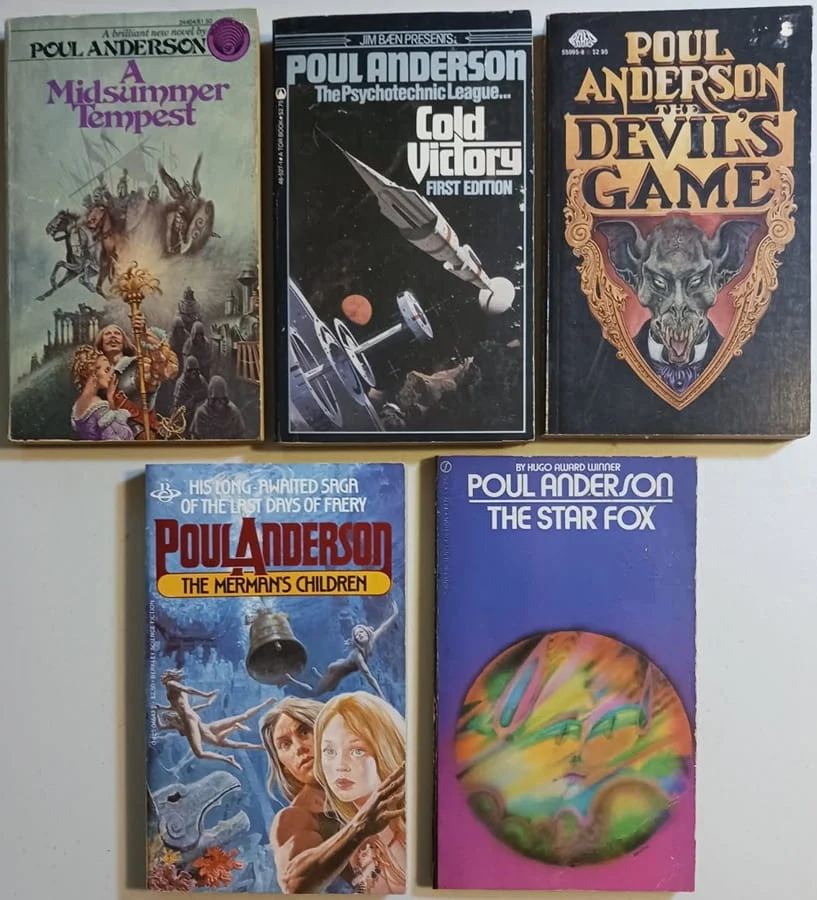
Poul Anderson stands as a towering figure in the annals of science fiction and fantasy literature, a prolific and award-winning author whose works consistently pushed the boundaries of genre while demonstrating a profound understanding of history, mythology, and human nature. This article delves into two of his most iconic novels, The High Crusade and Three Hearts and Three Lions, alongside a selection of his critically acclaimed short fiction, exploring their enduring appeal and significant impact on speculative fiction.
Anderson’s literary career spanned over five decades, marked by an unparalleled versatility that allowed him to craft everything from hard science fiction and space opera to epic fantasy rooted in Norse and European mythologies. His ability to blend intellectual rigor with adventurous storytelling earned him numerous accolades, including multiple Hugo and Nebula Awards, solidifying his reputation as a true master of his craft.
Main Facts: Two Pillars of Anderson’s Oeuvre
At the heart of Anderson’s diverse output lie two novels that perfectly encapsulate his genius across different genres: The High Crusade and Three Hearts and Three Lions. While one is a rollicking, humorous science fiction adventure and the other a foundational work of modern fantasy, both showcase Anderson’s distinctive voice, meticulous world-building, and keen insight into the human condition.
The High Crusade, a science fiction novel, presents a uniquely comedic and inventive premise: a 14th-century English army, poised for war with France, unexpectedly encounters an alien spaceship. What follows is a delightful inversion of typical invasion narratives, as the medieval Englishmen, with their anachronistic but effective military tactics and unwavering faith, manage to capture the vessel and embark on their own interstellar crusade.
Conversely, Three Hearts and Three Lions is a seminal work of high fantasy. It transports a modern (1950s) Earthman, Holger Carlsen, into a parallel medieval world where magic is real, mythical creatures roam, and the cosmic struggle between Law and Chaos dictates destiny. This novel is celebrated for its deep roots in Northern European folklore and its profound influence on the development of the fantasy genre, particularly its alignment systems.
Beyond these novels, Anderson’s short fiction is equally celebrated, demonstrating his command of various narrative forms and his imaginative scope. Collections like Fantasy and The Queen of Air and Darkness highlight his ability to craft compelling tales that often blur the lines between science fiction and fantasy, offering intricate plots and thought-provoking concepts.
Chronology: A Journey Through Publication and Influence
Poul Anderson’s works emerged during a vibrant period for speculative fiction, bridging the "Golden Age" of science fiction with the burgeoning popularity of fantasy. His early serializations in influential magazines like Astounding Science Fiction and The Magazine of Fantasy & Science Fiction placed him at the forefront of genre innovation.
The High Crusade first captivated readers in serialized form across three issues of John W. Campbell’s Astounding Science Fiction from July to September 1960. Its immediate success led to its publication in book form by Doubleday in the same year. Subsequent editions, such as the Berkley Medallion paperback in March 1978, continued to introduce new generations to its unique blend of medieval grit and spacefaring absurdity. The novel’s cover art, often uncredited in early paperback editions, became an iconic representation of its quirky premise.
Three Hearts and Three Lions predates The High Crusade in its initial serialization, appearing in The Magazine of Fantasy & Science Fiction in 1953. It was later released as a standalone novel in 1961. Like The High Crusade, it saw numerous reprints, including a Berkley Medallion edition in April 1978 featuring striking cover art by Wayne Barlowe. A notable 50th Anniversary edition from the Science Fiction Book Club in July 2003 featured artwork by the acclaimed Donato Giancola, underscoring the novel’s lasting literary significance.
These publication timelines illustrate Anderson’s consistent presence in both major genre magazines and mainstream publishing houses, allowing him to cultivate a wide readership and exert considerable influence over the evolving landscape of speculative fiction. His ability to produce compelling narratives across distinct genres simultaneously is a testament to his creative prowess and deep understanding of storytelling.
Supporting Data: Unpacking Themes and Inspirations
Both The High Crusade and Three Hearts and Three Lions are rich tapestries of ideas, meticulously woven with historical, mythological, and philosophical threads.
The High Crusade: Culture Clash and Cosmic Comedy
The brilliance of The High Crusade lies in its central premise: the clash of disparate cultures and technologies. When the advanced Wersgorix aliens land in England in 1345, expecting an easy conquest, they are met not with cowering primitives but with a formidable English army led by Sir Roger de Tourneville. The English, driven by a medieval worldview of divine right and martial prowess, quickly overcome the technologically superior but psychologically unprepared aliens.
Anderson masterfully uses this scenario for both humor and thoughtful commentary. The medieval knights, archers, and squires, completely unburdened by scientific understanding of space travel, adapt their feudal military structure to an interstellar stage. Their "crusade" across the galaxy, driven by a desire to spread their faith and conquer new lands, becomes a satirical mirror reflecting historical colonialism and the inherent absurdity of human conflict. The novel explores themes of human ingenuity, adaptability, and the often-underestimated power of a unified, if anachronistic, purpose. It’s a testament to how human spirit, even when cloaked in chainmail and fueled by medieval logic, can overcome seemingly insurmountable technological gaps.
Three Hearts and Three Lions: Myth, Identity, and the Struggle of Law vs. Chaos
Three Hearts and Three Lions is a cornerstone of modern fantasy, notable for its sophisticated integration of Northern European mythology and its exploration of profound philosophical concepts. The protagonist, Holger Carlsen, a "gigantic" Dane with "yellow hair" and "blue eyes" who fought in the anti-Nazi resistance, awakens in a fantastical parallel world after being shot. This world, an undefined medieval period after 814 A.D., is explicitly divided between the realms of Law and Chaos, humans and Faerie.
Anderson’s author’s note introduces Carlsen, hinting at a potential deliberate contrast with Holden Caulfield from A Catcher in the Rye, suggesting a character forged in the crucible of war rather than adolescent angst. Carlsen’s journey is one of rediscovery, as he slowly realizes he is a reincarnation of Ogier the Dane, a legendary paladin from the Matter of France, destined to fight for Law against the forces of Chaos.
The novel’s world-building is deeply immersive, drawing heavily from Norse and Celtic folklore. Carlsen encounters witches, dwarves (like his guide Hugi), elves, and other supernatural beings, most of whom are aligned with Chaos against humanity. This depiction of Faerie, where the lines between good and evil are complex and often morally ambiguous, is one of the novel’s strengths.
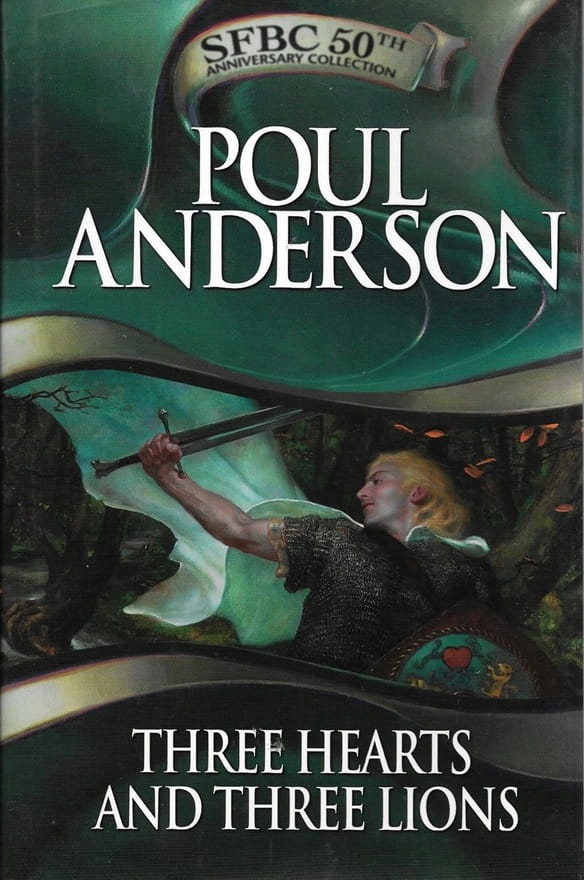
Thematic parallels can be drawn between Three Hearts and Three Lions and Anderson’s earlier, darker fantasy, The Broken Sword. Both feature the land of Faerie, Northern European myths, and the fundamental struggle between Law and Chaos. However, while The Broken Sword delves into an internal war within Faerie, Three Hearts and Three Lions focuses on Carlsen’s external quest, with the Faerie folk largely united against humanity and Law. Anderson’s profound understanding of these mythic structures is evident, a theme he revisited in later works such as Hrolf Kraki’s Saga (1973) and The Last Viking series (1980), cementing his reputation as a master of mythic fantasy. Holger Carlsen, with his martial prowess and unwavering sense of duty, embodies the archetypal Viking warrior found throughout Anderson’s other fantasy epics.
Short Fiction: Diverse Worlds in Miniature
Anderson’s mastery extended well beyond novels, with his short fiction often considered among his finest work. Two collections stand out for their exceptional quality and thematic breadth:
-
Fantasy (Tor, 1981): This collection showcases Anderson’s versatility. It includes "A Logical Conclusion," a prime example of "Sword & Planet" adventure; "Superstition," a unique tale of a future governed by "scientific" magic; and "Interloper," a suspenseful story of Earth’s salvation. Notably, the collection also contains "On Thud and Blunder," a widely celebrated non-fiction essay offering invaluable advice for aspiring fantasy writers on avoiding common pitfalls. His Conan parody, "The Barbarian," featuring "Cronkheit," demonstrates his playful side, even if, as some critics note, it doesn’t quite match the gravitas of his more serious work. The cover art for this first edition is surprisingly uncredited, despite its striking appearance.
-
The Queen of Air and Darkness (Signet, 1973): The title story of this collection is frequently cited as one of Anderson’s greatest achievements, a powerful blend of science fiction and fantasy that explores deep psychological and existential themes. Its intricate plot and evocative style have earned it a place on many "best of" lists. While the other five stories in the collection are good, the title story overshadows them, cementing its status as a masterpiece. Charles Moll provided the memorable cover art for this edition.
Perhaps Anderson’s most personally resonant short story for some readers is "Swordsman of Lost Terra," which appeared in the anthology Swordsmen in the Sky (Ace, 1964), famously featuring cover art by Frank Frazetta. This story, an early entry point into Anderson’s work for many, ignited imaginations with its blend of adventurous spirit and imaginative world-building, a testament to the power of well-crafted short fiction to inspire future writers. The anthology itself is considered a classic of the "Sword & Planet" subgenre.
Official Responses: Critical Acclaim and Enduring Influence
While "official responses" in a journalistic sense typically refer to institutional statements, in a literary context, this translates to critical reception, scholarly analysis, and the broader impact on the genre. Poul Anderson’s works have consistently garnered high praise from critics and fellow authors, earning him numerous prestigious awards, including:
- Hugo Awards: Seven wins for various novels and short stories.
- Nebula Awards: Three wins.
- Gandalf Grand Master Award: In 1978, for lifetime achievement in fantasy.
- SFWA Grand Master Award: In 1998, for lifetime achievement in science fiction.
These awards are direct "official responses" from the science fiction and fantasy communities, acknowledging his profound and lasting contributions.
The High Crusade is lauded for its originality and comedic brilliance, often cited as a prime example of how to inject fresh perspectives into well-worn genre tropes. Its unique blend of historical fiction and space opera has made it a perennial favorite, admired for its witty dialogue and clever plot twists.
Three Hearts and Three Lions is considered a foundational text in modern fantasy. Its depiction of the Law vs. Chaos dynamic, its detailed integration of European myth, and its heroic protagonist profoundly influenced later fantasy writers and the nascent role-playing game industry. Most notably, the alignment system in Dungeons & Dragons owes a significant debt to Anderson’s conceptualization of Law and Chaos, demonstrating a tangible, lasting impact beyond mere literary appreciation. The novel’s ability to create a sense of deep history and mythic resonance within its pages cemented its status as a classic.
The continued publication of his works in various editions, often with new introductions or analyses, further underscores their enduring critical relevance and popular appeal. The fact that cover artists like Wayne Barlowe, Donato Giancola, and Frank Frazetta have contributed to his books also speaks to the artistic merit and iconic status of his narratives.
Implications: Anderson’s Lasting Legacy
Poul Anderson’s legacy is multifaceted and profound. His ability to craft compelling narratives across the vast spectrum of speculative fiction, from the rigorously scientific to the richly mythological, sets him apart. He was a master of world-building, creating universes and parallel dimensions that felt both expansive and intimately detailed.
The High Crusade and Three Hearts and Three Lions exemplify his range and depth. They demonstrate his capacity for both lighthearted adventure and serious exploration of destiny, identity, and moral choice. These novels, along with his celebrated short fiction, continue to entertain, inspire, and challenge readers.
His deep understanding of history, linguistics, and various scientific disciplines allowed him to imbue his stories with an uncommon sense of authenticity, whether he was describing medieval siege warfare or the physics of interstellar travel. More importantly, Anderson was a humanist, consistently exploring the human element within his fantastical and futuristic settings. His characters, whether medieval knights or spacefaring adventurers, grapple with universal questions of courage, loyalty, faith, and the eternal struggle against overwhelming odds.
Anderson’s influence extends to generations of writers who have followed him, drawing inspiration from his intricate plots, nuanced characters, and imaginative concepts. His essays, like "On Thud and Blunder," continue to serve as guiding principles for crafting believable and impactful fantasy.
In an era where genre boundaries are increasingly fluid, Poul Anderson’s work remains a powerful reminder of the enduring power of imaginative storytelling. His ability to weave together disparate elements—be it 14th-century chivalry with alien technology, or modern pragmatism with ancient magic—created unique and unforgettable narratives that continue to resonate with readers today. To delve into the works of Poul Anderson is to embark on an epic journey through the very best of science fiction and fantasy, a testament to a master who truly shaped the genres.
This article is part four in a series exploring the epic science fiction and fantasy of Poul Anderson. For further reading, please see:
- Part One: The Last Viking trilogy
- Part Two: Flandry of Terra and 7 Conquests
- Part Three: The Broken Sword, Hrolf Kraki’s Saga, and Conan