Leah Bodine Drake: Unearthing the Haunting Verse of a Forgotten Master
FOR IMMEDIATE RELEASE
Lexington, KY – [Current Date] – In the annals of American literature, some voices, though profoundly impactful in their time, risk fading into obscurity. One such voice belongs to Leah Bodine Drake, a poet whose lyrical mastery traversed the realms of mainstream literary journals and the shadowy pages of pulp fiction, leaving behind a legacy of haunting verse and an intriguing personal history. Born in 1904, Drake carved a unique niche, her work appearing in publications as diverse as The New Yorker and Weird Tales, a testament to a versatility and talent that defied easy categorization. This article delves into the multifaceted life and enduring influence of Leah Bodine Drake, a writer whose work continues to captivate and whose story offers a compelling glimpse into the literary landscape of the mid-20th century.
Main Facts: A Dual Legacy in Verse and Mystery
Leah Bodine Drake (1904-1964) stands as a significant, albeit often overlooked, figure in 20th-century American poetry, particularly within the horror and speculative fiction genres. Primarily known for her evocative poetry, Drake also contributed a handful of short stories and served as a respected critic. Her work is distinguished by its blend of traditional poetic forms with themes of the macabre, mythology, and ancient dread, earning her a dedicated following among connoisseurs of the weird and fantastic.
Her career spanned several decades, beginning in the mid-1930s. Drake’s poetry found a home in an astonishingly wide array of publications, from the highbrow pages of The New Yorker and The Saturday Evening Post to the pulpy, yet influential, Weird Tales. It was her profound association with Weird Tales—where she published nearly three dozen poems and numerous letters—that cemented her status among aficionados of the genre. Her debut collection, A Hornbook for Witches, published by Arkham House in 1950, is now considered a rare and highly coveted masterpiece, its value escalating to thousands of dollars. The collection’s prestige was further amplified when legendary horror actor Vincent Price released an audio recording featuring four of its poems in 1976.
Beyond her poetic contributions, Drake’s life was rich with diverse experiences, including a stint as a Billy Rose dancer, a decade as a music and theatre critic, and a brief period as a poetry reviewer for The Atlantic Monthly. Despite her death in 1964, her work has experienced a resurgence of interest, culminating in the posthumous 2020 collection, The Song of the Sun: Collected Writings, which reintroduced her powerful verse to a new generation of readers and scholars. Drake’s story is one of a singular artistic vision, navigating both mainstream literary expectations and the burgeoning world of genre fiction with equal grace and unsettling power.
Chronology: A Life Woven in Words and Performance
Early Life and Formative Years (1904-1930s)
Leah Bodine Drake was born on December 22, 1904, in Chanute, Kansas, to Thomas and Cornelia (née Bodine) Drake. Her father’s profession in the oil industry likely provided a stable and comfortable upbringing, a privilege that afforded Leah access to educational opportunities beyond the norm for many women of her era. This foundation allowed her to pursue a robust education, first at the Oakhurst School for Girls in Cincinnati, an institution known for cultivating refinement and intellectual curiosity. Following this, she attended Hamilton College, a junior college under the auspices of Transylvania University in Lexington, Kentucky, and later Sayre College in the same city. These institutions, particularly during the early 20th century, offered a blend of liberal arts education and finishing school sensibilities, shaping her intellectual development and artistic inclinations. While specific details of her early creative endeavors are scarce, it is clear that these formative years laid the groundwork for her eventual turn to poetry.
The Rise of a Poet: From Dancer to Weird Tales (1930s-1940s)
Drake’s professional literary career officially began in 1935 with the publication of her first poem. However, her journey took an unexpected turn earlier in her life. From 1936 to 1937, she appeared as a Billy Rose dancer at the Fort Worth Centennial Exposition. This period of performance offers a fascinating counterpoint to her later, more contemplative poetic life, suggesting a woman of diverse talents and a willingness to embrace varied experiences. The world of a professional dancer in the 1930s was one of glamour and demanding physical artistry, a stark contrast to the solitary pursuit of poetry, yet both required discipline, expression, and a keen sense of rhythm.
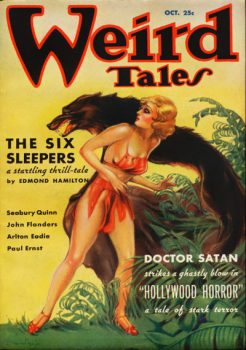
It was in October 1935 that Drake made her debut in the legendary pulp magazine Weird Tales with her poem “In the Shadows.” This marked the beginning of a prolific relationship with the magazine, which would publish nearly three dozen of her poems. Intriguingly, the same issue of Weird Tales also featured the first of eight letters she would have published in its pages. These letters, a window into her passion for the genre, revealed her dedicated pursuit of rare and expensive back issues of the magazine in used bookstores. This personal anecdote underscores her genuine enthusiasm for weird fiction, placing her not just as a contributor but as an active, engaged member of its nascent fandom. Her contributions to Weird Tales were often characterized by their atmospheric quality, drawing on folklore, myth, and gothic traditions to create verses that resonated with the magazine’s unique brand of unsettling fantasy.
Drake’s poetic reach, however, extended far beyond the specialized readership of Weird Tales. Her work graced the pages of a wide variety of magazines, demonstrating her versatility and broad appeal. Publications such as Nature, The Arkham Sampler, The New Yorker, The Saturday Evening Post, The Beloit Poetry Review, and Country Bard all featured her verse. This ability to navigate between the perceived "highbrow" literary world and the burgeoning genre fiction market was a rare feat, signaling a poet whose talent transcended conventional boundaries. Her poem "Ballad of the Jabberwork" was notably included in August Derleth’s influential anthology Dark of the Moon, a collection that featured eight of her poems, further solidifying her reputation within the speculative fiction community.
Critical Acumen and Arkham House Landmark (1940s-1950s)
The 1940s and early 1950s saw Drake expand her professional activities. From 1941 through 1951, she leveraged her keen artistic sensibility as a music and theatre critic for the Evansville Courier. During this decade, she also served as the editor of The Baton, a monthly newsletter for the Evansville Philharmonic Orchestra, where she was also a board member. These roles showcased her intellectual rigor and commitment to the arts, allowing her to shape public discourse on cultural matters within her community.
The year 1950 marked a pivotal moment in her literary career with the publication of her first poetry collection, A Hornbook for Witches, by Arkham House. Founded by August Derleth and Donald Wandrei to preserve the legacy of H.P. Lovecraft, Arkham House quickly became the preeminent publisher of horror and fantasy fiction. Drake’s collection, with its eerie verses and evocative imagery, fit perfectly within the publisher’s ethos. However, only 553 copies of A Hornbook for Witches were ever published, with 300 of these allocated to Drake herself. This extremely limited print run has rendered it one of the rarest and most sought-after Arkham House books. Today, copies fetch staggering prices, ranging from $1,433 to $6,250 online, a testament to its enduring artistic value and collector appeal. The book’s legacy was further cemented when, in 1976, legendary actor Vincent Price, known for his iconic roles in horror films, released an audio recording featuring his dramatic readings of four poems from the collection, introducing Drake’s work to an even wider audience.
While primarily a poet, Drake also made a brief foray into prose fiction. Her short story “Time and the Sphinx,” written in 1947, may have seen its first publication in the February 1965 issue of Fantasy and Science Fiction. Other stories include “Whisper Water” (May 1953, Weird Tales), “Foxy’s Hollow” (August 1953, Fantasy Fiction), and “Mop-Head” (January 1954, Weird Tales). These four stories appear to be her only published prose fiction, underscoring her primary dedication to poetry.
Later Years and Enduring Verse (1950s-1964)
The mid-1950s brought significant personal and professional transitions for Drake. In 1953, she relocated from Evansville to Henderson, Kentucky, where she took on the role of a special features writer for the Henderson Gleaner and Journal. This period, however, was also marked by personal loss. Following her mother’s death in 1956, Drake and her father moved to Parkersburg, West Virginia. In Parkersburg, she continued her literary contributions, serving for a year as a poetry reviewer for the prestigious The Atlantic Monthly, a role that further highlighted her critical acumen and standing in the literary world. It was during her time in Henderson that her second collection of poetry, This Tilting Dust, was published by The Golden Quill Press, offering readers another volume of her distinctive verse.
Tragically, Drake’s life was cut short. Her father passed away in 1963, and just over a year later, on November 21, 1964, Leah Bodine Drake succumbed to cancer. She was buried alongside her father in Parkersburg Memorial Gardens in Parkersburg, West Virginia. At the time of her death, she had prepared a third volume of poetry for publication, tentatively titled Multiple Clay. This collection, however, remained unpublished during her lifetime. Decades later, works from Multiple Clay were finally brought to light in the 2020 posthumous volume, The Song of the Sun: Collected Writings, meticulously edited by David E. Schultz, ensuring that her final poetic visions would not be lost to time.
Supporting Data: The Tapestry of Her Influence
The Weird Tales Legacy: A Poetic Cornerstone
Leah Bodine Drake’s deep connection with Weird Tales is central to understanding her legacy. Often dubbed "The Unique Magazine," Weird Tales was a groundbreaking publication that, from 1923 to 1954, became the premier venue for horror, fantasy, and science fiction. It launched the careers of literary giants like H.P. Lovecraft, Robert E. Howard, and Clark Ashton Smith. For Drake to publish nearly three dozen poems and eight letters in this revered pulp magazine was a significant achievement. Her poetry in Weird Tales often explored themes of ancient mythologies, forgotten gods, spectral landscapes, and the inherent dread within the human condition, resonating deeply with the magazine’s readership. Her letters, which detailed her fervent search for rare back issues, not only provided charming insight into her personal passion but also underscored the magazine’s growing cultural significance as a collectible and influential force in genre fiction. She was not merely a contributor but a true devotee of the weird.
Arkham House and the Horror Canon
The publication of A Hornbook for Witches by Arkham House in 1950 was a pivotal moment, cementing Drake’s place within the emerging horror canon. Arkham House, founded in 1939, was dedicated to preserving the works of H.P. Lovecraft and other writers of "weird fiction." Its publications were known for their quality craftsmanship and limited print runs, making them highly collectible. A Hornbook for Witches perfectly embodied the Arkham House aesthetic: dark, atmospheric, and exquisitely crafted verse that delved into the supernatural. Its extreme rarity—only 553 copies—has elevated it to legendary status among collectors. The escalating market value, with copies routinely selling for thousands of dollars, reflects not only its scarcity but also the enduring appreciation for Drake’s poetic genius and Arkham House’s historical significance.
The connection to Vincent Price further amplified the collection’s prestige. Price, a master of cinematic horror and a connoisseur of the macabre, choosing to record readings from A Hornbook for Witches in 1976, nearly a decade after Drake’s death, speaks volumes about the lasting power and quality of her verse. His endorsement introduced her poetry to a broader audience, bridging the gap between literary appreciation and popular culture, and ensuring her work continued to resonate long after its initial publication. Price’s distinctive voice brought Drake’s chilling verses to life, immortalizing them for generations of horror enthusiasts.
Bridging Mainstream and Genre Poetry
One of the most remarkable aspects of Leah Bodine Drake’s career was her ability to publish across such a wide spectrum of literary magazines. Her simultaneous appearance in Weird Tales and highly esteemed literary journals like The New Yorker and The Saturday Evening Post highlights a versatility rarely seen in her era. This duality suggests that her poetry possessed a quality that transcended the often-rigid boundaries between "literary" and "genre" fiction. While Weird Tales provided an outlet for her darker, more fantastic themes, her work in mainstream publications likely showcased her technical skill, lyrical beauty, and broader thematic explorations, proving her mastery of the craft irrespective of subject matter. This ability to appeal to diverse editorial tastes underscores her exceptional talent and challenges the notion of a strict divide in poetic expression.
The Rarity and Value of Her Works
The scarcity of A Hornbook for Witches is not merely a collector’s anecdote; it is a significant factor in understanding Drake’s literary trajectory. With only 553 copies printed, and a majority given to the author, the book’s initial reach was limited. This rarity, combined with the increasing appreciation for Arkham House publications and the works of overlooked female poets in the horror genre, has driven its market value to extraordinary levels. The prices observed online – ranging from $1,433 to $6,250 – are a clear indicator of its status as a foundational text in horror poetry and a highly prized collectible. This financial value, while secondary to artistic merit, serves as a tangible measure of the book’s cultural importance and the growing recognition of Drake’s unique contribution to American letters.
Official Responses and Critical Reappraisal
Contemporary Reception and Scholarly Interest
During her lifetime, Leah Bodine Drake enjoyed a degree of recognition, evidenced by her extensive publication record across diverse magazines and her roles as a critic and reviewer for prominent publications like The Atlantic Monthly. While comprehensive contemporary critical assessments are not readily available in the provided text, her consistent presence in both popular and literary venues suggests a positive reception from editors and a readership eager for her distinctive voice.
In recent decades, there has been a significant scholarly reappraisal of Drake’s work. Literary historians and critics specializing in speculative fiction, women’s literature, and 20th-century poetry have begun to foreground her contributions. This renewed interest is part of a broader movement to unearth and celebrate forgotten or marginalized voices, particularly those of women writers who navigated the complex literary landscapes of their time. Figures like David E. Schultz, who undertook the extensive work of editing her posthumous collection, are instrumental in this re-evaluation, providing critical context and making her complete body of work accessible to modern audiences.
Posthumous Recognition: The Song of the Sun
The publication of The Song of the Sun: Collected Writings in 2020 was a monumental event in the critical reappraisal of Leah Bodine Drake. This volume, which included works from her previously unpublished third collection, Multiple Clay, served as a comprehensive testament to her poetic output. It allowed scholars and readers to engage with the full scope of her thematic concerns, stylistic development, and artistic evolution. The Song of the Sun not only cemented her legacy but also provided crucial insights into her unfulfilled creative aspirations, offering a more complete portrait of her as an artist. Its release underscored a growing consensus that Drake was a significant figure whose contributions to poetry, particularly within the realms of the fantastic and the macabre, deserve wider recognition and deeper study. This posthumous collection has been vital in establishing her rightful place in literary history.
Implications: A Lasting Resonance
Drake’s Place in Literary History
Leah Bodine Drake’s legacy is multifaceted. She stands as a vital link between traditional lyric poetry and the emerging genre of speculative fiction in the mid-20th century. Her ability to craft technically accomplished verse while exploring themes of cosmic horror, ancient myth, and gothic romance made her a unique voice. She defied easy categorization, challenging the perceived hierarchy between "literary" and "genre" writing decades before such distinctions began to blur. As a female poet navigating a predominantly male-dominated genre like weird fiction, Drake’s success is particularly noteworthy. Her work paved the way for future generations of women writers in speculative fiction, demonstrating that tales of the strange and unsettling could be delivered with profound poetic beauty and intellectual depth. Her contributions enrich the tapestry of American poetry, offering a distinctive blend of the beautiful and the terrifying.
The Enduring Allure of the Macabre in Verse
The continued fascination with Leah Bodine Drake’s work, particularly A Hornbook for Witches, speaks to the enduring power of horror and the macabre when expressed through the refined medium of poetry. Her verse taps into primal fears and universal anxieties, exploring themes that remain relevant across generations. The lyrical quality of her writing elevates these often-dark subjects, transforming them into art that is both unsettling and profoundly beautiful. Drake’s ability to evoke atmosphere, build suspense, and delve into psychological complexities within the confines of poetic form ensures that her work continues to captivate. Her reappraisal highlights the cyclical nature of literary discovery, reminding us that truly resonant art, no matter how briefly overlooked, will ultimately find its way back into the collective consciousness, forever echoing its unique and haunting song.
About the Author of the Original Piece
The original biographical sketch of Leah Bodine Drake, which forms the foundation of this expanded article, was penned by Steven H. Silver. Silver is a highly respected figure in the science fiction and fantasy community, a twenty-two-time Hugo Award nominee, and a veteran publisher and editor. His dedication to documenting literary histories and preserving the legacies of significant authors underscores the importance of figures like Leah Bodine Drake to the broader literary world. Silver’s meticulous research and commitment to genre scholarship provide a credible and invaluable resource for understanding the lives and works of authors who have shaped speculative fiction.