Ninurta: The Evolving Saga of Mesopotamia’s Hero-God of War and Agriculture
[Main Facts]
Ninurta, a deity of immense significance within the ancient Mesopotamian pantheon, stands as a testament to the dynamic evolution of religious belief systems. Identified variously as Ningirsu, Pabilsag, and even linked to the biblical Nimrod, he was revered across Sumerian and Akkadian cultures primarily as a hero-god associated with war, hunting, and the south wind. However, his divine portfolio was far from static. Ninurta’s narrative is unique in its profound transformation: from his earliest appearances in the early 3rd millennium BCE as a local agricultural god of Girsu (as Ningirsu) and Larak (as Pabilsag), he gradually ascended to become a formidable warrior-god, a champion of the gods, and a protector of humanity. This evolution mirrors the societal shifts of Mesopotamia itself, as burgeoning city-states transitioned from agrarian societies to militarized empires engaged in ceaseless campaigns of conquest. Despite his increasingly aggressive nature, Ninurta remarkably retained strong ties to agriculture, healing, and protection, frequently invoked in magical spells against danger and disease, showcasing a complex duality at the heart of his worship.
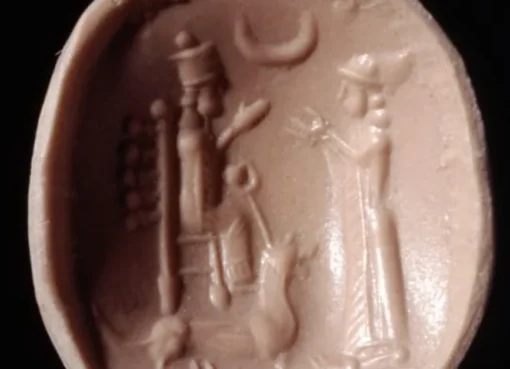
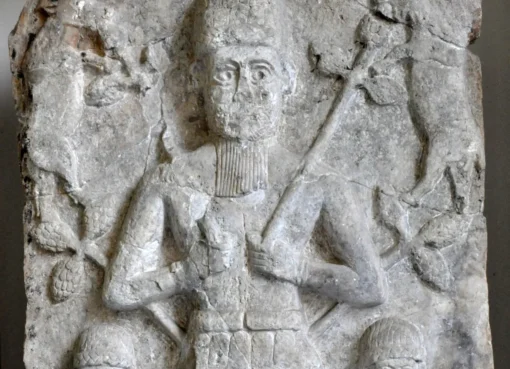
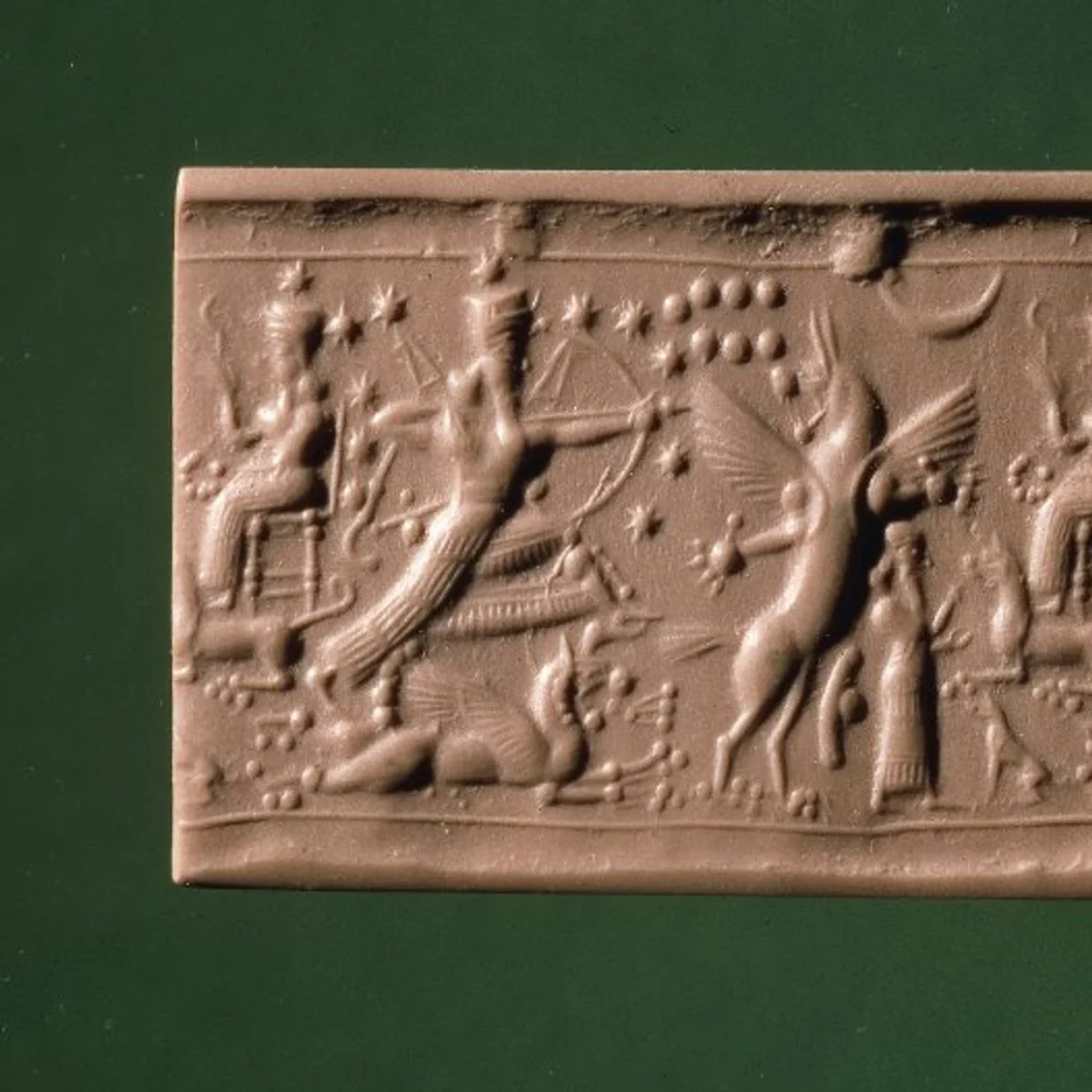
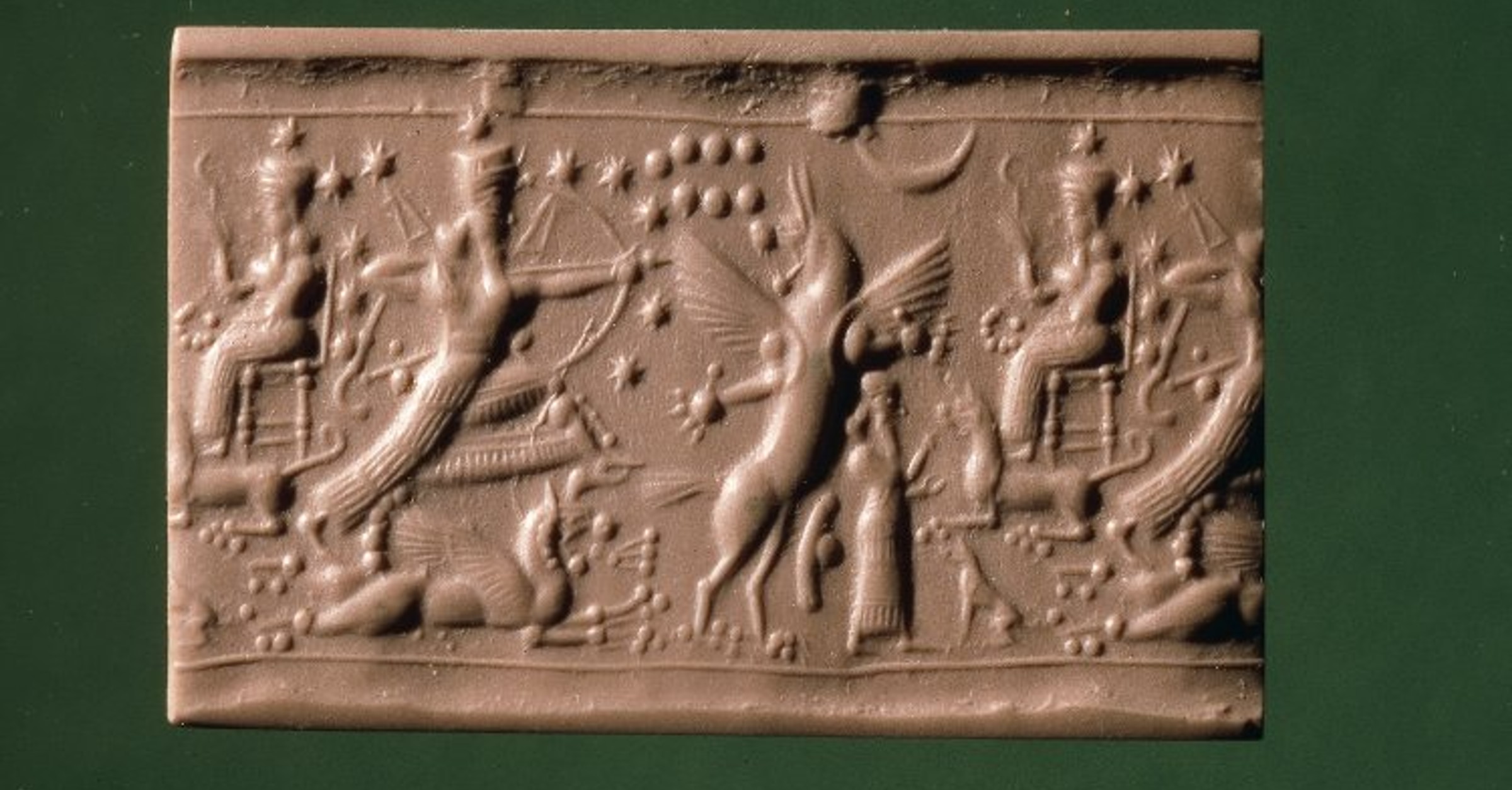
Represented often as a potent warrior, sometimes with magnificent upraised wings, Ninurta typically wielded a bow and arrow and his iconic mace, Sharur—a weapon imbued with the astonishing ability to speak and reason. Babylonian art frequently depicted him standing or running atop a scorpion-tailed lion-beast, an image that solidified his fierce warrior persona. Yet, even as late as 1500 BCE, his agricultural roots persisted, portraying him as a figure capable of immense feats, yet also possessing human-like flaws. This intricate blend of attributes—from nurturing farmer to fearsome conqueror, from divine healer to prideful hero—underscores Ninurta’s enduring relevance and multifaceted appeal throughout millennia of Mesopotamian civilization.
[Chronology]
Ninurta’s journey through Mesopotamian history is a fascinating chronicle of adaptation and reinvention.
- Early 3rd Millennium BCE: Ninurta first emerges in Sumerian texts under the names Ningirsu ("Lord of Girsu") and Pabilsag. During this period, he is primarily an agricultural deity, associated with irrigation and the fertility of the land, serving as the local patron god of the Sumerian towns of Girsu and Larak. His connection to farming is so deep that an ancient Sumerian "farmer’s almanac" would later be titled "The Instruction of Ninurta."
- Mid-3rd to Early 2nd Millennium BCE: As Mesopotamian city-states increasingly engaged in warfare and conquest, Ninurta’s role began to shift. The scholar Stephen Bertman notes this pivotal transformation: "Ninurta began his divine career as a god of irrigation and agriculture… But with the rise of imperialism he was transformed into a young and vigorous god of war." (Bertman, 124). By circa 2600 BCE, the name Ninurta, whose meaning remains unknown, was already in use, though Ningirsu continued to be referenced, especially in Sumerian contexts.
- Reign of Gudea of Lagash (c. 2144-2124 BCE): Gudea, renowned for his piety, dedicated himself to Ningirsu, demonstrating the god’s significant local prominence. Gudea’s successor, Ur-Ningursu, further honored the deity by incorporating his name. The famous Gudea Cylinders, detailing "The Building of Ningirsu’s Temple," highlight the god’s central role in civic and religious life.
- 2nd Millennium BCE (Babylonian Period): Ningirsu, now firmly established as a war god, is a central figure in Babylonian literature, most notably in The Epic of Anzu. This myth would later be revised in the 1st millennium BCE, with Ninurta replacing Ningirsu as the protagonist, signifying the broader adoption and popularization of the name Ninurta across Mesopotamia.
- Neo-Assyrian Empire (c. 912-612 BCE): This period marked the zenith of Ninurta’s worship. The Assyrians adopted Ninurta as the son of their chief god, Ashur.
- Tukulti-Ninurta I (c. 1244-1208 BCE): This early Assyrian king honored the god by taking his name, invoking him in battle, and attributing his military successes to Ninurta’s divine aid.
- Ashurnasirpal II (884-859 BCE): Ninurta’s cult reached its peak under this king. Ashurnasirpal II made the audacious decision to establish a new capital, Kalhu (biblical Calah), and his first major project was the construction of a magnificent temple and towering ziggurat dedicated to Ninurta. Seals from this era often depicted Ashur as a winged disc with Ninurta’s name beneath, suggesting their near-equal status.
- Sargon II (722-705 BCE): Ninurta’s prestige temporarily waned as Sargon II favored Nabu, the god of writing, also considered a son of Assur, moving the capital to Dur-Sharrukin.
- Esarhaddon (681-669 BCE) and Ashurbanipal (668-627 BCE): Ninurta regained prominence under these later Neo-Assyrian kings, frequently mentioned in their royal inscriptions and prayers.
- 612 BCE: With the fall of the Neo-Assyrian Empire to a coalition of invaders, the great cities like Nineveh, Kalhu, and Ashur were sacked. Statues and temples of Assyrian gods, including Ninurta, were destroyed, and his direct worship declined. However, his mythological influence persisted in later cultures.
[Supporting Data]
Ninurta’s rich mythology and tangible legacy provide ample data for understanding his multifaceted nature and profound impact on Mesopotamian civilization.
The Divine Farmer: Ninurta’s Agricultural Roots
Before his transformation into a fierce warrior, Ninurta, as Ningirsu, was deeply embedded in the agrarian rhythms of Sumer. His initial association with irrigation and agriculture was not merely symbolic; it reflected the very lifeblood of early Mesopotamian society. The prosperity of these communities hinged on their ability to harness the waters of the Tigris and Euphrates, making deities like Ningirsu vital for survival.
The most compelling evidence of this agricultural heritage is "The Instruction of Ninurta," the world’s first farmer’s almanac. Dating between 1700 and 1500 BCE, this extraordinary document, spanning 35 lines, reads like a paternal guide. It begins charmingly, "In days of yore a farmer instructed his son…", offering practical advice on soil preparation, planting, pest control, and harvesting techniques. Yet, its conclusion reveals its divine authorship: "These are the instructions of Ninurta, son of Enlil. O Ninurta, trustworthy farmer of Enlil, your praise is good."
As Orientalist Samuel Noah Kramer observed:
"Some of the more far-reaching technological achievements of the Sumerians were connected with irrigation and agriculture. The construction of an intricate system of canals, dikes, weirs, and reservoirs demanded no little engineering skill and knowledge… Farming, too, had become a methodical and complicated technique requiring foresight, diligence, and skill." (Kramer, 104-105)
By attributing this detailed manual to Ninurta, the Sumerians imbued agricultural practices with divine sanction, elevating the laborious task of farming to a sacred art guided by a powerful deity. This not only reinforced Ninurta’s authority but also highlighted the sophisticated understanding of agriculture prevalent in ancient Sumer.
The Warrior’s Ascent: Myths of Conquest and Order
Ninurta’s transition to a warrior-god is vividly portrayed in several key myths, showcasing his role as a protector against chaos and a champion of divine order.
The Epic of Anzu
In The Epic of Anzu, Ninurta confronts the monstrous Anzu bird, a divine creature that dared to steal the Tablets of Destiny from Enlil, the chief god of the pantheon. These tablets were not mere artifacts; they represented the very fabric of cosmic order, holding the fates of gods and mortals and legitimizing the rule of the divine assembly. Anzu’s theft plunged the heavens into disarray, as the other gods cowered in fear.
Ninurta alone rose to the challenge. His initial encounter, however, highlighted the immense power of the Tablets. As he fired his arrows, the Tablets’ power reversed time, causing his weapons to disintegrate mid-flight, reverting to their primal components. Driven back, Ninurta, displaying tactical acumen, invoked the mighty south wind, which tore off Anzu’s wings, forcing the creature to the ground. Ninurta then decisively defeated Anzu, restoring the Tablets of Destiny to Enlil and re-establishing cosmic harmony. This myth firmly cemented his reputation as a formidable warrior capable of confronting existential threats.
Lugale: The Exploits of Ninurta
The Sumerian poem Lugale, or The Exploits of Ninurta, further elaborates on his martial prowess and his role in shaping the physical world. Here, Ninurta faces the demon Asag (or Agag), a monstrous embodiment of sickness and disease dwelling in the underworld. Intriguingly, it is Ninurta’s sentient mace, Sharur, that instigates the conflict, praising its master’s strength and urging him to battle.
Asag, however, is not alone, commanding an army of formidable rock monsters and rebellious plants. Ninurta initially falters, "fle[eing] like a bird," but Sharur’s powerful encouragement—reminding him of past glories and prophesying future fame—reignites his resolve. Ninurta then unleashes his full might, annihilating Asag and his monstrous legions with his mace and bow.
The victory, however, unleashes a new crisis. Asag and his followers had held the primeval waters of the underworld in check. Their defeat caused these brackish waters to surge, threatening to flood the land and render it barren. Ninurta, demonstrating his divine foresight and creative power, took the corpses of his enemies, piling them into a massive wall and then a towering mountain to contain the destructive waters. He then raised the River Tigris, channeling fresh water to irrigate the land. The poem concludes with a celebration of this act of creation:
"Behold, now, everything on earth/Rejoiced afar at Ninurta, the king of the land/The fields produced abundant grain/The vineyard and orchard bore their fruit/The harvest was heaped up in granaries and hills/The lord made mourning to disappear from the land/he made happy the spirit of the gods." (Kramer, 152)
His mother, Ninmah ("Magnificent Queen"), descends from heaven to witness his triumph. Ninurta dedicates the newly formed mountain to her, renaming her Ninhursag ("Lady of the Mountain"). The goddess Nisaba, patron of writing, appears to record these momentous events, and the poem fittingly concludes with a eulogy for writing itself, which preserves such divine deeds for eternity. This myth seamlessly blends Ninurta’s warrior identity with his enduring connection to fertility and the very structuring of the landscape.
The Slain Heroes
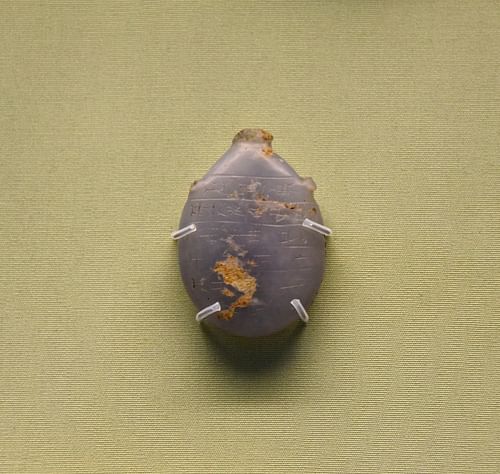
In the Slain Heroes myth, Ninurta faces a series of bizarre and dangerous adversaries: the Six-Headed Wild Ram, the Palm-Tree King, the Strong Copper, and the Seven-Headed Snake. Some of these foes, like the Magillum Boat (which carried souls to the underworld) or Strong Copper (symbolizing valuable materials), are not living creatures but symbolic entities or objects. This narrative, with its sequential trials and victories, bears striking resemblances to the later Greek legend of the Labors of Heracles, suggesting a cross-cultural influence and a shared archetypal hero narrative.
The Flawed Hero: Lessons in Humility
Despite his immense power and heroic deeds, Ninurta is not portrayed as an infallible deity. Like the Greek Heracles, he possesses human-like flaws, particularly pride, which sometimes leads to divine interventions designed to humble him.
Ninurta and the Turtle
The incomplete tale of Ninurta and the Turtle reveals this less flattering side of the hero-god. After his victories against Anzu and Asag, Ninurta is being honored by Enki, the god of wisdom and waters, at his dwelling in Eridu. Enki praises Ninurta’s achievements, but Ninurta, inflated by his triumphs, desires even greater glory, setting his "sights on the whole world."
Perceiving Ninurta’s hubris, Enki fashions a giant turtle and releases it behind the hero. The turtle bites and holds Ninurta’s ankle, and in their struggle, digs an enormous pit into which both fall. Enki then mocks Ninurta from above, asking, "You who made great claims – how will you get out now?" Though the tablet is broken at the conclusion, the intent is clear: to humble Ninurta, force him to recognize his limitations, and teach him to accept praise with gratitude rather than demand ever-greater accolades. This myth offers a profound insight into Mesopotamian understanding of divine character, where even gods could be subject to lessons in humility.
Architectural Grandeur: Ninurta in the Neo-Assyrian Heartlands
The Neo-Assyrian Empire’s adoption of Ninurta marked a significant chapter in his cult. Assyrian kings, masters of propaganda and imperial expansion, strategically integrated deities into their imperial ideology. Ninurta, already a formidable warrior-god, was a natural fit.
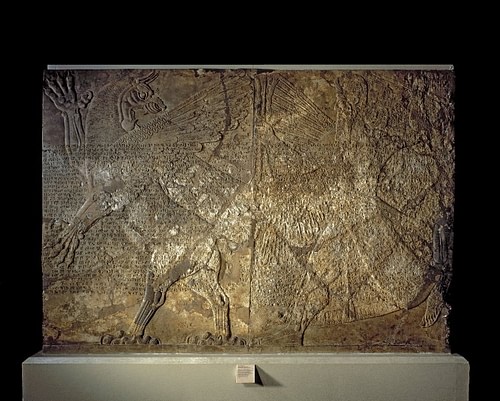
Under Ashurnasirpal II (884-859 BCE), Ninurta’s prominence reached its zenith. The king’s decision to build a new capital, Kalhu (modern Nimrud), was a monumental undertaking, and its centerpiece was the magnificent Temple of Ninurta. This temple was not merely a place of worship; it was a grand statement of imperial power and divine favor. Its walls were adorned with elaborate reliefs depicting Ninurta’s triumphs, particularly the iconic image of Ninurta battling the Anzu bird, an image that remains one of the most recognized Mesopotamian artworks.
This temple complex also served a crucial social function, ministering to the poor, orphans, and the homeless, and providing employment for itinerant laborers. The temple and its towering ziggurat dedicated to Ninurta became symbols of Assyrian might and divine patronage, recognized far beyond Mesopotamia’s borders. The close association between the city and the god was so profound that later Hebrew scribes identified Kalhu with "Calah," a "great city" built by Nimrod, "a mighty hunter" (Genesis 10:8-12), linking Ninurta directly to the biblical figure.
[Official Responses]
The "official responses" to Ninurta’s divinity are best observed through the actions and declarations of Mesopotamian rulers and religious institutions, which actively promoted, interpreted, and utilized his cult to legitimize their power and inspire their people.
From the early Sumerian period, rulers like Gudea of Lagash (c. 2144-2124 BCE) demonstrated profound devotion to Ningirsu, undertaking massive temple construction projects and dedicating themselves to the god. Gudea’s successor, Ur-Ningursu, even incorporated the deity’s name into his own, a clear act of reverence and a strategic move to align royal authority with divine favor. The detailed account of "The Building of Ningirsu’s Temple" on the Gudea Cylinders serves as an official record of this royal piety.
In the Neo-Assyrian Empire, the adoption of Ninurta by the ruling dynasty was even more explicit and politically charged. Kings such as Tukulti-Ninurta I (c. 1244-1208 BCE) not only took the god’s name but also invoked him directly in their military campaigns, crediting Ninurta with their "spectacular military victories." This practice established a direct divine mandate for Assyrian expansion and dominance. Tiglath-Pileser I (c. 1115-1076 BCE) and Adad Nirari II (c. 912-891 BCE) continued this tradition, ensuring Ninurta remained a central figure in royal ideology.
Ashurnasirpal II’s reign marked the most significant official endorsement of Ninurta. His decision to build Kalhu as the new imperial capital and dedicate its grandest structures—the Temple of Ninurta and a towering ziggurat—to the god was a powerful declaration. The extensive wall reliefs depicting Ninurta’s triumphs within the temple served as visual propaganda, reinforcing the king’s divine connection and the empire’s invincibility. The presence of Ninurta’s name beneath a winged disc representation of Assur on seals from this era further suggested an official elevation of Ninurta to near-equal status with the supreme deity of the Assyrian pantheon.
While Sargon II (722-705 BCE) temporarily shifted royal patronage to Nabu, the god of writing, by moving the capital to Dur-Sharrukin, Ninurta’s importance was quickly reinstated by his successors. Esarhaddon (681-669 BCE) and Ashurbanipal (668-627 BCE) frequently mentioned Ninurta in their royal inscriptions, underscoring his enduring role as a divine protector and military patron for the Assyrian state. These official acts demonstrate how deities were not just objects of worship but active participants in the political and military machinery of ancient Mesopotamia.
[Implications]
Ninurta’s multifaceted narrative carries profound implications for understanding ancient Mesopotamian religion, society, and its enduring influence on subsequent cultures.
Firstly, his transformation from an agricultural deity to a warrior-god vividly illustrates the adaptive nature of religious belief in response to societal evolution. As Mesopotamia transitioned from localized agrarian communities to expansive, militaristic empires, the divine attributes of its gods were reshaped to reflect these new realities. Ninurta’s dual identity thus serves as a powerful metaphor for the civilization itself—rooted in the fertility of the land but driven by the ambition of conquest. This dynamic transformation provides a window into the fluid relationship between human experience and divine representation.
Secondly, Ninurta’s complex character, particularly his human-like flaws evident in the Ninurta and the Turtle myth, offers crucial insights into the Mesopotamian understanding of divinity. Unlike distant, infallible supreme beings, Mesopotamian gods often mirrored human emotions, struggles, and learning curves. This relatability made them more accessible and their lessons more potent, suggesting that even divine power required humility and self-awareness.
Thirdly, the extensive architectural projects dedicated to Ninurta, especially under Ashurnasirpal II at Kalhu, underscore the integral role of religion in imperial governance and propaganda. The construction of magnificent temples and ziggurats was not merely an act of piety; it was a deliberate projection of royal power, divine legitimacy, and cultural dominance. These structures served as physical embodiments of the king’s connection to the gods, solidifying his rule and inspiring awe in both subjects and rivals. The social services provided by Ninurta’s temple further highlight the interwoven nature of religious, political, and welfare functions in ancient societies.
Finally, Ninurta’s legacy extends beyond Mesopotamia, influencing later cultural narratives. The striking parallels between the Slain Heroes myth and the Greek Labors of Heracles suggest a diffusion of heroic archetypes across ancient civilizations, demonstrating the interconnectedness of early mythologies. More directly, Ninurta’s identification with the biblical Nimrod ("a mighty hunter") in Genesis 10:8-12, and the association of Kalhu with "Calah" (later Nimrud), illustrates the profound impact Mesopotamian culture had on the nascent traditions of the ancient Near East. This connection, while subject to scholarly debate regarding its precise historical basis (e.g., whether Nimrod refers to Tukulti-Ninurta I or the spirit of Ninurta’s worship under Ashurnasirpal II), firmly links a Mesopotamian hero-god to a foundational text of Abrahamic religions, ensuring his name, albeit altered, continued to resonate for millennia.
In conclusion, Ninurta’s journey from a humble agricultural deity to a preeminent warrior-god, patron of empires, and figure of cautionary tales, offers a compelling narrative of divine evolution. His story is a vibrant testament to the ingenuity, adaptability, and profound spiritual depth of ancient Mesopotamian civilization, leaving an indelible mark on the religious and mythological landscape of the ancient world.