The Porcelain Paradox: Gil Batle’s ‘Double Life’ and the Artistic Synthesis of Incarceration and Freedom
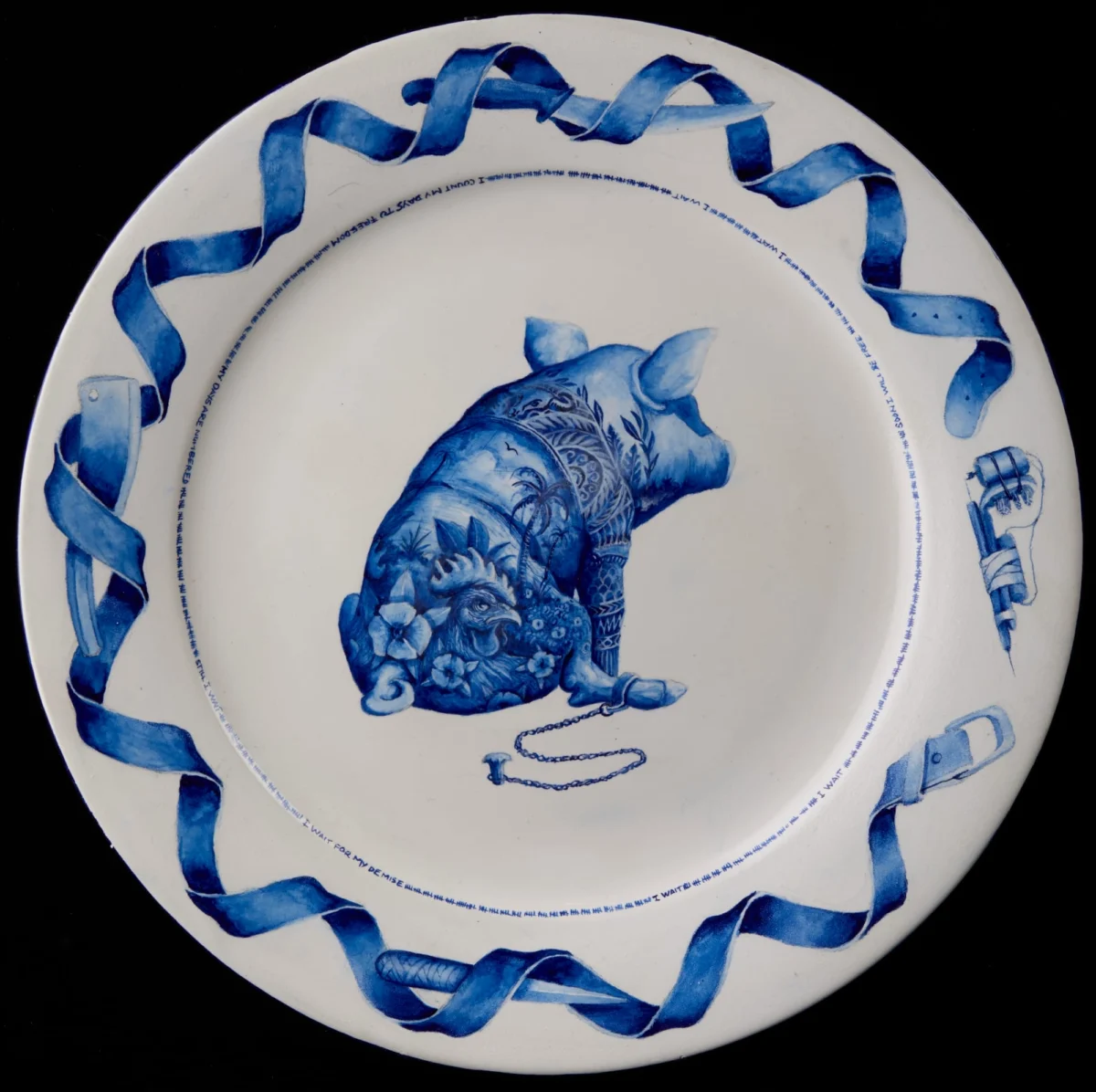
The white porcelain plate is a universal symbol of domesticity, civility, and the quiet rituals of the dinner table. Yet, in the hands of Gil Batle, these fragile discs become the canvas for a harrowing psychological landscape. Batle, a self-taught artist whose creative evolution was forged within the brutal confines of the California penal system, has emerged as a singular voice in contemporary "outsider" art. His latest exhibition, Double Life, currently on view at New York’s Ricco/Maresca Gallery, presents a profound juxtaposition: the lush, vibrant flora and fauna of a remote Filipino island entwined with the jagged, traumatic memories of a quarter-century spent behind bars.
Main Facts: The Intersection of Trauma and Tradition
Double Life is a collection of new works that utilizes blue acrylic on white porcelain plates to explore the dualities of Batle’s existence. The medium itself—porcelain—is a deliberate choice. Historically associated with refinement and the "civilized" world, the material acts as a fragile substrate for imagery that is anything but polite. Batle’s compositions are surreal, unsettling, and meticulously detailed, reflecting a life split between two vastly different realities.
The exhibition, which runs through August 21, showcases Batle’s transition from a clandestine prison artist to an internationally recognized figure in the folk and self-taught art movements. The works are characterized by a "blue and white" aesthetic reminiscent of traditional Delftware or Ming dynasty ceramics, but the pastoral scenes of old are replaced with bird cages, barbed wire, shivs, and shackled figures.

Key pieces in the collection, such as "Barbirusa" (2025) and "The Butcher" (2025), demonstrate Batle’s ability to weave together the biological beauty of his current home in the Philippines with the mechanical cruelty of his past. The use of blue acrylic mimics the ink of the tattoos he once etched into the skin of fellow inmates, further bridging the gap between his former life as a prisoner and his current life as a free man.
Chronology: From the Cell Block to the Gallery
The narrative of Gil Batle’s career is inseparable from the twenty-five years he spent navigating the California prison system. His journey is one of survival through aesthetic expression.
1. The Incarceration Years (Late 20th Century – Early 2000s)
During his decades of confinement, Batle developed his artistic skills out of necessity and a drive for preservation. In the high-stakes environment of California’s maximum-security facilities, art became his currency and his shield. He initially honed his hand by drawing and eventually moved into the clandestine world of prison tattooing.

Working with improvised tools—motors salvaged from cassette players and needles fashioned from guitar strings—Batle became known for his intricate designs. This period was not merely a hobby; it was a "clandestine practice" that allowed him to navigate the complex social hierarchies of the prison yard. The imagery he developed during this time—gang symbols, memorials, and depictions of violence—formed the foundational vocabulary of his later professional work.
2. Migration and Rebirth (The 2010s)
Upon his release, Batle made the pivotal decision to leave the United States and immigrate to the Philippines, his parents’ native country. Settling on a small, lush island, the change in environment was total. The gray concrete and steel of the American carceral state were replaced by tropical greenery, diverse wildlife, and the rhythmic cycles of island life. However, the memories of the "inside" did not fade; they merely found a new way to manifest.
3. The Shift to Fine Art (2014 – Present)
Batle’s transition to the fine art world was marked by his discovery of ostrich eggshells and, later, porcelain as mediums. These materials offered a surface that required the same precision as tattooing but provided a permanence and "preciousness" that his earlier work lacked. His relationship with Ricco/Maresca Gallery in New York solidified his status as a premier "outsider" artist, leading to the development of the Double Life series (2024-2026), which serves as a culminating reflection on his history.

Supporting Data: Symbols of the Carceral and the Natural
The power of Batle’s work lies in its symbolic density. By analyzing the recurring motifs in Double Life, one can quantify the psychological weight of his experiences.
- The Bird Cage: A recurring symbol throughout the exhibition, the bird cage represents the paradox of the prisoner. In works like "Bird Catcher" (2026), cages are shown in abundance, suggesting that even in nature, the threat of confinement remains. The cage is a surrogate for the cell, a space where life is preserved but freedom is extinguished.
- The Porcine Metaphor: Pigs appear frequently in Batle’s work, often in grotesque or anthropomorphic roles. In "Tattooed Pig" (2025), the animal’s hide is covered in the same markings found on inmates, blurring the line between human and beast, and highlighting the "branding" that occurs within the penal system. In "The Butcher" (2025), a headless pig hands a man back his own head, a surreal commentary on the loss of identity and the transactional nature of violence.
- Barbed Wire and Flora: Batle often weaves barbed wire into the roots of trees or the tusks of animals. In "Barbirusa" (2025), the curved tusks of the wild pig are mimicked by the sharp twists of wire, suggesting that in Batle’s world, nature has adapted to incorporate the tools of its own restraint.
The medium of blue acrylic on porcelain also serves as data for the "precarity of life." Porcelain has a high compressive strength but low fracture toughness—much like the human psyche under the pressure of long-term incarceration. It is "breakable," a nod to the lives lost or shattered within the system.
Official Responses and Gallery Context
The art world has responded to Batle’s work with a mixture of awe and critical introspection. Ricco/Maresca Gallery, a bastion for self-taught and folk artists, has positioned Batle as a primary example of how lived experience can bypass traditional academic training to reach a state of profound truth.

Frank Maresca, co-founder of the gallery, has often spoken about the "honesty" found in Batle’s work. The gallery’s mission is to represent artists who operate outside the "mainstream" art historical canon, and Batle fits this mold perfectly. His work is not influenced by art school trends but by the visceral reality of 25 years of survival.
Critics have noted that Batle’s work challenges the viewer’s comfort. By placing scenes of "barbarous acts" on objects usually reserved for fine dining, he forces the observer to acknowledge the violence that underpins modern society. The exhibition has been described by some curators as a "corrective" to the invisibility of the incarcerated population, bringing the horrors of the prison system into the pristine, climate-controlled environment of a Chelsea gallery.
Implications: Art as a Bridge Between Two Worlds
The implications of Gil Batle’s Double Life extend far beyond the walls of the gallery. His work serves as a vital document of the American carceral experience, translated through a lens of surrealism and beauty.

The Therapeutic and Redemptive Power of Art
Batle’s journey suggests that art is not merely an aesthetic pursuit but a survival mechanism. For the incarcerated, the act of creation can be a way to reclaim agency in a system designed to strip it away. Batle’s success provides a narrative of redemption, showing that the "clandestine practices" of the cell block can be transformed into a legitimate and celebrated career.
Challenging the Concept of "Civility"
By utilizing porcelain—a material that symbolizes "propriety" and "tradition"—Batle exposes the hypocrisy of a society that prides itself on civility while maintaining a massive, often brutal, prison infrastructure. The "Double Life" refers not just to Batle’s own history, but to the double life of a nation that celebrates freedom while leading the world in incarceration rates.
The Evolution of "Outsider Art"
Batle’s work pushes the boundaries of what is considered "outsider art." While he is self-taught, his technique is so refined and his conceptual framework so sophisticated that he bridges the gap between folk tradition and high-concept contemporary art. He proves that the "outsider" perspective is not one of lack, but one of a different, more intense kind of presence.

As Double Life concludes its run at Ricco/Maresca, the legacy of the works remains. Gil Batle has managed to do what few can: he has taken the "shackles, barbs, and shivs" of a traumatic past and transmuted them into something fragile, beautiful, and enduring. His plates are no longer just vessels for food; they are vessels for a history that society often prefers to keep hidden, served on a bed of blue ink and white porcelain for all to see.