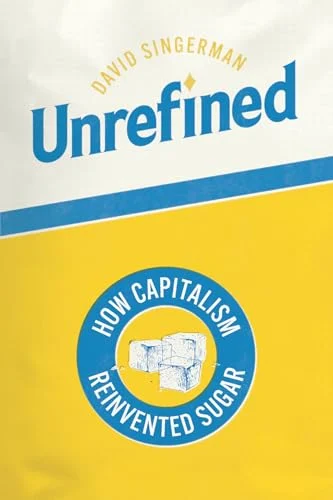
Unrefined Truths: David Singerman’s "Unrefined" Unveils Sugar’s Role in Forging Global Capitalism
FOR IMMEDIATE RELEASE
[City, State] – [Date] – A forthcoming scholarly work promises to redefine our understanding of global economic history, asserting the pivotal role of sugar in shaping the capitalist system we know today. David Singerman, Assistant Professor of History and American Studies at the University of Virginia, is set to release "Unrefined: How Capitalism Reinvented Sugar (Synthesis)" in 2025 through the University of Chicago Press. This 352-page tome, already garnering significant anticipation within academic circles, is described as a "thorough examination" of how imperialism and capitalism leveraged this ubiquitous substance to construct modern global structures.
The book, which has received an early and highly positive review, delves into the intricate connections between sugar production, trade, and consumption, and their profound impact on everything from the domination of nature and the organization of human labor to the evolution of legal frameworks and the very essence of market standardization. Reviewer Carisma Webb, an independent researcher and sociology student at the University of Michigan-Dearborn, praises Singerman’s meticulous research, noting its appeal to historians, academics, and scholars who appreciate dense, unsimplified historical texts. "Unrefined" is poised to become an indispensable resource for understanding the historical underpinnings of contemporary capitalism through the lens of one of its most transformative commodities.
The Sweet, Bitter Origins: A Chronology of Sugar’s Capitalist Reinvention
Singerman’s "Unrefined" is not merely a history of a commodity; it is a meticulously constructed narrative illustrating how sugar’s journey from luxury item to global staple became a crucible for capitalist development. The book’s three parts and eleven chapters unfold a chronological and thematic progression, charting sugar’s trajectory from the brutal realities of colonial plantations to the sophisticated, often deceptive, mechanisms of modern market control.
Part One: The Industrialization of Brutality and Labor
The initial section of "Unrefined" transports readers to the nascent stages of sugar production, primarily focusing on the Caribbean plantations. Singerman meticulously details the "industrialization of the sugar plantation," a process that was fundamentally reliant on the exploitation of enslaved workers. Far from being passive victims, these enslaved individuals possessed invaluable skills and knowledge that often surpassed those of their overseers and planters. Their expertise, particularly in cultivation, processing, and machinery operation, was critical in making the industrial-scale production of sugar possible. This part of the book highlights the paradox of technological advancement hand-in-hand with extreme human subjugation, laying bare how the foundational wealth of "sugar capitalism" was extracted through forced labor and the systematic dehumanization of millions. The narrative here is crucial for understanding how early capitalist ventures were inextricably linked to the transatlantic slave trade and the coercive transformation of natural landscapes into profit-generating engines.
Part Two: Federal Intervention and the Rise of Monopolies
The second part of the book shifts focus from the production site to the corridors of power, examining the "federal aspects" of the burgeoning sugar trade. Singerman explores how government policies, particularly tariffs and related laws, were instrumental in shaping the industry. He reveals how these regulations, ostensibly designed to manage trade or generate revenue, often became tools for powerful entities. Through a detailed analysis, the author illustrates how certain companies skillfully navigated, and often bypassed, these laws, leading to the rapid monopolization of the sugar trade. This section provides a stark illustration of regulatory capture and the formation of powerful cartels, demonstrating how early capitalist markets were far from free and open, but rather sculpted by political influence and economic might. The concentration of power and wealth in the hands of a few through legislative manipulation is a recurring theme that resonates deeply with contemporary economic debates.
Part Three: The Illusion of Purity: Standardization and Its Discontents
The final section of "Unrefined" delves into the concept of standardization, particularly concerning sugar. Singerman scrutinizes the "finicky—and perhaps false—nature of this standardization." He reveals how the drive for uniformity, initially presented as a means of efficiency and quality control, became a mechanism for market manipulation and the imposition of artificial hierarchies. This part of the book is particularly insightful as it connects the physical attributes of sugar—its color, in particular—to broader societal prejudices and power dynamics. The historical obsession with categorization, where "the whitest being the most coveted and the darkest less so," directly mirrored racial hierarchies and colonial attitudes. Western sugar was frequently deemed "purest," while foreign sugar was often devalued, reflecting a systemic bias that extended beyond the commodity itself. Singerman argues that this obsession with categorization and standardization, core to capitalist methodology, inherently creates avenues for corruption and conspiracy, as those with power can arbitrarily redefine the "rules" of quality and value.
Supporting Data: Unpacking the Pillars of Sugar Capitalism
Singerman’s "Unrefined" is a masterclass in interdisciplinary historical analysis, weaving together disparate threads to construct a comprehensive understanding of "sugar capitalism." The book’s strength lies in its ability to connect the tangible aspects of sugar production and trade to broader socio-economic and political phenomena.
Science, Chemistry, and Industrial Innovation: The narrative does not shy away from the scientific and technical complexities of the sugar industry. Singerman explains how advancements in chemistry and the development of sophisticated machinery—from the "top-of-the-line machinery" in Glasgow workshops to the refineries of New York—were crucial for transforming raw sugarcane into a refined, marketable product. This technological evolution, however, was not benign. It intensified the demand for raw materials and labor, pushing the boundaries of exploitation and environmental impact. The book highlights how scientific knowledge was harnessed not just for progress, but for profit, often at immense human cost.
Bureaucracy and Legal Frameworks: The role of bureaucracy in establishing and maintaining the sugar trade is meticulously explored. Singerman demonstrates how administrative systems, legal statutes, and regulatory bodies were co-opted or designed to facilitate the interests of sugar magnates. This involved not only tariffs and trade laws but also property rights, labor contracts (or their absence in the case of slavery), and commercial agreements that cemented monopolies and limited competition. The book reveals how the legal infrastructure of nations was bent to serve the burgeoning industry, showcasing the deep entanglement of state power with capitalist expansion.
Slavery and the Labor Question: Perhaps one of the most poignant aspects of "Unrefined" is its unflinching examination of slavery. Singerman vividly portrays the Caribbean plantations, where the enslaved were not just laborers but possessors of critical agricultural and processing skills. Their forced labor was the engine of early industrialization in the sugar colonies, a brutal foundation upon which immense wealth was built. The book also implicitly addresses the legacy of this exploitation, hinting at how the subsequent shift towards machinery, while ostensibly reducing reliance on human labor, often intensified the stress and demands placed upon remaining free laborers, creating new forms of industrial oppression.
Corruption and Monopolization: Singerman provides compelling evidence of how corruption infiltrated the booming sugar industry. As the stakes grew higher, the temptation and opportunity for illicit practices increased. The book illustrates how powerful companies leveraged their influence, often through clandestine means, to secure favorable laws, undermine competitors, and establish dominant monopolies. This detailed account of corruption offers a historical blueprint for understanding how concentrated economic power can subvert democratic processes and ethical conduct, a lesson that remains acutely relevant today.

The Power of Imagery: To enhance the reader’s immersion, "Unrefined" includes "contemporary photographs and ephemera." These visual aids are not mere embellishments but serve as crucial "supporting data," allowing readers to "visualize what the author is detailing in the text." From images of bustling refineries to depictions of plantation life, these historical artifacts ground the academic narrative in tangible reality, making the abstract concepts of industrialization, labor, and trade more immediate and impactful.
Official Responses: Authoritative Scholarship and Critical Acclaim
While "Unrefined" is slated for a 2025 release, the pre-publication review offers valuable insight into its anticipated reception and the authority of its author.
David Singerman’s Scholarly Authority: David Singerman is presented as an eminent scholar whose expertise is perfectly aligned with the book’s subject matter. As an Assistant Professor of History and American Studies at the University of Virginia, specializing in science, technology, and capitalism, his academic background provides a robust foundation for this ambitious project. The fact that his PhD dissertation also focused on sugar further underscores his deep, long-standing engagement with the topic. This prior research likely provided the bedrock of "Unrefined," allowing for the "deeply researched" and "meticulous exploration" lauded by the reviewer. Singerman’s position at a prestigious institution and his specialized focus lend significant academic weight to his arguments, ensuring that "Unrefined" will be regarded as a serious contribution to economic history, science and technology studies, and postcolonial studies.
Carisma Webb’s Critical Perspective: The review by Carisma Webb offers a crucial initial "official response" to Singerman’s work. Webb, an independent researcher and university student pursuing a BA in Sociology at the University of Michigan-Dearborn, brings a fresh and relevant perspective to the critique. Her academic focus on American culture, American history, and public policy makes her uniquely qualified to assess a book that dissects the historical forces shaping contemporary societal structures. Her appreciation for the book’s refusal to "simplify the language used to explain the chemistry, standardization, machinery, or the political and economic processes" highlights its intellectual rigor and its commitment to a scholarly audience. Webb’s assessment that "Unrefined" is a "masterful examination of how science, bureaucracy, slavery, and corruption shaped capitalism as we know it today" serves as a powerful endorsement of its comprehensive scope and analytical depth. Her review suggests that the book successfully bridges historical analysis with contemporary relevance, a key objective for impactful scholarship.
Implications: The Enduring Legacy of Sugar Capitalism
The profound implications of "Unrefined: How Capitalism Reinvented Sugar" extend far beyond the historical study of a single commodity. Singerman’s work offers a potent lens through which to understand the very DNA of modern capitalism and its enduring legacies.
Understanding Contemporary Capitalism: The most significant implication of "Unrefined" is its direct relevance to understanding today’s global economic system. Singerman explicitly draws parallels between "sugar capitalism and today’s capitalism," noting that they "aren’t much different." The historical patterns he uncovers—the attempts by those in charge to extract more power from the labor force through machinery, the ease with which corruption infiltrates booming industries, and the insidious nature of monopolies—are stark reflections of ongoing economic realities. Readers will find themselves equipped with a historical framework to analyze current issues such as automation’s impact on employment, the unchecked power of multinational corporations, and the ethical dilemmas of global supply chains. The book thus serves as a critical tool for economic literacy, urging a deeper examination of the historical roots of present-day challenges.
The Politics of Standardization and Categorization: Singerman’s exploration of sugar’s standardization, particularly its judgment based on color, carries profound sociological and cultural implications. The historical hierarchy where "the whitest being the most coveted and the darkest less so" is a powerful metaphor for societal biases and discriminatory practices. It reveals how the capitalist drive for categorization, while appearing neutral and efficient, can be manipulated to reinforce existing power structures and prejudices, including those based on race and origin. The notion that "Western sugar was deemed the purest, whereas foreign sugar was not" speaks volumes about colonial attitudes and the construction of "otherness." This aspect of the book forces readers to critically evaluate how standards are set, who benefits from them, and how they can be weaponized to control markets and perception.
The Interconnectedness of Global Systems: "Unrefined" brilliantly connects the localized events of plantation life and refinery operations to the broader forces of imperialism, industrialization, and global trade. It underscores the interconnectedness of seemingly disparate historical phenomena, demonstrating how the demand for a sweet commodity could drive technological innovation, fuel brutal labor practices, shape national laws, and establish complex international trade networks. The book illustrates that the Industrial Revolution was not solely a European phenomenon but a global transformation deeply intertwined with colonial exploitation and resource extraction.
A Call for Critical Engagement: Ultimately, "Unrefined" serves as a powerful call for critical engagement with the systems that govern our lives. By revealing how "whoever has the power can change the rules" within the context of sugar capitalism, Singerman challenges readers to question authority, scrutinize market practices, and understand the historical contingencies that have led to the current state of affairs. It suggests that the narratives we tell about progress and economic development often obscure darker truths about exploitation, corruption, and systemic injustice.
"Unrefined: How Capitalism Reinvented Sugar" is more than a historical account; it is a vital intervention in ongoing debates about economic justice, corporate responsibility, and the ethical foundations of global commerce. As we approach its 2025 release, David Singerman’s work promises to be an essential and thought-provoking contribution to our collective understanding of history and its enduring influence on the present.
### About the Author
David Singerman is an Assistant Professor of History and American Studies at the University of Virginia. He specializes in the history of science, technology, and capitalism, bringing a rigorous interdisciplinary approach to his research. His expertise includes a doctoral dissertation focused on the history of sugar.
### About the Reviewer
Carisma Webb is an independent researcher and a university student completing her BA in Sociology at the University of Michigan-Dearborn. Her research interests include American culture, American history, and public policy, providing a critical lens for her academic reviews.