
The Enduring Haunt of the "Indian Burial Ground": A Trope Built on Disrespect and Fabrication
In North American popular culture, the phrase "built on an Indian burial ground" has become synonymous with haunted houses, inexplicable misfortunes, and supernatural dread. From horror films to comedic memes, this trope is deeply embedded in the collective consciousness, serving as a convenient, if often lazy, explanation for all things spooky. However, behind its pervasive presence lies a troubling history of cultural appropriation, historical inaccuracies, and the perpetuation of harmful stereotypes that profoundly disrespect Indigenous peoples and their sacred sites. This article delves into the origins, evolution, and damaging implications of this enduring urban legend, urging a critical re-evaluation of its place in contemporary storytelling.
Main Facts: The Pervasive and Problematic Trope
The "Indian burial ground" trope posits that any land built over Indigenous ancestral resting places is cursed, leading to malevolent hauntings, misfortune, or even demonic possession. This narrative device has journeyed from the pages of pulp fiction and horror novels to blockbuster films, television series, and now, the ephemeral world of internet memes. Its widespread adoption has normalized a deeply flawed understanding of Indigenous spiritual beliefs and history, reducing complex cultures to a single, sensationalized motif.
At its core, the trope is a fabrication. It frequently relies on a generalized, monolithic view of diverse Indigenous nations, ignoring the rich tapestry of distinct traditions, languages, and spiritual practices across the continent. Crucially, most instances where the trope is invoked in popular culture lack any genuine historical or archaeological basis. Instead, they serve as a projection of settler anxieties and guilt, conveniently externalizing blame for present-day problems onto the very people whose lands were dispossessed. This not only trivializes Indigenous heritage but also distracts from the very real and ongoing injustices faced by Indigenous communities.
Chronology: From Horror to Meme – The Trope’s Troubled Evolution
The "Indian burial ground" trope, while feeling ancient, gained significant traction in the latter half of the 20th century, cementing its place in popular culture through a series of influential works.
The Amityville Horror: A Fictional Origin Story
Many erroneously trace the trope’s widespread popularity to Jay Anson’s 1977 runaway bestseller, The Amityville Horror: A True Story. Anson’s narrative claimed the infamous Amityville house was built not on a burial ground, but on a Shinnecock "enclosure for the sick, mad, and dying." He described a horrific scene where individuals were "penned up" and left to die from exposure, the land itself supposedly infested with demons that even the Shinnecock avoided. While not explicitly a "burial ground," this narrative introduced the concept of malevolent Indigenous-tainted land to a mass audience.
Later that same year, the narrative took a more sinister turn. Celebrity TV ghost hunter Hans Holzer, accompanied by medium Ethan Johnson Meyers, investigated the Amityville house. According to Holzer, Meyers channeled the ghost of an Indigenous chief who confessed to possessing Ronald Defeo Jr., leading him to murder his entire family. This dramatic intervention shifted the blame for the horrific killings from the human perpetrator to an Indigenous spirit, effectively making an "Indigenous ghost" the true culprit behind the haunting. The 1979 film adaptation of The Amityville Horror further amplified Holzer’s unsubstantiated claims, etching this distorted version of events into the cultural imagination.
However, these claims were swiftly and unequivocally refuted. The Shinnecock Nation confirmed they never resided in the Amityville area, nor was it part of their traditional territory. There has never been any archaeological evidence or oral history to support the existence of a Shinnecock burial ground or "enclosure" at the site. Holzer and Meyers, in their quest for legitimacy as paranormal experts, exploited the lesser-known but increasingly common "tainted Indigenous land" narrative, building upon Anson’s original fictional account to create a more sensational and, ultimately, more harmful story.
Mass Market Proliferation: Disney and Stephen King
The trope’s reach extended rapidly, embedding itself in diverse forms of entertainment. In 1979 and 1980, Disney theme parks launched their iconic Big Thunder Mountain Railroad rides in California and Florida, respectively. While the specific evolution of the ride’s backstory is somewhat obscured, it became widely understood that the runaway train traversed a haunted mine and ghost town built upon Indigenous burial grounds. A 2020 Disney blogger recounted an employee claiming to hear Indigenous spirits chanting on the ride, though the blogger herself only heard drums. Regardless of the audible specifics, hundreds of thousands, if not millions, of visitors were exposed to the "Indigenous burial ground" trope, often unknowingly, through this seemingly innocuous attraction.
Simultaneously, the literary world saw its own seminal contribution to the trope’s popularity. In 1983, Stephen King masterfully utilized an Indigenous burial ground as a central literary device in his chilling novel, Pet Sematary. King also controversially appropriated a version of the Algonquian people’s wendigo story, weaving it into the fabric of his horror narrative. The book’s immediate success and subsequent film adaptation solidified the trope’s place in mainstream horror. Renee L. Berland, in The National Uncanny: Indian Ghosts and American Subjects, noted that while early American writers had a fascination with Indigenous ghosts, King’s Pet Sematary became "one of the most popular novels that has ever been published," thus cementing the trope’s iconic status.
Widespread Media Adoption and Parody
The trope’s momentum continued unabated. It had already made an appearance in Stanley Kubrick’s 1980 adaptation of King’s The Shining, and was notably mentioned, though dismissed as the cause of the haunting, in the 1982 film Poltergeist. From there, its presence exploded across various media. It appeared in television shows like Buffy the Vampire Slayer and The Real Ghost Busters cartoon, as well as numerous other books, films, and video games.
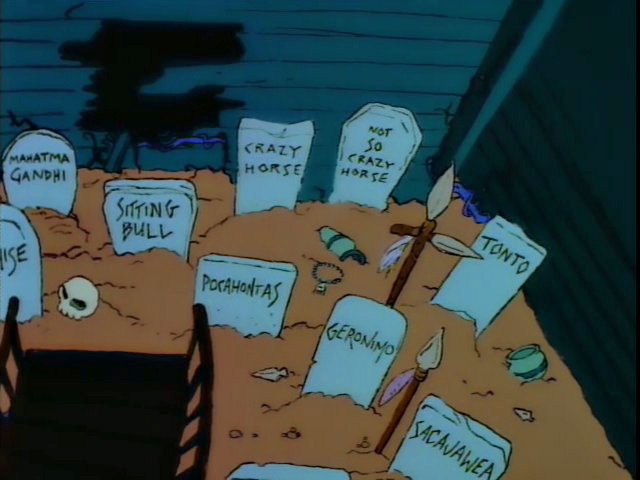
As with many overused narrative devices, the "Indian burial ground" trope eventually transcended horror to become a comedic cliché. Popular comedy series, recognizing its ubiquitous nature, began to poke fun at it. Shows such as The Simpsons, Friends, South Park, Family Guy, and Parks and Recreation have all featured storylines or gags built around the absurdity of the trope. Seth Grahame-Smith’s satirical How to Survive a Horror Movie humorously confirms a house is haunted by asking: "Are Native Americans constantly showing up to ask, ‘What happened to our cemetery?’" This comedic turn, while highlighting the trope’s absurdity, ironically also reinforces its widespread recognition and cultural imprint.
Modern Manifestations: Ghost Hunters and Digital Culture
In the contemporary landscape, the "Indian burial ground" trope continues to thrive, particularly within the genre of reality television ghost hunting shows. Programs like Ghost Adventures frequently resort to this explanation when confronted with supposedly "demonic" entities. There appears to be a consistent formula that leads these shows to conclude Indigenous ghosts are to blame, echoing Holzer’s earlier strategy of shifting responsibility to non-white entities. Unlike the comedic parodies, these shows present their findings as serious investigations, further solidifying the problematic narrative in the minds of their viewers.
The trope’s journey into the digital age was inevitable. In 2011, the satirical news source The Onion released a now-classic video titled "Report: Economy Failing Because U.S. Built on Ancient Indian Burial Grounds." This brilliant piece of comedy featured panelists discussing a congressional report attributing America’s problems, including poverty, to angry Indigenous spirits demanding a "blood offering." The video’s enduring popularity on YouTube demonstrates the trope’s deep cultural penetration and its potential for both critical commentary and ironic perpetuation.
Since then, the internet has become a fertile ground for the trope, with thousands of posts on Twitter and Reddit threads repeating variations of the same idea. Photo memes (image macros) and videos abound, showcasing the trope’s transformation into a widely recognized and often humorously deployed cultural shorthand. While critical awareness of the trope has grown in recent years, with publications like Atlas Obscura providing non-academic analyses as early as 2008, the original stories and memes that fueled its spread have rarely received the same rigorous critical attention.
Supporting Data: Unpacking the Trope’s Harmful Undercurrents
Understanding the "Indian burial ground" trope requires examining its complex folkloric origins, the inherent biases in settler narratives, and the very real historical context of Indigenous experiences.
Settler Stories vs. Authentic Indigenous Beliefs
The distinction between genuine Indigenous spiritual beliefs and settler-created narratives is crucial. While it is reasonable to assume there are real burial grounds, some of which Indigenous people themselves believe to be haunted or spiritually significant, the vast majority of settler-driven "burial ground" stories are baseless. These narratives often project traditional Christian fears of "uncivilized" or "heathen" people. Settler ideas about consecrated ground, the power of Christ’s name against paranormal activity, and the exclusive nature of Heaven for denominational believers subtly influence these ghost stories, framing Indigenous spirits as inherently vengeful or demonic.
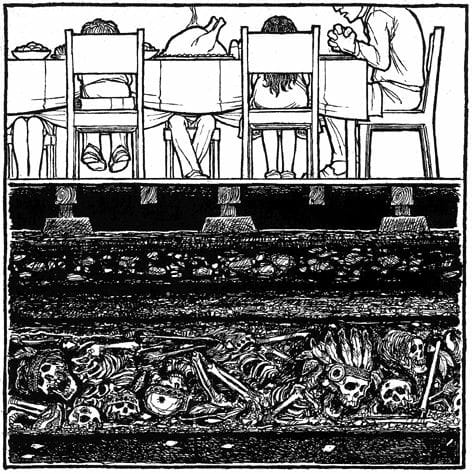
A compelling counter-argument to this "inferior-earthbound ghosts" perspective is the concept of "Settler Guilt." This theory posits that hauntings are manifestations of the collective conscience of descendants of colonizers, grappling with the horrific acts committed against Indigenous peoples. If ancestors perpetrated atrocities, then perhaps the benefits reaped from stolen land, resources, and disrupted trade routes—benefits that continue to this day—are metaphorically "haunted." Ron Cobb’s powerful 1968 illustration, "Thanksgiving in America," for The Los Angeles Free Press, vividly captures this sentiment, depicting a family celebrating atop skeletal remains. Some might believe we are haunted by the "sins of our forefathers and foremothers."
While "Settler Guilt" might explain why some individuals sympathetic to Indigenous struggles inadvertently spread these memes and stories, it does not absolve the harm. Claiming all places are Indigenous burial grounds ultimately delegitimizes actual sacred sites and minimizes very real crimes and injustices – from individual acts of violence like the Defeo murders to systemic genocidal acts, such as the unmarked graves discovered at residential schools.
Historical Precursors to Fear: The Ghost Dance and Wounded Knee
Fear of Indigenous ghosts is not a recent phenomenon and predates the popularization of the "haunted burial ground" legends. Historical records from the late 19th century, for example, reveal a deep-seated colonial dread. Newspapers in 1890 widely reported on the Ghost Dance movement, which was gaining momentum across North America. This ceremonial dance, performed by various Plains Indigenous nations, was intended to raise the spirits of recently deceased tribe members, offering protection and solace against the escalating injustices of settler encroachment and violence.
However, public fear among colonizers, fueled by sensationalist media and racist stereotypes, interpreted the Ghost Dance as a prelude to armed rebellion. This manufactured panic culminated in the horrific Wounded Knee Massacre, where the U.S. Army brutally killed between 150 and 300 Lakota people, predominantly women, children, and Elders. The irony is stark: they feared "resurrected ghosts" but harbored no compunctions about creating new ones. This tragic event illustrates a historical precedent for settler anxieties about Indigenous spiritual power, which later mutated into the "burial ground" trope.
Canadian Local Examples: A Pattern of Appropriation
The author’s research into Canadian folklore reveals a consistent pattern of the trope’s emergence and evolution, particularly in British Columbia.
The oldest report of an Indigenous grave causing a haunting in British Columbia that the author encountered dates back to 1924. The Victoria Daily Times reported that seven road builders were haunted for four consecutive nights where they had established their camp. A "whishing" sound and persistent rapping noises were heard nightly between 8 PM and 2 AM. Despite searching the darkness with lanterns and looking for animal prints by day, nothing tangible was found. The men eventually moved their camp, concluding it was built on the grave of a "Red Indian." This early account demonstrates the trope’s local application even before its national popularization.
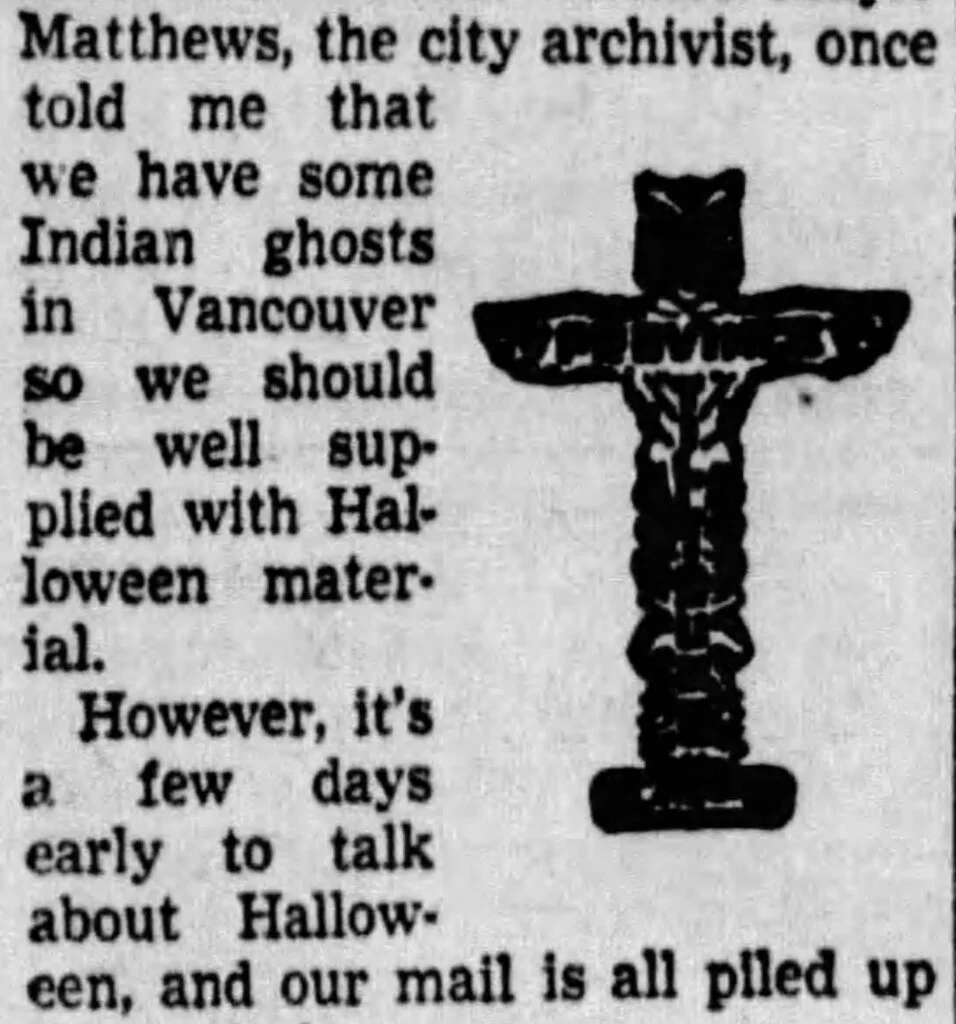
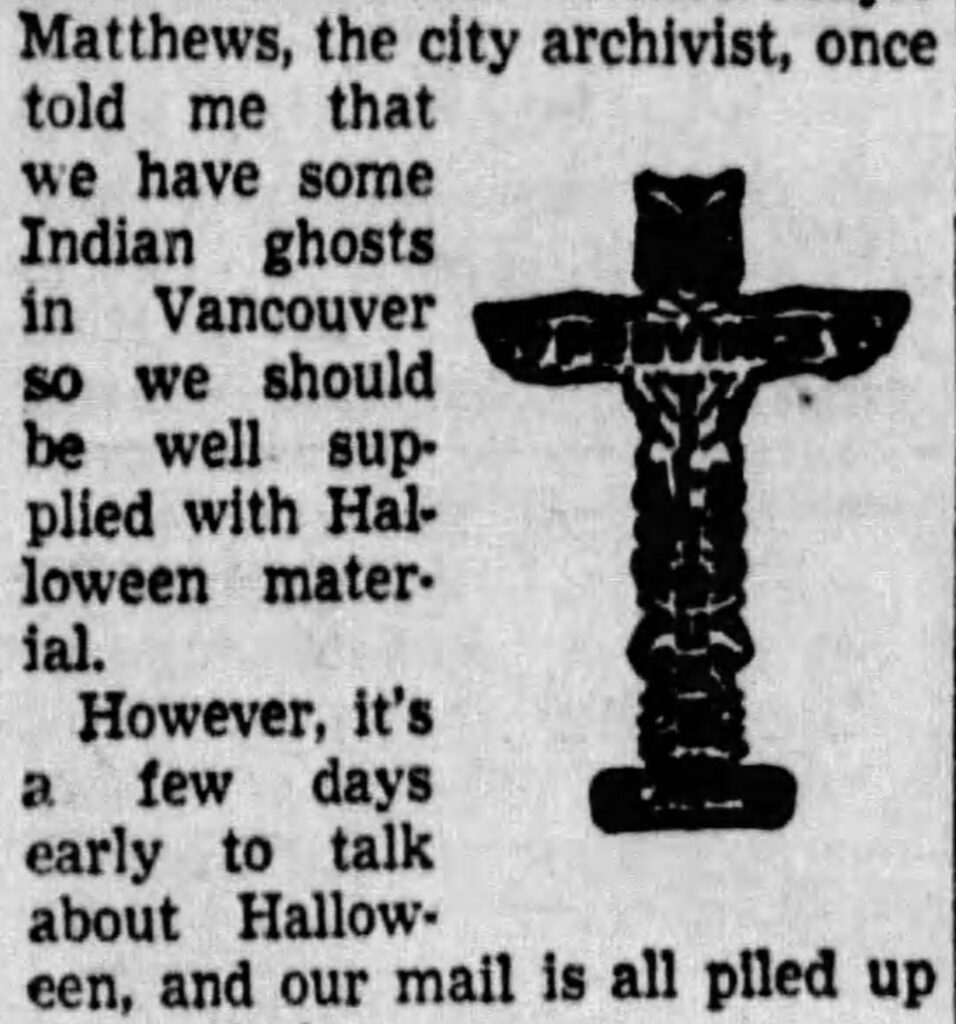
In 1940, City Archivist Major Mathews told a Province reporter that Vancouver had "Indian ghosts," though he provided no elaboration. This brief, almost dismissive mention in a section dedicated to youth Halloween parties, was the only haunting noted, underscoring how casually such claims were made.
An interesting Ontario story appeared in the Vancouver Sun in 1946, describing a headless woman’s ghost seen near the rumored secret burial site of Tecumseh. Tecumseh, a revered Shawnee chief, famously attempted to unite Indigenous groups against American expansion and allied with the British during the War of 1812, where he was killed in 1813. His subsequent romanticization as a folk hero likely contributed to the potency of this spectral tale, intertwining a powerful historical figure with a localized haunting.
In 1950, Bjarne Kirchhoff, a pulp writer, published "The Ghost of Graveyard Flats" in the Vancouver Sun. Remarkably, Kirchhoff’s narrative featured an Indigenous burial ground haunted by a wendigo, a full 33 years before Stephen King’s Pet Sematary popularized the same combination. This demonstrates that elements of the trope were circulating in popular fiction long before their mainstream explosion.
The Comox haunting, first reported in The Times Colonist in 1966, further illustrates the trope’s evolving nature. Earlier 1940s versions described a mist-like apparition that one witness claimed transformed into a dancing woman. By the 1960s, this "Bloody Mary" figure had transformed into an "Indigenous woman" described by another witness as "young and well-stacked." Later books dubbed her "Dancing Mary." The story eventually incorporated either her grave or a massacre site, becoming a confusing amalgamation of paranormal reports and settler cemetery involvement, showing how the trope could be retrofitted onto existing local legends.
Victoria: A Manufactured Haunting Hotspot
The city of Victoria, British Columbia, serves as a particularly poignant case study. In 1958, Colonist reporter Bert Benny lamented the scarcity of hauntings to write about in the provincial capital. Yet, by the 1980s, Victoria had gained a reputation as "very haunted," soon becoming one of Canada’s most haunted cities. This surge in spectral activity was largely attributable to local ghost hunters Robin Skelton and Jean Kozacari, both of whom claimed psychic abilities. Their efforts directly fueled the growth of ghost tourism. The two most common explanations offered for Victoria’s purported hauntings? Its proximity to water and, disturbingly, the claim that it was built on an Indigenous burial ground.
The burial ground stories are particularly shameful. While some news articles, quoting historians, mention well-known burial mounds in Beacon Hill Park, around Cadboro Bay, and on Saltspring Island, these claims are often misrepresented or taken out of context. Beacon Hill Park, for example, once claimed 23 mounds, none of which were ever built upon. Cadboro Bay, a neighboring city, had about a hundred, and Saltspring Island is geographically distinct. Compared to the tens of thousands of non-Indigenous bodies in established cemeteries, the idea that a few Indigenous graves could imbue an entire city with malevolent energy is disproportionate and illogical.
Furthermore, these claims often contradict actual Indigenous burial practices. Researchers find the burial mounds interesting precisely because local First Nations traditionally used cairns in ancient times, and for the last 1500 years, placed bodies in trees, on raised platforms, or within caves near the shoreline. Early settlers, unfortunately, often collected Indigenous bones as souvenirs, further disrupting sites. While Indigenous remains are indeed discovered, the city of Victoria was unequivocally not built upon a "mega burial ground" as many now claim.
Perhaps the most egregious example comes from Skelton and Kozacari’s 1989 book, Gathering of Ghosts. In their chapter "The Indian Inheritance," they claimed that "tainted land" was responsible for the actions of a cult near Nanaimo. After incorrectly identifying the territory as Kwakiutl and a "slave-body dump site," the authors asserted: "It seems not unlikely that the long history of Indian raids, feasts, and ritual killings accounted in part for the way in which Brother Twelve’s initially peaceful and gentle community became disturbed… The problem was the land and its history. It was crying out for blood. The evil was in the earth itself." These "facts" were entirely untrue. Yet, Indigenous ghosts were painted as the real culprits, or in this case, their "evil soil made sentient." The depiction of "body dumps," "ritual killings," and "evil feasts" is not only hateful but profoundly irresponsible, especially coming from Skelton, a respected university professor and admired public figure.
The author also shares personal experiences of hearing Indigenous burial ground urban legends, such as one about MacArthur Drive in Prince Albert

Leave a Comment