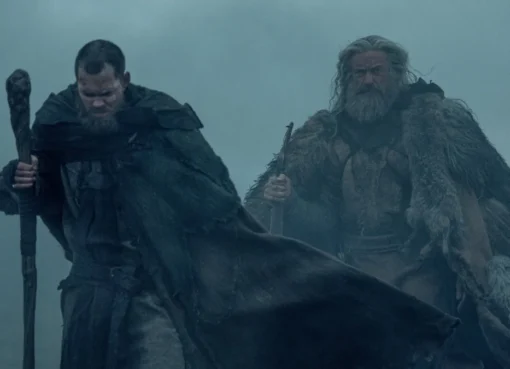
From Atomic Fire to Ancient Seas: Christopher Nolan Discusses ‘The Odyssey’ and the Power of the ‘Blank Check’
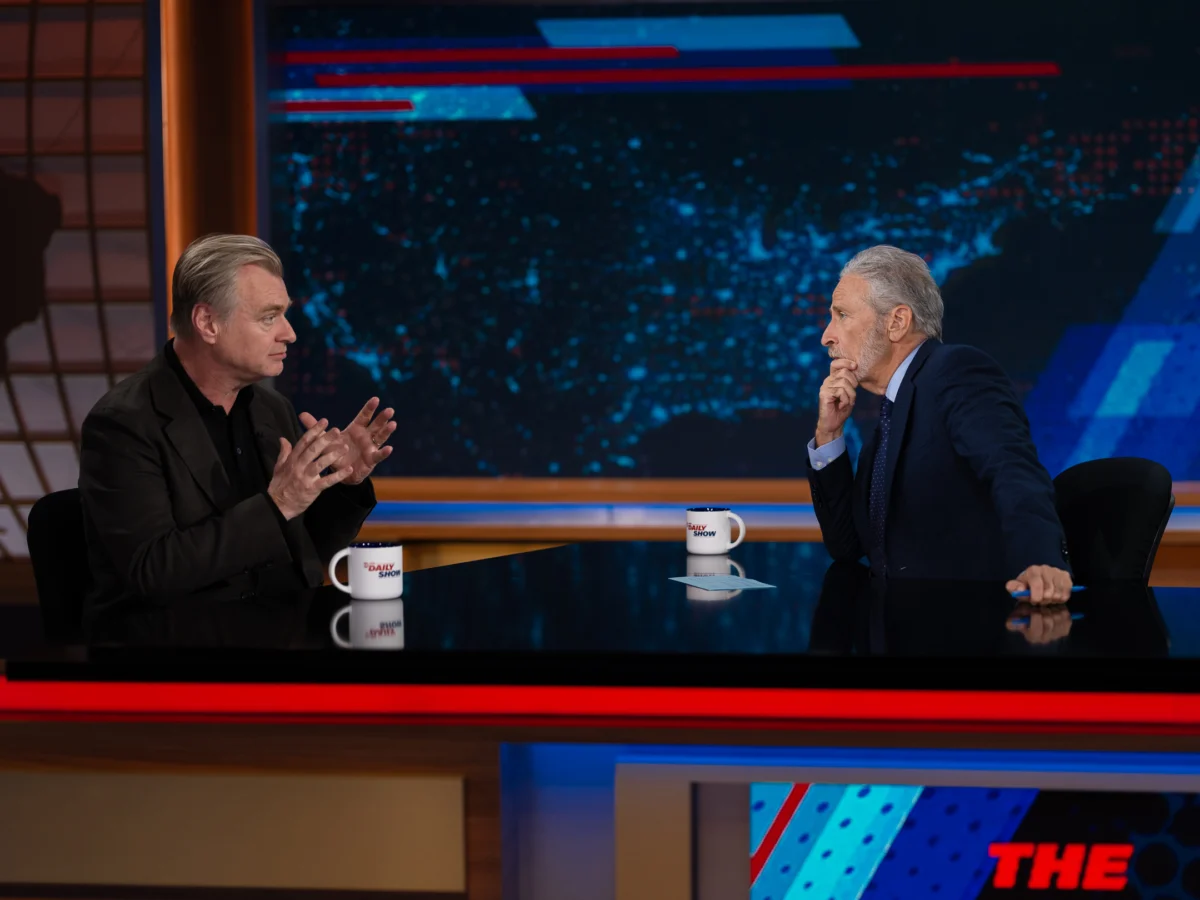
In a rare and candid television appearance, Oscar-winning director Christopher Nolan joined Jon Stewart on The Daily Show to discuss his latest and perhaps most ambitious undertaking: a high-budget adaptation of Homer’s The Odyssey. The conversation, which veered between profound meditations on cinematic leverage and "stoner-logic" inquiries into Greek mythology, provided a fascinating glimpse into the mechanics of modern Hollywood’s most successful auteur.
Nolan, fresh off the historic sweep of Oppenheimer, revealed that his decision to tackle the 8th-century BCE foundational text of Western literature was born directly from the political and financial capital earned by his recent success. The interview highlighted a director at the height of his powers, wielding the kind of creative autonomy rarely seen since the era of David Lean or Stanley Kubrick.
Main Facts: The Vision Behind the Epic
The core of the discussion centered on Nolan’s new project, The Odyssey. Based on the epic poem attributed to Homer, the film follows the ten-year journey of Odysseus as he attempts to return home to Ithaca following the fall of Troy. While the story has been adapted numerous times for television and film, Nolan’s version promises a scale and technical rigor that matches his previous spectacles like Interstellar and Inception.
During the interview, Nolan confirmed several key aspects of the production:
- The "Oppenheimer" Effect: The critical and commercial windfall of Oppenheimer—which earned over $975 million and seven Academy Awards—served as the primary catalyst for greenlighting The Odyssey.
- Production Efficiency: Despite the massive scale of the project, Nolan maintained his reputation for logistical precision, finishing the shoot nine days ahead of its 100-day schedule.
- Scale and Scope: The director emphasized that the film required a "massive budget" and a "massive cast" to do justice to the source material, positioning it as a cornerstone of upcoming theatrical releases.
Chronology: From Nuclear Physics to Bronze Age Mythology
The path to The Odyssey represents a logical progression in Nolan’s career, though the speed with which the project materialized surprised many industry insiders.
The Post-Oppenheimer Pivot
Following the release of Oppenheimer in July 2023, Nolan found himself in a position of unprecedented influence. While he has long been a "brand-name" director, the success of a three-hour, R-rated biographical drama about the father of the atomic bomb proved that audiences would follow Nolan into dense, intellectual territory.
As Nolan explained to Stewart, the "Oscar thing" and the box-office receipts provided the "opportunity to get something made that you might not otherwise be able to get made." By late 2023, whispers began to circulate that Nolan was looking at "unfilmable" or "monumental" texts for his next act.
The Production Phase
Once The Odyssey was greenlit, Nolan moved with his characteristic speed. Eschewing the modern trend of protracted "development hell," the film moved into pre-production almost immediately. Filming was scheduled for a grueling 100-day window, involving complex maritime sequences and expansive practical sets.
Nolan revealed that the production wrapped on Day 91. "By day 91, we couldn’t have taken another step," Nolan told Stewart, describing a crew that was "just exhausted" but satisfied with the result. This timeline reflects Nolan’s philosophy of "finishing at the right time" rather than expanding to fill the available budget.
Supporting Data: The Nolan Economic Engine
To understand why a studio would grant Nolan the "blank check" for a Greek epic, one must look at the empirical data of his career. Stewart expressed shock that Nolan—the man behind the Dark Knight trilogy—still felt he had to "prove himself" to secure funding for The Odyssey. However, the economics of 2024 Hollywood are increasingly risk-averse.
Box Office and Critical Pedigree
Nolan’s filmography represents a rare intersection of high art and mass commerce:
- The Dark Knight Trilogy: Over $2.4 billion combined.
- Inception: $839 million (an original IP).
- Interstellar: $733 million.
- Dunkirk: $530 million.
- Oppenheimer: $975 million+.
In an era dominated by superhero fatigue and franchise reboots, Nolan is one of the few directors whose name functions as the franchise itself. The Odyssey, while technically a "reboot" of a 3,000-year-old story, is being marketed as a "Christopher Nolan Film" first and a Greek myth second.
The Efficiency Metric
A major data point discussed in the interview was Nolan’s ability to come in under budget. In an industry where films like Indiana Jones and the Dial of Destiny or Mission: Impossible – Dead Reckoning have seen budgets balloon past $300 million due to delays and reshoots, Nolan’s 91-day finish on The Odyssey is a statistical anomaly. This efficiency reduces "burn rate" and increases the profit margin, making him the safest bet for a studio looking to invest $200 million+ in a single project.
Official Responses: The Stewart-Nolan Dialogue
The interview on The Daily Show was notable for its shift in tone. While most press junkets involve rehearsed talking points, Jon Stewart approached Nolan with a mix of reverence and irreverent "stoner humor," leading to some of the most humanizing moments of Nolan’s recent press tour.
The "Dorm Room" Queries
Stewart opened the segment by joking, “I will never get a chance to get high with you in a dorm room,” before launching into a series of philosophical and humorous questions about the logic of The Odyssey.
- On the Cyclops: Stewart asked why the Cyclops, Polyphemus, didn’t tell jokes or have a more nuanced personality.
- On the Trojan Horse: Stewart questioned the mechanics of the wheels on the Trojan Horse, a point that Nolan met with his trademark dry wit.
- On Subjectivity: Stewart posited a theory familiar to fans of Inception: "Is this all just happening in Odysseus’ head?" Nolan’s response remained cryptic, though he acknowledged that the "hardness" of the story is what makes it resonate.
Nolan’s Defense of the "Hard" Film
Nolan was firm in his belief that The Odyssey should not be sanitized or simplified. "I like to say it was a very hard movie, but hard for all the right reasons," Nolan said. "It’s The Odyssey. It should be hard. It shows up on screen."
This response aligns with Nolan’s long-standing advocacy for the theatrical experience and for films that challenge the audience’s intellect. He rejected the notion that he no longer has to prove himself, suggesting instead that each film is a negotiation with the studio’s appetite for risk.
Implications: The Return of the Mega-Epic
Nolan’s successful mounting of The Odyssey has several significant implications for the future of the film industry and the "Auteur Era" of the 2020s.
1. The Death of the "Safe" Bet
The fact that Nolan used his Oppenheimer capital to make The Odyssey—rather than a more conventional action film—suggests a shift in what constitutes a "prestige" blockbuster. It implies that the industry’s highest honors (Oscars) are once again being used as currency for ambitious, large-scale storytelling rather than just personal, small-scale dramas.
2. The Practical Effects Renaissance
Nolan’s insistence on finishing early and staying under budget is often attributed to his preference for practical effects over heavy CGI. By building sets and filming on location for The Odyssey, Nolan continues to set a standard that challenges the "fix it in post" mentality of modern blockbuster filmmaking. If The Odyssey is a hit, it may encourage other directors to return to more disciplined, pre-planned production cycles.
3. Reclaiming the Classics
For decades, the "swords and sandals" genre has struggled to find a balance between historical grit and campy spectacle. Following the mixed legacy of films like Troy (2004) or Alexander (2004), Nolan’s involvement signals a "prestige" reclamation of classical mythology. By treating Homer with the same gravity he gave the development of the atomic bomb, Nolan may be opening the door for a new wave of high-fidelity literary adaptations.
4. The "Nolan" Genre
Ultimately, the interview reinforces the existence of the "Nolan Genre." Whether he is exploring the vacuum of space, the dreams of a corporate spy, or the wine-dark sea of ancient Greece, the constant is a preoccupation with time, memory, and the "hardness" of the human journey.
As the interview concluded, it was clear that while Stewart might never get to "get high in a dorm room" with the director, the audience is about to embark on a different kind of trip—one guided by the most disciplined and powerful filmmaker working today. The Odyssey is not just a retelling of an old poem; it is the culmination of a career built on the belief that the biggest stories deserve the biggest screens and the most rigorous execution.