Sacred Light: Peter Marlow’s Definitive Photographic Study of the English Cathedral
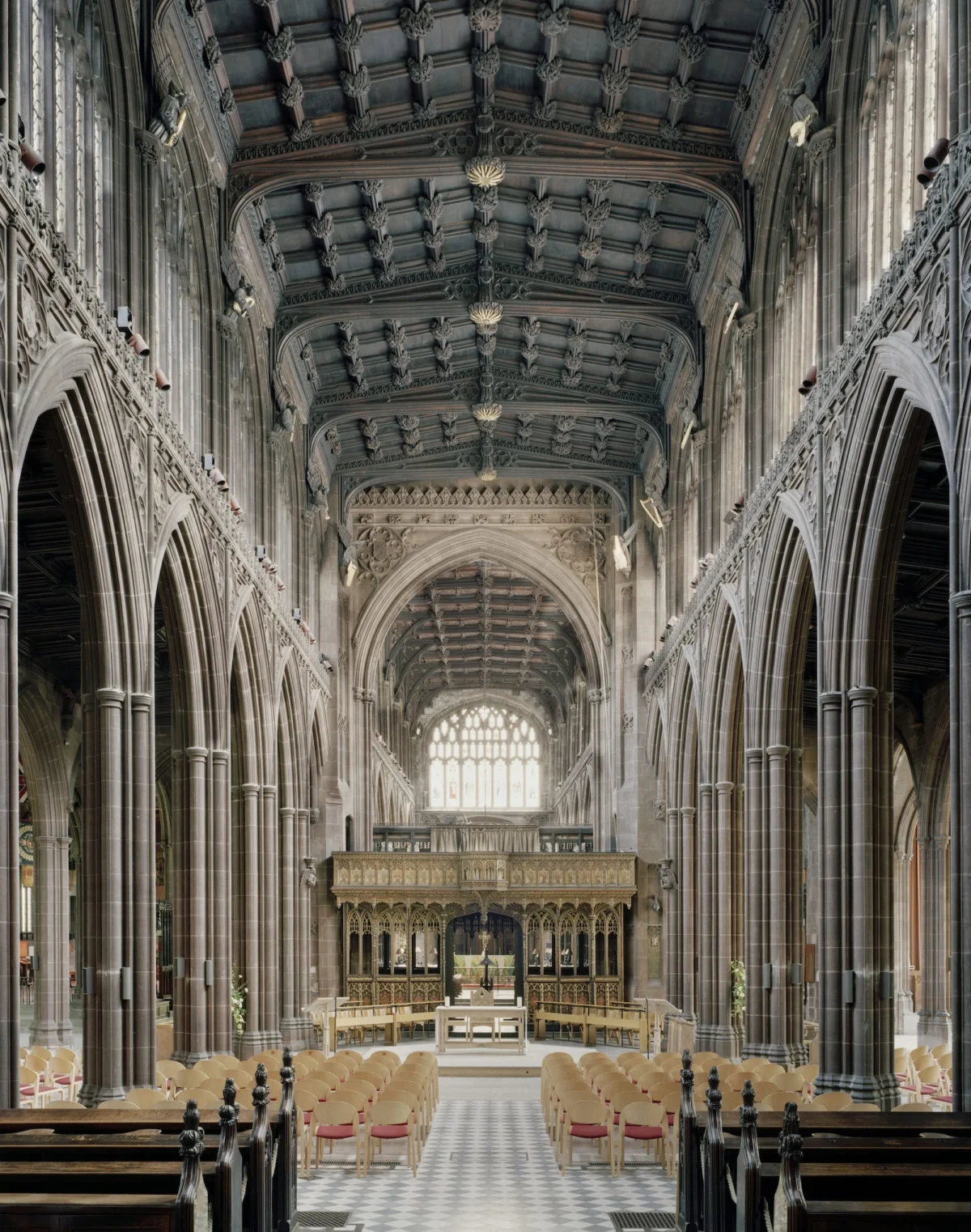
The late Peter Marlow (1952–2016) was a man who spent much of his life navigating the cacophony of the modern world. As a titan of photojournalism and a two-time president of the prestigious Magnum Photos agency, Marlow’s lens was frequently trained on the jagged edges of history: conflict zones, political upheavals, and the slow-motion collapse of industrial empires. Yet, in what would become one of his most enduring legacies, Marlow turned away from the noise to embrace a decade-long pursuit of silence, symmetry, and stone.
"The English Cathedral," a monumental series documenting all 42 diocesan cathedrals of the Church of England, stands as a testament to Marlow’s versatility and his obsession with the transformative power of natural light. Beginning July 21 and running through August 31, London’s Southwark Cathedral will host an exhibition of these works, offering a rare opportunity to view these architectural giants through the eyes of a master documentarian.
Main Facts: A Modern Pilgrimage in Large Format
The project is a comprehensive survey of the Anglican cathedrals of England. While the Anglican tradition itself was codified during the English Reformation of the 16th century, the buildings Marlow photographed are often much older, representing a palimpsest of Romanesque, Norman, Gothic, and Renaissance architecture.
Marlow’s approach was deceptively simple but logistically grueling. He sought to capture the nave of each cathedral—the central part of the church building—using only natural light. This was not a stylistic whim; it was an attempt to view these spaces as they had been experienced for the vast majority of their existence, prior to the introduction of gaslight and electricity.
To achieve the desired depth, clarity, and ethereal glow, Marlow worked during the "blue hour"—that fleeting window of time just before sunrise. By positioning his camera at the far west end of the nave, looking toward the altar, he captured the architectural "spine" of England. The resulting images are characterized by an almost impossible stillness, highlighting the rosette-covered wooden ceilings, the soaring Gothic arches, and the intricate geometry of the apses.

Chronology: From Conflict Zones to Sacred Spaces
To understand the weight of "The English Cathedral," one must look at the trajectory of Peter Marlow’s career. His professional life was defined by a transition from the "decisive moment" of street photography to a more contemplative, structured form of documentary art.
1970s–1980s: The Rise of a Photojournalist
Marlow joined the Sygma agency in 1976, quickly making a name for himself in the high-stakes world of international news. He covered the Lebanese Civil War and various uprisings across Africa and Northern Ireland. In 1980, he was invited to join Magnum Photos, the legendary cooperative founded by Henri Cartier-Bresson and Robert Capa.
Late 1980s–Early 1990s: Liverpool and Economic Decline
While his international work continued, Marlow began focusing on personal documentary projects. One of the most significant was Liverpool: Looking Out to Sea. Completed as the city faced a sharp economic downturn, the series captured the melancholy of a once-great global port whose historic docks had become obsolete. This project showcased Marlow’s ability to find beauty and dignity in fading structures—a theme that would eventually lead him to the cathedrals.
2008–2012: The Cathedral Project
The seeds of "The English Cathedral" were sown when Marlow was commissioned by the Royal Mail to photograph six cathedrals for a commemorative stamp issue. The experience was so profound that he decided to expand the scope to all 42 Anglican cathedrals. This was a self-funded, deeply personal mission that required meticulous planning, often involving staying overnight in cathedral cities to be ready for the precise moment the sun crested the horizon.
2016–Present: Posthumous Legacy
Following Marlow’s death in 2016, his estate and Magnum Photos have worked to ensure his final projects receive the recognition they deserve. The upcoming exhibition at Southwark Cathedral is part of a continuing effort to bring this specific body of work to the spaces that inspired it.

Supporting Data: The Technical and Historical Framework
The sheer scale of the project provides a data-driven look at English heritage. The 42 cathedrals included in the series represent a timeline of English history spanning over a millennium.
- Architectural Diversity: The series includes everything from the massive Norman pillars of Durham to the modern, post-war architecture of Coventry (rebuilt after the Blitz).
- The Southwark Connection: The exhibition venue, Southwark Cathedral, is a fitting choice. Its roots date back to at least the 11th century (appearing in the Domesday Book), and it stands today as the oldest Gothic church building in London.
- The Photographic Method: Marlow utilized a large-format camera, which allowed for extreme detail and the correction of perspective. In an age of digital snapshots, his process was slow and deliberate. He often spent hours setting up a single shot, waiting for the light to hit the stone at the exact angle that would reveal the texture of the masonry and the vibrancy of the stained glass without the need for artificial flash.
By removing the "clutter" of modern life—folding chairs, signage, and artificial spotlights—Marlow’s photographs serve as a visual census of England’s spiritual infrastructure.
Official Responses and Critical Perspectives
The photography community and the Church of England have both hailed the project as a landmark achievement.
In a statement regarding the project’s significance, representatives from Magnum Photos noted that Marlow’s cathedral work represented a "purity of vision." They remarked that while his earlier work was about the friction between people, this series was about the "harmony of space."
The Very Reverend Andrew Nunn, former Dean of Southwark, has previously commented on the power of Marlow’s work to speak to both the faithful and the secular. "Peter Marlow has captured the soul of these buildings," he noted. "By stripping away the artificial, he has allowed the stones to speak for themselves."

Art critics have frequently compared Marlow’s cathedral series to the work of 19th-century pioneers like Frederick Evans. However, where Evans focused on the romantic play of shadow, Marlow’s work is noted for its "forensic clarity." It is not just art; it is a document of record.
Implications: The Intersection of Faith, Heritage, and Art
The exhibition of "The English Cathedral" at Southwark Cathedral carries several layers of significance for the modern observer.
1. The Preservation of the "Invisible"
In a rapidly secularizing United Kingdom, these cathedrals remain some of the most visited heritage sites in the country. Marlow’s work reminds the public that these are not merely museums or relics; they are living environments designed to manipulate light and sound to evoke a sense of the transcendent. By capturing them in natural light, Marlow preserves a version of these buildings that is increasingly "invisible" to the modern visitor who usually sees them under the yellow hum of electric bulbs.
2. A Bridge Between Eras
The project serves as a bridge between the medieval craftsmen who carved the rosettes in Worcester and the 21st-century photographer using high-end optics. It highlights the enduring nature of English craftsmanship. The cathedrals have survived the Reformation, the English Civil War, the Industrial Revolution, and the World Wars. Marlow’s photographs capture that resilience.
3. The Evolution of Photojournalism
For the photography world, Marlow’s transition from conflict to cathedrals suggests an evolution in the role of the "witness." While a photojournalist usually witnesses the breaking of the world, in this project, Marlow witnessed its stability. It suggests that documenting what remains is just as vital as documenting what is being destroyed.

4. Accessibility of the Sacred
By bringing the exhibition into Southwark Cathedral, the art is placed back into its original context. This "full circle" approach allows visitors to stand in a nave and look at a photograph of a nave, creating a recursive experience that emphasizes the grandeur of the architecture.
Conclusion
Peter Marlow’s "The English Cathedral" is more than a collection of architectural photographs; it is a quiet, rhythmic heartbeat in the middle of a noisy century. For six weeks this summer, Southwark Cathedral will offer a sanctuary within a sanctuary. Visitors will find themselves invited into Marlow’s "blue hour," a time of day when the line between the physical stone and the ethereal light begins to blur, revealing the timeless majesty of the English spirit.
Exhibition Details:
- The English Cathedral by Peter Marlow
- Location: Southwark Cathedral, London
- Dates: July 21 – August 31
- Admission: Check venue for specific viewing times and entry requirements.