Spaghettin: A Dexterity Game Tangle That Falls Flat for Alley Cat Games
Main Facts
Alley Cat Games has cultivated a sterling reputation for its innovative series of pocket-sized dexterity games, charming players with their compact format, striking components, and engaging mechanics. Titles like Tinderblox, which challenged players to meticulously stack wooden blocks to construct a campfire, and Kittin, a delightful exercise in carefully arranging feline-shaped pieces, have consistently delivered satisfying, accessible fun. Both games earned acclaim for their ability to condense significant charm and bright, tactile play into a travel-friendly tin.
It was against this backdrop of high expectations that Spaghettin, the latest entry in Alley Cat Games’ "tin-pun" series, made its debut. Designed by Franco Sardo, this family and party game aims to evoke the precariousness of pulling strands of spaghetti from a communal bowl, daring players to extract pasta without disturbing delicate toppings. However, despite its visually appealing premise and the established pedigree of its publisher, Spaghettin finds itself in a precarious position, struggling to live up to the high standards set by its predecessors. While it maintains the series’ signature accessibility and compact design, the core mechanic intended to provide tension ultimately delivers an anticlimactic and often frustrating experience, marking it as a surprising misstep in an otherwise commendable line of dexterity games.
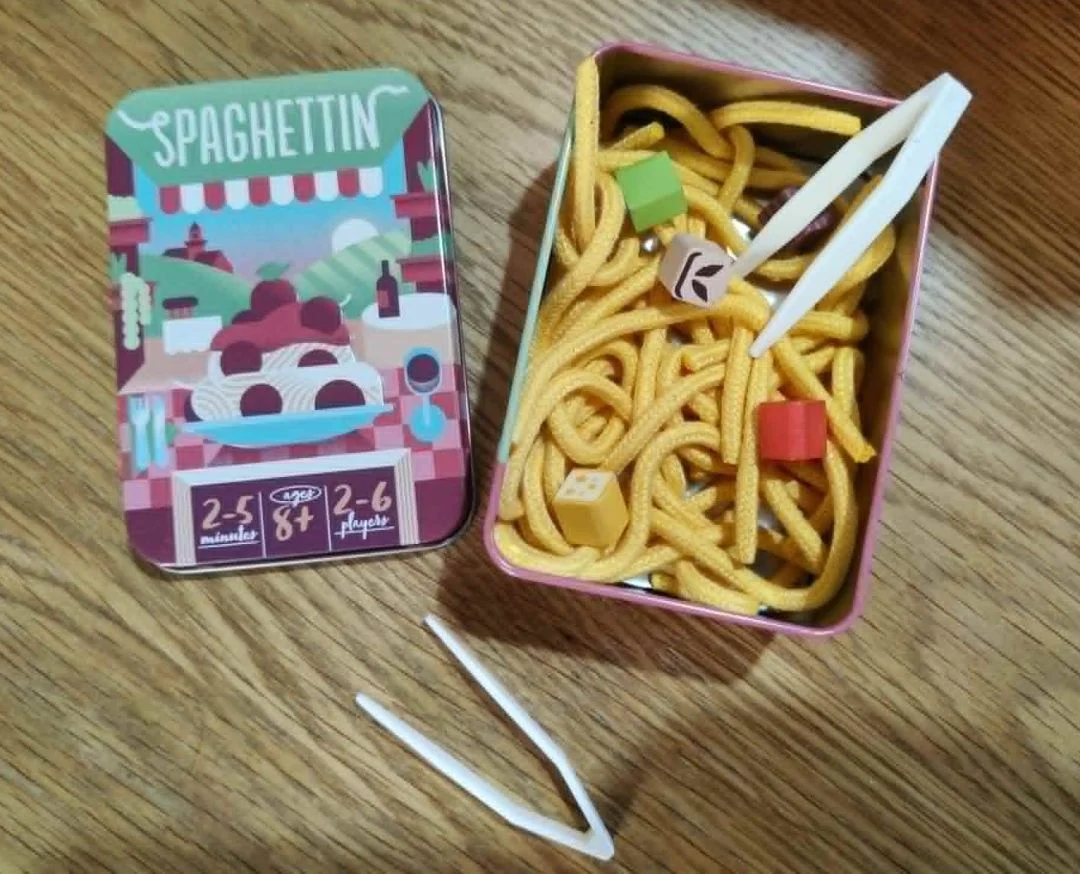
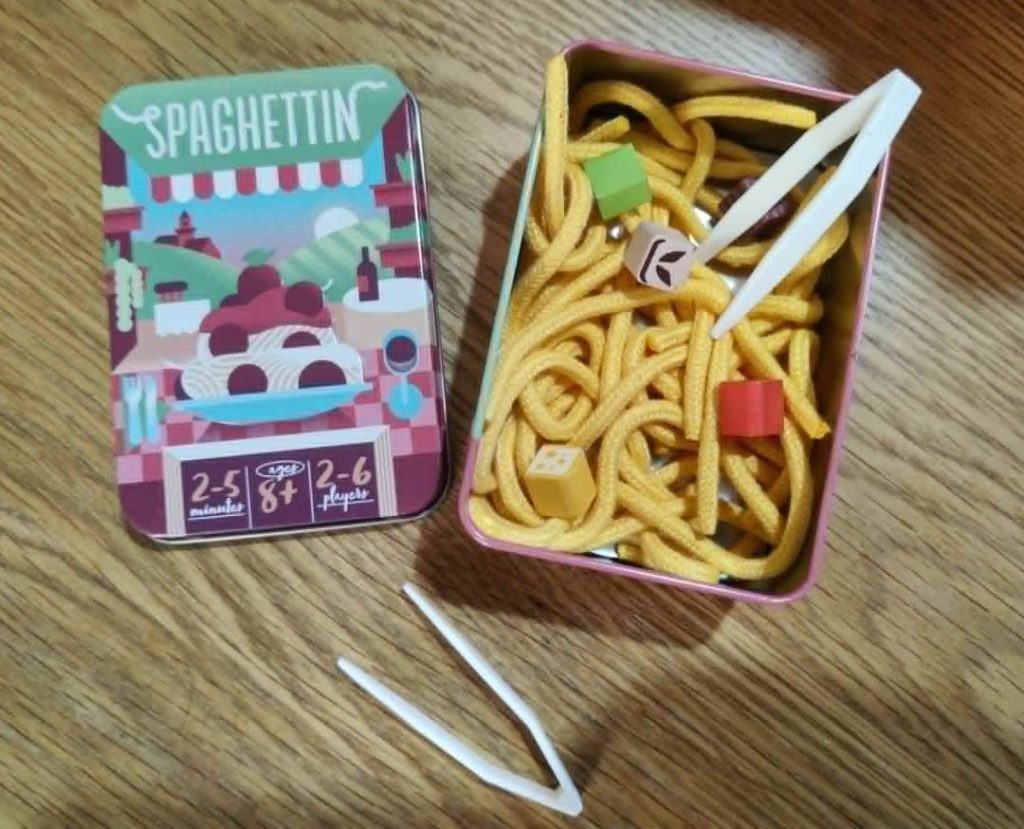
The game’s premise is deceptively simple: a tin filled with strings representing spaghetti of varying lengths, upon which rest five wooden topping blocks—a red tomato, a chunk of cheese, and others. Players take turns using provided tongs to carefully tease out a single strand of spaghetti. The critical rule, and the source of its most significant design flaw, states that if a topping falls and lands with one face completely flat against the bottom of the tin, the player responsible is eliminated. The last player standing wins. This seemingly straightforward condition, however, frequently results in fiddly, ambiguous conclusions, a stark contrast to the decisive, dramatic failures that characterize successful dexterity games. With an estimated maximum playtime of five minutes, often concluding in mere seconds for two players, Spaghettin‘s brevity highlights its mechanical shortcomings rather than enhancing its appeal, leaving players with a sense of unfulfilled potential rather than playful engagement.
Chronology
The Genesis of a Series: Alley Cat Games’ Dexterity Tins
The story of Spaghettin‘s reception cannot be fully understood without first appreciating the legacy established by Alley Cat Games in the realm of compact dexterity titles. For years, the UK-based publisher has demonstrated a keen understanding of what makes a successful "filler" game—a quick, engaging experience perfect for starting a game night, bridging longer titles, or simply providing a few minutes of lighthearted fun. Their "tin-pun" series has been a cornerstone of this strategy, packaging imaginative concepts into sturdy, portable metal tins that are both aesthetically pleasing and highly functional.
The series truly hit its stride with the release of Tinderblox. Launched to considerable critical and popular acclaim, Tinderblox presented a charming challenge: using tweezers to stack tiny wooden logs, mimicking the act of building a campfire. Its genius lay in its tactile satisfaction, the immediate visual feedback of a teetering stack, and the definitive "crash" when a player failed. The rules were simple enough for anyone to grasp within moments, yet the game offered genuine tension and a sense of accomplishment with each successfully placed log. Its compact nature made it an ideal travel companion, and its bright, inviting components ensured it stood out on any table. Tinderblox wasn’t just a game; it was an experience, embodying the perfect blend of theme, mechanics, and presentation for its genre.
Following this success, Alley Cat Games continued its trajectory with Kittin. Building on the foundation laid by Tinderblox, Kittin introduced adorable kitten-shaped blocks that players had to stack, often in precarious positions dictated by cards. The cuteness factor was undeniable, immediately drawing in players, particularly those with an affinity for felines. Mechanically, it retained the core dexterity challenge but added a layer of strategic thinking and variable setup, ensuring fresh experiences with each play. Like its predecessor, Kittin excelled at delivering clear, unambiguous outcomes. When a tower of kittens toppled, there was no doubt who had caused the collapse, leading to laughter, groans, and an immediate desire for a rematch. These titles set an exceptionally high bar, not just for Alley Cat Games, but for the entire genre of micro-dexterity games, establishing an expectation of both charm and flawless execution.
Spaghettin’s Development and Anticipation
Given the proven track record of Tinderblox and Kittin, the announcement of Spaghettin was met with considerable anticipation from fans of Alley Cat Games and the wider board gaming community. The concept itself held immediate thematic appeal. Who hasn’t, at some point, tried to extract a single strand of spaghetti from a communal plate without disturbing the rest? It’s a universally relatable act of careful manipulation, perfectly suited for a dexterity game. Designer Franco Sardo’s vision likely aimed to translate this everyday challenge into a fun, competitive format. The idea of colorful wooden toppings resting precariously on a tangle of "pasta" strings promised a visually engaging setup, a hallmark of the series.
The design team would have aimed for the familiar blend of simplicity, quick play, and visual appeal. The choice of spaghetti strings of different lengths and distinct wooden topping blocks—a red tomato, a yellow cheese chunk, perhaps a green basil leaf—suggested a thoughtful approach to components that would be both functional and attractive. The inclusion of tweezers, a recurring tool in Alley Cat Games’ dexterity lineup, further reinforced the expectation of precise, delicate gameplay. Fans could easily envision a game that, like its predecessors, would be easy to teach, quick to play, and elicit gasps and cheers as players attempted their delicate maneuvers. The expectation was that Spaghettin would seamlessly integrate into the successful "tin-pun" family, offering another dose of compact, engaging entertainment.
Release and Initial Impressions
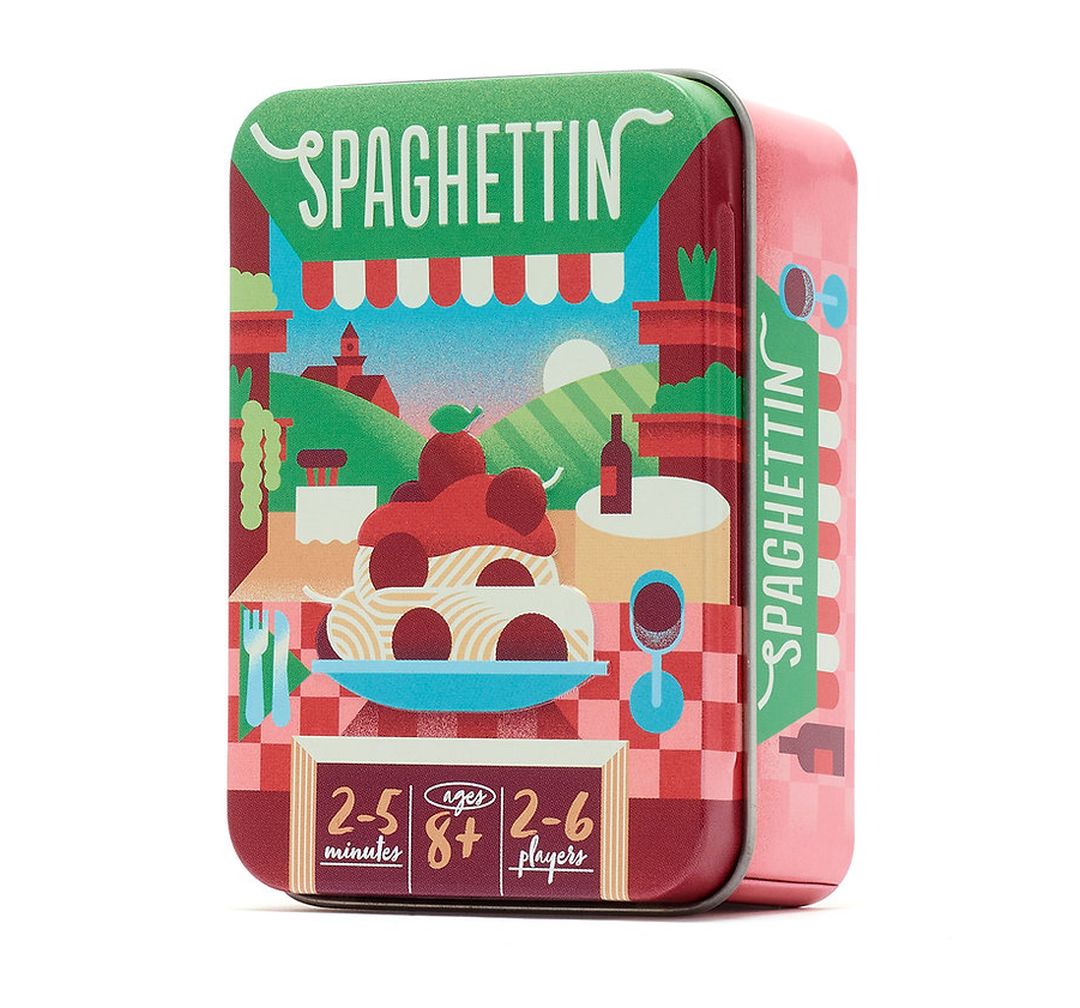
Upon its release, Spaghettin presented itself as a continuation of this beloved tradition. The game’s packaging was consistent with the series: a compact tin housing the components. The aesthetic was indeed appealing, with the vibrant wooden toppings contrasting against the tangle of strings. The rules, as promised, were incredibly straightforward, almost to the point of being non-existent, ensuring that players of all ages could jump in almost immediately.
The core gameplay loop involves players taking turns selecting a single strand of spaghetti and attempting to extract it using the provided tongs without causing any of the five wooden toppings to fall. If a topping does fall, the game requires a crucial distinction: for elimination, one face of the fallen topping must land completely flat against the bottom of the tin. This specific condition, intended perhaps to add a layer of precision or challenge, immediately became the game’s Achilles’ heel.
Early plays quickly revealed the stark contrast between Spaghettin and its more successful predecessors. The estimated maximum five-minute playtime often proved overly generous, with two-player games sometimes concluding in a mere 10 seconds. More critically, the failure condition—the requirement for a topping to fall "flat"—introduced a frustrating ambiguity. Instead of the satisfying "crash" of Tinderblox or the decisive tumble of Kittin, Spaghettin often led to players pausing, squinting into the tin, and debating whether a topping had indeed landed perfectly flat. This lack of immediate, unambiguous feedback undermined the very essence of a dexterity game, transforming moments of tension into anticlimactic inquiries and robbing the game of its potential for dramatic "Oh no!" moments. The initial impression, therefore, was one of a visually promising concept hampered by a fundamental flaw in its core mechanic, failing to deliver the clear-cut, engaging experience that Alley Cat Games’ fans had come to expect.
Supporting Data
Deconstructing the Gameplay: A Closer Look at Mechanics
At its heart, Spaghettin relies on a singular, minimalist mechanic: the delicate extraction of strings. The components—20 spaghetti strings of varying lengths, 5 distinct wooden topping blocks (a red tomato, a chunk of cheese, etc.), and 2 tweezers—are well-produced and visually appealing. The strings, designed to mimic actual pasta, offer different levels of challenge due to their length and how they entangle. The wooden toppings are chunky and inviting, adding to the game’s overall charm. Indeed, the game’s presentation lives up to the high aesthetic standards set by Alley Cat Games.
However, the simplicity of the rules, while initially a strength for accessibility, quickly exposes the fragility of the core mechanic. "The rules are so simple as to be practically non-existent" is an accurate assessment, meaning there’s little strategic depth or variation beyond the single action of pulling a string. This isn’t inherently a flaw in a dexterity game, but it places immense pressure on the dexterity challenge itself to be flawlessly executed and satisfying.
The critical breakdown occurs with the elimination condition: "a topping has to fall and have one face completely flat against the bottom of the tin to eliminate a player." This specific requirement, likely an attempt to add a layer of precision or differentiate it from simpler "anything falls" rules, paradoxically creates ambiguity and frustrates play. In the heat of the moment, as a topping tumbles into the spaghetti tangle, it is often incredibly difficult to discern if it has landed perfectly flat. The review highlights this perfectly: "results in fiddly, anticlimactic conclusions as you all pause and peer into the tangle of string like people hunting for a lost contact lens." This visual ambiguity saps the game of its tension. Sometimes a "dink" might be heard, but often there’s silence, followed by collective squinting and uncertainty.
Compare this to the definitive feedback loops of other renowned dexterity games:
- Jenga: The tower’s dramatic collapse leaves no room for doubt. The failure is loud, visual, and universally understood.
- Rhino Hero: The unstable building tumbles, a clear and decisive end to a player’s turn or the game.
- Operation: A buzzing sound and a flashing nose unequivocally signal failure.
- Tinderblox/Kittin: The carefully constructed stack visibly topples, creating a cascade of wooden pieces that leaves no question of who is out.
In Spaghettin, the lack of such a clear, immediate, and satisfying feedback mechanism transforms what should be a moment of tension and release into an irritating inspection. This fundamental flaw undermines the very purpose of a dexterity game, which relies heavily on clear cause-and-effect and immediate consequences.
Playtime and Player Engagement
The stated "Time to Play: 5m" is a testament to Spaghettin‘s intended brevity, positioning it as a quick filler game. However, even this modest estimate is often proven "too generous." The review notes that "If you’re playing with two players, the game might be over in 10 seconds." While quick games have their place, particularly in the party and family categories, a game that can end almost instantly, especially when combined with an anticlimactic failure condition, struggles to offer meaningful engagement or replayability.
For a game priced at £11.99, players typically expect a certain amount of play value. A game that consistently concludes in under a minute for multiple players, and whose conclusion is unsatisfying, risks feeling like poor value for money. The allure of a "quick, compact experience that’s accessible for all ages and looks visually appealing" is diminished if that experience is fleeting and unfulfilling. The target audience of Age 8+ might appreciate the simple rules, but even children are likely to tire of a game that ends abruptly with an ambiguous outcome. Engagement stems not just from initial interest but from sustained enjoyment and the desire to play again. Spaghettin‘s structure actively works against this, providing little incentive for repeated plays once the novelty of the concept wears off.
Market Context and Value Proposition
The compact tin format, a hallmark of Alley Cat Games’ dexterity series, is a strong selling point for portability and shelf appeal. At an RRP of £11.99, Spaghettin is positioned competitively within the market for small, accessible board games. However, value proposition in board gaming extends beyond mere price and size; it encompasses the quality of the play experience relative to its cost.
When compared to other compact games in a similar price bracket, Spaghettin‘s gameplay depth and longevity fall short. Many games at this price point offer either more strategic depth, more varied gameplay, or, crucially, a more satisfying core loop. The disappointment stems from the fact that its predecessors, Tinderblox and Kittin, delivered precisely this blend of value and enjoyment within the same compact format and price range. They demonstrated that a small game could offer big fun. Spaghettin, unfortunately, fails to meet this established benchmark. While its visual presentation and component quality are commendable, these positives are overshadowed by the critical flaw in its core mechanic, leading to a perception that the game, despite its reasonable price, doesn’t quite justify the investment of time or money for a truly engaging experience.
Official Responses
The Publisher’s Vision and Potential Design Intent
While Alley Cat Games has not issued an official response specifically addressing the critical reception of Spaghettin, we can infer their likely design philosophy and intentions for the game. Alley Cat Games has consistently demonstrated a commitment to producing approachable, family-friendly games that prioritize immediate fun and visual appeal. For the "tin-pun" series, the goal has always been to create games that are quick to teach, quick to play, and easy to transport, making them ideal for casual gatherings or travel.
It is highly probable that with Spaghettin, designer Franco Sardo and Alley Cat Games aimed to replicate the success of Tinderblox and Kittin by introducing another relatable, intuitive dexterity challenge. The theme of pulling spaghetti strands is universally understood, and the use of physical strings and wooden toppings aligns perfectly with the tactile nature of their previous successes. The specific "flat fall" condition might have been an attempt to add a unique twist, perhaps to introduce a heightened sense of precision or a slightly different kind of tension compared to a simple "anything falls" rule. They may have envisioned moments of players holding their breath, carefully inspecting the tin, and experiencing a subtle, sustained tension rather than an explosive collapse. Not every design experiment, however, lands perfectly, and even experienced publishers and designers can misjudge how a specific mechanic will translate to player experience. It’s a natural part of the creative process in game development, where balancing innovation with established principles of fun is a constant challenge.
Community and Critical Reception
Without specific public statements from Alley Cat Games or a broad compilation of community reviews, we must extrapolate the likely reception based on the detailed critique provided. It is reasonable to anticipate a mixed but generally lukewarm to negative reception from the wider board gaming community and other critics. Enthusiasts of Alley Cat Games’ dexterity series, having been spoiled by the clear, satisfying feedback loops of Tinderblox and Kittin, would likely echo the reviewer’s sentiments regarding Spaghettin‘s anticlimactic failure condition.
Online forums, review sites, and social media channels would likely feature discussions centered on the game’s brevity and the ambiguity of its "flat fall" rule. While some players might appreciate the game’s aesthetic and sheer simplicity, especially for very young children or those completely new to gaming, the core design flaw would almost certainly become a recurring point of criticism. Reviewers would likely highlight the contrast with other successful dexterity games, underscoring how crucial a definitive "fail state" is for player engagement and excitement. Such feedback is invaluable for publishers, offering insights into player expectations and the real-world performance of game mechanics. It helps guide future design decisions and reinforces the importance of thorough playtesting that identifies potential points of frustration before a game reaches the market.
Lessons Learned for Future Designs
The experience of Spaghettin, particularly its reception, offers crucial lessons for Alley Cat Games and the broader industry regarding dexterity game design. The primary takeaway is the non-negotiable importance of a clear, unambiguous, and satisfying feedback loop for success or failure. In dexterity games, where physical action is central, the consequence of that action must be immediate and universally understood. Ambiguity, as demonstrated by Spaghettin‘s "flat fall" rule, directly detracts from the fun, replacing excitement with confusion and deliberation.
For Alley Cat Games, this likely means a renewed focus on ensuring that future entries in their dexterity series prioritize definitive outcomes. While innovation is always encouraged, it must be balanced with foundational principles of game design that contribute to player enjoyment. This includes rigorous playtesting specifically aimed at identifying and resolving "fiddly" mechanics that can undermine the player experience. The publisher’s track record suggests they are adept at learning and adapting, and this particular misstep will undoubtedly inform their future creative processes, reinforcing the core strengths that made their other tin games so beloved.
Implications
Impact on Alley Cat Games’ Dexterity Series
The lukewarm reception of Spaghettin undoubtedly presents a challenge for Alley Cat Games, but it is unlikely to fundamentally tarnish the overall reputation of their highly successful dexterity series. Tinderblox and Kittin have established such a strong foundation of positive experiences that Spaghettin is more likely to be viewed as an outlier—a single experimental misstep rather than an indication of a declining trend. The series has built considerable goodwill, and fans are generally forgiving of a less-than-stellar entry when the overall catalog remains strong.
However, it does place an increased onus on future releases in the series to reaffirm the quality and engaging gameplay that players have come to expect. Alley Cat Games will need to ensure that their next dexterity tin not only offers a fresh concept but also rigorously adheres to the principles of clear, satisfying mechanics that made their earlier titles so popular. This situation also highlights the competitive nature of the board game market; even established publishers with beloved series must consistently deliver quality to maintain their standing and player trust.
Broader Implications for Dexterity Game Design
Spaghettin‘s shortcomings offer a valuable case study for the broader board game industry, particularly for designers of dexterity games. The central lesson is a reinforcement of the critical importance of a definitive failure state. Dexterity games thrive on tension, anticipation, and a clear, often dramatic, resolution. Whether it’s a tower collapsing, a piece clattering, or a buzzer sounding, the consequence of a misstep must be immediate and unambiguous. When the failure condition is open to interpretation or requires prolonged scrutiny, it drains the game of its inherent excitement and momentum.
This scenario underscores the delicate balance between simplicity and satisfying mechanics. While Spaghettin nailed simplicity, it stumbled on the latter, demonstrating that a game can be too simple if its core interaction lacks meaningful feedback. Designers must prioritize player experience, ensuring that every rule contributes to fun and clarity, rather than introducing friction or confusion. The ambiguity in Spaghettin serves as a cautionary tale: a clever idea on paper may not always translate into an enjoyable physical experience without meticulous attention to the practicalities of play.
Consumer Choice and Recommendations
For consumers seeking a fulfilling dexterity game experience, the recommendation for Spaghettin is unequivocally "No," as stated in the original review. While its visual appeal and compact size might initially draw attention, the fundamental flaw in its core mechanic leads to an unsatisfying and anticlimactic experience that fails to justify its purchase.
Instead, the article wisely suggests BEAKS as an alternative. BEAKS offers a similarly accessible, tin-based party game experience where players act as seagulls using tweezers to grab chips. This game, by all accounts, provides a much clearer and more satisfying gameplay loop, offering the precise, engaging dexterity challenge that Spaghettin aims for but misses. Furthermore, for those seeking the classic, definitive thrill of a dexterity game, timeless titles like Jenga or Rhino Hero remain superior choices, providing the dramatic "Oh no!" moments that are conspicuously absent in Spaghettin.
In conclusion, Spaghettin stands as a visually charming concept from a reputable publisher, but ultimately a missed opportunity. Despite its lineage from a highly successful series of compact dexterity games, its core mechanic—the ambiguous "flat fall" elimination—undermines the very essence of what makes dexterity games engaging. While Alley Cat Games continues to excel in its broader catalog, Spaghettin serves as a stark reminder that even the most promising ideas require meticulous execution of core mechanics to deliver a truly captivating and replayable experience. For players seeking genuine dexterity fun, it’s best to look elsewhere, perhaps to the very games that preceded it in Alley Cat’s own successful lineup.