The Heat of Injustice: How the “Degree of Violence” Campaign Maps the Human Cost of Climate Change
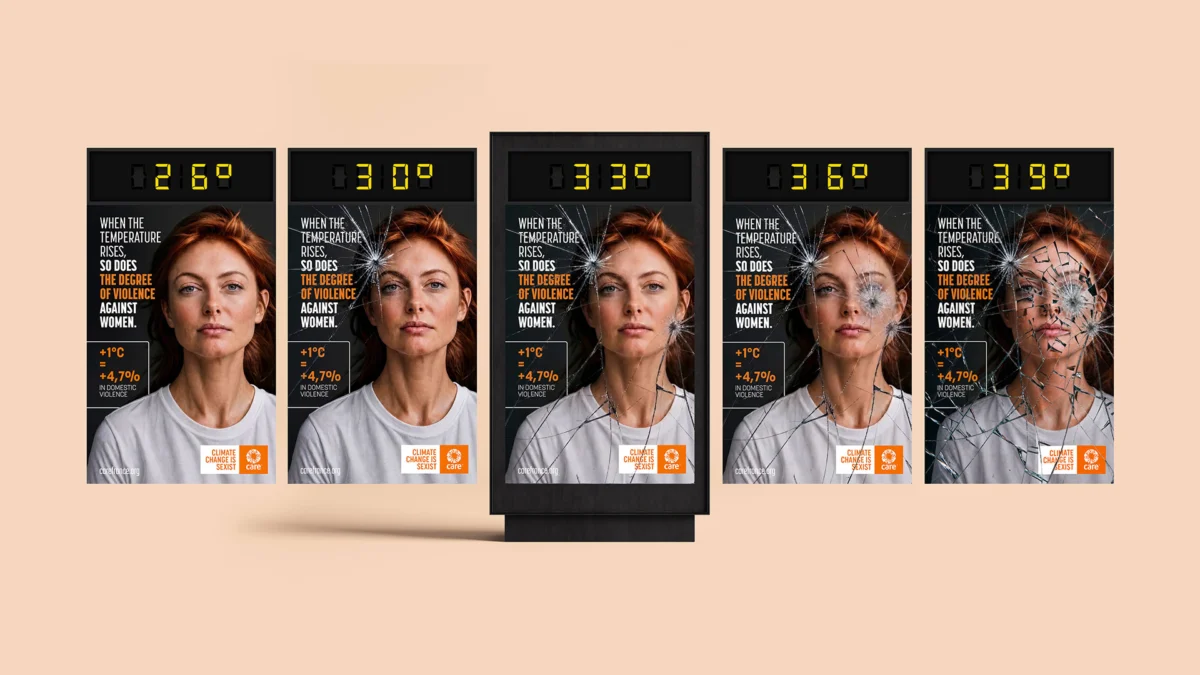
As the mercury climbed to record-breaking heights across Western Europe this past July, the residents of Paris were confronted with a visual representation of a crisis that extends far beyond meteorological data. Amidst the shimmering heat haze of the French capital, digital billboards began to tell a story not of rising sea levels or melting glaciers, but of a more intimate, domestic catastrophe.
The "Degree of Violence" campaign, a collaboration between the independent French creative agency Belle and the international humanitarian organization Care France, has sparked a global conversation on the intersection of environmental degradation and social vulnerability. By utilizing real-time weather data to alter the physical appearance of subjects on digital displays, the campaign has successfully translated a chilling statistic into a visceral public experience.
Main Facts: A Real-Time Mirror to a Hidden Reality
The "Degree of Violence" campaign is an innovative Out-of-Home (OOH) activation that ran from July 7 to July 14, strategically timed to coincide with one of the most intense heatwaves in recent Parisian history. The core of the creative execution features a portrait of a woman whose visage serves as a living barometer for the city’s temperature.
Using a sophisticated API integration, the digital billboards were programmed to respond to local weather sensors. As the temperature recorded in Paris increased, the image of the woman underwent a distressing transformation. For every degree the mercury rose, visible signs of physical trauma—bruises, abrasions, and cuts—emerged on her face. Simultaneously, the digital display itself appeared to "crack" under the pressure of the heat, creating a powerful metaphor for the breaking point of social stability.
The campaign is not merely an exercise in shock tactics; it is a data-driven intervention. Its creative foundation rests upon a 2025 report by the UN Spotlight Initiative, which provided the harrowing evidence that for every 1°C increase in temperature, there is a corresponding 4.7% rise in incidents of domestic violence. By visualizing this correlation in the public square, Care France and Belle have effectively stripped away the anonymity of the "shadow pandemic" of gender-based violence (GBV).
Chronology: From Data to Digital Street Intervention
The timeline of the "Degree of Violence" campaign reflects a strategic synchronization between creative output and environmental reality.
The Research Phase (April 2025)
The genesis of the project lies in the publication of the UN Spotlight Initiative’s research. This comprehensive study analyzed the link between environmental stressors and social aggression, specifically focusing on how extreme heat exacerbates existing tensions within households. This data provided the "why" for Care France, a charity that has long advocated for the rights of women and the protection of vulnerable communities in the face of the climate crisis.
The Creative Conception (May – June 2025)
The agency Belle was tasked with humanizing this data. The challenge was to move beyond the abstract—to show that climate change is not a distant threat but an immediate catalyst for human suffering. The decision was made to use OOH technology to create a "live" connection between the environment and the individual.
The Launch (July 7, 2025)
The campaign went live as Paris entered a period of extreme thermal stress. The timing ensured that the public was already feeling the physical discomfort of the heat, making them more receptive to the campaign’s message of shared vulnerability.

The Multi-Channel Expansion (July 10 – July 14, 2025)
To ensure the message reached beyond those walking past digital billboards, a "bike tour" was organized through the capital. This mobile protest stopped at symbolic locations, including the Ministry for Ecological Transition and the French National Assembly, demanding that policymakers recognize gender-based violence as a critical component of climate adaptation strategies. This was supplemented by a social media blitz involving 20 high-profile influencers and on-the-street interviews that captured the public’s visceral reaction to the billboards.
Supporting Data: The Science of Heat and Aggression
The campaign’s impact is anchored in a growing body of scientific and sociological evidence. While the UN Spotlight Initiative’s 4.7% figure served as the primary hook, the "Degree of Violence" work draws on broader psychological and environmental research.
The Physiology of Heat-Induced Conflict
Psychologists have long noted the "Heat Hypothesis," which suggests that hot temperatures increase aggressive motives and behaviors. Physiologically, extreme heat increases heart rate and testosterone levels while simultaneously disrupting sleep patterns and increasing cortisol (the stress hormone). When these biological factors are combined with the economic and social pressures of a climate-strained world, the household often becomes a pressure cooker.
The "Shadow Pandemic" and Resource Scarcity
Care France highlights that in many communities, climate change leads to resource scarcity—lack of water, crop failure, and economic instability. These stressors disproportionately affect women, who are often responsible for resource management within the home. When these stressors are compounded by extreme heat, the risk of domestic escalation reaches a tipping point.
Technological Efficacy
The use of programmatic OOH (pOOH) has been proven to increase engagement by up to 18% compared to static displays. By making the advertisement "reactive," Belle ensured that the message felt urgent. Passersby weren’t just looking at an ad; they were looking at the direct result of the weather they were currently experiencing.
Official Responses: NGOs and the Call for Policy Reform
Care France, a branch of one of the world’s largest humanitarian networks, has positioned this campaign as a cornerstone of its "Climate Justice" initiative. Last year, the organization supported over 58 million people across 100 countries, and their internal data reflects the campaign’s message: women are on the front lines of the climate crisis.
"Climate change is a multiplier of inequalities," a spokesperson for Care France noted during the campaign launch. "We cannot talk about ecological transition without talking about the safety of women. The ‘Degree of Violence’ campaign is a call to our leaders to integrate social and gender-based protections into their environmental agendas."
The Ministry for Ecological Transition has not yet issued a formal policy change in response to the campaign, but the visibility of the bike tour at the National Assembly has forced the issue into the legislative conversation. Critics of the government’s current climate plan argue that it focuses too heavily on infrastructure and carbon credits, ignoring the "human infrastructure"—the safety and resilience of citizens.
The creative agency Belle, known for its focus on social impact, emphasized that the goal was to create a "moral discomfort." An agency representative stated, "Advertising usually tries to make people feel good or want something. We wanted to make them feel the weight of a statistic that is usually ignored because it is too uncomfortable to face."

Implications: A New Era of Climate Communication
The "Degree of Violence" campaign represents a significant shift in how NGOs and creative agencies communicate the climate crisis. It moves the narrative from the "macro" (the planet) to the "micro" (the person).
1. The Intersection of Eco-Feminism and Advertising
This campaign is a prime example of "eco-feminism" in the mainstream. It posits that the exploitation of the environment and the exploitation of women are linked by the same systemic failures. By bringing this to the streets of Paris, the campaign forces a rethink of environmentalism as a purely scientific or technical field, reframing it as a human rights issue.
2. Comparison to Global Precedents
The campaign draws parallels to the work of the agency Elvis for Women’s Aid in the UK. That campaign used facial recognition technology to "heal" a woman’s bruised face on a billboard only when people stopped to look at her—highlighting the importance of not turning a blind eye. "Degree of Violence" takes this a step further by removing human agency from the visual change and replacing it with environmental agency, suggesting that we are all subject to the forces of a changing climate.
3. The Future of Reactive OOH
The success of this campaign demonstrates the power of pOOH to create "event-based" marketing. As climate events—heatwaves, floods, and storms—become more frequent, we can expect to see more organizations using real-time data to create "living" advertisements that reflect the immediate state of the world.
4. A Mandate for Holistic Policy
Ultimately, the campaign suggests that climate policy must be holistic. If a 1°C rise leads to a nearly 5% rise in domestic violence, then heat mitigation strategies (such as urban greening and improved cooling in low-income housing) are not just environmental goals—they are crime-prevention and public health necessities.
Conclusion: Beyond the Billboard
As the July heatwave eventually broke and the digital billboards in Paris returned to their standard rotations, the "Degree of Violence" campaign left a lasting mark on the public consciousness. It successfully bridged the gap between a meteorological phenomenon and a social epidemic, proving that the scars of climate change are not always found on the landscape—sometimes, they are found on the faces of the people living within it.
For Care France and Belle, the campaign was a victory in visibility. For the millions of women represented by the woman on the screen, it was a long-overdue acknowledgement of their reality. The challenge now lies with global leaders to ensure that as the world warms, the safety and dignity of its most vulnerable inhabitants do not fracture along with the thermometer.