The Final Descent: Analyzing the Aesthetic and Narrative Ambitions of The Last Day of H.P. Lovecraft
The cultural landscape of the 21st century is increasingly defined by the shadows of Providence. It has become a recurring observation in literary and artistic circles that any creator with a penchant for the macabre or a pitch for a new comic book will inevitably find themselves drawn to the orbit of Howard Phillips Lovecraft. Whether through the direct invocation of his "many-tentacled" deities or the adoption of his particular brand of cosmic nihilism, the "Lovecraftian" label has transitioned from a niche subgenre to a dominant, almost inescapable, aesthetic force.
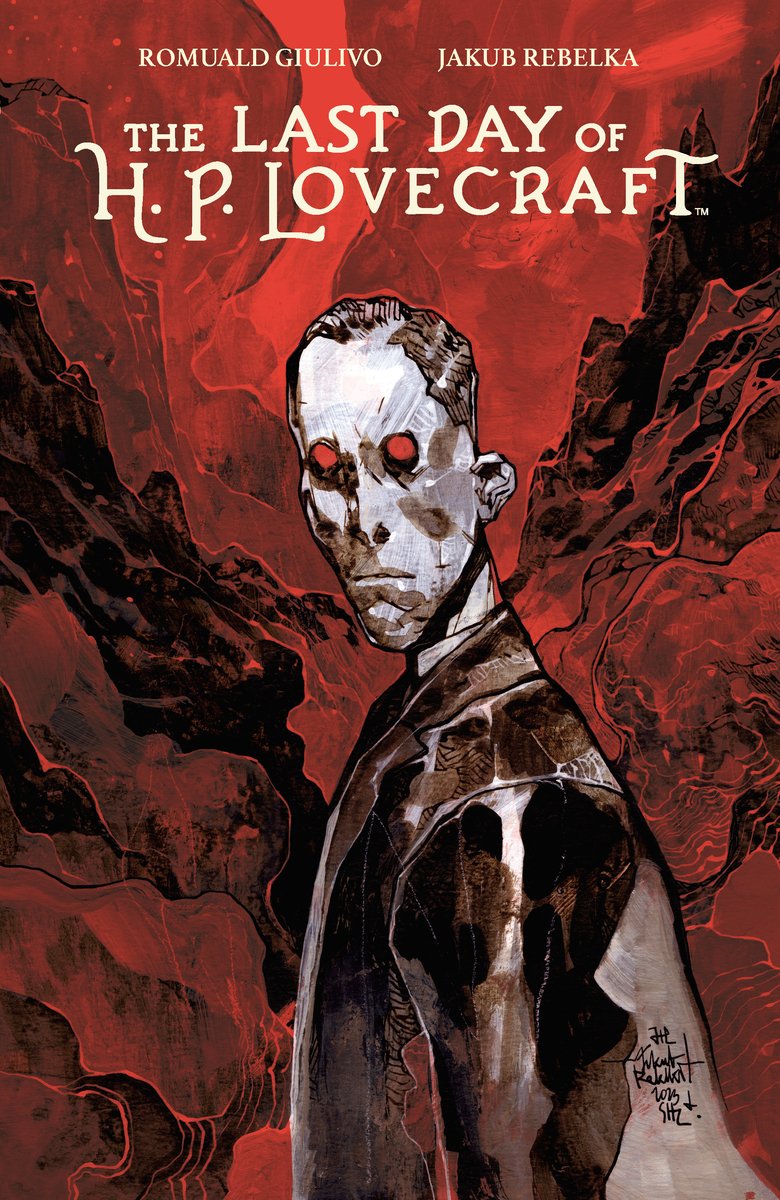
The latest entry into this crowded field is The Last Day of H.P. Lovecraft, a French graphic novel that attempts to deconstruct the man behind the myth during his final, agonizing hours. Written by Romuald Giulivo and illustrated by the visionary Jakub Rebelka, the work seeks to synthesize biography, literary criticism, and hallucinatory horror. However, as the work makes its way into the English-speaking market via Boom! Studios, it raises a fundamental question: In an era of "peak Lovecraft," does this new interpretation offer a fresh revelation, or is it merely another echo in the void?
Main Facts: The Genesis and Execution of the Work
The Last Day of H.P. Lovecraft arrived in the American market as a five-issue miniseries before being collected into its intended format as a singular graphic novel. The project represents a cross-continental collaboration, featuring the prose of Romuald Giulivo—a writer whose work is gaining traction in the European "Bande Dessinée" scene—and the art of Jakub Rebelka. Rebelka, a Polish artist known for his work on Names and Origin, has long been regarded by critics as a talent deserving of wider recognition in the English-speaking world for his ability to blend traditional painterly techniques with surrealist distortion.
The English edition features a translation by Mercedes Gilliom and lettering by the veteran Ed Dukeshire. While the American serialization by Boom! Studios introduced chapter breaks, critics note that the work is best consumed in a single sitting, as it was designed to mimic a stream-of-consciousness fever dream.
The narrative premise is stark: It is March 15, 1937. H.P. Lovecraft, aged only 46, is dying of intestinal cancer and Bright’s disease at Jane Brown Memorial Hospital. The story follows the "dying mind" of the author as he drifts between reality and a phantasmagoria of his own making. In this liminal space, Lovecraft is confronted by the people who defined his life—his wife Sonia Greene and collaborator Harry Houdini—and the literary figures who would eventually define his legacy, including cameos of modern icons like Alan Moore, Stephen King, and Neil Gaiman.
Chronology: From 1937 to the Modern Mythos
To understand the weight of the graphic novel, one must look at the timeline it inhabits, both historically and within the context of Lovecraft scholarship.
- March 15, 1937: Howard Phillips Lovecraft dies in relative obscurity. At the time of his death, he was a "minor writer within a minor literary scene," known primarily to the readers of pulp magazines like Weird Tales. He could not have anticipated that his name would eventually transcend those of his idols, save perhaps for Edgar Allan Poe.
- Post-War Era: The efforts of August Derleth and Donald Wandrei through Arkham House begin the slow process of canonizing Lovecraft, often flattening his complex cosmic horror into a more traditional good-vs-evil "Cthulhu Mythos."
- The Late 20th Century: Lovecraftian themes explode into the mainstream through cinema (John Carpenter’s The Thing) and gaming (Call of Cthulhu RPG).
- 2015–2017: Alan Moore and Jacen Burrows release Providence, a work widely considered the "final word" on Lovecraftian deconstruction. It integrated Lovecraft’s personal life, his bigotry, and his fiction into a unified, world-ending narrative.
- 2024–2026: The Last Day of H.P. Lovecraft is released. It enters a market already saturated by high-concept deconstructions like Victor LaValle’s The Ballad of Black Tom and Matt Ruff’s Lovecraft Country.
The graphic novel attempts to bridge the gap between the historical man of 1937 and the cultural titan of the 21st century by placing them in the same room—or rather, the same hallucination.
Supporting Data: Visual Mastery vs. Narrative Diffusion
The critical reception of The Last Day of H.P. Lovecraft is sharply divided between its aesthetic triumphs and its narrative efficacy.
The Art of Jakub Rebelka
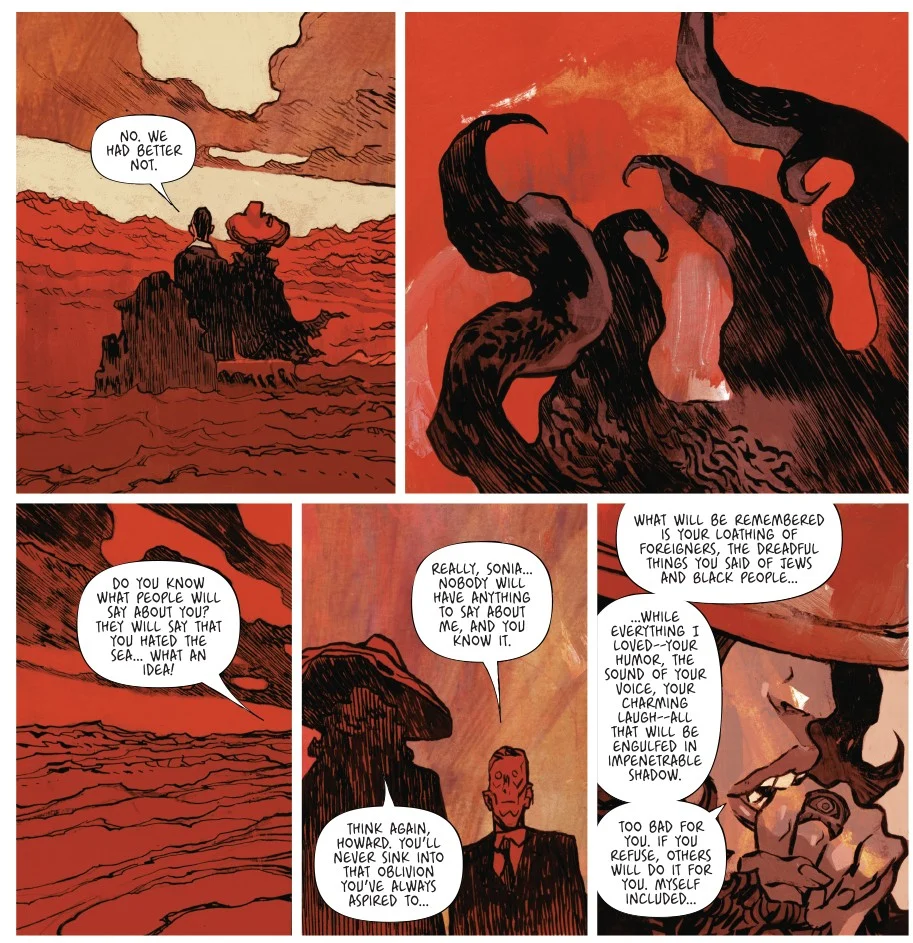
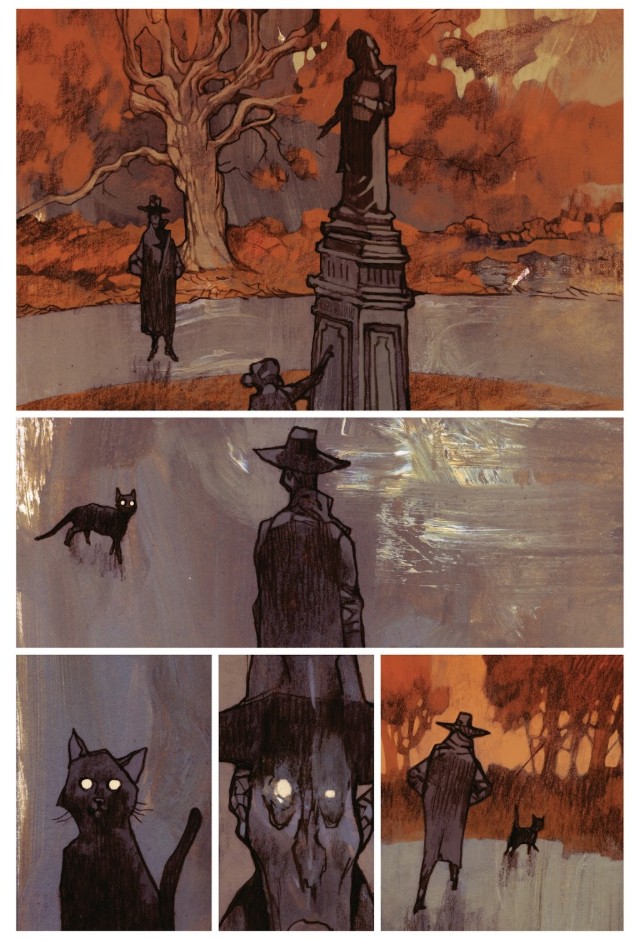
Rebelka’s contribution is almost universally lauded as the work’s strongest asset. His style is characterized by an "odd charm," with figures that appear as if molded from shifting clay. Critics have compared his work to the experimental animation of the Soviet bloc—low-budget in origin but high in metaphysical aspiration.
In Rebelka’s panels, the "pathetic fallacy" is employed with surgical precision; the environments are not mere backgrounds but reflections of Lovecraft’s deteriorating psyche. The opening sequence, which depicts nature as an abyss ruled by violent shades of red, serves as a masterclass in atmospheric dread. His ability to render the "amorphous, ever-shifting world" of a dying mind provides a visual resonance that echoes the work of Bill Sienkiewicz, though it maintains a unique, European sensibility.
Narrative Challenges
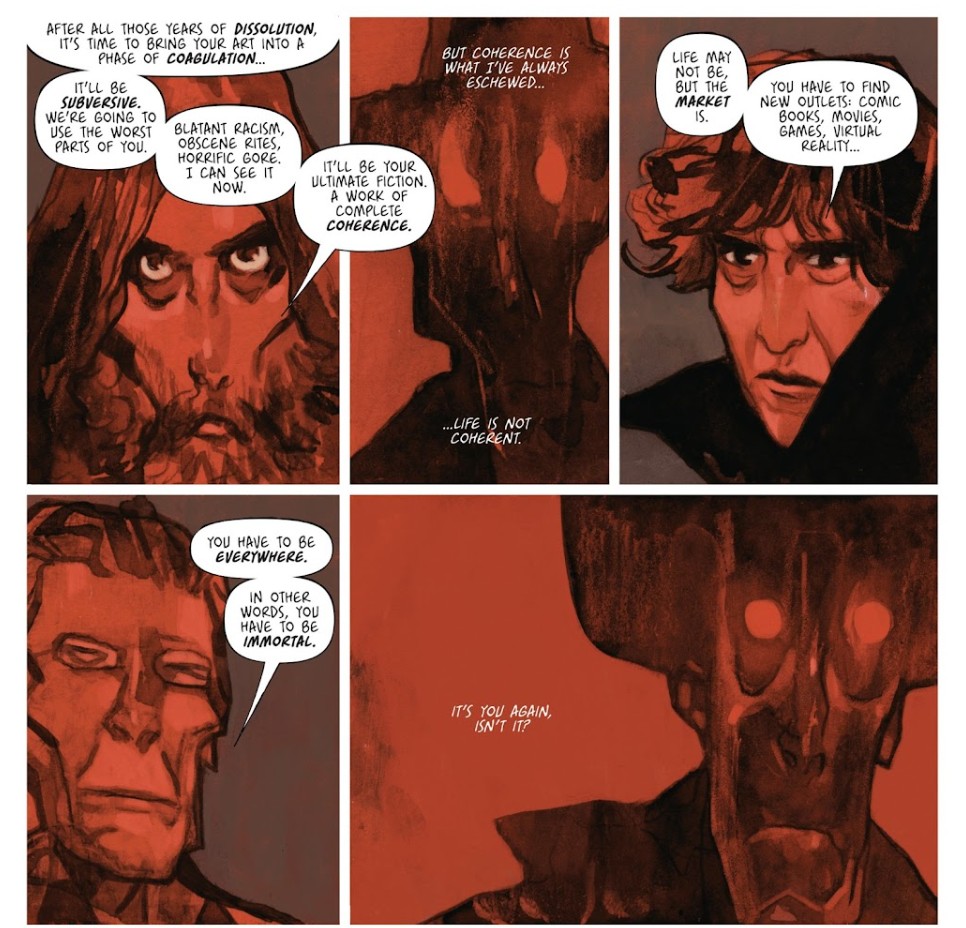
Conversely, the script by Romuald Giulivo has been described as a "dirge" that struggles to find its footing. While the book attempts to explore Lovecraft’s soul, critics argue it functions more like "an essay trying to birth itself" than a cohesive story.
The inclusion of modern literary successors—Moore, King, and Gaiman—is a bold meta-textual move, but one that risks alienating the reader. By having Lovecraft take "pot-shots" at his successors, the book invites a comparison to those authors’ works—a comparison that The Last Day of H.P. Lovecraft does not always survive. It gestures at themes of racism, literary influence, and cosmic indifference, but often fails to develop these notions beyond the "familiar homilies" already well-trodden by S.T. Joshi and other scholars.
Official Responses and Scholarly Context
The publication of this graphic novel occurs within a broader framework of "Lovecraft Scholarship" that has become increasingly rigorous. The work does not exist in a vacuum; it is measured against decades of deep-dive analysis.
- Biographical Accuracy: For those seeking a factual account of Lovecraft’s life, scholars point to S.T. Joshi’s definitive biography, I Am Providence. Giulivo’s work, by contrast, is a psychogeographic exploration rather than a historical one.
- The Deconstructionist Wave: The book follows in the wake of Providence (Moore/Burrows), which many feel has already said everything there is to say about the "physical and metaphorical" end of Lovecraft’s world.
- Cultural Critique: Works like Sex and the Cthulhu Mythos by Bobby Derie have explored the unexamined aspects of Lovecraft’s personal life and prejudices with more depth than the fleeting hallucinations presented in this graphic novel.
Critics suggest that while The Last Day of H.P. Lovecraft is a superior effort compared to previous biographical comics—such as Lovecraft: He Who Wrote in Darkness—it still struggles to justify its existence in a market where the "Shoggoth has been discussed as many times as it has eyes."
Implications: The Exhaustion of the Mythos
The release and reception of The Last Day of H.P. Lovecraft serve as a barometer for the current state of horror fiction. We are currently witnessing what some call "Lovecraftian Fatigue." The tropes of the genre—the fish-people, the avatars of Nyarlathotep, the "fear of the unknown"—have become so thoroughly "known" that they risk losing their potency.
The irony, as noted by many reviewers, is that the man who wrote that "the oldest and strongest kind of fear is fear of the unknown" has had his work so meticulously cataloged and replicated that it has become a comfortingly familiar brand. The Last Day of H.P. Lovecraft attempts to reclaim the "unknown" by diving into the subjectivity of death, but it finds itself trapped by the very icons it seeks to examine.
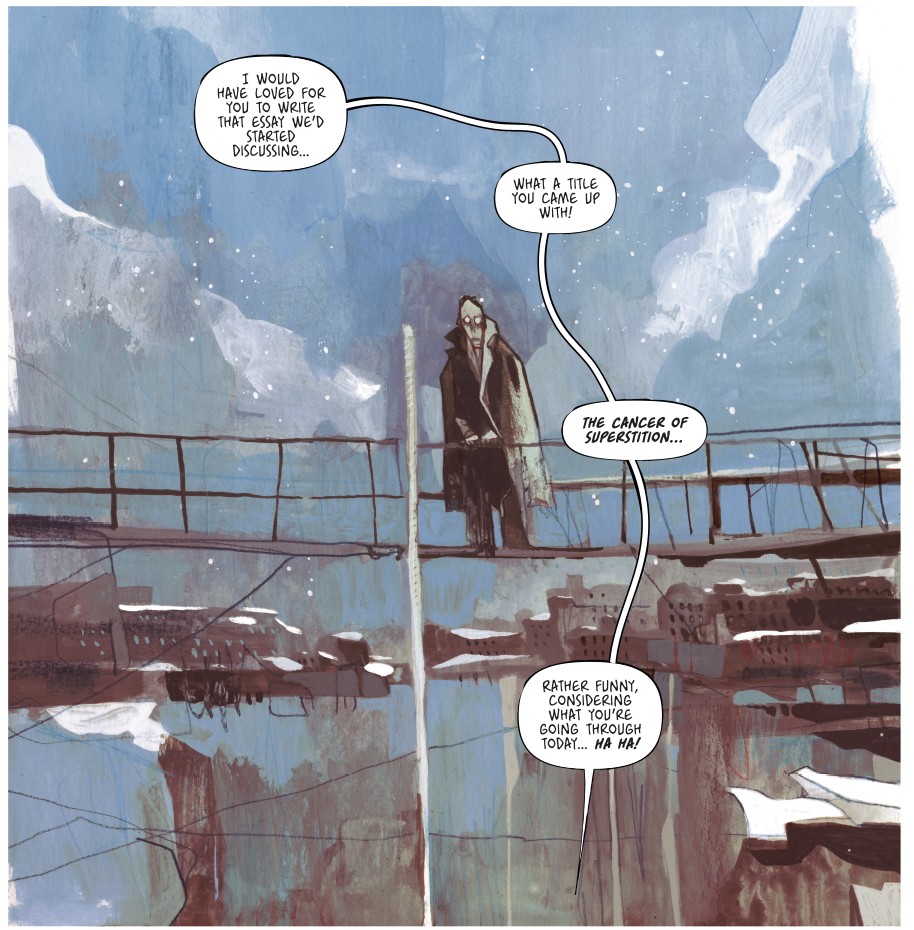
Ultimately, the book stands as a testament to the talent of Jakub Rebelka, whose art makes the "mad frenzy" of the narrative worth witnessing. However, for those seeking a profound new understanding of the man from Providence, the book may feel like a beautifully illustrated footnote. It confirms that while we may be living in H.P. Lovecraft’s world, the act of simply revisiting his deathbed is no longer enough to shock a modern audience out of its cosmic indifference. If a creator wishes to stand out in the "unholy spread of Lovecraftiana," they must offer more than a mirror to the past; they must find a way to make the void scream in a new voice entirely.