Political Brinkmanship and the Rise of Automation: A Nation at a Legislative and Cultural Crossroads

The final week of June 2026 has emerged as a watershed moment in American governance and labor relations. Within a matter of days, the intersection of executive unpredictability, high-stakes legislative maneuvering, and the encroaching shadow of artificial intelligence has created a landscape of profound uncertainty. From the halls of Congress, where a landmark bipartisan housing bill was derailed by a last-minute executive pivot, to the airwaves of Denver, where a 28-year radio veteran was replaced by an algorithm, the nation is grappling with the volatility of its leadership and the cold efficiency of its technology.
Main Facts: A Convergence of Crises
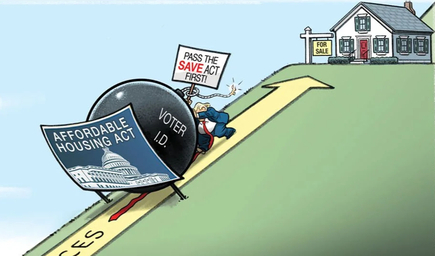
At the center of the political storm is the "21st Century ROAD to Housing Act," a rare piece of bipartisan legislation designed to alleviate the crushing burden of housing costs for American families. Despite passing both chambers of Congress with overwhelming majorities, the bill’s ceremonial signing was abruptly canceled by the White House. The administration has reportedly pivoted to use the housing bill as leverage to force the passage of the "Save America Act" (SAVE Act), a controversial voting reform package.
Simultaneously, the American labor market is facing a new front in the battle against automation. iHeartMedia, the nation’s largest radio station owner, has initiated a series of significant layoffs, most notably terminating Bret Saunders, the longtime morning host of KBCO-FM in Denver. These cuts are part of a broader corporate strategy to replace human "personalities" with generative AI, signaling a potential end to the era of local, community-focused broadcasting.
Furthermore, the judicial branch has added to the week’s gravity. Recent Supreme Court rulings have tightened the path for asylum seekers, specifically those from Syria and Haiti, affirming the government’s power to expedite deportations and limit access to the asylum process.
Chronology: From Bipartisan Triumph to Executive Farce
The timeline of the current legislative deadlock reveals a rapid descent from cooperation to confrontation.
The Legislative Surge (Mid-June 2026): After months of negotiation, the 21st Century ROAD to Housing Act moved through Congress. In a display of unity rarely seen in the modern era, the House of Representatives passed the measure with a 358-to-32 vote. The Senate followed suit shortly after, passing it 85-to-5. The bill was hailed as a "landmark act" intended to provide safeguards for average citizens and boost the prospects of incumbents ahead of the November midterm elections.
The Scheduled Celebration (June 24, 2026): A signing ceremony was scheduled at the White House. Republican legislators, eager to showcase a major policy win to their constituents, gathered in the briefing room. The press was assembled to capture what was expected to be a rare moment of national consensus.
The Cancellation (June 24, 2026, 11th Hour): Minutes before the event, the White House announced the cancellation. The President’s refusal to sign the bill left GOP leaders "standing around looking stupid," according to observers. The administration signaled that no housing relief would be granted until Congress addressed the Save America Act, a move widely interpreted as political extortion.
The Cultural Shift (June 25, 2026): As the political drama unfolded, the media world was rocked by the dismissal of Bret Saunders. Having served as the voice of Denver’s morning drive for nearly three decades, Saunders’ departure marked the beginning of iHeartMedia’s transition to AI-driven content, sparking a nationwide debate over the value of human connection in the digital age.
Supporting Data: The Mechanics of the Legislation and its Impact
To understand the stakes of this week’s events, one must look at the specific provisions and the demographic data underlying the contested bills.
The 21st Century ROAD to Housing Act
This legislation was specifically engineered to address the affordability crisis. Key provisions include:
- Mortgage Assistance: Subsidies for first-time homebuyers to offset high interest rates.
- Rent Control Incentives: Federal grants for municipalities that implement sustainable rent-stabilization programs.
- Supply Expansion: Tax breaks for developers focusing on "missing middle" housing—townhomes and duplexes that cater to younger families.
The Save America Act (SAVE Act)
Promoted as a tool to prevent non-citizen voting, the SAVE Act introduces several rigorous requirements:
- Documentary Proof of Citizenship: Voters must provide birth certificates or passports at the polls.
- Mail-in Restrictions: Significant limits on remote voting, which data shows is the primary method for elderly and rural voters.
- The Gender Gap: Analysts note that the act disproportionately affects women. Because approximately 80% of married women in the U.S. change their names, their current identification often does not match their birth certificates. Under the SAVE Act, these women would be required to produce marriage licenses or court orders to vote—a bureaucratic hurdle that could disenfranchise millions.
Despite the administration’s focus on non-citizen voting, data from the Center for Election Innovation suggests that such instances are "farcically rare," occurring in less than 0.0001% of cast ballots.
Official Responses: A Party in Turmoil
The reaction from Capitol Hill has been a mixture of public stoicism and private fury. While some staunch loyalists defend the President’s "tough negotiating tactics," many mainstream Republicans are alarmed.
A senior GOP aide, speaking on the condition of anonymity, described the mood as "apocalyptic." "We handed the President a gift-wrapped victory three months before an election," the aide stated. "Instead of taking the win, he’s holding it hostage for a voting bill that could actually hurt our own base in rural areas. It’s a strategic nightmare."
In the corporate sector, iHeartMedia issued a memo to its staff attempting to frame the layoffs as an "evolution." The memo, obtained by The Hollywood Reporter, emphasized "technological synergy" and the need to "remain competitive in a landscape dominated by on-demand streaming." However, the response from the public has been overwhelmingly negative. Social media campaigns to "Bring Back Bret" have gained traction, with listeners arguing that an AI bot cannot replicate the community bond established by a human broadcaster who knows the local weather, the local traffic, and the local heart.

On the judicial front, the Supreme Court’s affirmation of asylum controls was met with praise from the Department of Homeland Security. A spokesperson stated that the rulings "provide the necessary clarity to manage our borders effectively and ensure that our resources are focused on those with legitimate claims." Human rights organizations, conversely, have condemned the move, warning that sending asylum seekers back to volatile regions like Haiti is a "death sentence" for many.
Implications: The High Cost of Manipulation and Automation
The events of late June 2026 carry heavy implications for the future of the American social contract.
Political Fallout
The President’s decision to jeopardize a popular housing bill may backfire significantly in the midterm elections. By prioritizing the SAVE Act—a bill that focuses on a statistically insignificant problem while creating real-world hurdles for legal voters—the administration risks alienating the very "average people" the housing bill was meant to help. Furthermore, the internal rift within the Republican party suggests a growing fatigue with "Dear Leader" tactics. If the GOP loses its majority in November, the President will lose his primary lever of power, potentially rendering his final two years in office a period of total gridlock.
Economic and Social Burdens
For the American family, the delay of the ROAD to Housing Act is more than a political headline; it is a financial blow. As mortgage rates remain volatile and rents continue to consume a record percentage of household income, the "Sisyphus-like" struggle of the American worker continues. The political manipulation of these economic safeguards suggests a government more interested in its own survival than the welfare of its constituents.
The AI Displacement
The termination of Bret Saunders is a harbinger of a broader economic shift. As AI becomes "virtually free," the incentive for corporations to retain human staff diminishes. This trend raises a fundamental question: What is the value of community? In radio, as in many industries, the human element—the ability to comment on a rainy morning or share a local anecdote—is being traded for the efficiency of a bot. While this may improve corporate balance sheets, it risks a "hollowing out" of the cultural landscape, leaving listeners with a service that is technically perfect but emotionally vacant.
The Immigration Paradox
The Supreme Court’s rulings, combined with the legislative focus on the SAVE Act, reflect an increasingly isolationist stance. While automation and AI pose a demonstrably larger threat to American jobs than immigration, the political narrative remains focused on the latter. This misalignment of "villains" suggests that the current political strategy is rooted more in the exploitation of fear than the resolution of actual economic threats.
As the nation moves toward the 2026 midterms, the "Trumpian conundrum" remains: Is this a calculated strategy to depress opposition turnout, or a prideful miscalculation that will sink the party’s incumbents? Regardless of the motivation, the practical reality is a nation on edge, waiting to see if its leaders will choose to build houses or burn bridges.