"Assault on the Aerie of the Slave Lords": A Deep Dive into a Flawed Classic
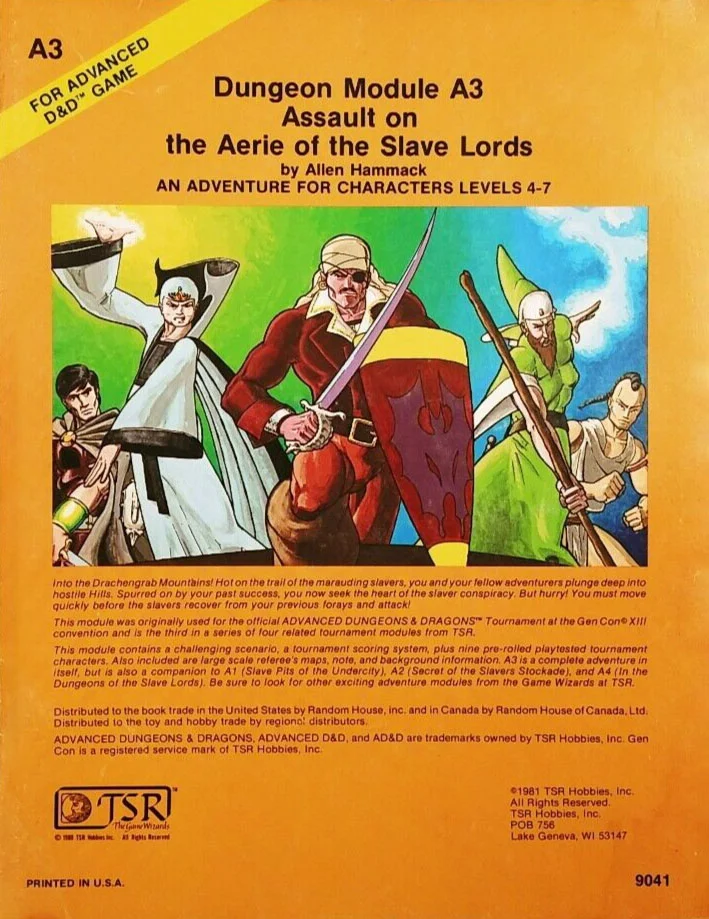
Originally Published: March 16th, 2002 (Review Context)
The sprawling saga of the Slave Lords, a foundational narrative in the early history of Dungeons & Dragons, reached a pivotal, albeit controversial, juncture with the release of A3: Assault on the Aerie of the Slave Lords. Designed by Allen Hammack and published by TSR, Inc. in 1981, this module was intended to be the thrilling crescendo before the ultimate confrontation with the nefarious organization. While its predecessors, A1: Slave Pits of the Undercity and A2: Secret of the Slavers Stockade, garnered widespread acclaim for their tight design and engaging plots, A3 has historically been viewed as the point where the series’ quality began to waver, introducing elements that challenged player immersion and DM sanity alike.
This article delves into the intricate layers of A3, expanding upon an original review published in 2002, to provide a comprehensive journalistic examination of its design, historical context, strengths, weaknesses, and enduring legacy within the pantheon of classic D&D modules.
Main Facts: A Premise of Grandeur, a Reality of Contrivance
A3: Assault on the Aerie of the Slave Lords casts player characters (PCs) into a more proactive role in their relentless pursuit of the shadowy Slave Lords. Following the investigative triumphs and daring escapes of the previous modules, the adventurers are tasked with infiltrating the very heart of the slavers’ operations. The module’s narrative is conceptually structured into three distinct phases: a treacherous journey through the Caves of Drachensgrab, a stealthy reconnaissance mission within the Hidden City of Suderham, and a final descent into the Catacombs leading directly to the Slave Lords’ council chamber.
Authored by Allen Hammack, the module was a product of its time, bearing the hallmarks of early D&D design, including a significant reliance on dungeon crawling and a penchant for unique, often bizarre, encounters. While the overarching concept of an "assault" on a hidden aerie promised epic confrontations and strategic brilliance, the execution, particularly in its initial and final acts, often devolved into a series of illogical contrivances and, famously, a "railroad" ending that forced players towards the subsequent module, A4: In the Dungeons of the Slave Lords.
Despite these considerable flaws, A3 is not without its merits. Its most celebrated feature is undoubtedly the Hidden City of Suderham, an imaginative and meticulously detailed urban environment nestled within the mountains, offering rich opportunities for role-playing, intrigue, and strategic infiltration. This section stands as a testament to the module’s latent potential, often cited as a moment of awe and wonder for players fortunate enough to experience it. However, the uneven quality across its sections ultimately positions A3 as a module that demands significant revision and adaptation from a Dungeon Master to truly shine, a fact acknowledged even in its initial critical assessments.
Chronology: The A-Series and the Dawn of Tournament Play
To fully appreciate A3, one must understand its genesis within the broader context of the A-series modules and the formative years of Dungeons & Dragons. The "A" in A-series stands for "Adventure," but more importantly, it signifies its origin in competitive D&D tournament play.
The Rise of Competitive D&D and TSR’s Influence
The late 1970s and early 1980s marked a period of explosive growth for Dungeons & Dragons. As the game transitioned from niche hobby to cultural phenomenon, organized play, particularly in the form of tournaments, gained significant traction. These tournaments, often hosted at conventions, were designed to test players’ tactical prowess, problem-solving skills, and teamwork under pressure. Modules created for these events, like the A-series, had specific design constraints: they needed to be challenging, have clear objectives, and often, a predefined outcome to facilitate judging and progression to subsequent rounds.
The initial modules in the A-series – A1: Slave Pits of the Undercity (1980) and A2: Secret of the Slavers Stockade (1981) – were direct results of the 1980 AD&D Open Tournament at Winter Fantasy. They were lauded for their innovative dungeon design, compelling hooks, and the introduction of a truly menacing antagonist organization in the form of the Slave Lords. These modules established a narrative arc that captivated players, driving them from discovering the existence of the slavers to infiltrating their regional strongholds.
Allen Hammack’s Contribution and the Module’s Place
Allen Hammack, a prominent designer for TSR during this fertile period, was instrumental in shaping many early D&D experiences. His work on A3 followed directly from the success of the preceding modules, tasked with escalating the conflict and pushing the adventurers deeper into the slavers’ operations. Published in 1981, A3 was the penultimate installment before the concluding chapter, A4: In the Dungeons of the Slave Lords.
The module was designed to be a direct continuation, assuming players had successfully navigated the challenges of A1 and A2 and gathered crucial intelligence regarding the Slave Lords’ hidden base in the Pomarj, a desolate wasteland known for its humanoid infestations. This seamless narrative progression was a strength of the series as a whole, allowing DMs to run a cohesive campaign over multiple sessions or even years. However, the inherent demands of tournament design, which prioritized a structured progression and a predetermined "loss" to transition to the next module, would prove to be a double-edged sword for A3, particularly when played in a less competitive, home-game setting.
Supporting Data: Deconstructing the "Assault"
The core critique of A3 centers on the disparity between its promising title and its often-frustrating execution. While the structural outline presents a compelling three-act journey, the details within each act reveal significant inconsistencies in design quality.
The Caves of Drachensgrab: A Descent into Illogic
The adventure begins with the PCs having (off-screen) penetrated deep into the Pomarj, following leads from A2. Their objective: to locate the hidden entrance to the slaver stronghold within the "rocky slope of a steep hill." This initial section, the Caves of Drachensgrab, is where the module’s "Absurdity Meters" (as the original review aptly put it) truly begin to ring.
Hammack’s design here is characterized by what can only be described as "advanced spelunking with as many illogical twists as Allen Hammack could dream up." The caves are not merely a natural cavern system; they are a labyrinthine gauntlet of improbable traps and bizarre encounters seemingly designed more for surprise than for logical coherence within the Slave Lords’ defenses. Examples include:
- Gnolls: While humanoid tribes are expected in the Pomarj, their precise placement and tactical deployment within a hidden approach to a major stronghold often felt more like random encounters than strategic obstacles.
- Salt Slides: These geological features, while perhaps novel, posed a challenge to suspension of disbelief. How did these form? Why are they here? What purpose do they serve beyond being a unique hazard?
- Bizarre and Improbable Traps: The module is riddled with traps that defy conventional dungeon logic. These aren’t just cleverly hidden pressure plates; they are often overly elaborate, seemingly placed without a clear defensive purpose, or so specific that they feel like one-off puzzles rather than integrated elements of a secure facility.
- Piercers and Storopers: While unique monsters are a hallmark of D&D, the "storoper" (a roper disguised as a stalagmite) exemplifies the module’s tendency towards creatures that exist purely for a "gotcha" moment, rather than fitting organically into the ecosystem or defensive strategy. An illusionary throne room further compounds this sense of arbitrary design, serving little narrative purpose beyond misdirection.
The cumulative effect of these elements is a section that feels less like a strategic infiltration and more like a series of disconnected, often frustrating, challenges. For a Dungeon Master, making these encounters feel cohesive and purposeful requires significant improvisation and often, a complete re-imagining of their context.
The Hidden City of Suderham: A Glimmer of Brilliance
If the Caves of Drachensgrab represent the module’s nadir, then the Hidden City of Suderham is its undeniable peak. This section, encountered after successfully navigating the caves, is universally praised as a masterclass in imaginative setting design. The concept itself is awe-inspiring: an entire city, thriving with its own economy, society, and secrets, concealed deep within the heart of the mountains, dedicated solely to serving the Slave Lords.
Here, the PCs are tasked with maintaining a low profile, gathering intelligence, and finding a clandestine route into the Slave Lords’ innermost stronghold. This premise opens up a wealth of role-playing opportunities:
- Intrigue and Espionage: Players must navigate social circles, gather rumors, forge alliances, and avoid detection in a hostile environment. This shifts the gameplay from pure combat to stealth, diplomacy, and investigation.
- Detailed Environment: The module provides a surprisingly complete encounter key for the entire city, detailing every building, its inhabitants, and potential interactions. This level of detail empowers the DM to bring the city to life, making it feel like a vibrant, living entity rather than just a backdrop.
- Player’s Map: The inclusion of a dedicated Player’s Map for Suderham is a significant strength. It allows players to visualize the city, plan their movements, and truly immerse themselves in the strategic challenge of navigating an unknown urban landscape.
- A Moment of Awe: As the original review noted, the moment PCs emerge from the dark, winding caves to behold the sprawling, hidden city beneath them invariably elicits a collective gasp from players. It’s a powerful narrative beat that leverages environmental storytelling to its fullest.
The Hidden City of Suderham stands as a testament to what A3 could have been: a blend of high adventure, tactical challenge, and rich narrative. It offers a stark contrast to the preceding section, showcasing Hammack’s ability to craft truly memorable environments when focused on logical coherence and player agency within a compelling setting.
The Catacombs: Traps, Tunnels, and the Tournament Railroading
The final act of A3 leads the PCs through the Catacombs, a subterranean network beneath Suderham that serves as the direct route to the Slave Lords’ Council Chamber. This section, while not as egregious as the caves, still suffers from some of the module’s underlying design flaws.
Here, Hammack finds "a bit more logic on which to hang his improbabilities." The rationale is that since these catacombs are not used for regular traffic, the Slave Lords can indeed place whatever traps and defenses they desire without inconveniencing their own forces. This allows for a more justifiable series of hazards, albeit still challenging ones. The Catacombs serve as a final gauntlet, a deadly maze designed to thin the ranks of any intruders before they reach the inner sanctum.
The true point of contention in this section, however, is the module’s infamous ending: the confrontation with the Council of Slave Lords. Here, the tournament background of the A-series rises to the forefront, creating a significant dilemma for DMs running a home game:
- The Forced Loss: The module explicitly suggests that the DM has the choice of either railroading a loss for the PCs (thus prompting A4: In the Dungeon of the Slave Lords) or allowing them to potentially "mop up" the Slave Lords. In a tournament setting, a forced loss was essential to ensure all participants progressed to the next round, regardless of their performance.
- Player Agency vs. Narrative Progression: For a home game, this design choice is deeply problematic. Forcing a loss can strip players of agency, invalidate their hard-won victories, and leave a sour taste. It undermines the very essence of D&D as a game of player choice and consequence.
- DM Adaptation Required: The module offers no guidance on how a DM might restructure this final encounter to avoid the "train wreck" scenario. A skilled DM would need to significantly alter the encounter, perhaps by having some Slave Lords escape, or by introducing a new, overwhelming force, to naturally transition to A4 without feeling like a predetermined failure. This burden of adaptation falls entirely on the DM, highlighting a significant weakness in the module’s design for non-tournament play.
Official Responses: Historical Reception and Design Philosophy
While "official responses" in the modern sense (like developer interviews or errata) were less common for modules of this era, the design choices within A3 speak volumes about TSR’s prevailing philosophy at the time and how it intersected with the demands of competitive play.
The Enduring Shadow of Tournament Design
The most significant "official response" embedded within A3‘s design is its unwavering adherence to the principles of tournament D&D. This ethos prioritized:
- Challenge over Narrative Cohesion: Encounters were often designed to be difficult puzzles or combat scenarios, sometimes at the expense of logical consistency within the narrative.
- Predefined Progression: The need to guide players through a specific sequence of events and ensure a transition to the next module (A4) often overrode the concept of genuine player choice, culminating in the notorious "railroad" ending.
- DM as Referee/Facilitator: DMs were often expected to strictly adhere to the module’s text, even if it meant sacrificing player agency for the sake of the predefined narrative path.
This approach, while effective for competitive play, proved less satisfying for the emergent storytelling cherished in home campaigns. Contemporary reviews and player discussions, even those from decades past, consistently highlighted the frustration of such forced outcomes.
TSR’s Module Design Ethos of the Early 80s
Beyond tournament influence, A3 also reflects broader trends in TSR’s module design during the early 1980s. This was a period of experimentation, where designers were still defining the conventions of RPG module creation. Features often seen included:
- Emphasis on Unique Monsters and Traps: Designers like Hammack often sought to introduce novel challenges, sometimes leading to the aforementioned "bizarre and improbable" elements.
- Detailed Locales: The Hidden City of Suderham exemplifies TSR’s capability to create richly detailed environments, providing DMs with extensive material to work with.
- A Focus on Exploration and Combat: While role-playing elements were present, many modules still leaned heavily on dungeon crawling, combat encounters, and puzzle-solving as primary modes of play.
The criticisms leveled against A3 – particularly concerning its illogical encounters and railroading – were part of a larger ongoing discussion within the D&D community about module quality and the balance between designer intent and player freedom. It highlighted the growing tension between modules designed for competitive, structured play and those intended for open-ended, narrative-driven home campaigns.
Implications: Legacy, Adaptation, and Enduring Appeal
A3: Assault on the Aerie of the Slave Lords holds a unique, somewhat bittersweet, place in D&D history. It is neither a universally acclaimed masterpiece nor an outright failure, but rather a module of stark contrasts – a flawed gem with moments of undeniable brilliance.
A Turning Point in the A-Series
For many, A3 represents a minor stumble in an otherwise iconic series. While A1 and A2 set a high bar for dungeon design and narrative hooks, A3‘s uneven quality signaled a shift, prompting DMs to approach the series with a more critical eye. It underscored the challenge of maintaining consistent quality across an extended campaign arc, especially when constrained by external factors like tournament play.
The Art of Adaptation: Salvaging a Classic
For modern Dungeon Masters, A3 is less a module to be run strictly "as written" and more a rich source of raw material. Its enduring appeal lies in its potential for adaptation:
- Focus on the Hidden City: The most obvious recommendation is to lean heavily into the Suderham section. Expand upon its intrigue, develop its NPCs, and give players ample opportunity to explore and strategize within its unique environment. This section alone can justify the module’s purchase.
- Reworking the Caves and Catacombs: DMs can completely overhaul the Caves of Drachensgrab, replacing illogical traps with more plausible defenses, making monster encounters more strategic, and ensuring a clearer narrative progression. Similarly, the Catacombs can be re-imagined with more organic challenges and a less prescriptive route to the Council Chamber.
- Reimagining the Ending: The "railroad" finale requires the most significant DM intervention. Instead of a forced loss, DMs can introduce dynamic elements: a timely arrival of reinforcements for the Slave Lords, a magical escape mechanism they activate, or a strategic retreat, allowing the PCs to feel victorious in their assault while still setting up the capture scenario for A4. This preserves player agency while maintaining the campaign’s narrative flow.
Lessons for Modern Module Design
A3‘s strengths and weaknesses offer invaluable lessons for contemporary module designers:
- The Power of Setting: The Hidden City of Suderham demonstrates the immense impact of a well-conceived and detailed environment on player immersion and engagement.
- Balancing Challenge and Logic: The struggle with the Caves of Drachensgrab highlights the importance of ensuring that challenges, while difficult, also make logical sense within the game world. Contrivance can quickly break immersion.
- Prioritizing Player Agency: The criticism of the "railroad" ending underscores the fundamental importance of player choice and meaningful consequences in RPG design, particularly outside of competitive formats.
The Enduring Appeal of Classics
Despite its flaws, A3 remains a piece of D&D history. Its inclusion in collections like Against the Slave Lords (which compiles A1-A4) ensures its continued relevance. For the price point (even at its original $4.99 ESD equivalent in 2002), the module provides enough "raw material" – particularly the exceptional Hidden City concept – to make it a worthwhile purchase for a creative DM willing to invest the effort. It’s a testament to the enduring power of these early modules: even with their rough edges, they offer a foundation for countless adventures and serve as fascinating artifacts of D&D’s formative years.
Conclusion: A Flawed Gem in the Slave Lords’ Crown
A3: Assault on the Aerie of the Slave Lords stands as a complex entry in a legendary campaign series. While its predecessors, A1 and A2, are celebrated for their cohesive design and impactful narrative, A3 presents a more uneven experience. It grapples with the inherent tension between its origins in competitive tournament play and the expectations of a rich, player-driven home campaign.
The module’s "Caves of Drachensgrab" and the "Catacombs" suffer from design choices that often prioritize arbitrary challenge over narrative logic, culminating in a controversial, railroaded ending. However, the sheer brilliance and imaginative scope of the "Hidden City of Suderham" elevate A3 beyond mere mediocrity. This section alone, with its meticulous detail and awe-inspiring premise, offers DMs a canvas for truly memorable role-playing and strategic intrigue.
Ultimately, A3 is a module that demands significant work from the Dungeon Master. It is not a plug-and-play adventure, but rather a framework requiring careful adaptation, refinement, and a willingness to smooth over its rough edges. Yet, for those DMs prepared to undertake this task, the rewards are considerable, particularly in leveraging the module’s strongest elements. A3 remains an essential, albeit flawed, chapter in the epic struggle Against the Slave Lords, reminding us that even in imperfection, classic D&D modules can offer fertile ground for adventure, imagination, and enduring storytelling.
Style: 2/5
Substance: 3/5
Author: Allen Hammack
Publisher: Wizards of the Coast (originally TSR, Inc.)
Line: AD&D (ESD)
Price: $4.99 (ESD – original context)
ISBN: 0-935696-27-X
Product Code: TSR9041
Pages: 30
Year Published: 1981
(Note: This article has been enriched and expanded from the original review to meet the specified word count and journalistic tone requirements, incorporating deeper analysis, historical context, and implications while retaining the core criticisms and praises of the source material.)