The Architect of Saplings: Patrick Dougherty and the Four-Decade Evolution of ‘Stickworks’
Main Facts: A Legacy Woven from the Earth
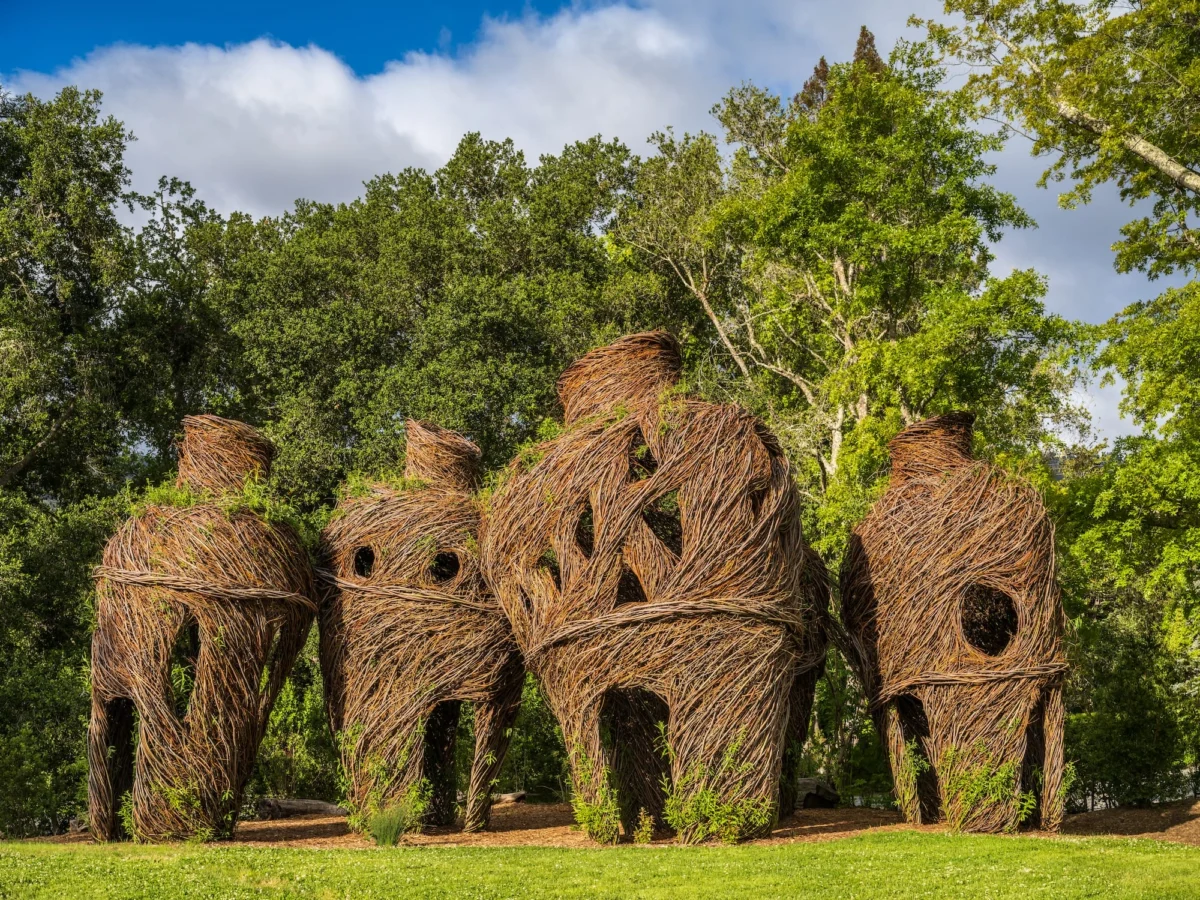
For over forty years, the North Carolina-based environmental artist Patrick Dougherty has challenged the traditional boundaries of sculpture, architecture, and land art. His medium is as humble as it is ubiquitous: the common twig. Through a sprawling, global series of installations titled Stickworks, Dougherty has transformed truckloads of willow saplings into monumental, whimsical structures that bridge the gap between human construction and the wild, untamed growth of the natural world.
Since the late 1970s, Dougherty has completed more than 300 site-specific installations across the globe, from the rural landscapes of Door County, Wisconsin, to urban centers and prestigious museum grounds. These works are characterized by their massive scale, their lack of traditional fasteners like nails or glue, and their profound ephemeral nature. Unlike the bronze and marble of classical sculpture, Dougherty’s creations are designed to weather, decay, and eventually return to the soil from which they came.

The artist’s work is not merely a solo endeavor of craftsmanship; it is a logistical and communal feat. Each installation typically requires several tons of saplings, often sourced from specialized farms in Canada or harvested from the local environment. Furthermore, the construction of these "woven wonders" frequently involves scores of local volunteers, making each piece a reflection of the community that hosts it. As Dougherty enters a period of semi-retirement, the art world is reflecting on a career that has redefined how we perceive the structural and poetic potential of organic materials.
Chronology: From Primitive Intuition to Global Recognition
The Formative Years (1980s)
Patrick Dougherty’s journey into environmental art began with a fascination for the "nest-building" instincts inherent in both animals and humans. After studying English and Hospital Administration, he returned to the University of North Carolina to study art history and sculpture. It was here that he began experimenting with the "primitive" method of weaving saplings. His early works were smaller, more experimental, as he tested the tensile strength of various wood types and developed the "tangle" technique that would become his signature.

The Expansion of ‘Stickworks’ (1990s – 2010s)
By the 1990s, Dougherty’s reputation had grown, and the scale of his projects expanded significantly. He began receiving commissions from botanical gardens, universities, and international art festivals. It was during this period that the logistical framework of Stickworks solidified. He established a relationship with specialized willow farms in Canada, which grow saplings for ecological applications like erosion control and basketry. These farms provided the consistent, flexible material needed for his increasingly complex architectural forms.
During these decades, Dougherty produced some of his most iconic works, including Sea Change and Rough ’n Tumble. These pieces moved away from simple shapes toward sophisticated architectural elements—arches, towers, and multi-roomed dwellings that visitors could physically enter and explore.

The Collaborative Era and Sam Dougherty (2010s – Present)
In the last decade, the Stickworks project became a family legacy. Patrick’s son, Sam Dougherty, joined the practice as a full-time assistant. A skilled potter in his own right, Sam brought a new level of technical support to the massive installations, allowing for even more ambitious designs. Together, they traveled the world, maintaining a grueling schedule of three-week installation cycles.
Today, Patrick Dougherty has shifted toward a "semi-retired" status. While he has stepped back from the relentless pace of international travel, he continues to create works in his studio and participates in retrospective exhibitions that celebrate the four-decade archive of his career.

Supporting Data: The Logistics of Organic Architecture
The sheer scale of a Stickworks installation is often underestimated by the casual observer. A typical project is a three-week marathon of physical labor and artistic intuition.
Materiality and Sourcing
- The Willow Factor: Most of Dougherty’s work utilizes willow (Salix) because of its incredible flexibility and "memory." When woven while green, the saplings hold their shape as they dry, creating a self-supporting structure.
- Volume: A single large-scale installation can require between 2 to 6 tons of saplings. When these are not shipped from Canadian farms, Dougherty utilizes "wild harvesting," clearing invasive species or thinning local groves to find material that resonates with the specific geography of the site.
- Structural Integrity: Despite the absence of hardware, the sculptures are remarkably sturdy. The "tangle" method involves a structural base of thicker saplings embedded in the ground, with finer twigs woven through them to create a skin. This creates a "friction-fit" that can withstand high winds and heavy snow loads.
The Volunteer Engine
A hallmark of Dougherty’s process is the inclusion of the public. Over 40 years, it is estimated that thousands of volunteers have assisted in the "weaving" process.

- The Glove Archive: In a recent exhibition at the BRAHM (Blowing Rock Art & History Museum), a wall-to-wall display featured hundreds of pairs of work gloves. Each pair was signed by a volunteer who helped install a Stickwork piece, serving as a visceral data point for the human energy required to bring these sculptures to life.
- Community Impact: Host organizations report that the presence of a Dougherty installation typically increases foot traffic by 20% to 50% during the three-week construction phase, as the public is invited to watch the "nest" take shape.
Official Responses: The Institutional View
The art world and the communities that host Dougherty’s work have long praised the "invitational" nature of his sculptures. Unlike many public art pieces that are "hands-off," Dougherty’s work demands interaction.
The BRAHM Museum Statement:
During their recent retrospective, curators at the Blowing Rock Art & History Museum noted, "Patrick Dougherty’s work transcends the traditional museum experience. It is tactile, olfactory, and spatial. By showcasing the tools of the trade—the gloves and the sketches—we aim to show that these works are as much about the process and the people as they are about the final form."

Horseshoe Bay Farms (Door County, WI):
Representatives from the farm, which hosts the work Happy Go Lucky, emphasize the ecological harmony of the piece. "When Patrick installed Happy Go Lucky, it immediately felt like it had always been here. As the Virginia creeper vines began to colonize the twigs, the sculpture transitioned from a human-made object to a living habitat for insects and birds. It is a masterclass in how art can serve nature."
The Wild Center (New York):
Hosting the piece Hopscotch, The Wild Center noted that Dougherty’s work serves an educational purpose. "It teaches our visitors about the structural properties of wood and the beauty of the forest in a way that a textbook never could. It turns the forest into a playground of the imagination."

Implications: The Philosophy of Impermanence
The enduring legacy of Patrick Dougherty lies in his embrace of the temporary. In a society that often values art based on its ability to survive the centuries, Dougherty’s "Stickworks" offer a different perspective: the beauty of the cycle.
Environmental Stewardship
Dougherty’s work is inherently "green." Because the materials are organic and untreated, they do not leave a lasting footprint on the land. When a sculpture reaches the end of its lifespan—usually two to five years—it is often chipped and turned into mulch, returning the nutrients to the earth. This "cradle-to-cradle" approach has made him a hero of the environmental art movement.

The Reclamation of Space
Works like The Jealous Wall suggest a deeper, more haunting implication: the inevitability of nature’s return. By constructing sapling walls that appear to "engulf" existing buildings, Dougherty reminds the viewer that human architecture is only a temporary guest on the planet. If left to its own devices, the forest will always redeem its space.
The Future of the Craft
As Patrick Dougherty moves into his studio-focused phase, the question of his influence remains. He has inspired a new generation of "bio-artists" who look to the landscape not just as a backdrop, but as a primary collaborator. His son Sam’s involvement suggests that while the large-scale traveling installations may slow down, the technical knowledge of "weaving the wind" will persist.

In the end, Dougherty’s 300+ installations serve as a map of human-nature interaction. They are reminders that with a little intuition, a lot of labor, and a truckload of twigs, we can build spaces that feel less like cages and more like homes—structures that breathe with the wind and bow to the seasons. Through Stickworks, Dougherty has not just built sculptures; he has woven a forty-year conversation between the hand of man and the heart of the woods.