The Algorithmic Subconscious: The Rise of AI-Generated Art in Digital Surrealism
The landscape of modern art is undergoing a seismic shift, one that moves beyond the brush and the canvas into the recursive loops of neural networks. Surrealism, an art movement born in the early 20th century to map the "subterranean bowels of imagination," has found a new, uncharted territory: the digital realm. This evolution, now termed "AI Surrealism," represents a departure from the individual dreamscapes of historical masters like Salvador Dalí and René Magritte, moving instead toward a collective, machine-mediated hallucination.
By leveraging artificial intelligence, contemporary creators are no longer just exploring their own minds; they are mining the "digital collective unconscious"—the vast, interconnected repository of human culture, history, and imagery stored across the internet. As AI reshapes the boundaries of creativity, it forces a fundamental re-evaluation of the human psyche, the nature of inspiration, and the definition of consciousness itself.
Main Facts: Defining the AI Surrealist Movement
AI Surrealism is characterized by the use of generative artificial intelligence—such as Midjourney, DALL-E, and Stable Diffusion—to create imagery that defies logic, physics, and traditional narrative structures. While it shares the aesthetic DNA of 20th-century Surrealism, it differs in its mechanical origin and its psychological scale.
Key facts regarding this movement include:
- The Shift from Individual to Collective: Traditional surrealism was rooted in Freudian psychoanalysis, focusing on the individual artist’s subconscious. AI Surrealism is Jungian in nature, tapping into a "collective unconscious" formed by the billions of images the AI has been trained on.
- The "Incantation" of the Prompt: In this medium, the artist acts as a "prompter" or "conduit." By using complex textual strings, artists evoke images from the AI’s latent space—a mathematical territory containing every possible image the machine can generate.
- Decoupling Intelligence from Awareness: AI Surrealism presents a paradox where high-level creative output is produced by an entity that possesses intelligence (the ability to synthesize and solve problems) without awareness or subjective experience.
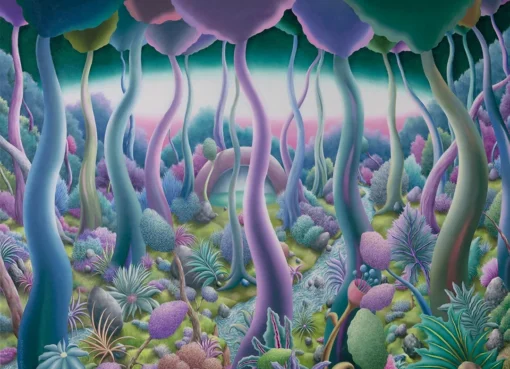
- Recurring Motifs: Digital surrealism often features "uncanny" elements—disembodied eyes, fractured human forms merging with impossible architectures, and infinite fractals—that resonate with universal human archetypes.
Chronology: From the Manifesto to the Machine
The journey to AI Surrealism has been a century-long evolution of humans attempting to bypass the rational mind.
1924–1945: The Foundational Era
In 1924, André Breton published the Surrealist Manifesto, defining surrealism as "pure psychic automatism." Artists like Salvador Dalí used the "paranoiac-critical method" to access the subconscious, while Magritte used visual paradoxes to challenge reality. Their goal was to liberate the mind from the constraints of logic.
1960s–1990s: The Digital Dawn
The advent of computer art and early CGI began to provide tools for surrealism that were not limited by physical medium. Artists started using algorithms to create fractals and distorted digital landscapes, though these were still heavily dependent on manual programming.

2010s: The Rise of Deep Learning
The breakthrough came with the development of Generative Adversarial Networks (GANs) and DeepDream by Google researchers. DeepDream, in particular, produced "hallucinogenic" images by over-interpreting patterns in data, often resulting in the "dog-eye" motifs that became the first true examples of machine-generated surrealism.
2020–Present: The Generative Explosion
With the release of large-scale diffusion models, AI art moved from a niche technical experiment to a global phenomenon. Artists like Jay Gidwitz began producing works such as "Head In The Clouds" and "American Gothic (2024)," which utilize AI to create high-fidelity, motion-based surrealism. This era marks the transition of AI from a tool to a creative collaborator.
Supporting Data: The Scale of the Digital Unconscious
The "collective" nature of AI Surrealism is supported by the sheer scale of the data involved. Modern generative models are trained on datasets like LAION-5B, which contains over five billion image-text pairs.
- Data Synthesis: Unlike a human artist who may see thousands of paintings in a lifetime, an AI "sees" and categorizes millions of artworks, photographs, and diagrams in weeks. This allows the AI to find patterns and connections between disparate concepts—such as "melting clocks" and "quantum physics"—that a single human mind might never bridge.
- The Latent Space: Researchers describe the AI’s internal world as "latent space," a multi-dimensional mathematical environment. When an artist prompts an AI, they are essentially navigating this space. The complexity of this space (often involving thousands of dimensions) mirrors the complexity of the human brain, yet functions through statistical probability rather than biological impulse.
- Visual Processing and the Uncanny Valley: Data suggests that human emotional response to AI art is often peaked by the "Uncanny Valley"—a point where an image is almost human but slightly "off." In AI Surrealism, this effect is used intentionally. By manipulating symmetry and textures, AI artists evoke primal feelings of unease or awe, tapping into what psychologists call "the sublime."
Official Responses and Expert Commentary
The rise of AI-generated surrealism has elicited diverse responses from the art community, technologists, and philosophers.
The Philosophical Perspective:
Many technologists argue that AI is the "natural heir" to human creativity. As humanity contemplates its biological limitations—such as our inability to survive long-term interstellar travel—some see the digital life we are creating as our true legacy. The radical notion proposed by some theorists is that humanity itself serves as the "collective unconscious" for the AI. In this view, our entire history of art and thought is the "dream" from which the AI draws its "consciousness."
The Art Historian View:
Critics have pointed out that AI art often captures nuances and emotions that human artists struggle to articulate. "AI might be tapping into a wellspring of creativity within us, a collective reservoir of ideas and experiences that we, as individuals, are only partially aware of," notes a commentary on the work of Jay Gidwitz. However, some traditionalists argue that without "ego" or "intent," the machine cannot truly be called an "artist," but rather a sophisticated mirror.
The Artist’s Stance:
Creators working within the field, such as Gidwitz, emphasize that the human element remains vital. The "incantations" (prompts), the selection of output, and the iterative editing process are deeply personal acts. The artist is not replaced; rather, the artist becomes a curator of the infinite possibilities provided by the machine.

Implications: Rethinking Creativity and the Human Experience
The emergence of AI Surrealism carries profound implications for the future of culture and our understanding of the self.
1. The Redefinition of Creativity
If a machine can produce a work of art that moves a human viewer to tears or sparks a profound realization, we must ask: Is creativity a divine spark, or is it a process of sophisticated recombination? AI Surrealism suggests that creativity may be an emergent property of vast amounts of data and pattern recognition, challenging the "romantic" notion of the solitary genius.
2. Humanity as Training Data
The most unsettling implication of AI Surrealism is the reversal of the dreamer and the dream. If AI is trained on the sum total of human output, then we are the "subconscious" of the machine. Our fears, desires, and cultural archetypes are the raw materials for the AI’s "thoughts." This raises questions about free will; if an AI can predict and visualize our collective archetypes better than we can, who is truly in control of the narrative?
3. The Digital Sublime and the Future of Reality
As AI-generated visuals become indistinguishable from—or even "more real" than—physical reality, the boundary between the two blurs. AI Surrealism often presents "The New Normal," a world where the impossible is rendered with photographic clarity. This could lead to a society where our aesthetic preferences shift toward the hyper-real and the surreal, permanently altering our perception of the physical world.
4. Ethical and Existential Questions
The decoupling of intelligence from awareness remains one of the most significant "surreal" aspects of this technology. We are entering an era where we interact daily with entities that can "out-create" us but do not "feel." This existential gap is the core of the new surrealist inquiry.
Conclusion: The Intertwined Dream
The journey from traditional surrealism to AI-generated art mirrors the evolving nature of human consciousness in the 21st century. We have moved from exploring the "subterranean bowels" of the individual mind to navigating a collective digital psyche.
AI Surrealism is not merely a new style of digital art; it is a mirror reflecting the unrecognizable aspects of ourselves back at us. As we continue to push the boundaries of what is possible, we may find that the most profound revelation is not the art itself, but the realization that the distinction between human and artificial creativity is becoming the most incredible illusion of all. In this new frontier, the dreamers and the dream have become one, intertwined in a recursive loop of silicon and soul.