The Architecture of Failure: Slavoj Žižek and the Paradox of Modern Self-Sabotage
Main Facts: The Crisis of Human Agency in the 21st Century
In an era defined by a multi-billion-dollar self-improvement industry and ubiquitous access to productivity tools, a fundamental psychological paradox remains unresolved: why do individuals consistently and effectively sabotage their own progress? While traditional psychology often attributes self-defeating behavior to trauma or lack of willpower, a growing school of philosophical thought, led by the provocative Slovenian philosopher Slavoj Žižek, suggests a more unsettling reality.
The core of the issue, according to Žižekian analysis, is not that we fail to achieve our goals, but that we are unconsciously invested in our own stagnation. Modern self-sabotage is not an accident; it is a highly consistent, structured behavior that serves a hidden emotional purpose. By synthesizing Lacanian psychoanalysis with cultural critique, Žižek argues that the human psyche is not a unified "true self" seeking actualization, but a fragmented entity that often finds a perverse satisfaction—termed jouissance—in its own suffering.
As global rates of burnout, "pseudoactivity," and existential dissatisfaction rise, Žižek’s "brilliant lunacy" offers a diagnostic framework for understanding why "finding oneself" often leads to paralysis, and why "resilience" may actually be a barrier to meaningful life changes.
Chronology: From Self-Help to Radical Psychoanalysis
The evolution of how society views self-sabotage has undergone three distinct phases over the last century, culminating in the current "Žižekian moment."
The Era of Moral Willpower (1900s–1950s)
In the early 20th century, self-sabotage was largely viewed through a moralistic lens. Failure to succeed was attributed to a lack of character or "grit." The solution was discipline and the suppression of "baser" instincts.
The Humanistic "Authenticity" Movement (1960s–1990s)
Following the rise of humanistic psychology (led by figures like Abraham Maslow and Carl Rogers), the narrative shifted. Self-sabotage was rebranded as a temporary detour on the path to "self-actualization." The prevailing theory suggested that every human has a "true self" that is inherently good and wise, and that external societal pressures simply need to be peeled away to reveal this core essence.
The Late-Capitalist Malaise and the Žižekian Critique (2000s–Present)
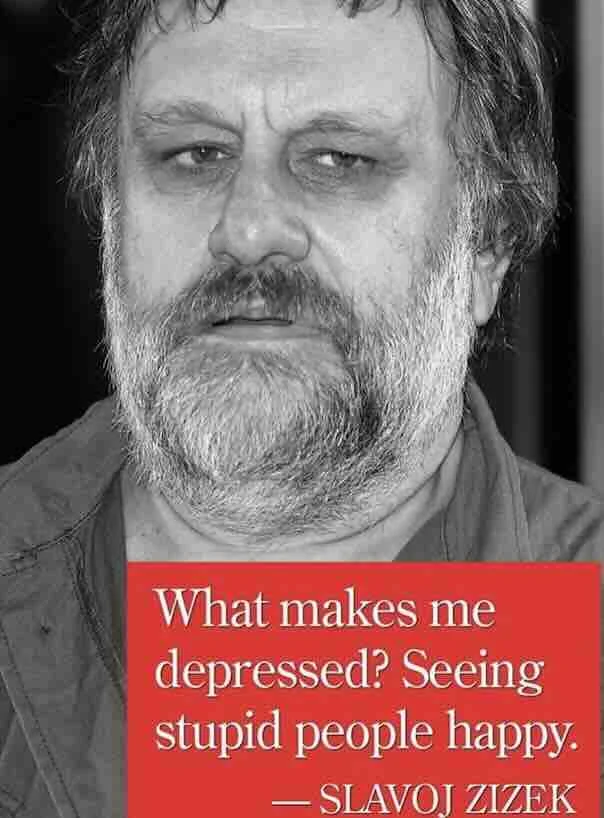
As the digital age accelerated, the promise of the "true self" began to feel like a commercial myth. Enter Slavoj Žižek—a philosopher who looks more like a disheveled traveler than an academic authority. Žižek rose to global prominence by arguing that the "true self" is a vacuum and that our desires are not our own, but are "borrowed" from the ideologies around us. In the last two decades, his work has increasingly focused on the "superego of enjoyment," where the modern command to "be happy" has become the ultimate source of anxiety and self-sabotage.
Supporting Data: The Six Pillars of Self-Defeat
To understand the mechanics of self-sabotage, one must examine the specific philosophical concepts Žižek uses to dismantle the "polite nonsense" of modern self-help.
1. The Economy of Jouissance
The most difficult concept for the modern mind to grasp is jouissance—a French psychoanalytic term for a "painful pleasure." Žižek argues that we repeat bad habits because we receive "emotional kickbacks." This isn’t the simple pleasure of eating a cookie; it is the "ugly thrill" of being a martyr, the secret satisfaction of being the "wounded party" in a relationship, or the adrenaline of a last-minute deadline. We don’t just fail; we "enjoy" the failure because it confirms our identity as a victim or a misunderstood genius.
2. Pseudoactivity: The Productivity Trap
In the corporate world, self-sabotage often wears the mask of extreme busyness. Žižek identifies this as "pseudoactivity." This is the act of remaining in constant motion—clearing inboxes, rearranging calendars, and downloading new productivity apps—specifically to avoid the one "scary" task that would actually move the needle. It is a defense mechanism against real action; we act so that nothing will actually change.
3. The Myth of the "True Self"
The modern obsession with "authenticity" is, according to Žižek, a primary driver of paralysis. By treating every decision as an existential referendum on "who I really am," individuals become too terrified to act. Žižek posits that there is no "pure essence" to find. There is only a "mess of drives" and the choices we make. Self-sabotage occurs when we wait for "inner certainty" before taking "outer action."
4. The Superego of Enjoyment
Historically, the "superego" (the internal moral judge) told us to deny ourselves pleasure. Today, Žižek argues the command has flipped: "You must enjoy yourself!" We are pressured to have meaningful hobbies, fulfilling sex lives, and restorative weekends. This turns leisure into a "performance review." When we fail to feel sufficiently "restored" by a Sunday afternoon, we feel like failures, leading to a cycle of self-sabotage where we can no longer simply be.
5. Toxic Resilience and the "House on Fire"
Žižek offers a scathing critique of modern resilience. While resilience is usually praised, he argues it is often used to train people to tolerate intolerable conditions. By telling ourselves "this is a growth opportunity," we use optimism as an anesthesia. This prevents us from acknowledging that "the house is on fire," which is the only realization that would actually lead to escaping the burning building.
6. Interpassivity: The Outsourcing of Life
Finally, Žižek identifies "interpassivity"—the act of "consuming" through proxies. We bookmark articles we never read, buy gym memberships we never use, and add movies to watchlists we never start. This gives us the "shape of a life" without the pulse. We feel like we are progressing because we are "collecting the accessories" of success, while the actual living of life is indefinitely postponed.
Official Responses and Critical Perspectives
The Žižekian approach to self-sabotage has met with both acclaim and significant pushback from the psychological and academic communities.
The Cognitive-Behavioral (CBT) Perspective:
Mainstream psychologists often argue that Žižek’s focus on deep-seated "unconscious enjoyment" is too speculative. Practitioners of CBT emphasize that self-sabotage is often a result of "cognitive distortions"—simple errors in thinking that can be corrected through habit tracking and rational reframing, rather than deep philosophical excavation.
The Positive Psychology Critique:
Proponents of Positive Psychology, such as Martin Seligman, argue that Žižek’s "embrace of hopelessness" is counterproductive. They contend that while "false hope" can be a trap, optimism is a scientifically proven driver of health and longevity. They view Žižek’s insistence on "acknowledging the fire" as a form of "pessimistic bias" that can lead to clinical depression.
The Academic Consensus:
Sociologists often find Žižek’s work valuable for its critique of "Late Capitalism." They agree that the pressure to "be yourself" and "maximize enjoyment" is a byproduct of a consumer culture that needs individuals to be perpetually dissatisfied so they will continue to buy "solutions."
Implications: Building a Self Without an Essence
The shift from seeing self-sabotage as a "mistake" to seeing it as a "structured investment" has profound implications for how we live.
The End of the "Authenticity" Search
If we accept the Žižekian premise that there is no "true self" to find, the pressure of self-discovery vanishes. The implication is that we must stop "excavating" and start "building." Identity is not something found in a quiet room of meditation; it is something forged in the "embarrassing business" of acting, failing, and revising in the real world.
The Necessity of Radical Honesty
To stop self-sabotaging, the first step is not to "feel better," but to "stop lying." This requires an uncomfortable audit of our jouissance. We must ask: "What am I getting out of staying in this bad relationship? What do I gain by being the most stressed person in the office?" Until the "ugly thrill" of the problem is acknowledged, the solution will never take hold.
From Interpassivity to Active Living
In a digital world, the ultimate act of rebellion against self-sabotage is to "stop the proxy." This means choosing one three-dimensional act over a hundred digital simulations. Reading one page of a physical book or seeing one friend in person is more "real" than managing a thousand digital bookmarks.
Conclusion: The Value of the "Impolite Relative"
Slavoj Žižek functions as the "impolite relative" of the global psyche. His insights suggest that self-sabotage is the inevitable result of trying to live a "movie trailer" version of life. By accepting that reality is messy, that some systems are "functioning versions of bad ones," and that there is no "pure version" of ourselves waiting to be discovered, we can finally stop the machinery of sabotage. The path forward is not found in more "self-help," but in the courageous acceptance of the "madness" that lives in our everyday normalities. Only when we admit the house is on fire can we begin the work of putting it out.