Unpacking the "Lie": The Profound Psychology of Character Arc and Personal Growth
For writers and storytellers, the concept of a character’s "Lie the Character Believes" has been a cornerstone of crafting compelling narratives. This central tenet, popularized by K.M. Weiland in her influential work Creating Character Arcs, posits that a character’s internal journey is driven by a fundamental, often unconscious, falsehood they hold about themselves or the world. This misconception acts as an invisible barrier, preventing them from embracing a more profound "Truth" until the crucible of the story forces them to confront and overcome it. However, a deeper examination reveals that this "Lie" is not merely a fabrication but a complex manifestation of a character’s deeply ingrained beliefs and their journey towards self-awareness and alignment.
The Evolving Understanding of the "Lie"
At its core, the "Lie the Character Believes" represents a state of being, a perspective that a character must evolve beyond to achieve positive transformation. In a positive change arc, characters shed this limited viewpoint to embrace a more expansive, truthful understanding. Conversely, a negative change arc sees characters devolve, their inability to grow leading to a more constricted or distorted worldview.

While the term "Lie" offers an accessible entry point for understanding character motivation, its true nature is more nuanced. As explored in depth by Weiland, the "Lie" is not an outright falsehood but rather a "comparatively limited belief" that exists on a continuum with a "comparatively expansive Truth." This initial belief, though ultimately limiting, often served a purpose for the character up to the point the story begins. It was, to some degree, their "Truth" in a specific context.
For instance, in the early stages of Feyre’s journey in Sarah J. Maas’s A Court of Thorns and Roses series, her unwavering focus on survival skills is instrumental in supporting her family. This "Lie" of self-reliance, however, becomes a limitation when she is thrust into the complex world of the Fae. Her perspective must expand to accommodate new realities and her own evolving identity. This illustrates how a once-functional belief system can become a barrier to growth when circumstances change.

This continuum of belief is not static. What constitutes "Truth" at one stage of a character’s development can, in time, become a limiting "Lie." Feyre’s realization at the end of the first book that love is worth sacrifice, while a significant step, is later challenged. The narrative evolves to show that authentic love cannot demand the perpetual sacrifice of one’s identity. This demonstrates a continuous process of leveling up, where yesterday’s expansive Truth becomes tomorrow’s restricted perspective as one’s horizons widen.
The "Lie" as Clarity and Alignment, Not Deception
Delving deeper, the author posits that many significant personal revelations and expansions of consciousness do not feel like a dramatic shift from "untruth" to "truth." Instead, they are experienced as moments of profound clarity, a coming into alignment with an underlying truth that was always present but obscured. This shifts the understanding of the "Lie" from a deliberate deception to a fissure in consciousness. It’s a state where the conscious self is anchored in an ego identity that creates a separation between its surface-level understanding and a deeper, more fundamental truth of being.

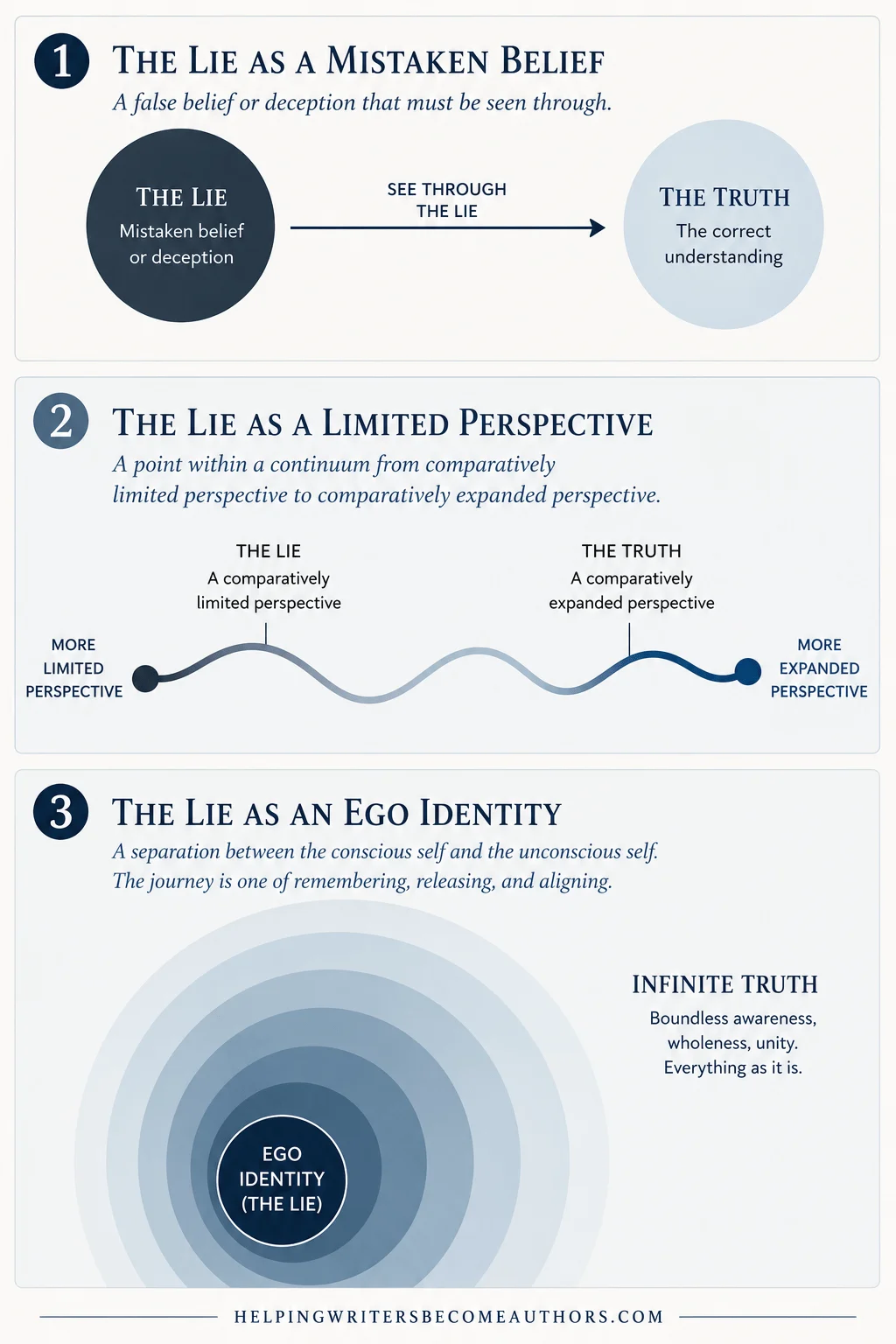
This perspective offers three interconnected models for understanding the "Lie the Character Believes":
- Model 1: The Mistaken Belief: This is the most straightforward interpretation, where the "Lie" is an outright error in judgment or a piece of misinformation that must be recognized and corrected.
- Model 2: The Limited Perspective: Here, the "Lie" is understood as a point on a spectrum between a comparatively limited and a comparatively expanded perspective. Neither "Lie" nor "Truth" is absolute; they are relative markers of a character’s evolving understanding.
- Model 3: The Ego Identity/Limited Consciousness: This model presents the most profound understanding, where the "Lie" is an ingrained ego identity or a constricted form of consciousness. It signifies a separation between the conscious self and the unconscious self, a blockage preventing alignment with the deeper truths of existence.
The Shadow of the Ego: Unpacking the "Lie" as Separation
To truly grasp the "Lie the Character Believes," one must understand the concept of ego identification. The ego, as a limited awareness of the self, can define individuals by external markers: their name, profession, gender, ethnicity, past traumas, or societal roles. This self-definition is often mirrored in how they perceive the world – either through an overly idealistic or a deeply cynical lens. However, these identifications are not the entirety of one’s being. The author emphasizes that one is not solely defined by their name or profession; these are merely aspects of their existence, not their fundamental identity.

When the ego latches onto these identifications as absolute truths, it creates a sense of separation from a broader continuum of consciousness, resulting in a limited perspective. This ego-driven defense mechanism can be insidious, leading individuals to fiercely protect these constructed identities, often without even recognizing the process.
In opposition to the "Lie" within a narrative stands the thematic "Truth." While a specific story might present a truth like "my family loves me even if I fail," beneath this lies a more universal truth: "our perspectives are always limited, and our identification with those perspectives often causes us pain." Different stories will employ these models of the "Lie" based on their thematic depth and psychological complexity.

Illustrative Examples:
- The Truman Show (1998): Truman Burbank lives a life constructed by others, believing his reality is authentic. His "Lie" is the fabricated world he inhabits, and his arc involves breaking free from this illusion to discover genuine existence.
- Pride and Prejudice (2005): Elizabeth Bennet’s initial prejudice against Mr. Darcy, fueled by societal expectations and misunderstandings, serves as her "Lie." Her journey is about dismantling these preconceived notions to see the truth of his character and her own feelings.
- The Lord of the Rings: The Fellowship of the Ring (2001): Frodo Baggins’s initial reluctance to accept the burden of the Ring, stemming from his desire for a simple life, represents a "Lie" of avoidance. His arc involves embracing his destiny and the immense responsibility it entails.
The Ghost in the Backstory: The Genesis of the "Lie"
The origins of this limiting ego identification often trace back to the "Ghost in the character’s backstory." This "Ghost," frequently a past wound or trauma, acts as the catalyst for forming or rigidly clinging to an ego identity. In the context of expanding consciousness, these childhood coping mechanisms become evident. They are the initial severances of inner wholeness, developed to meet early emotional needs.

Drawing on the work of Loretta Graziano Breuning, the author highlights how early experiences and the resulting hormonal wiring (dopamine, serotonin, endorphins, cortisol) shape our perceptions and personality. These ingrained patterns influence the narratives we construct about ourselves and others, which in turn solidify our identities.
Essentially, the "Lie" can be viewed as a coping mechanism. Just as a "Lie" only becomes a detriment when it ceases to be effective, a coping mechanism is rarely questioned until it starts generating more problems than it solves. This is the precipice where a story often begins – the point at which characters embark on a journey toward a consciousness that transcends their limiting coping mechanisms.

This journey is frequently fraught with pain. Even when moving towards a healthier state, the ego’s survival instincts can trigger resistance, interpreting transformation as dangerous. The ego’s programming, designed for survival, may not adapt quickly enough to life’s demands. When what the ego believes will ensure safety is revealed as a "Lie," it employs painful tactics to maintain the status quo.
Richard Rudd, in The Gene Keys, articulates this struggle: "The suffering we feel, though real within the context of our physiology, is an illusion when it comes to our minds." The mind’s tendency to collapse into confusion when faced with underlying pain underscores the difficulty of this process. However, a willingness to confront this pain is the catalyst for profound change.

Character Arc as Alignment, Not Metamorphosis
While the idea of character arc as "transformation" is appealing, a more accurate framing might be "coming into alignment." It’s less about fundamentally altering the character’s core self and more about shedding the false self. This involves the removal of what is not true, allowing the character to perceive more clearly.
In the distinction between "ego-driven" (karmic) and "soul-driven" (dharmic) character arcs, the latter demonstrates a greater willingness to embrace change. Even amidst struggle, these characters accept the inevitability and benefit of movement toward Truth. This explains why characters embodying archetypes like "the Mage" may experience less overt plot conflict; they are more receptive to the process of initiation and understand the power of non-reactivity. As Rudd notes, "As your inner spirit decides to face who you really are for the first time ever, the mind tricks are witnessed."

Ultimately, even characters deeply entrenched in egoic "Lies" will, upon successful arc completion, recognize that embracing Truth necessitates a non-reactive stance towards the "Lie" and its ensuing confusion. They must allow Truth to "enthuse and fire your mind with inspiration."
Carl Jung and his colleagues, in works like Man and His Symbols, explored this concept extensively. Jungian scholar Marie-Louise von Franz suggests that the "creative active aspect of the psychic nucleus can come into play only when the ego gets rid of all purposive and wishful aims and tries to get a deeper, more basic form of existence." The ego’s role is to "listen attentively and to give itself, without any further design or purpose, to that inner urge toward growth."

Examples of Alignment:
- Kung Fu Panda (2008): Po’s journey is not about becoming a different panda, but about aligning with his true potential as the Dragon Warrior, shedding his self-doubt and embracing his identity.
- The Matrix (1999): Neo’s awakening is about aligning with the reality of his existence beyond the simulated world, shedding the "Lie" of the Matrix to embrace his role as "The One."
- Star Wars: Return of the Jedi (1983): Luke Skywalker’s arc culminates in him aligning with the Force and his Jedi destiny, overcoming the "Lie" that he must succumb to the dark side to save his father.
- Everything Everywhere All at Once (2022): Evelyn Wang’s journey is a profound exploration of embracing all her potential selves and aligning with the love and connection that have always been present, despite her limited perception.
- Jane Eyre (2006): Jane’s arc is about aligning with her own sense of self-worth and independence, rejecting societal expectations and the "Lie" that she must compromise her integrity for love or security.
The "Lie" as Social Reality and the Tyranny of the Status Quo
The concept of the "Lie the Character Believes" extends beyond individual psychology to encompass the broader construct of social reality. Ego identities are not solely personal; they are reinforced by collective social consensus. Society itself can be viewed as a grand ego identity, a social construction of reality as described by sociologists Peter L. Berger and Thomas Luckmann. Customs, traditions, language, and even the very notion of nationhood are social conventions that shape our understanding of the world and our place within it.

While individuals contribute to society, society exerts a profound influence on our ego identities, dictating not only our social interactions but also our internal self-perceptions. Many of these inherited ego identities function as useful "uniforms" that enable us to navigate various roles—parent, child, professional, citizen. This established order, the status quo, provides a sense of stability and wards off chaos.
However, this same status quo can be stifling. Joseph Campbell termed this force "the tyrant-ogre Holdfast, Keeper of the Status Quo." Symbolically, it represents the central antagonist in the Hero’s Journey and other archetypal character arcs. While there is value in integrating the status quo, every Positive Change Arc fundamentally involves a movement away from the confines of social reality toward the initiation of individuation.

Individuation, as described by Jung, is the process by which the smaller egoic consciousness enters into a relationship with the larger Self. It’s about recognizing that the ego is merely a part of the totality of the psyche. The ego’s purpose is not to pursue arbitrary impulses but to help realize this totality, to illuminate the entire system, making it conscious and thus lived. This process is only truly effective when the individual is aware of it and actively connects with this inner urge toward growth.
The transformation at the heart of character arc, therefore, is an awakening to consciousness and a departure from the ego’s identification with social reality. This shift fosters greater alignment with self-responsibility and accountability. The overarching "Lie" that underpins many individual "Lies" is the belief that circumstances dictate one’s life, which can lead to a profound lack of responsibility. With awareness comes responsibility, with responsibility comes accountability, and with accountability comes both pain and, crucially, freedom and deep health.

The Union of Consciousness and the Unconscious: The Essence of Character Arc
The profound connection between storytelling and personal growth is striking. The very elements that create compelling narratives mirror the deeper truths of life, growth, healing, and conscious expansion. The hidden structure of story and character arc is, in itself, a thematic journey toward truth.
Archetypally, character arc represents the quest for the union of conscious awareness with the unconscious self. Joseph L. Henderson, in Man and His Symbols, posits that "a sense of completeness is achieved through a union of the consciousness with the unconscious contents of the mind." This movement allows writers to craft "myth from the inside out," tapping into the fundamental archetypal journey of the psyche.

As Richard Rudd eloquently states, "All natural energy or life force has one inbuilt program: to grow and evolve. This is the nature of life." Perhaps this innate human drive for growth is why stories resonate so deeply. Every Positive Change Arc serves as a reminder of this fundamental truth: that growth is ultimately about discovering who we are beneath the layers of fear, defense mechanisms, and accumulated identities. It is a journey of shedding the limitations to embrace our true, expansive selves.