Echoes of 2020: Trump’s Midterm Strategy and the Media’s Measured Response
By [Your Name/Agency]
July 17, 2026
The political landscape of the United States shifted once again last night as former President Donald Trump delivered a high-stakes address aimed at shaping the narrative for the upcoming midterm elections. However, the event was defined as much by the media’s cautious handling of the broadcast as it was by the rhetoric itself. As smoke from Canadian wildfires continued to haze the skies across the Northeast and Midwest, the former president revisited familiar grievances, blending legacy complaints with new accusations of foreign interference.
The following report synthesizes the primary developments of the address, the critical analysis of the documents presented, and the cultural commentary provided by the nation’s leading political cartoonists.
Main Facts: A "Greatest Hits" Performance Amidst Media Hesitation
The primary takeaway from the July 16 address was its reliance on established tropes. Dubbed by critics as a "performance of his greatest hits," the speech focused heavily on the 2020 election, alleged voter fraud in Michigan, and a newly emphasized claim regarding Chinese interference.
A significant point of contention emerged not just from the podium, but from the newsrooms of major broadcasters. Unlike previous eras where a presidential or former presidential address would command "roadblock" coverage across all major networks, the response this time was fragmented. ABC, CBS, and NBC largely declined to carry the speech on their primary feeds. The editorial consensus among these outlets was that the address did not constitute a "national emergency" or a policy announcement of public interest, such as updates on the war in Ukraine or the economy. Instead, it was categorized as a partisan political strategy session regarding the Republican Party’s midterm approach.
While the Guardian provided lead-page digital coverage, other legacy outlets like the New York Times placed the event below pressing environmental and international news, specifically the intensifying Canadian wildfires and the ongoing conflict in Ukraine. This editorial de-prioritization signals a shift in how the American press corps handles "self-serving political announcements."
Chronology: From Late-Night Rhetoric to Morning-After Scrutiny
The Evening of July 16: The Speech
The address began late in the evening, strategically timed to reach a primetime audience on the West Coast while hitting the late-night news cycle on the East Coast. Trump appeared framed by two flags—one the American Stars and Stripes, the other a banner often associated with his specific political movement.
The delivery was described by observers as "angry and rapid-fire." He touched upon:
- The 2020 Election: Reasserting that the results were illegitimate.
- Michigan Voter Registration: Claiming that fraudulent registrations in Michigan were a sign of a larger conspiracy.
- Chinese Interference: Alleging that Beijing had obtained voter lists to influence the 2020 outcome.
- The Midterms: Framing the upcoming elections as a battleground for "election integrity."
The Overnight Response: Global and Digital
Due to the late hour, most American print newspapers missed the window for their morning editions. This gave international commentators, specifically those in Australia like the cartoonist David Rowe, the first opportunity to react. By the time the sun rose on the East Coast, digital platforms were already saturated with fact-checks.
The Morning of July 17: The "Epstein Trap" and Legal Fallout
Concurrent with the speech, a secondary news story broke regarding Todd Blanche, Trump’s nominee for Attorney General. Senator Thom Tillis (R-NC) reportedly withheld his "green light" for Blanche’s nomination until a meeting was held with survivors of Jeffrey Epstein. While the meeting occurred, reports suggest it was viewed by survivors as a "check-the-box" exercise rather than a substantive step toward justice. This development was quickly linked to Trump’s broader legal and political strategy, symbolized in the media as a "trap" of his own making.
Supporting Data: Debunking the Claims
In the aftermath of the address, several key claims were subjected to rigorous fact-checking. Analysts pointed out that the "evidence" provided by the former president often contradicted his own conclusions.
The Michigan Voter Registration Incident
Trump cited an incident in Michigan involving false voter registrations as proof of systemic fraud. However, state election data tells a different story. The registrations in question were flagged by election officials almost immediately. Because the system worked as intended, no fraudulent votes were cast, and the names never made it onto the official voter rolls. The incident was traced to a single individual being paid per registration, a localized criminal act rather than a state-wide conspiracy.
The China Allegations and Public Voter Lists
One of the more sensational claims involved China "obtaining" American voter lists. Security analysts, including Tom Nichols of The Atlantic, pointed out that voter lists are, by law, public documents. Political campaigns, third-party organizations, and even foreign entities can access these lists through standard legal channels. "Where do you think all that political junk mail comes from?" Nichols noted, highlighting that the "revelation" was actually a description of standard public record accessibility.
The White House Security Documents
Following the speech, a cache of documents was posted to White House servers (whitehouse.gov) under the heading of "Election Integrity." However, former White House security official Miles Taylor noted that these documents were largely assembled during Trump’s first administration. According to Taylor, none of the internal data supports the claims of a stolen election or successful foreign hacking of the vote counts. This has led to questions from analysts about whether the former president has actually read the sources he cites as evidence.
Official Responses and Expert Analysis
The reaction from the political and intellectual establishment has been one of weary concern.
Tom Nichols (The Atlantic): Nichols argued that the documents Trump offered "tell a different story" than the rhetoric. He suggested that the disconnect between the evidence and the speech raises the question of whether the former president is "deliberately lying" or simply "unable to process the data."
Miles Taylor (Defiance News): Taylor, who helped oversee election security, emphasized that the material being touted as "new proof" is actually old data that had already been cleared by security agencies. He warned that the persistence of these claims is a tactical move to prepare the "faithful" to reject future election results.
The Artistic Critique:
Political cartoonists have provided a more visceral response:
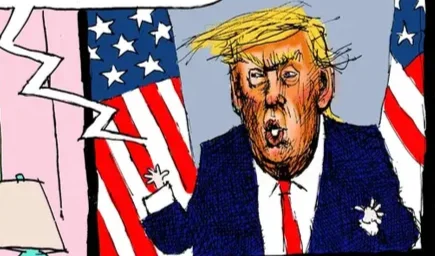
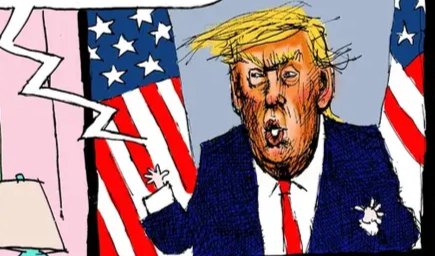
- McKee: Highlighted the "unbalanced" nature of the delivery, depicting the disconnect between the rapid-fire accusations and reality.
- German: Focused on the irony of the China claims, noting that any foreign attempt to influence the election involved spreading information rather than the "invasion-level" interference Trump’s rhetoric implies.
- Luckovich: Focused on the "framing" of the event, suggesting the speech was a calculated attempt to maintain a grip on the Republican base ahead of the midterms.
Implications: Climate, Democracy, and the Path Forward
The implications of last night’s address extend beyond the ballot box, touching on environmental policy and the stability of democratic institutions.
The Environmental Backdrop
As Trump spoke, much of the United States was literally choking on the consequences of climate change. The Canadian wildfires, which have blanketed the Northeast in hazardous smoke, served as a grim backdrop to the political theater. Cartoonists like MacKay and Steve Sack (a Minnesotan directly affected by the smoke) have pointed out the "depraved indifference" of a political platform that denies climate science while favoring the coal and oil industries. Sack noted that Trump’s policies—including his reported pressure on oil executives for campaign funding—directly interfere with the development of alternative energy sources that could mitigate such wildfires.
The Midterm Strategy
The speech confirms that the 2026 midterms will not be fought solely on the economy or foreign policy, but on the very legitimacy of the American electoral system. By reinforcing the belief that the 2020 election was "fixed," the former president is laying the groundwork to negate any unfavorable results in the upcoming cycle.
Conclusion
The July 16 address was less a disclosure of new facts and more a consolidation of a political identity. While the media’s decision to downplay the broadcast suggests a growing "exhaustion" with the narrative, the effectiveness of the speech remains to be seen. For his supporters, the "greatest hits" are a call to action; for his critics, they are a warning of a repeating history. As the smoke from the north continues to drift south, the political atmosphere in Washington remains equally clouded.