The Unfinished Symphony: Re-evaluating the Divisive Climax of D&D’s "A4: In the Dungeons of the Slave Lords"
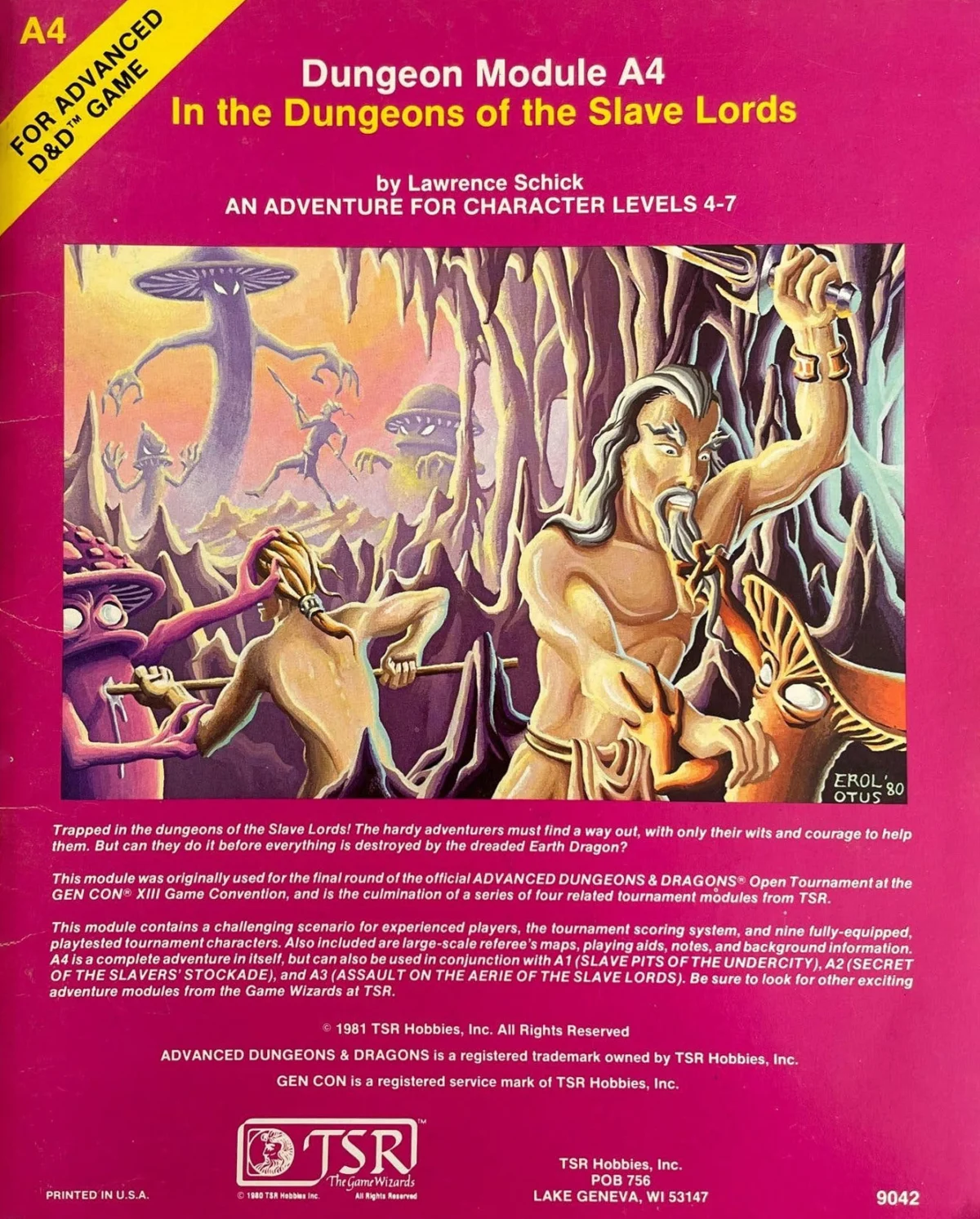
Originally Published March 16th, 2002 (Review)
The annals of tabletop role-playing games are replete with legendary adventures, sagas that captivate generations of players and Dungeons & Dragons Dungeon Masters alike. Among these, TSR’s "A-series," often known as the "Slavers saga," holds a revered, if somewhat complicated, position. Comprising four modules – A1: Slave Pits of the Undercity, A2: Secret of the Slavers Stockade, A3: Assault on the Aerie of the Slave Lords, and the concluding A4: In the Dungeons of the Slave Lords – this epic campaign was designed to challenge players with a harrowing journey from initial capture to a climactic confrontation with a formidable criminal organization. However, as noted in a critical review first published on RPGNet on March 16th, 2002, the final act, A4, ultimately faltered, delivering a "whimper instead of a bang" and leaving many players and critics questioning its narrative coherence and overall execution.
This retrospective analysis delves into the criticisms leveled against A4, examining its ambitious yet flawed concept, the specific narrative weaknesses highlighted, and the broader implications for adventure design within the D&D landscape. The original review, authored by a critic who had previously dissected the preceding modules in the series, provides a crucial lens through which to understand the disappointment surrounding what should have been an unforgettable finale.
Main Facts: A Promising Premise, a Disappointing Payoff
A4: In the Dungeons of the Slave Lords, published by TSR, Inc. in 1981 and penned by Lawrence Schick, was intended to be the grand conclusion to the celebrated "A-series" of Advanced Dungeons & Dragons (1st Edition) modules. Following the dramatic capture of player characters (PCs) at the end of A3, A4 posits a dire scenario: the heroes are imprisoned, stripped of their gear and magical abilities, and forced to escape a complex underground labyrinth beneath a volcanic peak. The ultimate goal is to confront the nefarious Slave Lords, disrupt their escape, and bring their tyrannical reign to an end.
However, the 2002 review starkly contrasts this promising premise with a deeply flawed execution. The primary critique centered on the module’s pervasive lack of narrative logic, described as "nonsensical" from its very first page. The reviewer highlighted a series of perplexing plot decisions, such as the Slave Lords’ inexplicable choice to imprison the powerful PCs for months only to then drug and dump them into a volcanic cave system. This, coupled with an anti-climactic final confrontation (or lack thereof) with the series’ titular villains, severely undermined the dramatic tension built across the previous three modules. Despite an inherently compelling "stripped of gear" survival concept, A4 was ultimately deemed a missed opportunity, failing to deliver the epic resolution players deserved after an extensive campaign. The review’s stark "Style: 2" and "Substance: 2" ratings underscored its profound disappointment, recommending that DMs instead use A4‘s core concept as a springboard for their own custom ending.
Chronology: The Arc of the Slavers Saga
The "A-series" modules represent a significant chapter in the early history of Dungeons & Dragons, illustrating TSR’s evolving approach to campaign design and narrative progression.
- 1980: A1: Slave Pits of the Undercity – The saga begins. Players are introduced to the sinister machinations of the Slave Lords, investigating disappearances and uncovering a vast network of slaving operations. This module set a dark, gritty tone and immediately established the antagonists as a formidable threat.
- 1981: A2: Secret of the Slavers Stockade – The adventure deepens. PCs infiltrate a heavily guarded stockade, gathering intelligence and striking further blows against the Slavers’ infrastructure. The narrative continued to build momentum, revealing more about the organization’s scope and power.
- 1981: A3: Assault on the Aerie of the Slave Lords – A dramatic turning point. Players launch a direct assault on a major Slaver stronghold. This module culminated in a shocking twist: the PCs are captured by the very villains they sought to defeat, setting the stage for a dramatic escape and revenge. This ending was designed to leave players on a cliffhanger, eagerly anticipating the next installment.
- 1981: A4: In the Dungeons of the Slave Lords – The intended climax. Released shortly after A3, A4 was positioned to resolve the overarching narrative, offering players the chance to escape their imprisonment and finally confront the Slave Lords. Its immediate release after the cliffhanger of A3 built significant anticipation for a powerful conclusion.
The original review, published in March 2002, offered a retrospective look at these modules, more than two decades after their initial release. This temporal distance allowed for a more considered analysis, free from the immediate hype of release and with the benefit of hindsight regarding its impact on player groups over the years. The reviewer, having previously covered A1, A2, and A3, approached A4 with a comprehensive understanding of the series’ narrative trajectory and the expectations it had cultivated. The critical tone of the 2002 review, therefore, wasn’t just a contemporary reaction but a seasoned assessment of a classic module’s lasting efficacy. The reviewer’s concluding thought, suggesting A4 was "Arguably a great concept for a tournament scenario, but a terrible railroad in any other context," hints at its origins and the inherent challenges of adapting such a design for a home campaign.
Supporting Data: The Unraveling Conclusion
The core criticism of A4 lies in its inability to translate a genuinely compelling premise into a coherent and satisfying player experience. The module’s strengths, identified by the reviewer, are almost exclusively conceptual, while its weaknesses manifest in fundamental narrative and design choices.
The Conceptual Brilliance: Stripped and Resourceful
At its heart, A4 presents an undeniably cool idea: the player characters, having been defeated and captured by their arch-enemies, are stripped of their hard-won equipment, their magical abilities hampered (spellcasters tortured to prevent spell memorization, thieves denied tools, fighters disarmed), and forced to rely solely on their wits and their core class abilities to survive and ultimately turn the tables. This "zero to hero" or "resourcefulness under duress" scenario is a classic trope with immense dramatic potential. It forces players to think creatively, appreciate the value of mundane items, and rebuild their power base from scratch. Such a setup promises a unique and memorable challenge, pushing players out of their comfort zones and making any small victory feel incredibly significant. The idea of escaping a perilous dungeon beneath a volcanic peak, with the added threat of an impending eruption, provides a dynamic and time-sensitive backdrop for this struggle.
The Fatal Flaws: A Cascade of "Why?"
Despite this potent concept, the module’s execution, as detailed in the review, is riddled with baffling decisions that undermine its very foundation:
-
Illogical Villainy: The most glaring issue is the inexplicable behavior of the Slave Lords themselves. The review asks, "Keep the adventurers imprisoned for months? Why? Then knock them out again and dump them in volcanic tunnels? Why?" From a narrative standpoint, these actions make no sense. Why would a supposedly cunning and dangerous organization go to such lengths to capture powerful adversaries, only to then release them into a semi-controlled environment with a chance of escape? The prolonged imprisonment without immediate execution or more effective neutralization strains credulity, while the subsequent act of dumping them into a dangerous but potentially escapable cave system feels like an act of bizarre self-sabotage rather than calculated villainy. This immediately breaks player immersion and transforms formidable antagonists into agents of plot convenience.
-
Environmental Incoherence: The subterranean environment itself raises further questions: "Why are there kobolds, myconids, giant ants, and magmen all living in close proximity to each other down here?" While fantasy settings often feature diverse ecosystems, the arbitrary clustering of creatures with vastly different needs and habitats without a clear ecological or magical explanation suggests a lack of thoughtful world-building. This patchwork of encounters feels less like an organic dungeon and more like a collection of monster manual entries strung together, further contributing to the module’s narrative disjointedness.
-
The Anti-Climax of the Century: The gravest sin of A4, according to the review, is its failure to deliver a satisfying climax to the entire four-part saga. After three modules of building up the Slave Lords as masterminds and formidable opponents, the concluding module largely denies players a direct, epic confrontation. The review lamented, "Why, after an epic, four-part adventure, was the decision made to deny the PCs an epic confrontation with the Slave Lords?" The final encounter, if it happens at all, is presented as a "slight chance" encounter with the Slave Lords’ escape ship, the Water Dragon, or an even more casual possibility of "bumping into them in the next pub." This design choice is catastrophic for narrative payoff. It trivializes the efforts of the PCs, diminishes the stature of the villains, and transforms what should have been a memorable, defining battle into a whimpering formality. The volcanic eruption, a potentially brilliant environmental complication, is likewise used to facilitate escape rather than to heighten the drama of a final stand.
The reviewer, having meticulously analyzed A1, A2, and A3, was uniquely positioned to articulate this profound disappointment. The earlier modules had successfully established the Slave Lords as a credible threat and built significant anticipation for a decisive showdown. A4‘s structural and narrative deficiencies, therefore, represent a significant betrayal of that build-up, leaving players with a sense of unfulfilled promise rather than cathartic victory.
Official Responses and Community Reception
Given that A4: In the Dungeons of the Slave Lords was published in 1981 and the review in question dates to 2002, there is no record of an "official response" from TSR, Inc. (or its successor, Wizards of the Coast) to this specific review. Such direct engagement with decades-old critical assessments was not a common practice in the RPG industry. However, the module’s historical context and its reception within the broader D&D community over the years can shed light on its legacy.
TSR in the early 1980s operated in a rapidly expanding, less critically scrutinized market compared to later decades. Module design philosophies were still evolving, and the conventions of strong narrative arcs, character motivation, and logical villainous schemes were not always as rigorously applied as they are in modern adventure design. Many early modules, while groundbreaking in their time, often exhibited elements that, in retrospect, could be seen as "railroading" or containing plot contrivances to move the story forward. A4‘s perceived flaws, therefore, might be understood as a product of its era, where the emphasis was often on challenging dungeon crawls and unique scenarios, sometimes at the expense of narrative cohesion.
Despite the critical reception of A4‘s ending, the "A-series" as a whole remains a beloved and iconic part of D&D history. This enduring appeal speaks volumes about the strength of A1, A2, and A3, which successfully established a compelling premise and engaging gameplay. The initial modules were so strong that they effectively carried the reputation of the entire saga, even with A4‘s perceived missteps.
The D&D community, however, has long acknowledged the issues with A4‘s conclusion. Over the decades, many Dungeon Masters have taken it upon themselves to "fix" A4, crafting their own alternative endings, re-writing the Slave Lords’ motivations, or entirely re-designing the final confrontation to provide the epic payoff that the original module lacked. This widespread practice of DM adaptation and modification is a testament to both the community’s dedication to making classic modules work and its implicit recognition of A4‘s original shortcomings. Forums, fan sites, and even later publications have offered advice and resources for DMs looking to improve the A4 experience, demonstrating a collective effort to rectify what was widely seen as a missed opportunity. This unofficial "community response" is perhaps more telling than any potential official statement, highlighting the module’s enduring place in D&D lore despite its narrative flaws.
Implications: Lessons from a Misfire
The critical assessment of A4: In the Dungeons of the Slave Lords, especially through the lens of the 2002 review, offers several significant implications for adventure design, player expectations, and the enduring legacy of Dungeons & Dragons.
The Primacy of Narrative Cohesion
A4 serves as a potent cautionary tale regarding the importance of narrative cohesion and logical progression, even in a fantasy setting. Illogical villainous motivations and arbitrary plot devices undermine player immersion and trust. Players invest heavily in the story and the actions of their characters; when the plot defies internal logic, it breaks the suspension of disbelief and diminishes the impact of their choices. A compelling villain, such as the Slave Lords, requires consistent, understandable motivations, even if those motivations are evil. Their actions should escalate the stakes, not inadvertently offer escape routes.
The Imperative of a Satisfying Climax
Perhaps the most crucial lesson from A4‘s shortcomings is the absolute necessity of a satisfying climax, especially for multi-part sagas. The reviewer’s lament about denying PCs an "epic confrontation" with their long-standing adversaries underscores a fundamental truth of storytelling: the build-up demands a payoff. Players spend countless hours developing their characters, overcoming challenges, and investing emotionally in the campaign’s overarching narrative. To deny them a direct, memorable, and challenging confrontation with the primary antagonists at the saga’s conclusion is to pull the rug out from under their feet. A climax should be the culmination of all prior efforts, a moment that solidifies the campaign’s legacy in players’ memories. A4‘s failure to deliver this epic battle transformed what could have been a legendary finish into an anti-climax, proving that even the most exciting journey can be marred by a weak destination.
Player Agency vs. the "Railroad"
The reviewer’s final comment, "Arguably a great concept for a tournament scenario, but a terrible railroad in any other context," is particularly insightful. Tournament scenarios often prioritize specific challenges and dramatic moments over open-ended player agency, sometimes "railroading" players through a predetermined sequence of events to ensure a consistent experience across different groups. While this can work in a competitive, time-limited setting, it rarely translates well to a long-form home campaign where player choice and consequence are paramount. A4‘s design, with its predetermined events and lack of meaningful choices in confronting the Slave Lords, likely felt like a "railroad" that frustrated players seeking to exert their will on the narrative. Modern adventure design increasingly emphasizes player agency, offering multiple paths to resolution and ensuring that player choices have tangible impacts on the story.
The Enduring Power of a Strong Concept (Even with Flawed Execution)
Despite its widely acknowledged flaws, the "A-series" – and even A4‘s core premise – continues to resonate. This highlights that a strong, evocative concept can sometimes transcend imperfect execution. The idea of "In the Dungeons of the Slave Lords," with its emphasis on survival, resourcefulness, and turning the tables on powerful captors, remains a compelling hook. This suggests that DMs, armed with critical feedback and a willingness to adapt, can often salvage and improve upon classic modules, turning perceived weaknesses into opportunities for their own creative input.
The Evolution of RPG Design
The retrospective criticism of A4 also reflects the evolution of Dungeons & Dragons and RPG design principles over the decades. Modern modules generally prioritize stronger character motivations, more coherent world-building, and richer narrative arcs that offer satisfying conclusions. The lessons learned from modules like A4, both positive and negative, have undoubtedly contributed to the more sophisticated and player-centric design philosophies prevalent in today’s tabletop RPG landscape.
In conclusion, A4: In the Dungeons of the Slave Lords stands as a complex artifact of D&D history. While its conceptual audacity is commendable, its narrative and design execution ultimately fell short, leaving players and critics alike yearning for a more fitting end to an otherwise epic saga. The 2002 review served as a poignant reminder that even in the realm of high fantasy, logic, consistent character motivation, and a powerful climax are indispensable ingredients for a truly legendary adventure. The "Slavers saga," though ending with a critical whimper, paradoxically continues to echo loudly in the memories of D&D enthusiasts, a testament to the power of its initial promise and the enduring desire for epic storytelling at the gaming table.