The Subterranean Roots of Modern Myth: Rediscovering ‘The Phantom Empire’ (1935)
In the landscape of 2026’s prestige television and sprawling cinematic universes, the concept of the "cliffhanger" or the "genre-mashup" feels like a modern invention—a product of writers’ rooms and algorithmic fine-tuning. However, to truly understand the DNA of contemporary blockbuster storytelling, one must look back nearly a century to the dusty, low-budget fringes of the 1930s.
As part of the IndieWire After Dark series, which honors the "midnight movie" spirit in the streaming era, we revisit a pivotal, if eccentric, piece of film history: the 1935 Mascot Pictures serial, The Phantom Empire. Starring a young Gene Autry, this 12-part saga is more than a relic of "Poverty Row" cinema; it is a foundational text that bridged the gap between the American Western and speculative science fiction, paving the way for everything from Star Wars to Stranger Things.
Main Facts: The Genesis of the Sci-Fi Western
The Phantom Empire arrived at a time when Hollywood was still navigating the transition to "talkies" and experimental narrative forms. Produced by Mascot Pictures—a studio known for its high-octane, low-budget serials—the project was a calculated risk that combined three disparate elements: the "Singing Cowboy" trope, the adventure serial format, and the burgeoning genre of science fiction.
Key Production Details:
- Release Year: 1935
- Format: 12-chapter film serial (approximately 240 minutes in total)
- Directors: Otto Brower and B. Reeves ("Breezy") Eason
- Lead Cast: Gene Autry (playing a fictionalized version of himself), Frankie Darro, and Betsy King Ross.
- Core Premise: A rancher must broadcast a radio show every day at 2:00 PM to keep his land, all while battling radium-seeking villains and discovering a high-tech civilization 20,000 feet underground.
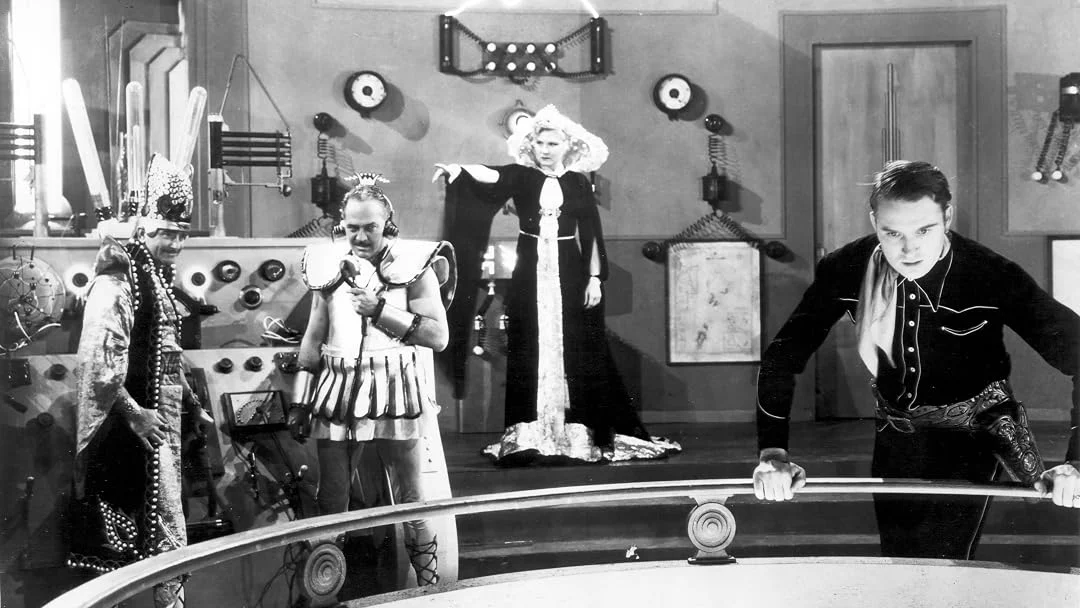
The serial is historically significant as the first true "Science Fiction Western." While westerns were the bread and butter of 1930s matinees, the introduction of the "Scientific City of Murania"—complete with robots, death rays, and television monitors—transformed a standard ranch dispute into an epic struggle for the future of humanity.
Chronology: From Radio Ranch to the Depths of Murania
The narrative structure of The Phantom Empire was designed to keep audiences returning to theaters week after week. Each 20-to-30-minute installment followed a rigid but effective formula of escalation and suspense.

The Setup: Radio Ranch
The story begins at "Radio Ranch," where Gene Autry performs his daily musical broadcast. The ranch is under threat from a group of unscrupulous researchers led by Professor Beetson, who has discovered radium deposits beneath the property. To secure the land, the villains must prevent Gene from making his broadcasts, as his contract stipulates he will lose the ranch if he misses a single performance.
The Discovery: The Muranians
While evading the villains, Gene’s young sidekicks, Frankie and Betsy (played by real-life trick riders Frankie Darro and Betsy King Ross), discover a secret entrance to the subterranean world of Murania. This hidden empire, ruled by the icy Queen Maya (Dorothy Christie), possesses technology far beyond 1935 standards. The Muranians wear "bucket hat" helmets and utilize advanced robotics, but they are wary of the "surface dwellers" and their potential to bring war to the depths.
The Climax: A Synthesis of Genres
The middle chapters of the serial involve a frantic back-and-forth between the surface and the underground. Gene is frequently captured by Muranians, escaped through trick riding, and forced to race back to his microphone just in time to sing "Uncle Noah’s Ark." The series concludes with the destruction of Murania and the triumph of the Radio Ranchers, but not before establishing a template for the "hero’s journey" that would be echoed in 20th-century cinema.
Supporting Data: The Technicality of the "Poverty Row" Masterpiece
Despite its limited budget, The Phantom Empire was a marvel of resourcefulness. The production relied on the "B-unit" expertise of directors Otto Brower and B. Reeves Eason. Eason, in particular, was famous for his work on action sequences, including the legendary chariot race in the 1925 Ben-Hur.
Visual and Narrative Innovation
- The Robots: The Muranian robots, famously described as looking like men in galvanized trash cans with bucket hats, have become icons of camp. However, in 1935, they represented a terrifying vision of mechanized labor and surveillance.
- The "Wipe" Transition: The serial made extensive use of creative transitions, including "wipes" and "iris-outs," to maintain a frantic pace. These visual flourishes would later become a hallmark of George Lucas’s Star Wars editing style.
- Genre Fluidity: The serial effortlessly transitioned from musical interludes to high-speed horse chases to "mad scientist" laboratory scenes. This tonal flexibility was uncommon for the era’s prestige features but was the lifeblood of the serial format.
Historical Context of 1935
To understand the "After Dark" appeal of The Phantom Empire, one must look at its contemporaries. 1935 saw the release of Alfred Hitchcock’s The 39 Steps and the Oscar-winning Mutiny on the Bounty. While those films were refined and self-contained, The Phantom Empire represented the "wild west" of the industry—a space where logic was secondary to spectacle and where the rules of storytelling were being written in real-time.

Official Responses and Critical Legacy: "Matinee Melodrama"
Film historians have long debated the cultural impact of the sound serial. Professor Scott Higgins, a leading authority on the subject and author of Matinee Melodrama: Playing with Formula in the Sound Serial, posits that these films were "high-concept TV before high-concept TV."
The Academic View
Higgins argues that serials like The Phantom Empire taught audiences how to engage with long-form, episodic narratives. Unlike a standalone feature, the serial required a "fandom"—a dedicated group of viewers who would track plot threads over months. The "bucket hat" robots and radium rays weren’t just gimmicks; they were the building blocks of a "cinematic universe" decades before the term was coined by Marvel or DC.
The Creator’s Perspective
While George Lucas has frequently cited Flash Gordon (1936) as his primary inspiration for Star Wars, the influence of The Phantom Empire (released just a year prior) is undeniable. The "Scientific City of Murania" bears a striking resemblance to the sleek, oppressive architecture of the Death Star or the subterranean cities of later sci-fi. Furthermore, the character of Gene Autry—a man of the frontier who is suddenly thrust into a high-tech conflict—is the spiritual ancestor of Luke Skywalker.
Implications: Why ‘The Phantom Empire’ Matters in 2026
In the current media landscape, where genre boundaries are increasingly porous, The Phantom Empire feels strangely contemporary. We see its echoes in shows like Outer Range, which blends the neo-Western with metaphysical sci-fi, and in the Star Wars video game Jedi Survivor, which treats the frontier as a place of ancient, technological mystery.
The Evolution of Serialization
The serial shows us that the "popular consensus" on what cinema should be is always in flux. In 1935, the feature film was the gold standard, while the serial was "trash" for kids. Today, the eight-hour limited series is the prestige format, and the self-contained 90-minute movie is increasingly rare. The Phantom Empire was an early indicator that audiences crave continuity and "world-building" over simple resolution.

The Power of "Play"
Ultimately, the enduring appeal of this cult classic lies in its commitment to play. It is a narrative that refuses to be boxed in by realism or logic. It asks the audience to accept that a man can be a radio star, a champion rider, and a galactic diplomat all at once.
As Sarah Shachat notes in her analysis, "The flicks made on the margins can often show us ways for cinema to evolve." The Phantom Empire was made on the extreme margins of the studio system, yet it contained the seeds of the most successful film franchises in history. It reminds us that at the heart of all great adventure is a sense of "irrepressible ridiculousness"—the willingness to put on a bucket hat, hop on a horse, and ride toward the unknown.
For the modern viewer, revisiting The Phantom Empire isn’t just an exercise in nostalgia; it is a trip to the fountainhead of the American imagination. It is a reminder that the most "bonkers" ideas of today might just become the mythology of tomorrow.