Unveiling the Universal Tapestry: ‘The Treasury of Folklore’ Compendium Illuminates Shared Human Narratives
FOR IMMEDIATE RELEASE
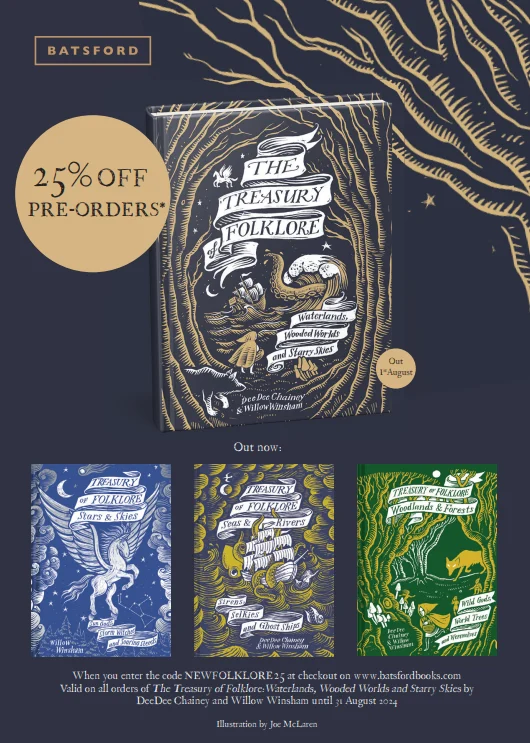
London, UK – [Insert Current Date] – Nearly a decade after embarking on a remarkable journey into the depths of human storytelling, the acclaimed Treasury of Folklore series is set to culminate in a magnificent single-volume compendium. Titled The Treasury of Folklore: Waterlands, Wooded Worlds and Starry Skies, this ambitious new release from authors Dee Dee Chainey and Willow Winsham promises to fulfill their original vision: to unite the world’s diverse folkloric traditions within a single, beautifully curated collection. Available for pre-order now, the much-anticipated volume will officially launch on August 1st, 2024.
The original Treasury of Folklore series, comprising Seas and Rivers, Trees and Woodlands, and Stars and Skies, captivated readers with its insightful exploration of how humanity weaves customs, beliefs, and tales around the physical landscapes it inhabits. This forthcoming compendium gathers the most cherished narratives and profound insights from these three successful volumes, offering a cohesive and immersive experience that underscores the shared human condition found within seemingly disparate myths and legends.
The Genesis of a Global Narrative: From Hashtag to Hefty Tome
The journey began almost ten years ago, sparked by the vibrant global community fostered through the #FolkloreThursday hashtag. This digital outpouring of shared cultural heritage illuminated a powerful truth for Chainey and Winsham: the profound, unifying universality of folklore across the globe. What initially started as an aspiration for a single comprehensive book quickly expanded as the wealth of material proved too vast for one cover. This abundance led to the creation of the three distinct volumes, each focusing on a specific realm of human interaction and imagination: the mystical depths of Seas and Rivers, the ancient secrets of Trees and Woodlands, and the cosmic wonders of Stars and Skies.
The popularity and heartwarming reception of these initial books underscored the deep human need to connect with these ancestral stories. Readers embraced the meticulously researched narratives, which highlighted not only the unique cultural expressions but also the underlying commonalities that bind us. It was this success, coupled with the enduring initial vision, that prompted the suggestion of a compendium.
"When the idea was first suggested to bring out a compendium of the Treasury of Folklore books, we immediately knew that we had to take this opportunity to bring the folklore together as originally envisaged: in one volume," the authors reflect. This decision initiated a meticulous process of revisiting and curating the extensive material. Behind-the-scenes, countless hours were dedicated to re-reading familiar words with fresh eyes, carefully selecting the most compelling narratives and profound insights to craft a cohesive single volume. The goal was to seamlessly span shared landscapes across time and place, presenting the essence of the series in its most distilled and impactful form.
The result, a "hefty tome" combining the essence of waterlands, wooded worlds, and starry skies, has exceeded even the authors’ high expectations. Described as "beautifully bound," with an appealing size, a thoughtfully designed cover, and printed on elegant cream paper, the compendium is designed to be a tactile and visually engaging experience. This physical presentation underscores its role not merely as a collection of stories, but as a significant cultural artifact.
Unearthing Universal Truths: The Core Philosophy
At the heart of The Treasury of Folklore series lies a profound quest for understanding. Chainey and Winsham embarked on their initial exploration driven by a desire to comprehend how diverse human societies across the globe construct customs, beliefs, and intricate tales around the environments they inhabit. This inquiry led to a remarkable revelation: despite the superficial variations in cultural expression—the differing attire, architectural styles, or the names given to the monstrous figures of myth—humanity is, at its core, inherently the same.
The authors discovered that across continents and centuries, humans share fundamental, primal fears and dreams. Whether gazing into the boundless expanse of the ocean, yearning for distant treasures, or huddling around a campfire in the heart of a dark forest, dreading the unknown, these universal emotions resonate. We all stand in profound awe of the seemingly endless march of time beneath the ancient, glimmering stars, contemplating the unwritten future of our own fleeting lives. Folklore, in this context, serves as a mirror reflecting these shared human experiences, offering solace, explanation, and a sense of belonging in a vast and often bewildering world.
It is important to note for existing fans that The Treasury of Folklore: Waterlands, Wooded Worlds and Starry Skies is a compilation. It does not contain new material but rather thoughtfully curated text drawn directly from the existing three books. However, its value lies in its comprehensive scope and exquisite presentation. It is envisioned as more than just a book; it is a potential "conversation starter, a way to connect," designed to grace any bookshelf or coffee table, inviting readers to delve into its pages and explore the rich tapestry of human imagination.

The compendium is expertly structured into three distinct sections, mirroring the original themes of water, land, and sky. Each section is further enriched by the wonderful original illustrations of Joe McLaren, whose distinctive artwork has become synonymous with the series, bringing these ancient tales to vivid life.
Supporting Data: A Glimpse into the Compendium’s Riches
To whet the folkloric appetites of prospective readers, here are some extracts showcasing the depth and diversity of the stories contained within this monumental new volume:
H2: Water Horses: Majestic and Malevolent Creatures from the Depths
Folklore from around the world is replete with tales of perilous steeds lurking beneath the tranquil surfaces of lakes and waterways. These water horses, whether considered real creatures or potent cautionary tales, embody both allure and mortal danger. Imagine a lonely, weary traveler, exhausted by his journey, who suddenly hears the rhythmic beat of hooves and catches a flash of a majestic mane in the water. A horse appears, seemingly an answer to all his troubles. Yet, mounting without caution proves to be a fatal mistake, for this is no ordinary steed—it is a water horse, and the traveler has become its next victim.
One of the most renowned of these aquatic equines is the Scottish kelpie. While often used interchangeably, Scottish folklore actually distinguishes between the kelpie, typically found in rivers, and the each-uisge (water horse), which prefers the deeper, more expansive lochs and lakes. Both, however, share a chilling propensity for dragging their unwary riders beneath the water to their death. Tales suggest fleeting methods to cheat the kelpie, such as taming it with a bridle marked with a cross, but this control is often illusory, with the creature eventually returning to its watery home, often with its rider still attached. The definitive way to vanquish a kelpie, according to some narratives, involves red-hot iron, a classic bane for many folkloric entities.
The enduring power of the kelpie in the Scottish imagination is dramatically visible in the colossal 30-meter-tall sculptures near Falkirk, a striking part of the landscape since 2013. Its influence also extends into modern literature, appearing in the works of authors like Lari Don and finding a place in J.K. Rowling’s Fantastic Beasts and Where to Find Them. Interestingly, despite its prominence in Scotland, the kelpie, or any similar water horse, is notably absent from English folklore.
However, the deficit is splendidly redressed in Wales with tales of the Ceffyl Dwr, a staple of Welsh folkloric belief well into the 19th century. The Ceffyl Dwr varied in appearance and purpose; in the north, it was a shapeshifting spirit, often violent, while in the south, it consistently appeared as a small, enchanting horse that lured people onto its back. Its incredible speed is a recurring theme, with stories describing it covering vast distances in impossibly short times before vanishing, leaving its hapless rider to drown. A curious exception to this rule was made for clergymen of any creed, who were said to be able to ride the horse safely to their destination, while their accompanying clerks or deacons met the usual watery fate.
Scandinavian folklore offers the bäckahäst, or ‘brook horse,’ often sighted in foggy conditions. Described as a majestic and luminous being, it beguiles riders before plunging back into the water, its victims unable to dismount. Children frequently feature as riders in these tales, perhaps to heighten the sense of peril. One popular version tells of boys playing near a frozen river who mount a beautiful horse one by one. The last child, in awe, mispronounces a phrase, accidentally invoking the name of Christ, which the bäckahäst despises, causing it to disappear and save the children. Like the kelpie, the bäckahäst could also be put to work if tricked. These water horses symbolize the untamed power and hidden dangers of natural waters, reminding humanity of its vulnerability and the thin veil between the mundane and the mythical.
H2: Lords of the Wild: Shapeshifting Guardians of the Verdant Realms
Leaving the watery depths, we venture into the verdant heart of the forest, the domain of powerful spirits and creatures known as the Lords of the Wild. These entities abound across the world’s forests and jungles, manifesting as either malevolent forces, wreaking havoc and destruction, or as protective wild beings, safeguarding the flora and fauna. Uncovering their true faces involves brushing away the leafy shadows that conceal them, revealing ancient beliefs about humanity’s relationship with the natural world.
H3: The Forest God Tapio, Finnish
In Finnish mythology, Tapio, also known as Metsähine or Hiisi, reigns as the revered king of the forest realm. He is depicted as tall and thin, his body cloaked in ermine fur or moss, his head topped with a hat. Much like the Green Man or foliate heads prevalent in European folklore, Tapio often peers out from beneath bushy eyebrows of moss and lichen, sporting a great beard that can range from straggling black hair to verdant growth. A striking characteristic, similar to the hulder and other female spirits of Scandinavia, is his human-like appearance from the front, contrasting with the gnarled, tree-like back. Said to be as tall as a tree, Tapio embodies both the personification and the fierce protector of the forest. In ancient times, hunters would seek his blessing before a chase, pledging respect for the wilderness, its creatures, and its delicate balance. Tapio, as lord of all forest creatures, could grant a bountiful hunt or curse a hunter to return empty-handed. His Estonian equivalent shares many traits but is notably one-eyed, echoing figures like the Norse god Odin. Tapio is also a family man; his wife is Mielikki (benevolent) or Kuurikki (malevolent), his son Nyrikki guides hunters, and his daughter Tulikki directs prey. These deities reflect a deep respect for and reliance on the forest, where every aspect of the hunt was imbued with spiritual significance.

H3: The Leshy, Slavic
Among the Slavic peoples, the leshy, leshii, or lyeshy stands as a formidable tutelary spirit of the woods, a protector of trees and animals. In Ukraine, he is considered the guardian of wolves, while other traditions link him to bears, whose hibernation cycle he shares. Known by a multitude of names, all hinting at his connection to the forest, the leshy is often seen as a servant of either the woodsman or the Devil. Resembling Greek satyrs, leshies are typically human from the waist up but possess horns, claws, and a bushy beard, sometimes forest green or entirely moss-covered. They are master shapeshifters, capable of growing taller than the tallest tree or shrinking to the size of a blade of grass. They can mimic any human, animal, or plant, yet in human form, they betray themselves by lacking eyelashes or brows, wearing shoes on the wrong feet, or having their garments wrapped contrary to local fashion. Some possess only one eye, but all are covered in wild hair, with the cloven feet reminiscent of fauns or even the Devil himself. In certain regions, they sport wings and a black furred tail, or appear in white with swollen eyes.
The leshy’s presence is palpable: his bellowing charges through the forest whip up great winds, scattering all creatures in terror. Intruders who ignore his shrieking laughter, clapping, or howling risk being confused and lured off the path, never to be seen again. As trickster figures, leshies can alter their voices to mimic others, enticing victims closer, where they are said to tickle them to death. Their voices can also manifest as the creaking of branches or rustling leaves. Crossing a leshy can bring illness, and they are known to abduct women for marriage or take children cursed by their parents or found wandering alone. Historically, leshies were blamed for cursing entire farms, even sucking milk from cattle. Farmers in Russia’s Olonetsky District would annually sacrifice a cow to appease them and protect their herds. Those who offered prayers before entering the forest or left offerings of bread and tobacco were generally safe from their wrath.
Leshies are believed to live alone or with their wives, the lesovikha, and children, sometimes in secluded forest huts. They are not above battling their own kind, wielding clubs and uprooting trees in their skirmishes. One Vologda leshy was even said to frequent local taverns, driving his wolf pack, before returning to the night after consuming an entire bucket of vodka. They are notorious gamblers, often bartering with squirrels or playing cards, though they avoid clubs, which too closely resemble the Christian cross.
Safeguarding oneself against a leshy, much like with fae folk globally, involves specific actions: turning one’s shirt inside out and shoes on the wrong feet is said to provoke laughter, which instantly returns the lost to their rightful path. Some traditions suggest stripping naked and then re-donning clothes backwards. Swearing at them mercilessly is another method to make them retreat. The sign of the cross is a more solemn banishing method. For those daring enough to summon a leshy, the process is simple: enter the forest, cut down young trees (birch preferred), arrange them in a circle with tops touching, stand in the center devoid of Christian symbols, and call out to the "grandfather of the forest." These tales highlight the complex relationship between humans and the wild, emphasizing respect, boundaries, and the power of nature spirits.
H2: The Hare: A Lunar Legacy Across Cultures
Finally, we turn our gaze skyward to the moon, that greatest of celestial bodies, whose luminous face has inspired myriad tales across time and place. A particularly common motif is that of a rabbit or hare living on the moon, an image found in diverse cultures worldwide. The Sea of Tranquillity is often seen as the rabbit’s head, with the seas of Fertility and Nectar forming its ears.
In the Buddhist Sasa-Jātaka, the hare, along with his friends—an otter, a jackal, and a monkey—exemplified the virtue of giving alms. On a forthcoming fast day, the hare instructed his companions to offer food to any beggar. When the deity Sakka, ruler of the Trāyastriṃśa heaven and protector of Buddhism, descended to earth disguised as an old man to test them, the otter, jackal, and monkey readily shared their food. The hare, having only grass to gather, recognized its unsuitability and, in an ultimate act of self-sacrifice, offered himself upon a fire for Sakka to eat. For this profound faithfulness, Sakka did not allow the hare to perish but plucked him from the flames and immortalized him in the moon for all to see. Some versions suggest Sakka extracted the essence of a mountain to draw the faithful hare’s image on the lunar surface. Similar stories of a self-sacrificing hare exist in other cultures, sometimes with different animal companions.
A tale from Sri Lanka recounts Buddha lost in a wood, hungry and poor. The hare offered to guide him, and upon hearing Buddha’s hunger, immediately offered himself as sustenance. When Buddha built a fire, the hare threw himself into it, but Buddha, using his divine powers, saved the selfless creature and sent him to reside on the moon. Japanese folklore features a similar narrative with Tsuki no Usagi (the Rabbit of the Moon). The Man in the Moon descends to earth as a beggar, and while other animals present him with food, the rabbit, possessing only grass, sacrifices itself on the fire. The beggar then reveals his true form and takes the rabbit to live with him on the moon as a testament to its selflessness. This popular Japanese tale is often shared with children in September, coinciding with the Harvest Moon and the Mid-Autumn Festival, linking the lunar cycle with themes of generosity and sacrifice.
In a different vein, a fascinating tale from South Africa attributes human mortality to the hare. The Moon dispatched Hare to inform people that just as she, the moon, "died" by fading each month only to be reborn, so too would humankind. However, the flighty Hare misdelivered the message, telling people only that they would die, without the promise of return. Enraged upon discovering Hare’s error, Moon attacked him with a hatchet, intending to cleave him in two. She only succeeded in splitting his lip. In retaliation, Hare lashed out with his claws, scarring Moon’s face, marks that are still visible today as the dark shapes on the moon’s surface. These diverse lunar hare myths collectively reflect humanity’s age-old fascination with the moon, imbuing it with stories that explore themes of sacrifice, immortality, and the origins of life and death, often serving as profound moral allegories.
Official Responses and Enduring Legacy
The authors, Dee Dee Chainey and Willow Winsham, express immense gratitude for the overwhelming support received since the series’ inception. "The popularity of the three books in the Treasury of Folklore series has been both surprising and heartwarming, and we thank each and every person who has bought and read these books," they state. The creation of this compendium is, in many ways, a direct response to this readership, an offering designed to consolidate the beloved content in a format that honors the original, ambitious vision.

Their enthusiasm for the final product is palpable: "To say we have been blown away by the end result is an understatement, and we are utterly thrilled to be able to share this beautifully bound volume with you. We love the size and the cover combining everything and the beautiful cream paper: it is a ‘hefty tome’ indeed." This reflection highlights not just the intellectual content but also the aesthetic and physical experience of engaging with the book, a testament to the care and passion poured into its creation.
Implications: Folklore in the Modern World
The release of The Treasury of Folklore: Waterlands, Wooded Worlds and Starry Skies carries significant implications for both the literary world and broader cultural understanding. In an increasingly globalized yet often fragmented world, the compendium serves as a powerful reminder of humanity’s shared heritage. By bringing together tales from disparate cultures that echo similar fears, hopes, and explanations for the inexplicable, the book fosters a sense of interconnectedness. It demonstrates that beneath the surface of cultural difference, fundamental human experiences resonate universally.
This collection is more than a mere archive; it is an invitation to engage with the enduring power of storytelling. Folklore provides crucial insights into the historical values, moral codes, and ecological relationships of past societies, offering valuable lessons for contemporary challenges. It serves as a repository of collective wisdom, warning against hubris, celebrating courage, and explaining the mysteries of nature long before scientific understanding.
Furthermore, in an age dominated by digital media, the physical beauty and substantiality of this "hefty tome" champion the enduring value of printed books as cherished objects. It aims to be a focal point in homes, sparking conversations and encouraging readers of all ages to explore the rich narratives within. As a "conversation starter, a way to connect," it underscores the social function of folklore—to bring people together, to share stories, and to find common ground in the vast tapestry of human experience.
By consolidating these narratives, the compendium reinforces the idea that folklore is not merely a collection of quaint old tales but a living, breathing part of human identity. It nurtures imagination, preserves cultural memory, and offers a timeless lens through which to understand ourselves and our place in the world. As we gaze upon the moon, walk through forests, or ponder the depths of rivers, these stories remind us that our shared dreams and fears are as ancient and as enduring as humanity itself.
The Treasury of Folklore: Waterlands, Wooded Worlds and Starry Skies is now available for pre-order and will be released on August 1st, 2024.
Link to pre-order on Amazon
Readers can also enjoy 25% off when ordering directly from Batsford Books using the code NEWFOLKLORE25.
### About the Authors:
Dee Dee Chainey and Willow Winsham are acclaimed folklorists and authors, known for their engaging and insightful explorations of global folklore. Their work brings ancient stories to life, highlighting the universal threads that connect humanity across cultures and generations.
### About Batsford Books:
Batsford Books is an esteemed publisher with a rich history, specializing in a diverse range of non-fiction titles, including highly regarded works on folklore, history, and the arts.
### Contact:
[Insert PR Contact Information if available, otherwise omit]