Unlocking the Great Enigma: Inside the Immersive Science of ‘The Secret of the Pyramid Builders’

The Great Pyramids of Giza have stood as the ultimate testament to human ambition for over 4,500 years. For centuries, the question of their construction has remained one of history’s most enduring mysteries, fueling countless theories ranging from the plausible to the supernatural. Today, a new frontier in storytelling and archeology is allowing the public to step inside these limestone giants without ever leaving the ground.
The Secret of the Pyramid Builders, the latest immersive VR expedition from the French developer Excurio, has officially debuted at Japan’s "Immersive Journey" location in Tokyo. By blending cutting-edge virtual reality technology with the latest breakthroughs from the ScanPyramids mission, the experience offers a glimpse into the architectural genius of the Old Kingdom that was previously inaccessible to all but a handful of elite Egyptologists.
Main Facts: A New Era of Digital Egyptology
The Secret of the Pyramid Builders is a location-based, free-roaming virtual reality experience. Unlike home-based VR, which is often limited by living room space and hardware constraints, this project utilizes large-scale tracking environments where visitors physically walk through a digital recreation of Ancient Egypt.
Developed by Excurio in collaboration with scientific experts, the experience serves as a narrative and technical successor to the widely acclaimed Horizon of Khufu. While the previous installment focused on the funerary rites and the spiritual journey of Pharaoh Khufu, this new expedition pivots toward the engineering marvels and the logistical Herculean efforts required to raise the monuments.
The experience is currently a flagship attraction at Tokyo’s Immersive Journey but is also available at various Excurio-partnered locations globally, including sites in Paris, London, and Shanghai. It leverages the HTC Vive ecosystem and advanced spatial tracking to allow dozens of users to inhabit the same virtual space simultaneously, appearing to one another as ethereal avatars to prevent physical collisions.
Chronology: From Cosmic Rays to Virtual Reality
The development of this experience is inextricably linked to the timeline of modern archaeological discovery, specifically the "ScanPyramids" project launched in 2015.
2015–2017: The Discovery of the Voids
Using non-invasive technologies such as infrared thermography and muon tomography—a process that uses cosmic-ray particles to "X-ray" solid rock—an international team of scientists discovered several "voids" or unexplained cavities within the Great Pyramid. The most significant of these, the "Big Void," is a 30-meter-long space located above the Grand Gallery.
2021–2023: Narrative Development
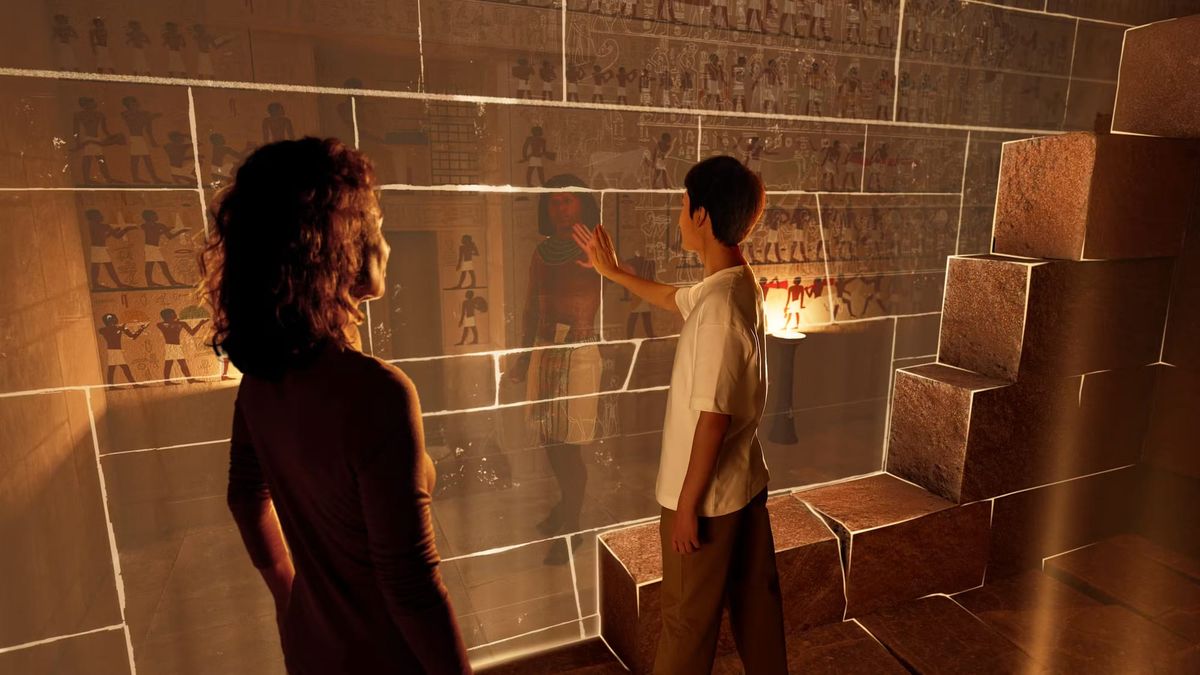
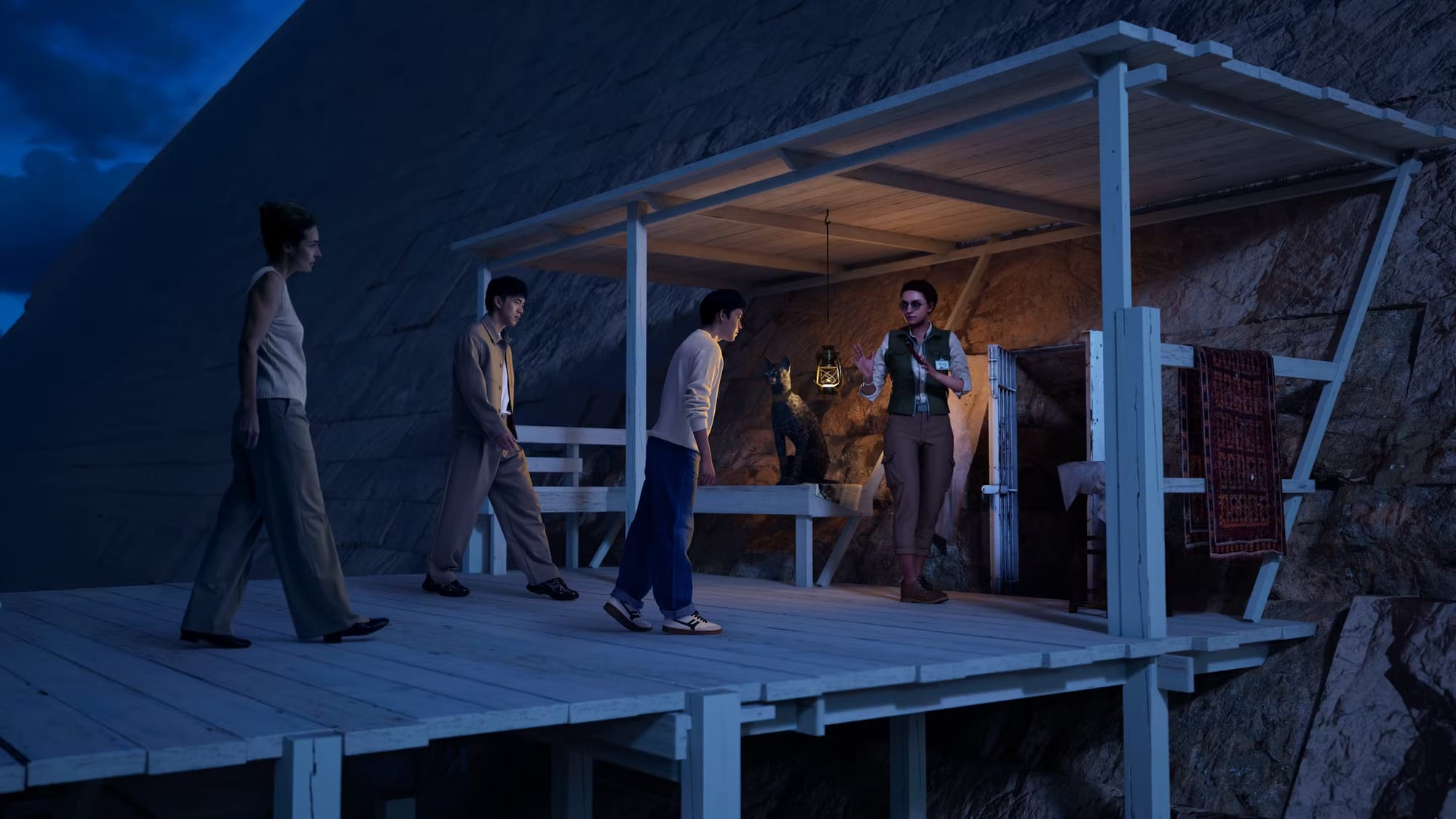
Following the success of Horizon of Khufu, Excurio began synthesizing the ScanPyramids data into a narrative format. The goal was to move beyond a "virtual museum" and toward an "immersive documentary." The development team worked to refine the characters of Mona, a young, passionate Egyptologist, and her supernatural companion, the cat-god Bastet, to guide users through these new findings.
Summer 2024: Global Rollout
The Secret of the Pyramid Builders launched as a seasonal highlight in Tokyo. This release marked a significant upgrade in the software’s "flow," moving away from the cramped, linear corridors of earlier VR models toward more expansive, open-air environments that better simulate the scale of the Giza plateau.
Supporting Data: The Science Underpinning the Simulation
What sets The Secret of the Pyramid Builders apart from standard entertainment VR is its commitment to archaeological accuracy. The experience is built upon several key datasets and theories currently being debated in the scientific community.
1. The Muon Tomography Data
The "voids" visualized in the experience are not artistic inventions. They are based on the 3D maps generated by the ScanPyramids team. In the VR experience, users can see these voids superimposed over the pyramid’s structure, allowing them to understand the spatial relationship between the King’s Chamber, the Grand Gallery, and these newly discovered mysteries.
2. The Internal Ramp Theory
For decades, the "External Ramp" theory—suggesting a massive, miles-long ramp used to haul stones to the top—was the standard. However, mathematical modeling has shown that such a ramp would require more material than the pyramid itself.
Excurio’s experience visualizes the "Internal Ramp" theory, popularized by architect Jean-Pierre Houdin. This theory suggests that the Egyptians built a spiral tunnel inside the pyramid to move stones to the higher tiers. By using VR, visitors can stand "inside" the stone layers to see how this internal corkscrew mechanism might have functioned, a visualization that is nearly impossible to convey through traditional 2D sketches.
3. Epigraphic Evidence
The experience incorporates the "Diary of Merer," a logbook discovered in 2013 at Wadi al-Jarf. This papyrus is the only first-hand account of the pyramid’s construction, detailing how limestone was transported by boat from Tura to Giza. The VR experience recreates these ancient piers and bustling harbors based on the descriptions found in Merer’s logs.
Official Responses: Balancing Innovation and Tradition
The integration of technology into Egyptian heritage has not been without its hurdles. The ScanPyramids project, which provides the backbone for this VR experience, has occasionally faced friction with local authorities.
The Ministry of Tourism and Antiquities
Egyptian officials have generally supported the ScanPyramids project but remain protective of the monuments’ "dignity." Dr. Zahi Hawass, the former Minister of Antiquities and a prominent voice in the field, has often urged caution regarding the "Big Void," suggesting it might be a structural necessity (a "construction gap") rather than a hidden chamber.
Excurio’s narrative handles this by presenting the information as an ongoing scientific debate rather than settled fact. By doing so, they have secured the tacit approval of the broader archaeological community, positioning the VR experience as a tool for public education rather than sensationalism.
The Developer’s Perspective
In statements regarding the launch, Excurio representatives emphasized that the goal was to "democratize" Egyptology. "Most people will never have the opportunity to crawl through the narrow shafts of the Great Pyramid," the developers noted. "And even those who do cannot see the pyramid as it was 4,000 years ago. VR allows us to bridge that gap between the ruins of today and the vibrant construction sites of the past."
Implications: The Future of Cultural Tourism and Education
The success of The Secret of the Pyramid Builders signals a shift in how history is consumed in the 21st century. The implications of this technology reach far beyond gaming.
1. Digital Preservation and "Virtual Repatriation"
As climate change and mass tourism threaten the physical integrity of ancient sites, digital twins—highly accurate VR recreations—offer a way to preserve these wonders for future generations. Furthermore, it allows for a form of "virtual repatriation," where the cultural heritage of Egypt can be experienced globally without the need for physical artifacts to leave their country of origin.
2. Pedagogical Evolution
The "Immersive Journey" model proves that "edutainment" can be both scientifically rigorous and commercially viable. By using a narrative (Mona and Bastet) to explain complex theories like muon tomography, the experience makes high-level physics and archaeology accessible to children and adults alike. It moves the classroom from the textbook to the "field."
3. The Evolution of VR Hardware
The use of the HTC Vive in a free-roaming capacity demonstrates the maturing of VR hardware. The experience’s ability to handle dozens of users in a single 3D space without latency or "motion sickness" (a common complaint in early VR) suggests that location-based entertainment (LBE) is becoming a stable pillar of the tech industry.
Conclusion: A Wonder Reborn
The Secret of the Pyramid Builders is more than a mere tour; it is a sophisticated synthesis of history, physics, and digital art. While the experience does have minor localized quirks—such as the linguistic pronunciation of "Giza" that may grate on the ears of purists—the sheer ambition of the project is undeniable.
By allowing visitors to stand on the sun-drenched piers of the Nile and watch the limestone casing being polished to a mirror shine, Excurio has managed to do what thousands of years of erosion could not: they have made the pyramids feel new again. As science continues to peel back the layers of the Giza plateau, VR stands ready to ensure that the public is not just told about these discoveries, but is allowed to live them. For those in Tokyo or near any Excurio hub, this is a journey through time that is well worth the step into the digital unknown.