
The Unsung Guardians of Magic’s Rules: How "Muddle, the Ever-Changing" Redefines Commander Strategy
Strixhaven, Arcavios – In the sprawling multiverse of Magic: The Gathering, where arcane spells clash and legendary creatures vie for dominance, the meticulous interpretation of rules forms an often-overlooked bedrock. While the official Magic Judge program may have been formally scaled back by Wizards of the Coast, its ethos — a deep understanding of the game’s intricate syntax — remains an indispensable component of local play communities and competitive circuits alike. These custodians of clarity, adept at dissecting complex timings and esoteric rulings, are the silent architects behind fair gameplay and the catalysts for innovative deck construction.
This truth becomes strikingly apparent when confronting cards that challenge conventional understanding, such as "Muddle, the Ever-Changing" from the recent Secrets of Strixhaven set. Initially dismissed by many, including this author, as a rather unremarkable value piece, Muddle reveals itself, upon closer inspection and a deep dive into the Comprehensive Rules, to be a canvas for unparalleled rules-bending creativity. It is a testament to the enduring legacy of Magic’s judges, and the vibrant community of rules enthusiasts, that such intricate interactions can be unearthed and transformed into a potent, if peculiar, Commander strategy.
A Legacy of Precision: The Judge Program’s Enduring Spirit
The formal discontinuation of the Magic Judge program in its previous, officially sanctioned capacity marked a significant shift in the game’s infrastructure. However, the foundational principles it instilled—precision, clarity, and an encyclopedic knowledge of the Comprehensive Rules—continue to empower players to navigate Magic’s ever-evolving complexities. For those who once passed certifications, like this author, the lens of rule-parsing becomes an intrinsic part of the game experience, transforming seemingly straightforward card texts into tantalizing puzzles. This perspective is not merely academic; it is the very engine that drives the discovery of interactions that elude the casual glance, shaping the competitive landscape and enriching casual play. Without this foundational "education" and the collective wisdom of a community fascinated by Magic’s deeper mechanics, the extraordinary potential of "Muddle, the Ever-Changing" would have remained obscured.
Muddle, the Ever-Changing: A Misunderstood Enigma
Upon its reveal, "Muddle, the Ever-Changing" — an unassuming Otter Elemental from the Prismari college — appeared to offer a straightforward path to value. Its ability to become a copy of a target nonlegendary creature, "except it has Myriad," suggested standard combo lines, often leveraging powerful attack triggers from creatures like Port Razer. Such applications, while functional, represented a well-trodden path in Commander, failing to ignite the spark of truly innovative deckbuilding. The initial assessment was that Muddle was, at best, a niche enabler for established strategies.
However, the pursuit of an engaging Prismari option for Secrets of Strixhaven coverage necessitated a deeper investigation. It was during this process that a single, unassuming word in Muddle’s text began to resonate with profound implications: "Except." In Magic’s rules lexicon, "except" is not merely a conjunction; it is a critical differentiator, often heralding unique interactions involving "copiable values." This realization pivoted the entire understanding of Muddle, shifting it from a fragile combo piece to the linchpin of a bizarre, yet remarkably potent, Prowess-style aggro deck—a list further complicated and enriched by the often-dreaded mechanic of Mutate.
Decoding Muddle: The Power of "Except" and Copiable Values
The intricate dance of Muddle’s abilities hinges entirely on the nuanced concept of "copiable values," a cornerstone of Magic’s rules governed primarily by Comprehensive Rule 707.2. Understanding what information is retained when a permanent becomes a copy, or when a token is created as a copy, is paramount to unlocking Muddle’s true potential.
The Esoteric Art of Cloning: Comprehensive Rule 707.2
When a permanent becomes a copy of another, or a token is created as a copy, it generally inherits what is physically printed on the card it copies. This includes its name, mana cost, color, card type, subtype, rules text, power, and toughness. However, crucial distinctions exist. Not every characteristic or ability carries over. For instance, counters (like +1/+1 counters), most temporary effects (like "this creature gains haste until end of turn"), and delayed triggers (abilities that trigger at a later point, often at the end of a turn or phase) are typically not copiable values.
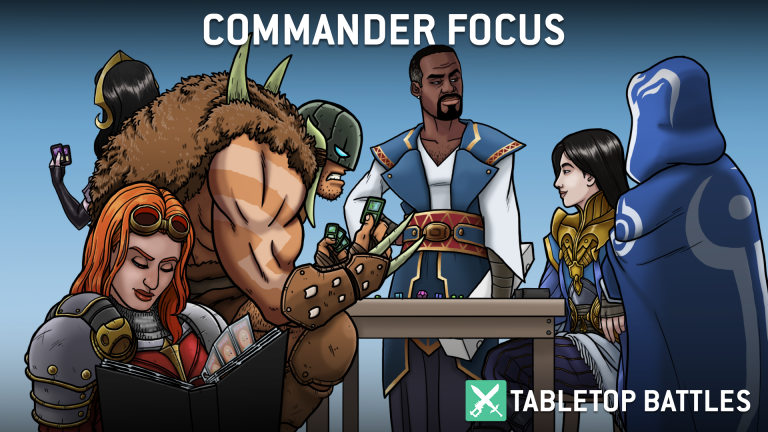
Consider a common example: creating a token copy of "Grinning Ignus" with "Twinflame." If you then "Populate" that Twinflame token, creating a copy of the copy, what attributes does the new token possess? It will have Ignus’s printed mana cost, name, text, and P/T. Crucially, it will not inherit the "exile this token at the beginning of the next end step" delayed trigger from Twinflame. This is because that delayed trigger is not a copiable value. However, if the Twinflame token had gained haste (an effect that directly modifies its characteristics rather than creating a delayed trigger), that haste would typically be copied.
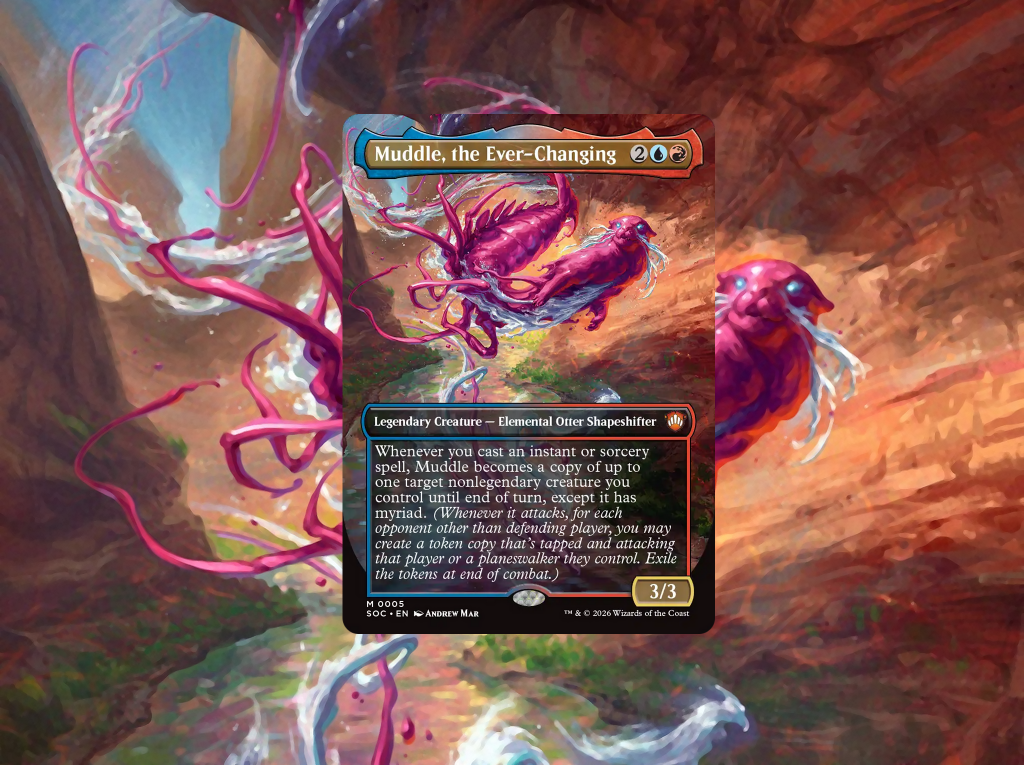
This brings us back to "Muddle, the Ever-Changing." Muddle’s text states it becomes a copy of a nonlegendary creature, "except it has Myriad." The critical insight is that "essentially everything after ‘except’ in Magic text is a copiable value." Therefore, if Muddle copies Grinning Ignus, it becomes an Ignus with Myriad. If you then create a copy of that Muddle-as-Ignus (for example, with a "Clone" effect), the new token enters as an Ignus with Myriad. More importantly, it never reverts to Muddle at the end of the turn, because Muddle’s own delayed trigger to return to its original form is not a copiable value. This seemingly minor rules interaction transforms Muddle from a fleeting shapeshifter into a progenitor of permanent, Myriad-equipped copies.
The Non-Legendary Conundrum: Overcoming Muddle’s Restriction
Despite the groundbreaking discovery regarding copiable values, a significant hurdle remains: Muddle can only become a copy of a "target nonlegendary creature." This clause presents a unique challenge, particularly if the goal is to have Muddle’s own ability (the "become a copy, except it has Myriad" text) become a copiable value itself. If Muddle copies a nonlegendary creature, it retains Myriad but loses its original ability. This means it cannot then repeatedly shift forms or create subsequent Myriad-enabled copies of itself in its altered state.
The ideal scenario would be for Muddle to copy itself while being nonlegendary, allowing its unique text to propagate. Cards like "Mirror Gallery" or "Mirror Box" prevent the "legend rule" from applying, but they do not remove the Legendary supertype itself. To achieve Muddle’s self-replication, the Legendary supertype must be removed, and the resulting "nonlegendary" characteristic must also be copiable. This can be accomplished through various means: sorceries like "Irenicus’s Vile Duplication" or "Quantum Misalignment," or enchantments such as "The Apprentice’s Folly" or "The Clone Saga." However, the most elegant and synergistic solution for this specific build lies within the creature type itself: Mutate.
A Symphony of Mutations: Unlocking Muddle’s True Potential
Mutate, a mechanic introduced in Ikoria: Lair of Behemoths, is a notorious source of rules headaches, yet it provides the crucial missing piece for Muddle’s grand strategy. It allows players to merge creatures into a single entity, creating a stack where the top card dictates the merged creature’s identity, while the text boxes of all cards below it are retained.
The Beautiful Chaos of Mutate: Merging Abilities
When creatures are mutated, the resulting permanent has the characteristics (name, mana cost, power/toughness, types) of the topmost creature, combined with the rules text of all creatures in the stack. Internal logic dictates how conflicting abilities are resolved (e.g., P/T setting effects like Tarmogoyf apply regardless of layer), but crucially, the entire merged stack is treated as a single permanent whose copiable values include all its printed text.
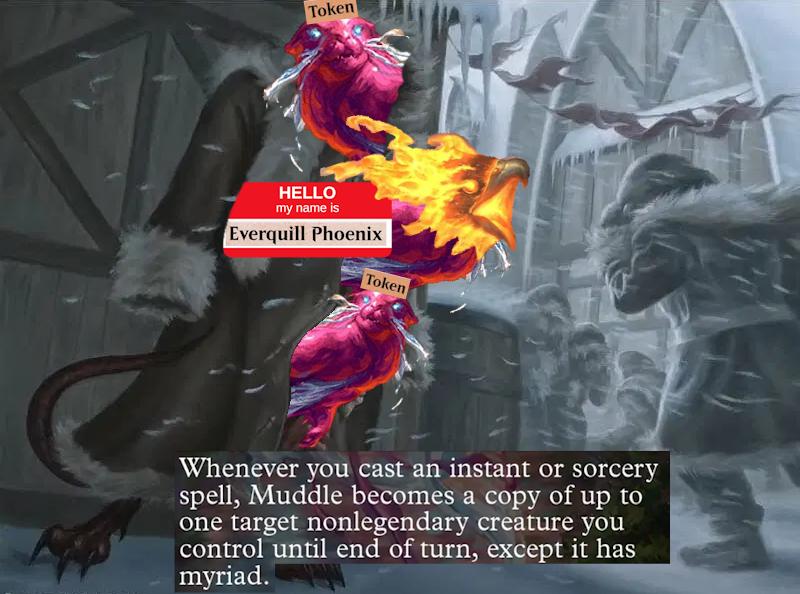
This is where Mutate perfectly intersects with Muddle’s requirements. By mutating a nonlegendary creature onto Muddle, or vice-versa, the resulting merged creature effectively possesses Muddle’s "Whenever you cast an instant or sorcery spell, target nonlegendary creature you control becomes a copy of it, except it has Myriad" ability. For example, mutating an "Everquill Phoenix" onto Muddle creates an Everquill Phoenix that now has Muddle’s full ability. Since Everquill Phoenix is nonlegendary, the merged creature can then be targeted by Muddle’s own ability (which it now possesses), or more importantly, by other copy effects.
The Prowess Paradox: Swarming the Battlefield
The implications of this Mutate-Muddle synergy are profound. If you have a mutated Muddle (e.g., Everquill Phoenix with Muddle’s text) and you cast an instant or sorcery, you can target the merged creature itself. It then becomes a copy of the creature on top (Everquill Phoenix), except it has Myriad, and crucially, it also retains Muddle’s ability (because Muddle’s text is part of its merged identity). If you then clone this creature, you get a copy that is Everquill Phoenix, has Myriad, and has Muddle’s ability—and it never reverts.
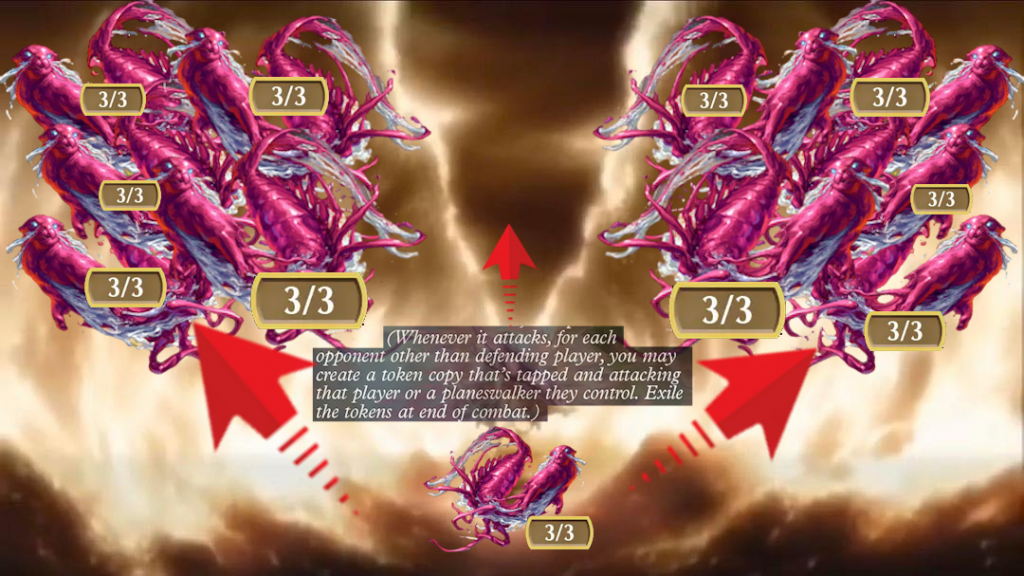
This creates a unique "Prowess-like" engine. Instead of simply gaining +1/+1, casting instants or sorceries allows you to create additional attacking copies of your Myriad-enabled Muddle stack. When these copies attack, they generate two more tokens each (one for each opponent other than the defending player), which also have Myriad. This snowball effect can quickly generate an overwhelming swarm of attackers. While the original attack might only deal a modest 3-5 power to one opponent, the Myriad triggers can easily triple that damage across the other two players, distributed among multiple bodies. This aggressive combat strategy also introduces a fascinating political dimension, allowing players to negotiate with the player being attacked by the original Muddle, leveraging the threat of the Myriad swarm against others. Furthermore, many Mutate creatures offer valuable side benefits, such as "Sea-Dasher Octopus" for card draw or "Lore Drakkis" for returning cards from the graveyard, enhancing the deck’s overall resilience and value generation.
The Elemental Engine: Fueling the Otter’s Assault
Beyond the intricate rules interactions, the Muddle deck is designed with a cohesive strategy, built around a powerful Elemental tribal sub-theme. Muddle itself, being an Otter Elemental, synergizes perfectly with this package, transforming what might otherwise be "overcosted" Mutate creatures into efficient threats.
Kindred Spirits: Tribal Synergies for Ramp and Value
The deck’s ramp suite leverages Muddle’s Elemental typing through cards like "Smokebraider" and "Flamebraider." These two-mana creatures each tap for two mana, specifically usable for Elemental spells. This allows for an explosive start, catapulting Muddle onto the battlefield or powering out expensive Mutate creatures ahead of schedule. Other Elementals in the 99, such as "Orvar, the All-Form" (a Changeling, thus all creature types), benefit from this ramp. "Dreamtail Heron," a powerful Mutate piece, also gains from the Elemental theme, being tutorable with "Flamekin Harbinger." "Runaway Steamkin" fuels storm turns, while "Ashling, Rekindled" and "Ashling, Rimebound" provide additional flexible mana for Elemental costs.
This Elemental density extends beyond just creatures. "Kindle the Inner Flame," "Ashling’s Command," and "Blades of Velis Vel" are all Elemental spells that contribute to the deck’s type density, ensuring the specialized mana from the ‘braiders is efficiently utilized. These spells are not merely type-aligned; they also frequently target, creating further synergy with Muddle’s ability and other targeted spell payoffs.
Targeted Precision: Maximizing Instant/Sorcery Triggers
The core engine of Muddle’s strategy relies on casting numerous instants and sorceries to trigger its ability. This necessitates a suite of cheap, often advantage-neutral, spells that can be cast repeatedly or provide additional utility. Beyond triggering Muddle, these targeted spells also enable powerful interactions with cards like "Vesuvan Duplimancy" and "Orvar, the All-Form," both of which generate copies of permanents when targeted by spells.
"Flame Jab" stands out as a particularly potent inclusion. Costing a mere R, and possessing the ability to be cast from the graveyard via its Retrace ability, it provides a repeatable, functionally free spell when combined with mana generators like Birgi, God of Storytelling or Electro, Assaulting Battery. This ensures a consistent stream of triggers for Muddle, Orvar, and Duplimancy, preventing the deck from running out of gas during critical turns. "Crowd’s Favor," a free instant with Convoke, offers similar advantages, providing a cost-effective trigger that can also make Muddle more difficult to block. Other targeted spells, like "Snap" and "Snapback," offer crucial disruption or the ability to reset mutated creatures for repeated value.
Preserving the Swarm: Strategies for Myriad Retention
While Muddle’s ability to generate multiple Myriad-equipped copies is powerful, Myriad itself comes with a significant drawback: the tokens are exiled at the end of combat. To truly maximize the aggressive potential of this strategy, these tokens must be preserved. The deck employs several clever rules-based interactions to achieve this.
Stifling the Ephemeral: Countering Myriad’s Demise
The key insight here lies in Myriad’s mechanics: the delayed trigger to exile the tokens at the end of combat is a single trigger for all tokens created by that instance of Myriad. This presents a vulnerability that can be exploited. If that single trigger can be countered or prevented from resolving, the Myriad tokens remain on the battlefield indefinitely. Cards like "Stifle," "Spider-Sense," and "Consign to Memory" serve dual purposes in this deck. They can disrupt opposing game plans, countering problematic activated or triggered abilities, but they can also be strategically deployed to counter Myriad’s exile trigger, permanently retaining the generated copies. This vastly amplifies the deck’s damage output, allowing the swarm to grow exponentially over subsequent combat phases.
Phasing Through Peril: Indefinite Protection
Another powerful mechanism for Myriad token retention is Phasing. If a permanent phases out, it is treated as though it no longer exists on the battlefield until it phases back in. Crucially, phased-out permanents cannot be targeted, exiled, or sacrificed. This makes Phasing an ideal protective measure for Myriad tokens. "March of Swirling Mist" and "Slip Out the Back" can protect Muddle and its copies from removal or, more pertinently, from Myriad’s exile trigger. By phasing out the Myriad tokens at the end of combat, they return at the beginning of the next untap step, safe and sound, ready to attack again.
"Teferi’s Veil" offers a repeatable, consistent solution for protecting attackers from sorcery-speed board wipes and, most importantly, for keeping Myriad copies on the battlefield. Any attacking creature that is non-token and not tapped (which Myriad tokens often are not, having just attacked) phases out at the end of combat. This ensures the Myriad copies, if they are copies of Muddle itself (and thus non-tokens), survive turn after turn, creating an unstoppable tide of otters. This card is so synergistic that it feels almost mandatory for any Muddle strategy aiming for token retention.
Beyond the Main Deck: Alternative Retention Methods
While highly effective, some token retention methods were ultimately relegated to the sideboard or cut for space due to their less flexible nature. Cards like "Discontinuity" and "Sundial of the Infinite" can prevent Myriad’s exile trigger by ending the turn with the triggers on the stack. However, their primary function is often solely for this purpose, making them less versatile than cards like Stifle, which can also interact with opponents. The main deck prioritizes effects that offer both protection/retention and broader interaction, aligning with a more proactive and adaptable game plan.
The Path to Victory: Combat, Combo, and Controlled Chaos
The Muddle deck primarily aims for victory through overwhelming combat damage, leveraging the exponential growth of Myriad tokens. However, like many well-rounded Commander decks, it includes an efficient infinite combo as a contingency, carefully selected to ensure each component contributes meaningfully to the primary strategy.
Aggressive Ambition: The Core Combat Strategy
The core strategy revolves around establishing a Muddle-Mutate engine, casting cheap instants and sorceries to generate Myriad copies, and then retaining those copies to build an unstoppable army. The ability to attack multiple opponents simultaneously with an ever-growing swarm of Myriad tokens allows for rapid damage accumulation and a unique political dynamic. The deck’s speed and resilience, bolstered by Elemental ramp and targeted protection, aim to close out games before opponents can stabilize.
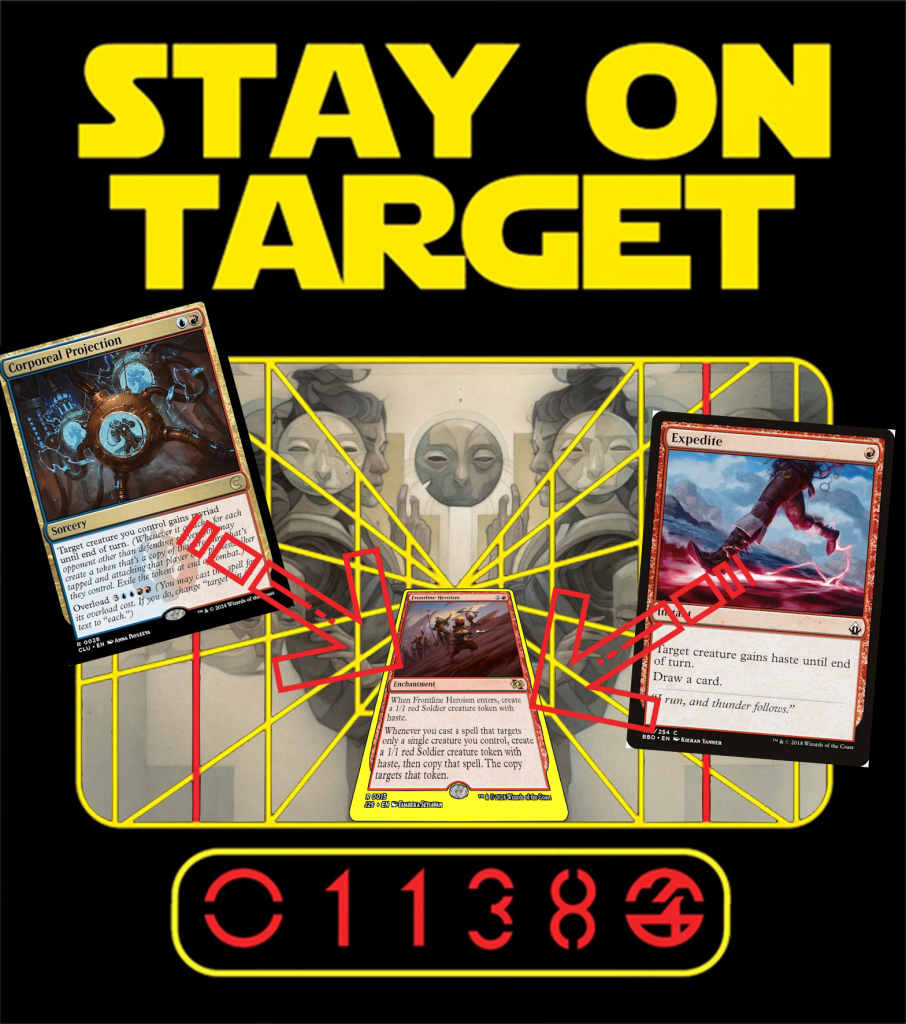
The Bracket 2.5 Combo: Elegant Efficiency
For situations where combat might be stalled or a quicker win is needed, the deck incorporates a streamlined infinite combo: "Grinning Ignus" combined with either "Birgi, God of Storytelling" (or its backside, Harnfel, Horn of Bounty) or "Runaway Steam-Kin." Both Birgi and Steam-Kin can generate enough mana to make Grinning Ignus mana-neutral or even mana-positive when repeatedly cast and returned to hand. This creates an infinite loop of casting Grinning Ignus, generating infinite storm count.
The beauty of this combo lies in its integration: all pieces are independently valuable. Grinning Ignus itself is an Elemental, synergizing with the tribal ramp. Birgi and Runaway Steam-Kin are powerful mana engines that accelerate the deck’s primary game plan, providing crucial resources for casting multiple instants and sorceries or powering out Mutate plays. The infinite storm count can then be leveraged with a card like "Grapeshot" to eliminate all opponents. This "Bracket 2.5" combo exemplifies the ideal balance: potent enough to win, yet composed of pieces that contribute naturally to the deck’s overall strategy, avoiding the inclusion of "dead cards" solely for combo purposes.
Muddle’s Quiet Council: An Example Decklist Analysis
Delving deeper into the 99 cards reveals a carefully curated selection designed to maximize the synergy between rules-bending interactions and an aggressive combat plan.
Core Engine Components: Beyond the Rules-Bend
Beyond the crucial Mutate and token retention pieces, several cards enhance the deck’s functionality. As previously highlighted, "Flame Jab" provides invaluable repeatable triggers, ensuring a constant flow of spells for Muddle, Orvar, and Vesuvan Duplimancy. "Crowd’s Favor" offers a free, instant-speed trigger that can also save Muddle from combat.
A particularly cunning package involves the "theft Drakes": "Gilded Drake" and "Volatile Stormdrake." By holding priority when their enter-the-battlefield triggers are on the stack, Muddle can be transformed into a copy of one of these Drakes via an instant. When that Muddle-as-Drake then attacks with Myriad, the subsequent copies will also trigger, allowing the player to permanently steal multiple creatures from opponents—a massive swing in value and board presence. "Snap" and "Snapback" serve as flexible interaction, bouncing problematic permanents or resetting mutated creatures for additional triggers.
Strategic Omissions: Why Roaming Throne and Twinflame Travelers are Out
Conspicuously absent from the list are cards like "Roaming Throne" and "Twinflame Travelers," which might, at first glance, appear to be ideal inclusions. Roaming Throne doubles triggered abilities of a chosen creature type, while Twinflame Travelers offers a second instance of Myriad. Doubling Muddle’s ability would result in two copy effects per instant/sorcery, and doubling Myriad would lead to four attackers per trigger—seemingly exponential power.
However, the current strategy heavily relies on Mutate to transform Muddle into a nonlegendary creature that also retains Muddle’s ability. In this state, the merged creature often takes on the type of the topmost Mutate card (e.g., Everquill Phoenix is a Phoenix, not an Elemental). This means that Roaming Throne, which requires choosing a creature type, might not consistently benefit Muddle itself or its copies. Similarly, Twinflame Travelers, while powerful, adds another layer of complexity and relies on Muddle being a particular type (Warrior) or having its ability copied in a way that retains the Warrior type. The consistency and directness of the Mutate strategy, which ensures Muddle’s core ability is always present and functional, outweighed the potential, but less consistent, power of these doublers. There is certainly a viable alternative build focusing on nonlegendary copy effects that preserve creature types, but the chosen path prioritizes the robust and consistent interaction of Mutate.
The Metagame and the Future of Commander Design
This Muddle build exists at what many experienced Commander players term "Bracket 2.5"—a sweet spot in the metagame that is increasingly popular. This bracket represents a tier of decks that are highly optimized and competitive, often capable of winning rapidly, but intentionally eschew "Game Changer" cards like "The One Ring" or "Rhystic Study" (or at least limit their inclusion). This deliberate choice fosters longer, more interactive, and often more creative games, allowing for a broader array of strategies to flourish. Muddle, with its intricate rules interactions and unique combat approach, fits perfectly into this emerging metagame, offering a refreshing alternative to traditional powerhouses.
Navigating Bracket 2.5: A New Frontier
The prevalence of Bracket 2.5 reflects a growing desire within the Commander community for competitive play that doesn’t immediately default to the fastest, most efficient, or most universally powerful cards. It’s a space where intricate synergies and novel approaches are rewarded, and Muddle’s rules-bending Prowess strategy is a prime example. The absence of format-defining "auto-includes" opens up valuable deck slots, allowing for the inclusion of specialized cards that might otherwise be overlooked. This meta encourages deep dives into card interactions and creative problem-solving, aligning perfectly with the ethos of discovering Muddle’s hidden potential.
Accessibility and Adaptability: Budgeting for Muddle
While the presented version of the Muddle deck is highly optimized, it is also remarkably adaptable to different budget constraints. For players not looking to proxy, the cost can be significantly reduced without compromising the core gameplay experience. Swapping out high-value cards like "Gilded Drake," "Wheel of Fortune," and "Volcanic Island" can drastically cut the monetary investment, bringing the deck’s price down to a fraction of its optimized cost. Further adjustments, such as removing "Quantum Misalignment" or focusing solely on "Birgi, God of Storytelling" as the most expensive piece, still yield a robust and enjoyable deck. This accessibility ensures that the innovative and engaging gameplay of Muddle is within reach for a wider audience, fostering creativity regardless of financial investment.
Conclusion: A Celebration of Esoteric Discovery
The journey to uncover the true potential of "Muddle, the Ever-Changing" is a testament to the rewards of deep rules analysis and unconventional thinking in Magic: The Gathering. What began as a cursory glance at a seemingly innocuous value commander evolved into the discovery of a complex, rules-bending aggro strategy. The initial dismissal of Muddle, echoed by the predominantly "banal value pile" builds found on EDHREC, only amplifies the satisfaction of unearthing such a spectacularly unique approach.
Challenging Conventional Wisdom: The EDHREC Anomaly
The current landscape of Muddle decks on EDHREC, with its near-total absence of Mutate creatures or Stifle effects among its almost 2,000 recorded builds, underscores the often-linear nature of initial community interpretation. Players naturally gravitate towards obvious synergies and established archetypes. However, the true joy of Commander often lies in pushing these boundaries, finding the "fun" in esoteric interactions, and eking out surprising power from overlooked cards. This Muddle build stands as a powerful counter-narrative to conventional wisdom, demonstrating that sometimes, the most exciting discoveries lie hidden beneath layers of complex rules text.
Reinventing the Road: Muddle’s Lasting Impact
While this Muddle strategy might not "reinvent the wheel" in terms of its fundamental goal (winning through combat), it undeniably "reinvented the road" to get there. It offers a gameplay experience that, while ultimately an aggro pile, achieves its objective through such a wacky, rules-bending, and politically charged fashion that it demands full attention. It challenges players to think beyond the obvious, to appreciate the intricacies of Magic’s rules, and to find unique ways to express their creativity within the game’s vast design space. Until next time, let’s otter up.
Have any questions or feedback? Drop us a note in the comments below or email us at [email protected]. Want articles like this linked in your inbox every Monday morning? Sign up for our newsletter. And don’t forget that you can support us on Patreon for backer rewards like early video content, Administratum access, an ad-free experience on our website, and subscriber-only content covering competitive Warhammer 40K!


Leave a Comment