
"Kiraz: The Lost City" – A HârnWorld Paradox: Superb Foundations, Unfulfilled Potential
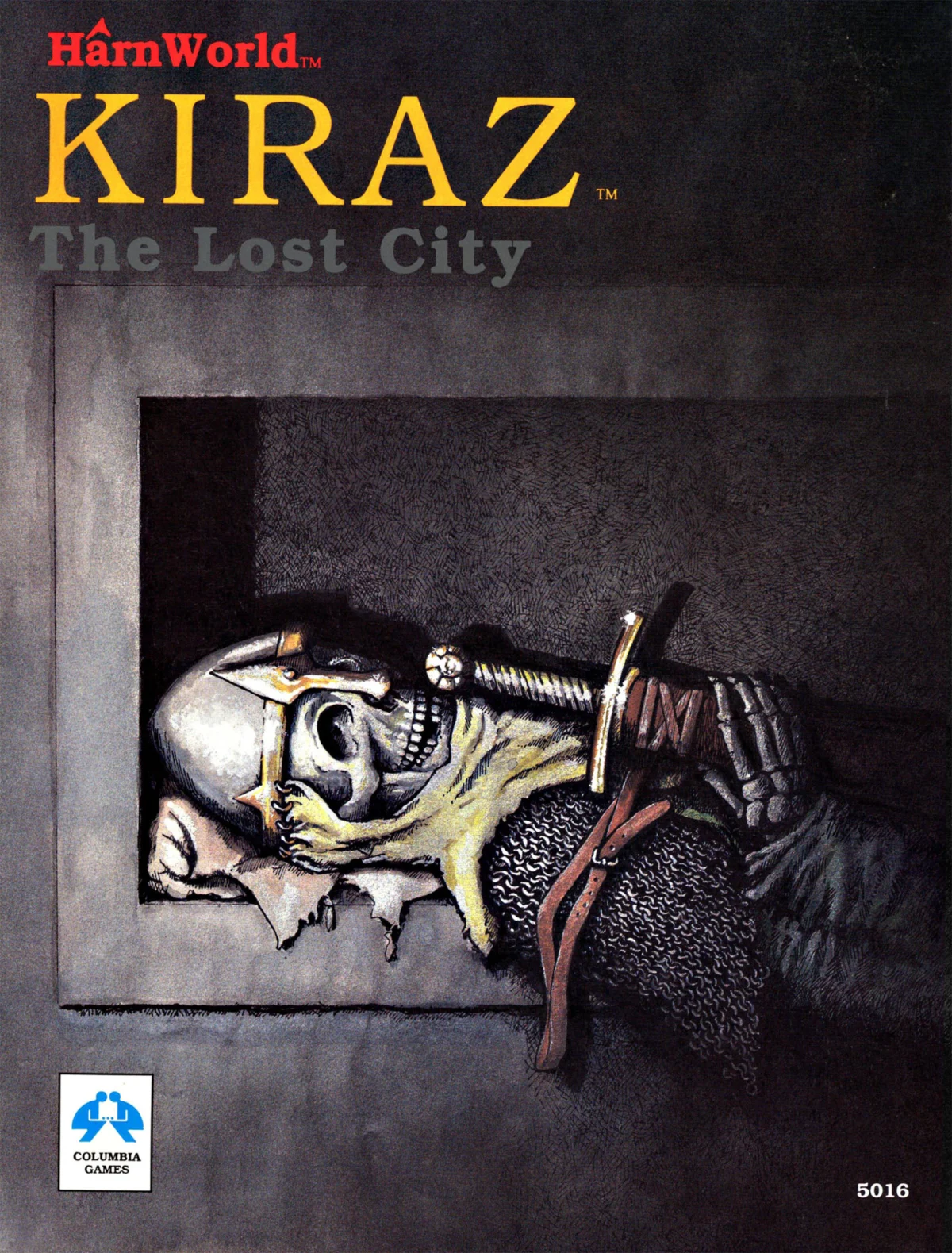
Originally reviewed October 10th, 2001, and revisited for contemporary analysis, "Kiraz: The Lost City" remains a compelling yet conflicted artifact in the annals of tabletop role-playing games. Published by Columbia Games for its critically acclaimed HârnWorld setting, this module presents a richly detailed vision of an ancient dwarven citadel, yet its design philosophy leaves many game masters yearning for more. As one prominent reviewer succinctly put it, "It’s like starving yourself for three days, and then eating a pecan. Kiraz makes you hungry for information, but leaves you unsatisfied when all is said and done."
This article delves into the intricate offerings of "Kiraz: The Lost City," examining its dual nature as both a captivating sourcebook and an underdeveloped adventure module. We will explore the strengths of its world-building, dissect the controversial design choices that define its incompleteness, and consider its lasting implications for module design and the HârnWorld community.
Main Facts: Unearthing the Dwarven Legacy
"Kiraz: The Lost City," bearing product code 5016 and ISBN 0-920711-28-6, was authored by N. Robin Crossby and published by Columbia Games Inc. in 1989. Retailing at $14.98, this 28-page supplement (often cited as 30 pages including covers and blank GM notes) is the second installment in the "In Search of Panaga" trilogy of modules for the Hârn role-playing game system. However, its primary draw and the bulk of its content function as a sourcebook for the eponymous lost dwarven city of Kiraz.
The core of the product is dedicated to Kiraz, the oldest dwarven citadel in Hârn and a former pinnacle of dwarven civilization. Its tragic history, marked by the devastating siege led by Lothrim the Foulspawner and his orc armies approximately six hundred years prior to the module’s timeline, forms the poignant backdrop for its current desolate state. The city’s halls, once vibrant, now stand largely deserted, with only the lower levels breached and occupied by opportunistic orcs.
The supplement is structured into three main articles:
- Kiraz (14 pages): The extensive source material detailing the city’s history, geography, and key locations.
- Ushet (4 pages): A smaller article focusing on a former dwarven hunting lodge connected to Kiraz, now overrun by orcs.
- Horns of Ikaras (5 pages): The adventure portion, intended as the second part of the "In Search of Panaga" trilogy, which leverages Kiraz and Ushet as its setting.
Beyond these articles, the module includes two pages of full-color illustrations, featuring maps of the areas surrounding Ushet and Kiraz, along with evocative visuals of their entrances. Two blank pages, provocatively labeled "GM Notes," are also included, perhaps an early indicator of the design philosophy at play.
The review, initially penned in 2001, lauded the exceptional quality of the material presented. The maps are described as "beautiful and superbly executed," and the city’s internal logic and detailed construction are deemed "meticulous." Crossby’s commitment to making the city "make sense" is highlighted as a significant accomplishment, imbuing Kiraz with a tangible sense of reality. Despite this praise for the content’s quality, a fundamental critique emerges regarding the sheer volume of missing information, a deliberate design choice by the publisher to encourage GM customization.
Chronology: A Glimpse Across Decades
The journey of "Kiraz: The Lost City" spans several distinct periods, from its initial conception to its contemporary re-evaluation.
- 1989: Publication and Initial Release: "Kiraz: The Lost City" makes its debut. N. Robin Crossby, the module’s author, notes in his preface the intertwined genesis of Kiraz and the "In Search of Panaga" trilogy. Both projects were reportedly behind schedule, leading to the decision to set "Horns of Ikaras" within the Lost City itself. This expediency likely shaped the module’s dual nature as both a sourcebook and an adventure, perhaps contributing to the perceived incompleteness of the latter.
- October 10th, 2001: Original Review Publication: The critical assessment, which forms the basis of this expanded article, is published. At this point, the module has been in circulation for over a decade, allowing for extensive playtesting and community feedback. The reviewer, not owning the preceding or subsequent parts of the trilogy, primarily assesses "Kiraz" as a standalone sourcebook, highlighting its impressive world-building while lamenting the brevity of the adventure content. The "starving yourself for three days" metaphor firmly enters the lexicon of module criticism.
- Present Day (Revisiting the Review): The original review is revisited, with the author expressing "somewhat surprised" at the initial "Substance" rating of 4. This retrospective reflects on the enduring quality of the maps and the core conceptualization, acknowledging the module’s value despite its inherent design flaws. The re-evaluation underscores the timeless debate within RPG design: the balance between providing a complete, ready-to-run experience and offering a framework for GM creativity. The context of its original publication in 1989 also becomes more significant, as RPG design philosophies have evolved considerably since then.
Supporting Data: Anatomy of a HârnWorld Supplement
A detailed look at the components and characteristics of "Kiraz: The Lost City" provides further insight into its design and value proposition.
Physical Specifications:
- Pages: 28 pages, often marketed as 30 when including covers and blank pages. For a 1989 product priced at $14.98, this translates to roughly 50 cents per page, which was considered on the "pricey side" even in 2001. This cost-per-page ratio highlights the expectation for dense, high-utility content.
- Illustrations: Two pages of full-color illustrations are a notable inclusion. High-quality maps, particularly cut-away diagrams of complex subterranean structures, are resource-intensive to produce and contribute significantly to the perceived value and immersive quality of a module. The presence of player-facing visuals (entrances to Ushet and Kiraz) further enhances its utility at the table.
- "GM Notes" Pages: Two blank pages explicitly labeled for GM notes might seem like a minor detail, but they subtly reinforce the publisher’s philosophy of requiring GM input. While practical for actual session notes, their inclusion within a published module also signals an expectation of additional creative labor from the game master.
Content Breakdown by Section:
I. Kiraz (14 pages)
This section is unequivocally the heart of the module and its greatest strength.
- History and Overview (3 pages): Provides a concise yet evocative narrative of Kiraz, from its inception as the preeminent dwarven citadel in Hârn to its devastating fall at the hands of Lothrim the Foulspawner’s orcish hordes. This foundational lore establishes the city’s significance within the HârnWorld setting and the profound tragedy that shaped its current state. The "dark memories" sealed within its halls are a powerful narrative hook.
- Cut-Away Map and Summary (2 pages): A masterfully crafted cut-away map offers a comprehensive visual representation of the entire dwarven complex. This is complemented by a one-page summary of the city’s major features, providing GMs with an immediate overview of its intricate layout.
- Detailed Area Descriptions (6 pages): This segment delves into specific, critical areas of Kiraz, each receiving a one-page summary and corresponding map. These areas include:
- The High Halls: The former seat of power, encompassing the Great Hall, Royal Apartments, and Council Chamber. This section would typically inspire scenarios involving political intrigue, lost royal treasures, or encounters with spectral remnants of the dwarven elite.
- Gallreda Complex: A residential area for royal government officers, including the Hall of Galreda and the Hall of Zelanthu. These spaces offer opportunities for exploring the daily lives of Kiraz’s former inhabitants and discovering personal stories amidst the ruins.
- West Gate: The primary entrance to the city, crucial for both historical context and practical adventuring, potentially serving as a major choke point or a heavily guarded ruin.
- Ranzad Complex: The largest cavern, once the bustling marketplace and social center. This area could contain forgotten merchant stalls, signs of past revelry, and evidence of the city’s vibrant economic life.
- Minehead: The gateway to the city’s mining operations, featuring workshops and ore storage. This highlights the dwarves’ industrial prowess and could lead to encounters with mining equipment, hidden veins, or subterranean creatures.
- The Catacombs: Serving as both communal graves and the Royal Tombs, this area also houses the sacred Hall of the Godstone, an ancient earthmaster site predating dwarven civilization. This location is pivotal, considered "the birthplace of the Hârnic Khuzdul [dwarves]," offering profound lore, potential mystical encounters, and insights into dwarven origins.
- GM Development and Artifacts (3 pages): This section provides guidance on how GMs can further develop the presented material and introduces several artifacts and special locations that can be integrated into the city. While useful, this is where the "missing information" critique begins to surface, as the guidance often implies significant GM effort rather than providing ready-to-use content.
II. Ushet (4 pages)
This concise article details the Rock of Ushet, a former dwarven hunting lodge connected to Kiraz via spent mining tunnels.
- Historical Context: Following the Carnage of Kiraz, the Ushet entrance was sealed, isolating it from the main citadel.
- Current State: Recent years have seen orcs break through these seals, establishing a new residence within the lodge. This sets up an immediate conflict and a clear entry point for adventurers.
- Dual Purpose: Ushet serves both as the specific entry point for "The Horns of Ikaras" adventure and as a generic template for other dwarven hunting lodges scattered across the region. This dual utility is praised for its practicality, offering GMs a reusable resource.
III. Horns of Ikaras (5 pages)
The adventure portion of the module, intended as the second part of the "In Search of Panaga" trilogy, receives the most significant critique for its brevity and lack of detail.
- Adventure Outline: Described as a "four-page outline of an adventure, rather than an adventure." This suggests a high-level plot summary rather than a comprehensive, playable scenario.
- Content Breakdown:
- Summary of previous adventure (1 page): Provides context for the trilogy, but assumes familiarity with the first part.
- NPC description (1 page): Details the character who provides the adventure hook, but likely lacks the depth for dynamic role-playing without GM expansion.
- Player handouts (1 page): Useful for immersion, but limited in scope.
- Adventure summary (1 page): A high-level overview of the plot, which essentially boils down to: "PCs hear rumors of villain’s activities (kidnapping, theft, arson), go to Kiraz (likely via Ushet), find a key, access a room where the Horn is kept." This level of detail requires GMs to flesh out every encounter, challenge, and resolution.
Official Responses (Implicit) and Design Philosophy
While no direct "official response" from Columbia Games to the 2001 review is provided in the source material, the module itself contains an explicit statement of its design methodology that serves as an implicit response to criticisms of incompleteness:
"In keeping with our long term policy, there is lots of room for the GM to customize his own version of the Golden City – even if a player should get hold of a copy of this module, it won’t help him much."
This statement reveals a deliberate philosophical stance from Columbia Games. The company aimed to provide a robust framework and evocative setting elements, rather than a prescriptive, fully detailed adventure. The rationale appears twofold:
- GM Empowerment: To encourage game masters to personalize the content, tailoring it to their specific campaigns and player groups.
- Player Proofing: To prevent players from gaining an unfair advantage by reading the module, ensuring surprises and discoveries remain intact at the table.
The reviewer, however, strongly contests this approach, arguing that it places an undue burden on the GM. The core argument is that GMs purchase supplements precisely to reduce their design workload, not to receive an elaborate outline that demands extensive additional creation. While the ability to modify existing material is desirable, being forced to generate "material out of wholecloth" is deemed "vastly" more difficult and less satisfying. This fundamental disagreement highlights a long-standing tension in RPG module design: the balance between providing comprehensive content and fostering GM creativity.
Implications: Legacy and Lessons in Module Design
"Kiraz: The Lost City" stands as a fascinating case study with several implications for role-playing game module design and the HârnWorld legacy.
The "Open Design" vs. "Ready-to-Play" Debate Endures
The core critique of Kiraz—its superb foundations marred by significant incompleteness—epitomizes a perennial debate in the RPG industry. Is a module a complete narrative experience, or a toolkit for GMs? Columbia Games’ explicit "long term policy" championed the latter, offering rich lore and compelling maps but leaving much of the actionable content for the GM to develop. While this approach can foster immense creativity and campaign personalization, it risks alienating GMs who seek pre-prepared adventures due to time constraints or a preference for curated experiences.
The reviewer’s strong preference for "complete material that can be modified" rather than "creating material out of wholecloth" resonates with many GMs who juggle busy lives. Modern RPG modules often attempt to strike a balance, providing detailed encounters and NPCs while also offering "plot hooks" or "adventure seeds" for GMs to expand upon. Kiraz, from a contemporary perspective, leaned heavily into the "toolkit" side, perhaps to its detriment as a commercial adventure product.
The Value of World-Building vs. Scenario Design
"Kiraz" undeniably excels in its world-building. The meticulous detail, logical consistency, and evocative history of the dwarven city are universally praised. The maps are lauded as "spectacular," providing an unparalleled visual and conceptual foundation. This underscores the immense value of strong setting material in an RPG product. A well-realized location, even if sparsely populated with adventure hooks, can inspire countless campaigns.
However, the contrast with the "Horns of Ikaras" adventure section highlights that excellent world-building does not automatically translate into excellent scenario design. A compelling setting needs equally compelling narrative structures, detailed encounters, and clear objectives to become a playable adventure. "Kiraz" demonstrates that while the "what" (the city) is brilliant, the "how" (the adventure within it) was critically underdeveloped.
HârnWorld’s Distinctive Identity
"Kiraz: The Lost City" is emblematic of HârnWorld’s reputation for deep, realistic, and often gritty fantasy. The setting is known for its detailed historical and cultural background, and Kiraz perfectly encapsulates this with its rich dwarven lore, the tragedy of Lothrim the Foulspawner, and the significance of the Hall of the Godstone. For dedicated Hârn GMs, Kiraz provides an invaluable addition to an already dense and immersive world. It offers a sandbox of historical ruins ripe for exploration, political intrigue, and dangerous encounters with remnants of past conflicts.
The module’s design, demanding significant GM input, might also align with a certain segment of the HârnWorld fanbase, who appreciate the granular detail and the freedom to weave their own narratives within its meticulously crafted framework. For these GMs, Kiraz is less a pre-packaged adventure and more a vital piece of the Hârn jigsaw puzzle, awaiting their creative touch.
Long-Term Shelf Life and Replayability
Despite its initial criticisms regarding incompleteness, "Kiraz: The Lost City" has likely enjoyed a long shelf life, particularly among dedicated HârnWorld enthusiasts. Its strength as a sourcebook ensures its utility far beyond a single adventure playthrough. GMs can continually re-contextualize Kiraz, placing different threats, treasures, or narrative arcs within its well-defined halls. The "generic template" nature of Ushet further extends its practical application.
The enduring quality of its maps and the depth of its conceptualization mean that "Kiraz" remains a valuable resource. It serves as a testament to the idea that even an "incomplete" product, when its core elements are exceptionally strong, can find an appreciative audience and exert a lasting influence on campaigns. It prompts GMs to engage more deeply with the material, ultimately leading to unique and memorable experiences that are truly their own.
In conclusion, "Kiraz: The Lost City" is a paradoxical gem. It is a testament to N. Robin Crossby’s masterful world-building and Columbia Games’ commitment to detailed settings, offering an unparalleled glimpse into a lost dwarven civilization. Yet, it simultaneously serves as a cautionary tale in module design, highlighting the fine line between empowering GMs and overburdening them. Its legacy is one of both frustration and profound appreciation, a module that truly makes you "hungry for information," leaving GMs to feast on the pecan and then bake the rest of the pie themselves.

Leave a Comment