
The Return of the Ghost Cat: Confirming the First Reproducing Cougar Population in Minnesota in a Century
For over a hundred years, the cougar (Puma concolor) existed in the state of Minnesota primarily as a phantom of the wilderness—a creature of blurred trail camera photos, disputed tracks, and campfire stories. While the occasional lone traveler was documented passing through the North Woods, the species was considered "extirpated" as a breeding resident. However, a landmark discovery by researchers in northern Minnesota has fundamentally rewritten the state’s natural history.
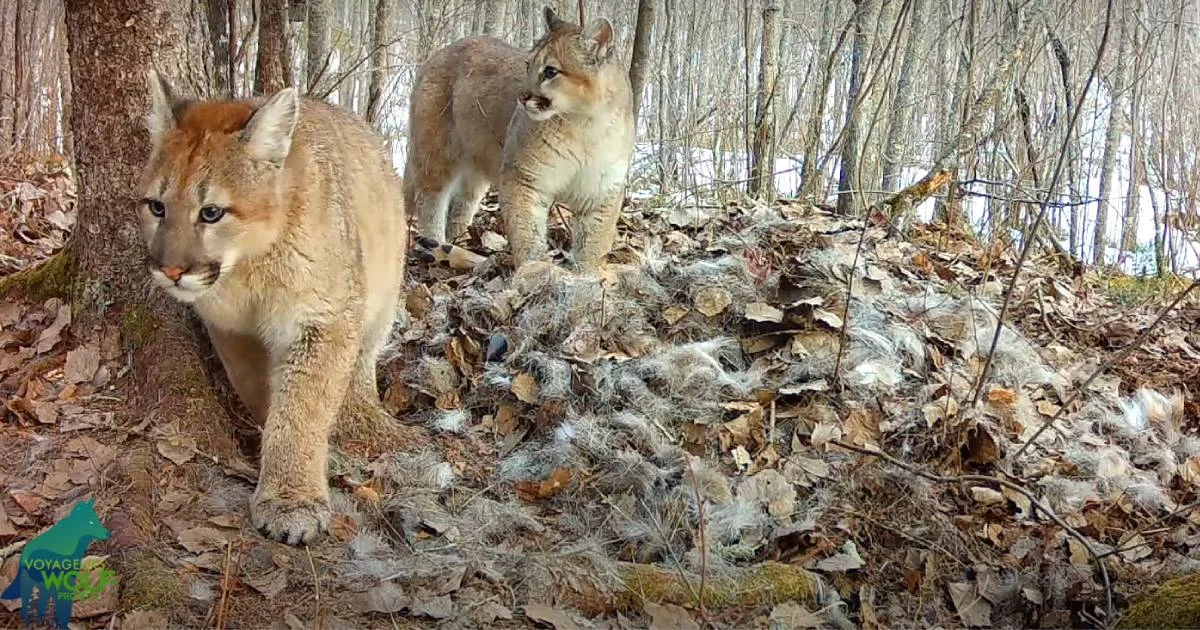
In a breakthrough that has electrified the conservation community, the Minnesota Department of Natural Resources (DNR) recently confirmed the first definitive evidence of a reproducing cougar population within state lines in more than a century. The evidence, captured via high-definition trail camera footage, depicts a healthy mother cougar leading three kittens through the snow-dusted landscape of the Voyageurs National Park region. This discovery marks a pivotal shift from the occasional presence of "transient" individuals to the potential re-establishment of a resident, breeding population.
Main Facts: A Century of Absence Ends in the North Woods
The confirmation stems from footage recorded in late March near the outskirts of Voyageurs National Park, a rugged expanse of water and forest near the Canadian border. The discovery was not the result of a targeted cougar hunt, but rather a serendipitous moment captured during routine wildlife monitoring. Researchers had positioned trail cameras near a deer carcass—a common technique used to study scavengers and apex predators like wolves and bears.
The resulting video provided far more than a fleeting glimpse. It showed a mature female cougar accompanied by three kittens, estimated by biologists to be between seven and nine months old. The kittens were observed exhibiting social play, investigative behavior, and feeding alongside their mother—actions that confirm they were raised in the immediate area rather than being part of a long-distance migration.
According to the Minnesota DNR, while there have been dozens of verified cougar sightings in the state since the early 2000s, almost all of them were determined to be young males. In the world of feline biology, young males are "dispersers"—solitary wanderers that travel hundreds, sometimes thousands, of miles from established populations in the Black Hills of South Dakota or the badlands of Nebraska in search of territory and mates. Because females rarely roam such distances, the presence of a mother with kittens is the "holy grail" of evidence for wildlife biologists, signaling that a female has not only found a home in Minnesota but has also successfully found a mate.
Chronology: From Extirpation to Re-emergence
To understand the magnitude of this discovery, one must look back at the historical decline of large carnivores in the American Midwest.
The Era of Disappearance (1850–1910)
In the mid-19th century, cougars (also known as mountain lions, pumas, or panthers) ranged across nearly all of North America, including the entirety of Minnesota. However, as European settlement expanded, the species faced a dual threat: the systematic clearing of forests for agriculture and a state-sanctioned bounty system. By the late 1800s, cougars were viewed as a threat to livestock and a competitor for game. By 1900, the population had collapsed. The last "official" resident cougar in Minnesota was thought to have vanished shortly after the turn of the century, leaving the state’s apex predator niche almost exclusively to the gray wolf.
The "Ghost Cat" Decades (1910–2000)
For much of the 20th century, cougars were considered extinct in Minnesota. While "sightings" were reported every year, the DNR often attributed these to misidentified large dogs, bobcats, or even yellow Labrador retrievers. Without physical evidence—hair, tracks, or clear photos—the cougar remained a creature of modern folklore.
The Rise of the Transients (2000–2023)
With the advent of affordable, high-quality trail cameras in the early 2000s, the "ghosts" began to take shape. Between 2004 and 2024, the Minnesota DNR verified roughly 80 cougar sightings. Analysis of DNA from hair and scat samples frequently linked these cats to populations in the Black Hills of South Dakota, roughly 600 miles away. These were almost exclusively young males—biological pioneers testing the boundaries of their range but failing to establish a permanent footprint because of the lack of females.
The March Breakthrough (2024)
The trajectory changed in late March when the footage from the Voyageurs region was retrieved. The presence of kittens—who lack the stamina for the thousand-mile treks undertaken by adult males—provided the first undeniable proof that a female had established a territory and successfully reproduced on Minnesota soil.
Supporting Data: Biological Indicators and Survival
Wildlife biologists have meticulously analyzed the footage to gather data on the health and viability of this new family unit.
Age and Seasonality: The kittens’ size and development suggest they were born in the late summer or early autumn of the previous year. This is a critical data point because it means the family successfully navigated a Minnesota winter—a season defined by sub-zero temperatures and deep snow. The ability of the mother to provide enough caloric intake (primarily through white-tailed deer) for three growing kittens during the harshest months of the year indicates that the habitat in northern Minnesota is more than capable of supporting the species.
The "Female Factor": In cougar ecology, the movement of females is the primary bottleneck for range expansion. While a male cougar might travel from South Dakota to Connecticut (as one famous individual did in 2011), females typically establish territories adjacent to or overlapping with their mother’s range. The fact that a breeding female is now in northern Minnesota suggests a slow, incremental "stepping-stone" migration from western populations that has finally reached the Great Lakes region.
Behavioral Observations: The footage spans several hours of interaction. Researchers noted that the kittens displayed "social play" behaviors—mock stalking and pouncing—which are essential for developing hunting skills. Their presence at a deer carcass also confirms they are transitioning from their mother’s milk to a meat-based diet, a key milestone in their survival.
Official Responses: Caution and Celebration
The reaction from the scientific and governmental community has been a mix of professional excitement and scientific caution.
The Minnesota Department of Natural Resources released a statement acknowledging the historical significance of the find while tempering expectations regarding a "population explosion." DNR officials noted that while this is a verified reproductive event, it does not yet constitute a "self-sustaining" population. They emphasized that the state will continue its "passive monitoring" strategy, relying on trail cameras and public reports rather than active collaring or trapping at this stage.
Dan Stark, a large carnivore specialist with the Minnesota DNR, commented on the rarity of the event: "Finding evidence of a female with kittens is a significant milestone. It confirms that the habitat can support the reproductive cycle of the species. However, we have to recognize that these animals face significant challenges, from road mortality to natural competition with the state’s robust wolf population."
Conservation groups, such as The Nature Conservancy and local wildlife advocates, have hailed the news as a testament to the health of Minnesota’s northern ecosystems. They argue that the return of an apex predator like the cougar is a sign that the "wildness" of the North Woods is being restored, providing a more balanced ecological hierarchy that can help manage overabundant deer populations.
Implications: Ecology, Policy, and Public Safety
The re-emergence of a breeding cougar population carries profound implications for the future of Minnesota’s wilderness and its human inhabitants.
Ecological Balance
Cougars are "keystone predators." Their presence can influence the behavior of prey species, a phenomenon known as the "ecology of fear." By keeping deer populations in check and forcing them to move more frequently, cougars can inadvertently protect forest undergrowth from overgrazing, which in turn benefits songbirds, amphibians, and soil health. Furthermore, cougar kills provide a vital food source for a wide array of scavengers, including eagles, ravens, and even smaller carnivores like fishers and martens.
Challenges to Recovery
Despite this milestone, the path to a full recovery is fraught with obstacles:
- Habitat Fragmentation: Minnesota is crisscrossed by highways and agricultural development. For a species that requires large, contiguous territories, roads are the leading cause of death.
- Genetic Diversity: If the Minnesota population remains small and isolated from the western herds, inbreeding could become a concern over the next several decades.
- Climate and Prey: While the recent mild winters may have aided this specific family, a return to "polar vortex" winters could test the limits of kittens born late in the season.
Human-Wildlife Coexistence
The return of the cougar inevitably raises questions about public safety and livestock protection. The DNR has been quick to remind the public that cougars are naturally elusive and generally avoid human contact. In states with much higher cougar densities, such as Colorado or California, attacks on humans remain exceedingly rare. However, the DNR plans to increase educational outreach to hunters, hikers, and farmers in the northern counties to ensure that the public knows how to "be cougar aware"—which includes keeping pets indoors at night and not leaving food sources that might attract deer (and thus, cougars) to residential areas.
Conclusion: A New Chapter for the North Star State
The discovery of a mother cougar and her three kittens is more than just a viral video; it is a biological bridge to Minnesota’s past and a window into its ecological future. It represents the resilience of a species that was once hounded to the brink of local extinction, only to find its way back through the shadows of the forest.
As these three kittens grow and potentially stake out territories of their own, they carry with them the hope of a restored ecosystem. For the people of Minnesota, the woods have become a little more mysterious, a little more "wild," and a little more complete. The "ghost cat" has returned, and this time, it appears it may be here to stay.




Leave a Comment